New Jersey Consent Order in Family Matter
About this form
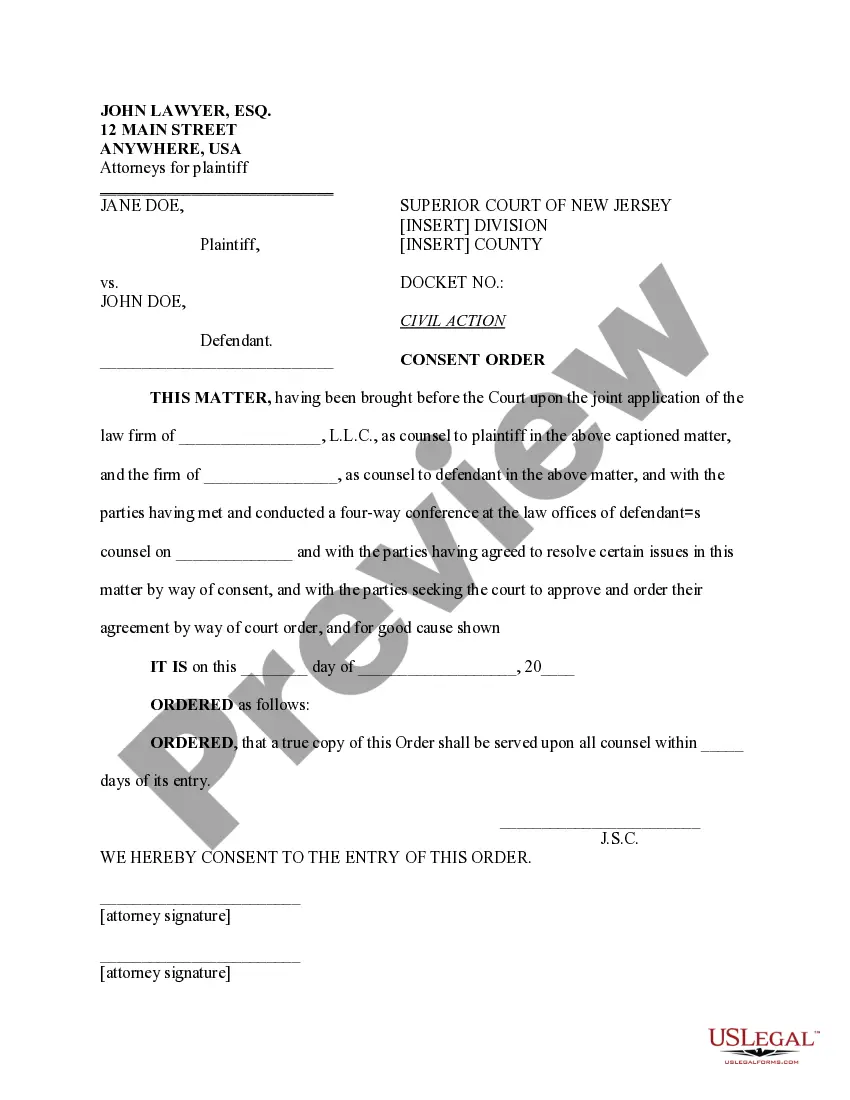
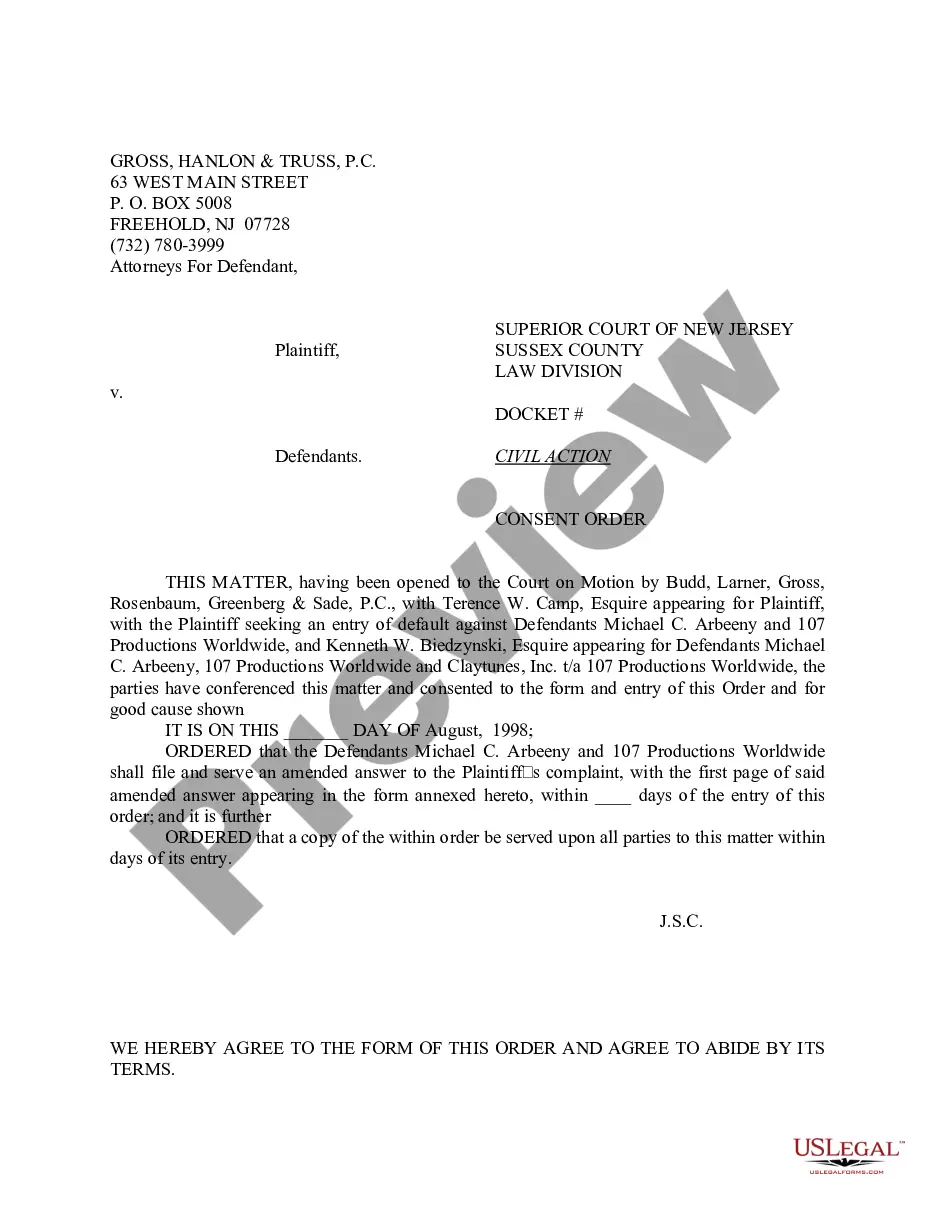
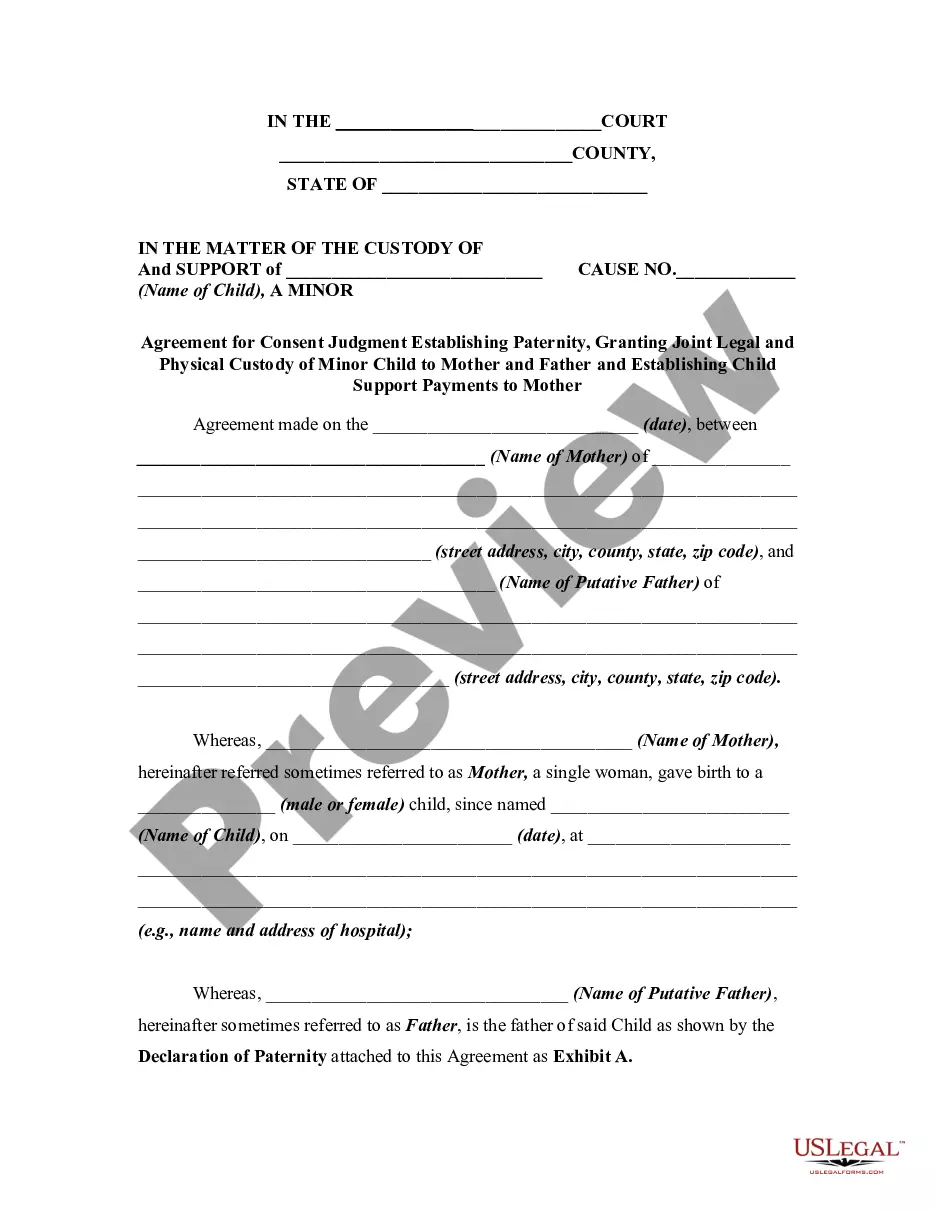
The Consent Order in Family Matter is a legal document used in family law proceedings in New Jersey. It formalizes agreements made between parties in relation to family issues, such as custody or support, ensuring that these agreements are recognized and enforceable by the court. Unlike other legal forms that may require litigation for resolution, this form allows parties to mutually agree and seek judicial approval, which helps streamline the process and minimize conflict.
Key parts of this document
- Identification of the parties involved (plaintiff and defendant).
- Court details, including the division and county information.
- Specific orders resulting from the joint application of both parties.
- Signatures of attorneys representing each party, indicating consent.
- A directive for serving copies of the order to counsel.
Situations where this form applies
This form should be used when parties in a family law case wish to settle certain issues amicably without needing a court trial. Scenarios may include agreeing on child visitation schedules, support payments, or property division. It is particularly useful when both parties have reached an agreement through mediation or discussions and want to ensure the court recognizes their settlement.
Who can use this document
- Individuals involved in a family law case in New Jersey.
- Parents seeking a formal agreement on child custody or support.
- Spouses wanting to resolve property division amicably.
- Attorneys representing clients in family law matters.
Completing this form step by step
- Identify the full names of the parties involved in the case.
- Fill out the court details, including the division and county.
- Ensure that all agreements reached are clearly stated in the order.
- Have both attorneys sign the document to indicate their consent.
- Serve copies of the signed order to all counsel involved within the specified timeframe.
Notarization requirements for this form
This form usually doesn’t need to be notarized. However, local laws or specific transactions may require it. Our online notarization service, powered by Notarize, lets you complete it remotely through a secure video session, available 24/7.
Get your form ready online
Our built-in tools help you complete, sign, share, and store your documents in one place.
Make edits, fill in missing information, and update formatting in US Legal Forms—just like you would in MS Word.
Download a copy, print it, send it by email, or mail it via USPS—whatever works best for your next step.
Sign and collect signatures with our SignNow integration. Send to multiple recipients, set reminders, and more. Go Premium to unlock E-Sign.
If this form requires notarization, complete it online through a secure video call—no need to meet a notary in person or wait for an appointment.
We protect your documents and personal data by following strict security and privacy standards.

Make edits, fill in missing information, and update formatting in US Legal Forms—just like you would in MS Word.

Download a copy, print it, send it by email, or mail it via USPS—whatever works best for your next step.

Sign and collect signatures with our SignNow integration. Send to multiple recipients, set reminders, and more. Go Premium to unlock E-Sign.

If this form requires notarization, complete it online through a secure video call—no need to meet a notary in person or wait for an appointment.

We protect your documents and personal data by following strict security and privacy standards.
Mistakes to watch out for
- Failing to include all parties involved in the agreement.
- Not filling out court details accurately.
- Omitting to specify the terms of the agreement clearly.
- Neglecting to serve copies to all relevant counsel.
- Not obtaining necessary signatures before submission.
Why complete this form online
- Convenient access to editable templates that can be filled out from anywhere.
- Time-saving, as users can complete forms without visiting a lawyer's office.
- Peace of mind from using forms drafted by licensed attorneys.
- Ability to easily store and retrieve completed forms at any time.
Main things to remember
- The Consent Order in Family Matter is crucial for formalizing agreements in family law disputes.
- It enhances the enforceability of the agreement by obtaining court approval.
- Proper completion and filing ensures that the terms agreed upon are recognized legally.
Looking for another form?
Form popularity
FAQ
Can I change a child support amount if I need to? A: Yes, but to change it, you must go through a process like the one when the child support order was entered. Whoever wants the change must file papers at the Court, and ask for a hearing or conference.
You have only 14 days to respond to a regular motion. The time to respond runs from the date the motion was filed. Check the certificate of service, which should be included with the Motion papers. If you need to respond to an Administrative Motion, you have only 4 days.
Overview. If one party to a case has filed a motion with the court, the other side can file an opposition. An opposition is a written statement explaining to the judge why the other side is not entitled to whatever he is asking for in his motion. It is your opportunity to oppose the other side's request.
Fill out your court forms. Have your forms reviewed. Make at least 2 copies of all your forms. File your forms with the court clerk. Serve your papers on the other parent. File your Proof of Service. Go to your court hearing.
You will need to file a motion asking the court to grant your request for a modification. To that you'll need to attach a copy of the court order you want to change, a copy of a prior and current case information statement or statements, supporting affidavits (sworn statements) and briefs (legal arguments).
It does not matter who files first. The court considers the best interests of the child and it is presumed that it is best for the child if both parents see the child. Custody cases are complex.
Fill out the forms. You have to fill out at least 2 forms, maybe more, to file your opposition. File the forms. Turn in your completed forms by mail or efiling. Serve the other party. Get ready for the hearing. Prepare an order.
If the other parent refuses to cooperate with a collaborative custody arrangement modification, the concerned parent may file a motion to modify it through the court. That means that an official request is submitted to the court, which then leads to a hearing with a judge.
Read the summons and make sure you know the date you must answer by. Read the complaint carefully. Write your answer. Sign and date the answer. Make copies for the plaintiff and yourself. Mail a copy to the plaintiff. File your answer with the court by the date on the summons.