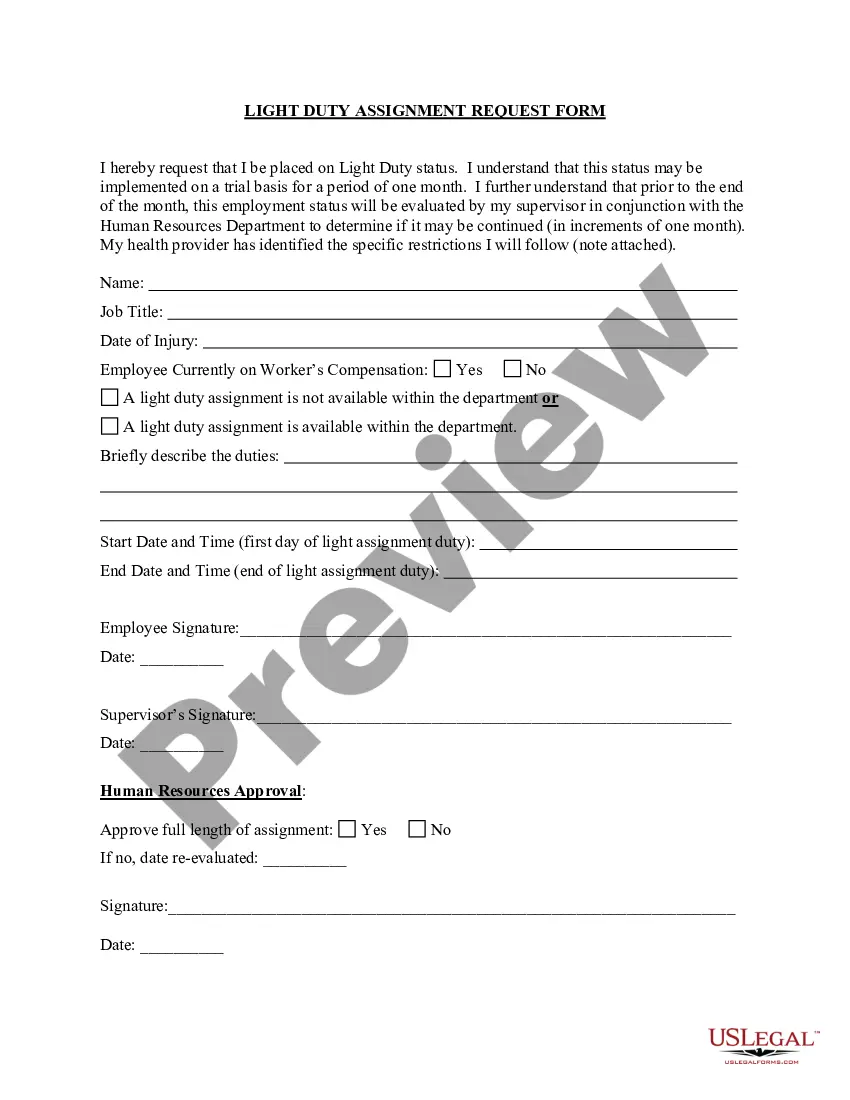
Light Duty Assignment Request
What this document covers
The Light Duty Assignment Request form is a legal document used by employees to formally request a temporary light duty work assignment due to health issues. This form is designed to facilitate communication between the employee, management, and human resources regarding necessary work accommodations. It differs from other employment forms by specifically focusing on work modifications required to support an employee's recovery or manage health limitations during their transition back to regular duties.
Form components explained
- Employee's request for light duty assignment.
- Trial basis period of one month for the assignment.
- Supervisor and Human Resources evaluation of the status at the end of the trial period.
- Health provider's specific restrictions attached to the request.
- Section for Human Resources approval with options for full length assignment approval.
- Signature and date fields for both the employee and Human Resources.

When this form is needed
This form should be used when an employee experiences health issues that prevent them from performing their regular job duties but can still work under modified conditions. Common situations for use include recovery from surgery, managing a chronic condition, or any temporary limitations that affect the employee's ability to perform their standard responsibilities.
Intended users of this form
This form is intended for:
- Employees who are experiencing health issues requiring a modified work assignment.
- Employers and human resources professionals managing employee accommodations.
Completing this form step by step
- Fill out the section requesting placement on light duty status.
- Attach any medical documentation from your health provider that specifies your work restrictions.
- Enter the date you are submitting the form.
- Sign and date the form to confirm your request.
- Submit the form to your supervisor for review and necessary approval.
Notarization requirements for this form
This form usually doesn’t need to be notarized. However, local laws or specific transactions may require it. Our online notarization service, powered by Notarize, lets you complete it remotely through a secure video session, available 24/7.
Get your form ready online
Our built-in tools help you complete, sign, share, and store your documents in one place.
Make edits, fill in missing information, and update formatting in US Legal Forms—just like you would in MS Word.
Download a copy, print it, send it by email, or mail it via USPS—whatever works best for your next step.
Sign and collect signatures with our SignNow integration. Send to multiple recipients, set reminders, and more. Go Premium to unlock E-Sign.
If this form requires notarization, complete it online through a secure video call—no need to meet a notary in person or wait for an appointment.
We protect your documents and personal data by following strict security and privacy standards.

Make edits, fill in missing information, and update formatting in US Legal Forms—just like you would in MS Word.

Download a copy, print it, send it by email, or mail it via USPS—whatever works best for your next step.

Sign and collect signatures with our SignNow integration. Send to multiple recipients, set reminders, and more. Go Premium to unlock E-Sign.

If this form requires notarization, complete it online through a secure video call—no need to meet a notary in person or wait for an appointment.

We protect your documents and personal data by following strict security and privacy standards.
Typical mistakes to avoid
- Failing to attach required medical documentation specifying restrictions.
- Not signing or dating the form before submission.
- Submitting the form to the wrong individual or department.
Benefits of completing this form online
- Convenient access at any time to download and fill out the form.
- Easy editing allows you to customize your request as needed.
- Reliability of a professionally drafted document decreases the likelihood of errors.
Summary of main points
- The Light Duty Assignment Request is essential for employees needing temporary work modifications.
- It's crucial to include medical documentation with the form for proper evaluation.
- Understanding evaluation and approval processes can help streamline your request.
Looking for another form?


Form popularity
FAQ
The term "light duty" has a number of different meanings in the employment setting. Generally, "light duty" refers to temporary or permanent work that is physically or mentally less demanding than normal job duties (EEOC, 1996).
There is no legal limit on how long an employer can keep an employee on light duty. As long as the doctor has the injured worker on work restrictions, the employer can keep them in a light duty position.
If you are offered an appropriate light-duty job and you decline to accept it: Your employer can petition a judge to modify, and in some cases, even terminate your workers' compensation benefits.
No one can force you to return to work for a light duty job. However, the insurance company may be able to stop your benefits immediately if you refuse suitable, light duty work that is offered to you. If possible, trying out the light duty job is most likely your best option here.
Light duty is any task that is physically or mentally less demanding than an injured worker's previous job.This allows the employee to maintain an income, while the employer may be able to use the employee's salary to hire temporary support until the injured worker recovers.
As a general rule, employers are not obligated to offer light-duty work to workers seeking to return after a work-related injury.There is an incentive of sorts for employers to create a position to accommodate someone who is cleared to return to work with light-duty restrictions.
Light Duty and the ADA (Part I): An employer is not required to create light duty work, but if it does, it can create this position on a temporary basis (EEOC Guidance, question 29).Such a policy might state, for example: Temporary work does not normally extend beyond x days.
Modified duty is also sometimes called light duty.An employee assigned to modified duty may perform a portion of the duties of her regular job or a completely different job. Modified duty is intended to allow employees to earn a salary and perform productive work while they continue to recover.
While employers are not generally mandated to have light duty, allowing an employee to an existing light duty job might be required as a reasonable accommodation under the Americans with Disabilities Act (ADA).