Louisiana Rule to Evict Tenant failure to pay rent
What this document covers
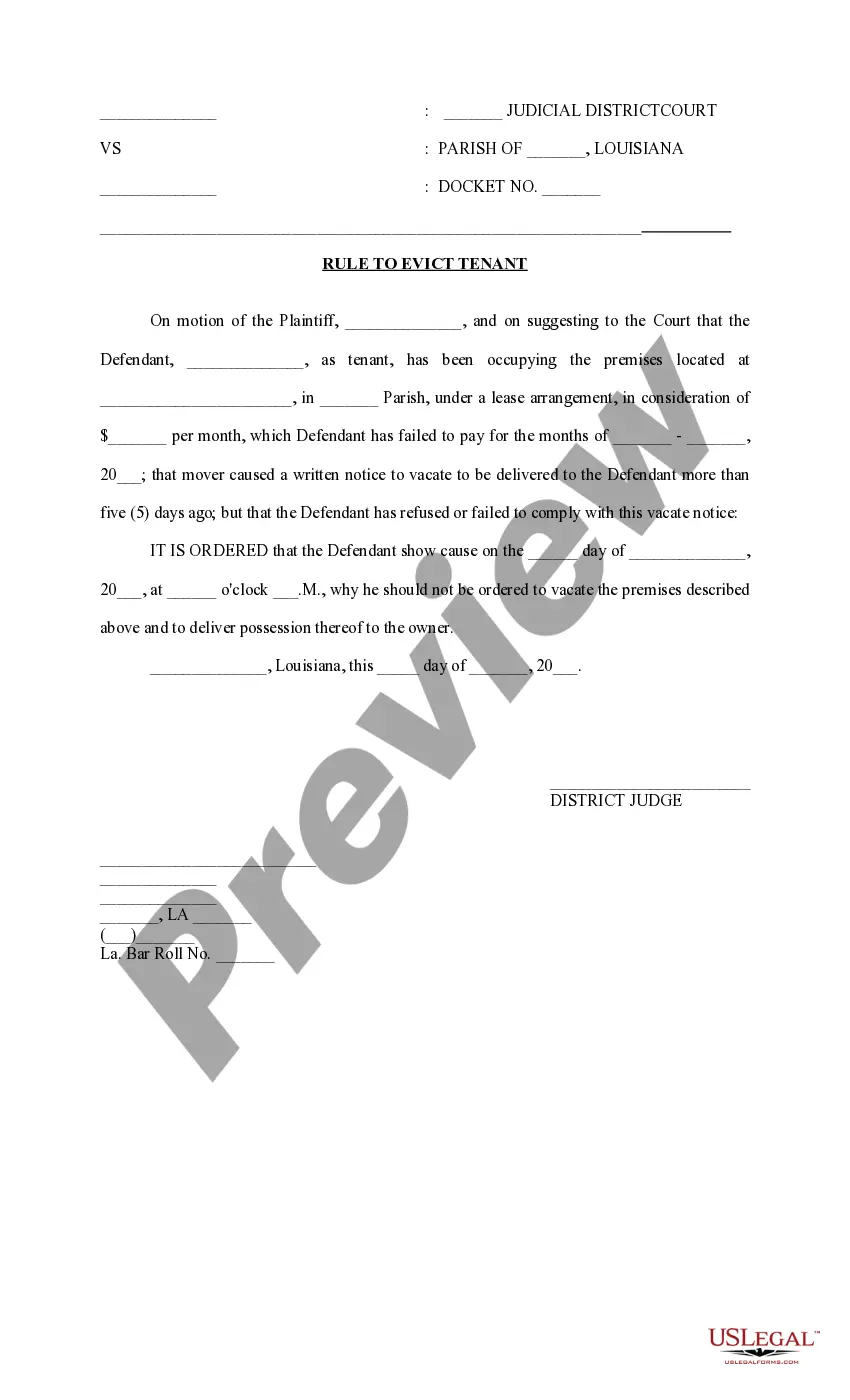
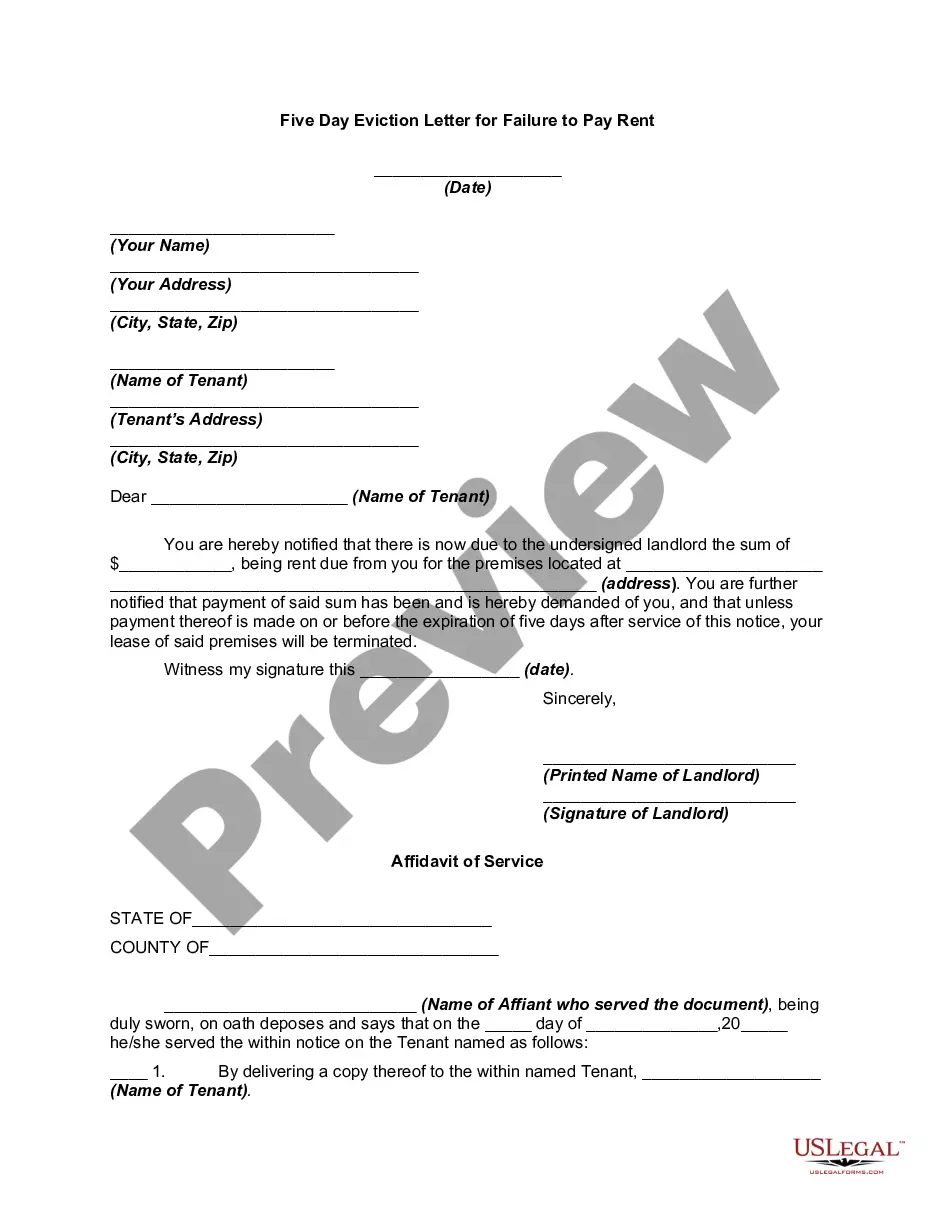
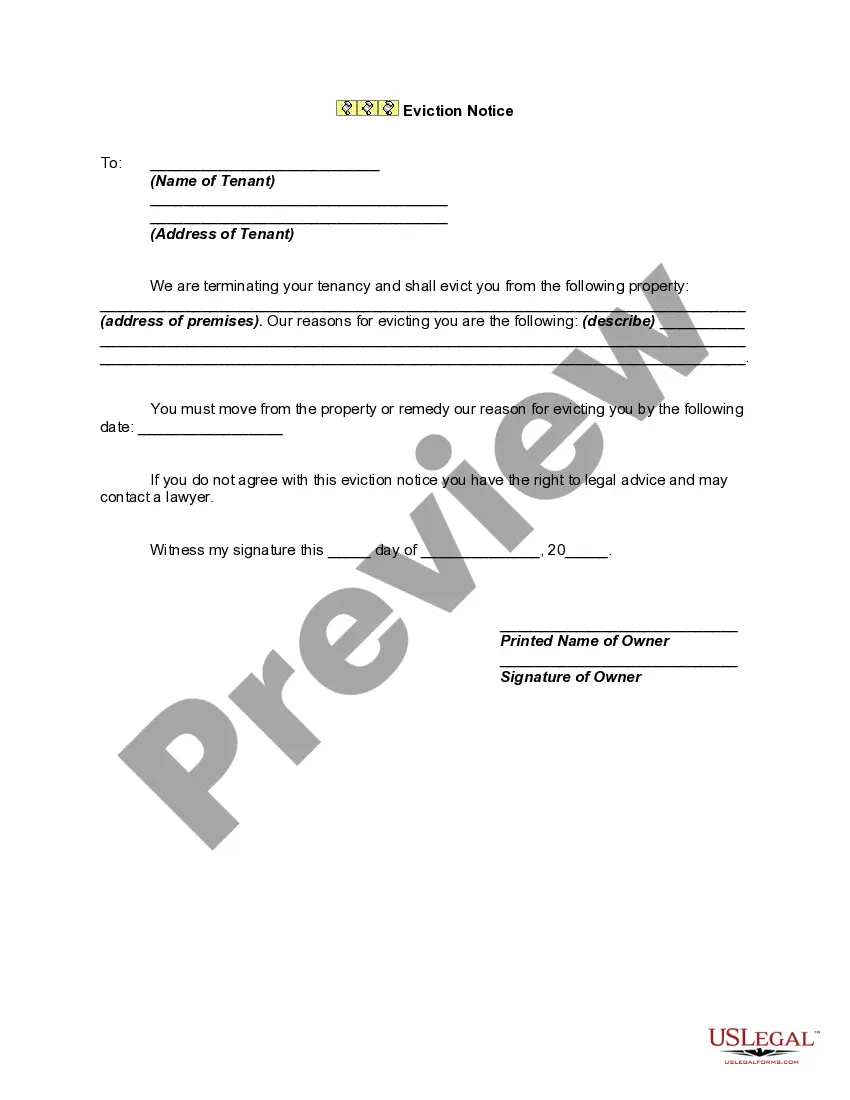
This form is a Rule to Evict Tenant for failure to pay rent, specifically designed for use in Louisiana. It allows a landlord to request a court order requiring a tenant to explain why they should not be evicted after failing to pay rent. This form is distinct from other eviction processes, such as those based on lease violations, as it focuses specifically on nonpayment of rent.
What’s included in this form
- Identification of the plaintiff (landlord) and defendant (tenant).
- Details of the lease agreement, including rental amount and payment terms.
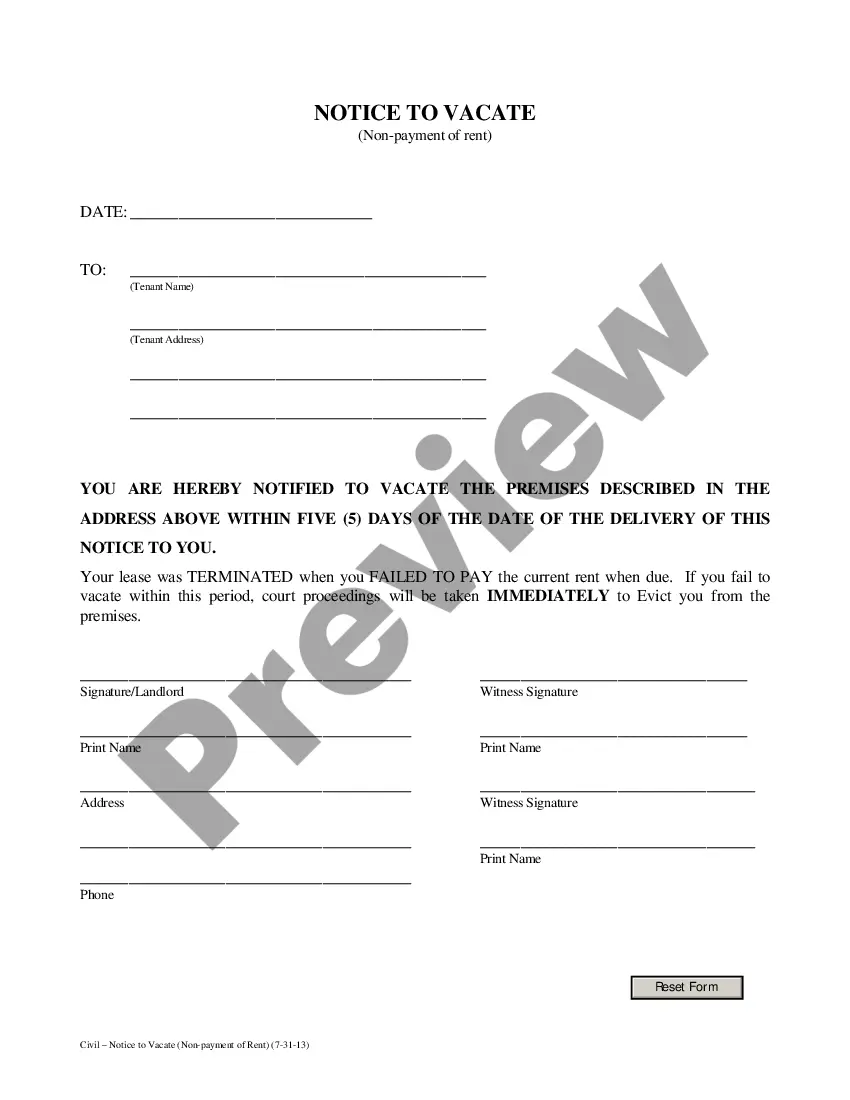
- Confirmation that a written notice to vacate has been delivered to the tenant.
- A request for the tenant to show cause in court why they should not be evicted.
- Specifications of the court date and time for the hearing.

When to use this document
Intended users of this form
- Landlords seeking to evict tenants for nonpayment of rent.
- Property management companies managing rental units.
- Investors who own residential rental properties and need to enforce lease agreements.
How to prepare this document
- Identify the plaintiff (landlord) and defendant (tenant) with full legal names.
- Specify the property address where the tenant currently resides.
- Detail the lease agreement, including the monthly rent and months that are unpaid.
- Confirm the delivery of the written notice to vacate and the date it was served.
- Enter the court date and time for the eviction hearing.
Does this form need to be notarized?
This form usually doesn’t need to be notarized. However, local laws or specific transactions may require it. Our online notarization service, powered by Notarize, lets you complete it remotely through a secure video session, available 24/7.
Get your form ready online
Our built-in tools help you complete, sign, share, and store your documents in one place.
Make edits, fill in missing information, and update formatting in US Legal Forms—just like you would in MS Word.
Download a copy, print it, send it by email, or mail it via USPS—whatever works best for your next step.
Sign and collect signatures with our SignNow integration. Send to multiple recipients, set reminders, and more. Go Premium to unlock E-Sign.
If this form requires notarization, complete it online through a secure video call—no need to meet a notary in person or wait for an appointment.
We protect your documents and personal data by following strict security and privacy standards.

Make edits, fill in missing information, and update formatting in US Legal Forms—just like you would in MS Word.

Download a copy, print it, send it by email, or mail it via USPS—whatever works best for your next step.

Sign and collect signatures with our SignNow integration. Send to multiple recipients, set reminders, and more. Go Premium to unlock E-Sign.

If this form requires notarization, complete it online through a secure video call—no need to meet a notary in person or wait for an appointment.

We protect your documents and personal data by following strict security and privacy standards.
Avoid these common issues
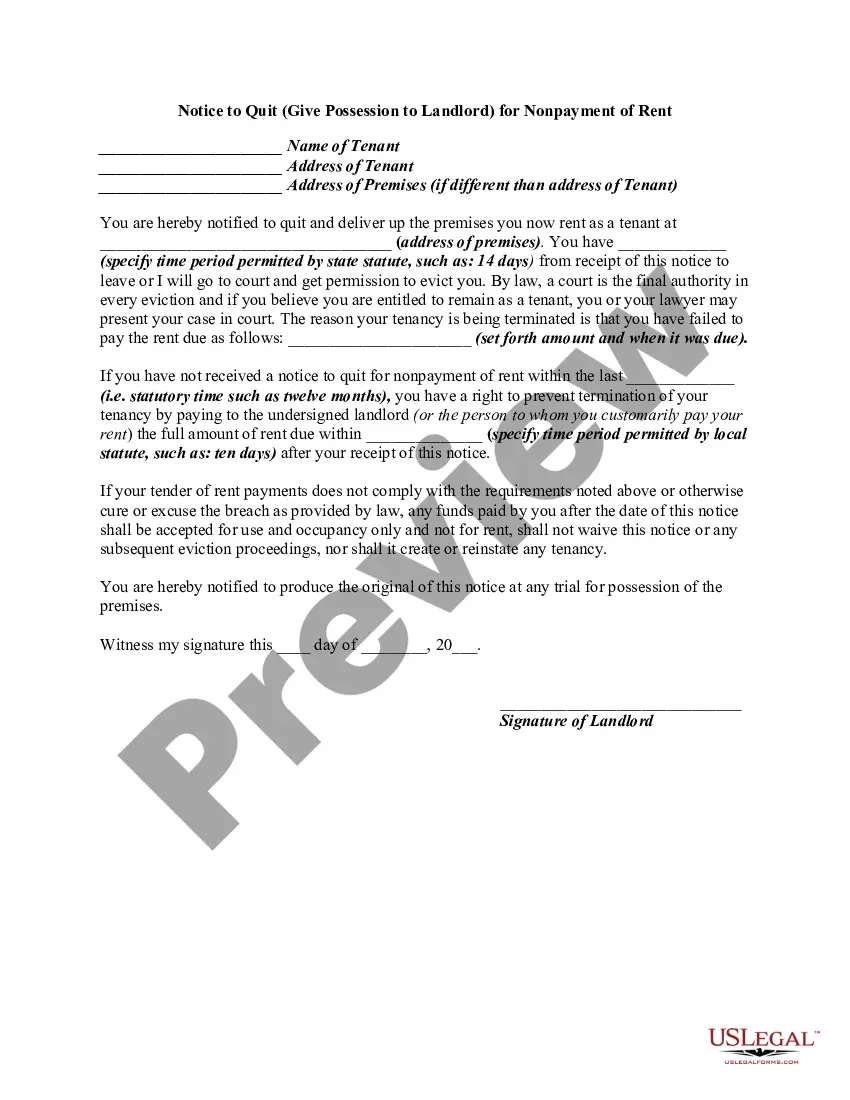
- Failing to properly serve the written notice to vacate.
- Not including all required details of the lease agreement.
- Missing the deadline for filing the eviction request after the notice period expires.
Why use this form online
- Convenient access to legally compliant eviction templates.
- Ability to edit and customize the form according to specific circumstances.
- Prepared by licensed attorneys, ensuring reliability and legal sufficiency.
Key takeaways
- The Rule to Evict Tenant form is essential for landlords seeking to evict tenants for non-payment of rent in Louisiana.
- Proper completion and filing of the form can expedite the eviction process.
- Understanding local laws and procedures is crucial for successful eviction proceedings.
Definitions you should know
- Eviction: A legal process to remove a tenant from rental property.
- Tenant: An individual who rents and occupies property owned by another.
- Petitioner: The party requesting the eviction in court (usually the landlord).
- Notice to vacate: A written notice informing the tenant of the requirement to leave the property.
Looking for another form?
Form popularity
FAQ
To lawfully evict a tenant in Louisiana for failure to pay rent, the landlord must follow the Louisiana Rule to Evict Tenant failure to pay rent. Initially, the landlord must provide the tenant with a written notice that specifies the rent owed, allowing the tenant time to remedy the situation. If the tenant fails to pay within the allotted time, the landlord can file a formal eviction suit in court. It’s crucial for landlords to adhere strictly to these legal procedures to ensure a smooth eviction process.
To evict a tenant in Louisiana, the landlord must follow the legal process stipulated by the Louisiana Rule to Evict Tenant failure to pay rent. First, the landlord must issue a written notice to the tenant, stating the reason for eviction, such as non-payment of rent. If the tenant does not comply with the notice, the landlord can file a petition for eviction in the local court. Utilizing platforms like USLegalForms can help you navigate the eviction process effectively, ensuring all legal requirements are met.
In Louisiana, a landlord cannot evict you immediately due to a failure to pay rent. The Louisiana Rule to Evict Tenant failure to pay rent requires landlords to follow specific legal procedures, including giving you a written notice of eviction. After the notice period, if you do not pay the rent owed, the landlord can then file for eviction in court. It is essential to understand these steps to ensure your rights are protected.
Recently, Louisiana updated its eviction laws to streamline processes and enhance tenant protections. The Louisiana Rule to Evict Tenant failure to pay rent now includes requirements that landlords must fulfill before proceeding with an eviction. These adjustments aim to provide fairness for both tenants and landlords, while also reinforcing the importance of adhering to rental agreements. For detailed assistance, uslegalforms can help navigate these changes effectively.
In Louisiana, the landlord can begin the eviction process immediately after a tenant fails to pay rent. The Louisiana Rule to Evict Tenant failure to pay rent allows landlords to file an eviction lawsuit just five days after the rent is due. However, the actual timeframe can vary based on court schedules and specific circumstances. It's wise to consult with legal experts for guidance to ensure compliance with all necessary steps.
By failing to pay their rent, your tenant has broken the terms of their tenancy agreement, meaning you can serve them a Section 8 notice at any point in the tenancy. Your tenant may dispute the eviction, so you need to be ready with evidence of unpaid rent and your efforts to resolve the issue.
Evictions in Louisiana typically follow a 5 to 10 day timeline mandated by its Code of Civil Procedure. Most evictions are handled in Justice of the Peace Courts. Otherwise, a landlord must file suit in the county or parish where the property is located.
As the next step in the eviction process, Louisiana landlords must file a complaint in the appropriate court, and the court will issue a rule for possession ordering the defendant to appear for a hearing. In Jefferson Parish, this costs $150 in filing fees and an additional $225 if a writ of possession is requested.
Your landlord can evict you if you fall behind with your rent - you could lose your home. Coronavirus (COVID-19) has not changed this, but there are new rules that mean your landlord must give you at least 6 months' notice if they plan to evict you, unless you owe at least 6 months' rent.
Using a Section 8 notice By failing to pay their rent, your tenant has broken the terms of their tenancy agreement, meaning you can serve them a Section 8 notice at any point in the tenancy. Your tenant may dispute the eviction, so you need to be ready with evidence of unpaid rent and your efforts to resolve the issue.