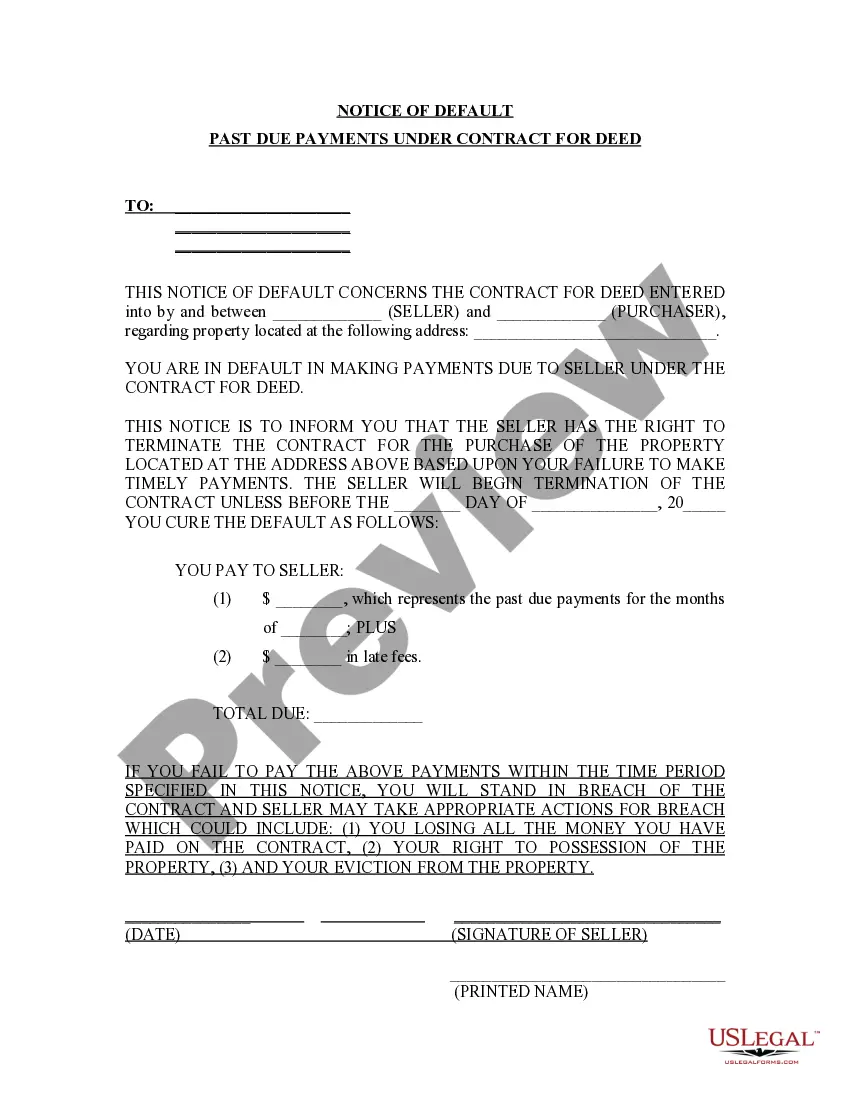
Missouri Notice of Default for Past Due Payments in connection with Contract for Deed
What is this form?
The Notice of Default for Past Due Payments in connection with Contract for Deed is a legal document used by sellers to formally notify buyers of overdue payments on a real estate contract. This notice serves as the seller's initial communication regarding any late payments and outlines the consequences of continued non-compliance with the payment terms established in the contract for deed.
Form components explained
- Identification of the seller and purchaser.
- Details of the contract for deed, including payment terms.
- Specifics of the overdue payment(s) such as amount and due date.
- Statement of the potential consequences for continued non-compliance.
- Instructions for the purchaser to remedy the default.

Situations where this form applies
This form is typically used when a purchaser under a contract for deed has failed to make timely payments. It acts as a formal step taken by a seller to notify the buyer that they are in default of their financial obligations. The seller should use this form as soon as they recognize any missed payments to initiate the remedy process and protect their rights under the contract.
Who should use this form
- Sellers of properties under a contract for deed.
- Real estate investors managing seller-financed properties.
- Legal representatives or advisors involved in property transactions.
- Purchasers who wish to understand the implications of default notices they may receive.
Steps to complete this form
- Identify the parties involved by entering the names and addresses of both the seller and purchaser.
- Specify the details of the property being sold, including the address.
- Enter the amount that is past due and the original due date for payment.
- Include a clear statement of the consequences for failing to cure the default.
- Sign and date the notice to formalize the communication.
Does this document require notarization?
This form does not typically require notarization unless specified by local law. However, certain jurisdictions may have additional requirements, so it is important to check your specific state laws to confirm.
Get your form ready online
Our built-in tools help you complete, sign, share, and store your documents in one place.
Make edits, fill in missing information, and update formatting in US Legal Forms—just like you would in MS Word.
Download a copy, print it, send it by email, or mail it via USPS—whatever works best for your next step.
Sign and collect signatures with our SignNow integration. Send to multiple recipients, set reminders, and more. Go Premium to unlock E-Sign.
If this form requires notarization, complete it online through a secure video call—no need to meet a notary in person or wait for an appointment.
We protect your documents and personal data by following strict security and privacy standards.

Make edits, fill in missing information, and update formatting in US Legal Forms—just like you would in MS Word.

Download a copy, print it, send it by email, or mail it via USPS—whatever works best for your next step.

Sign and collect signatures with our SignNow integration. Send to multiple recipients, set reminders, and more. Go Premium to unlock E-Sign.

If this form requires notarization, complete it online through a secure video call—no need to meet a notary in person or wait for an appointment.

We protect your documents and personal data by following strict security and privacy standards.
Common mistakes
- Failing to accurately specify the amount overdue.
- Not including the correct due date for payments.
- Omitting the seller's signature or date on the notice.
- Not providing sufficient details about the consequences of default.
Benefits of using this form online
- Convenience of accessing and downloading the form at any time.
- Easy to edit the form to meet specific needs without extensive legal knowledge.
- Reliable templates drafted by licensed attorneys to ensure legal compliance.
Looking for another form?


Form popularity
FAQ
The 407.675 law in Missouri pertains to the protections offered to buyers under certain contracts for deed. This law outlines the requirements for providing a Missouri Notice of Default for Past Due Payments in connection with Contract for Deed, ensuring that buyers receive proper notice before any actions are taken against them. It is essential for buyers to be aware of this law as it safeguards their interests and provides a clear process for addressing payment defaults. Resources from US Legal Forms can assist you in understanding and complying with this law.
A notice of default in real estate serves as a formal alert to a borrower that they have fallen behind on their payments. In the context of a Missouri Notice of Default for Past Due Payments in connection with Contract for Deed, this notice indicates that the borrower has failed to meet the payment obligations set forth in the contract. This document is crucial as it initiates the process for potential foreclosure or other legal actions. Understanding this notice helps borrowers take timely action to rectify their payment issues.
In Missouri, the statute of limitations for a written contract is generally five years. This means that if you need to enforce a contract, such as one related to a Missouri Notice of Default for Past Due Payments in connection with Contract for Deed, you must do so within five years of the breach. If you fail to act within this timeframe, you may lose your legal right to claim any payments due. It's essential to stay informed about these deadlines to protect your interests.
Does a default notice affect your credit rating? The notice of default doesn't affect your credit file, but when the account defaults this will be recorded. After the marker for the missed payment or default is added to your credit file, your credit score will be updated by the credit reference agencies.
The term notice of default refers to a public notice filed with a court that states that the borrower of a mortgage is in default on a loan. The lender may file a notice of default when a mortgagor falls behind on their mortgage payments.A notice of default is often considered the first step toward foreclosure.
A notice of default is the first step to a bank or mortgage lender's foreclosure process.If the mortgage is not paid up to date, the lender will seize the home. A notice of default is also known as a reinstatement period, notice of public auction, or notice of foreclosure.
The term notice of default refers to a public notice filed with a court that states that the borrower of a mortgage is in default on a loan. The lender may file a notice of default when a mortgagor falls behind on their mortgage payments.
The notice of default doesn't affect your credit file, but when the account defaults this will be recorded.If the debt is regulated by the Consumer Credit Act, you must be sent a default notice warning letter and have time to act on it before the default is recorded on your credit file.
A notice of default is the first step to a bank or mortgage lender's foreclosure process.If the mortgage is not paid up to date, the lender will seize the home. A notice of default is also known as a reinstatement period, notice of public auction, or notice of foreclosure.
Write to the agency making the claim. Present evidence of why the NOD was improperly issued or why you legitimately cannot make payments. Ask the agency in the letter if they will take a lower monthly payment, total settlement or a payment plan. Send a copy of your letter by certified mail.