Massachusetts Limited Power of Attorney where you Specify Powers with Sample Powers Included
About this form
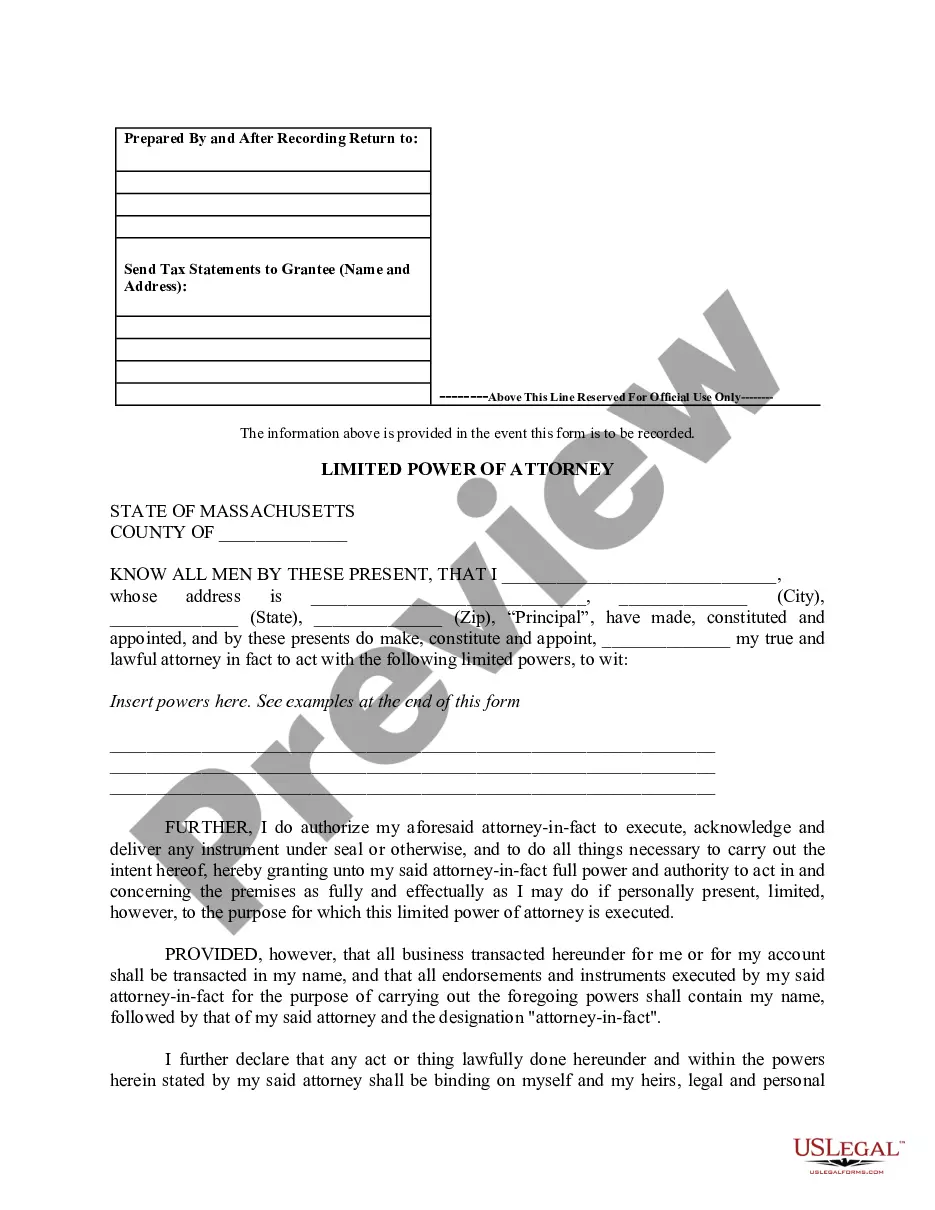
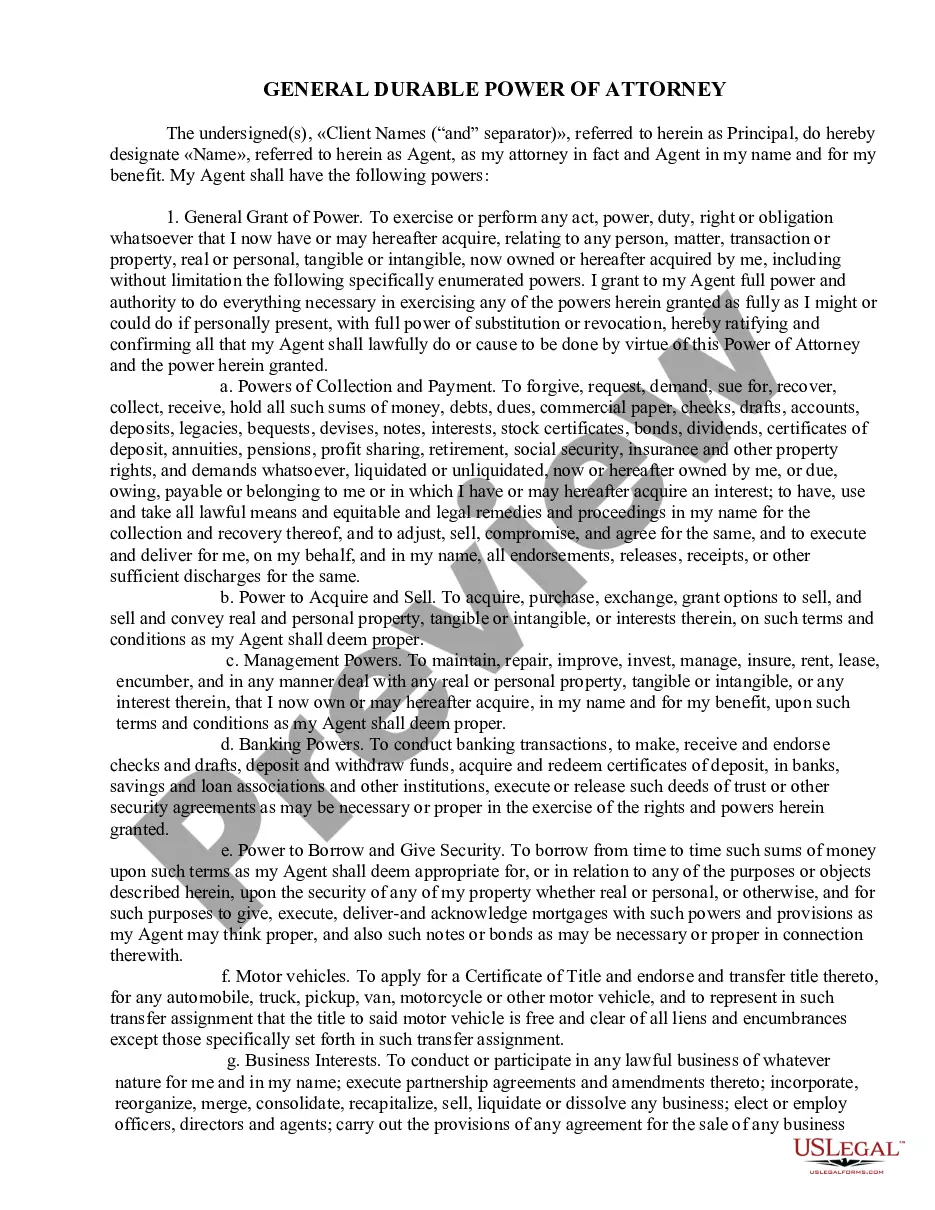
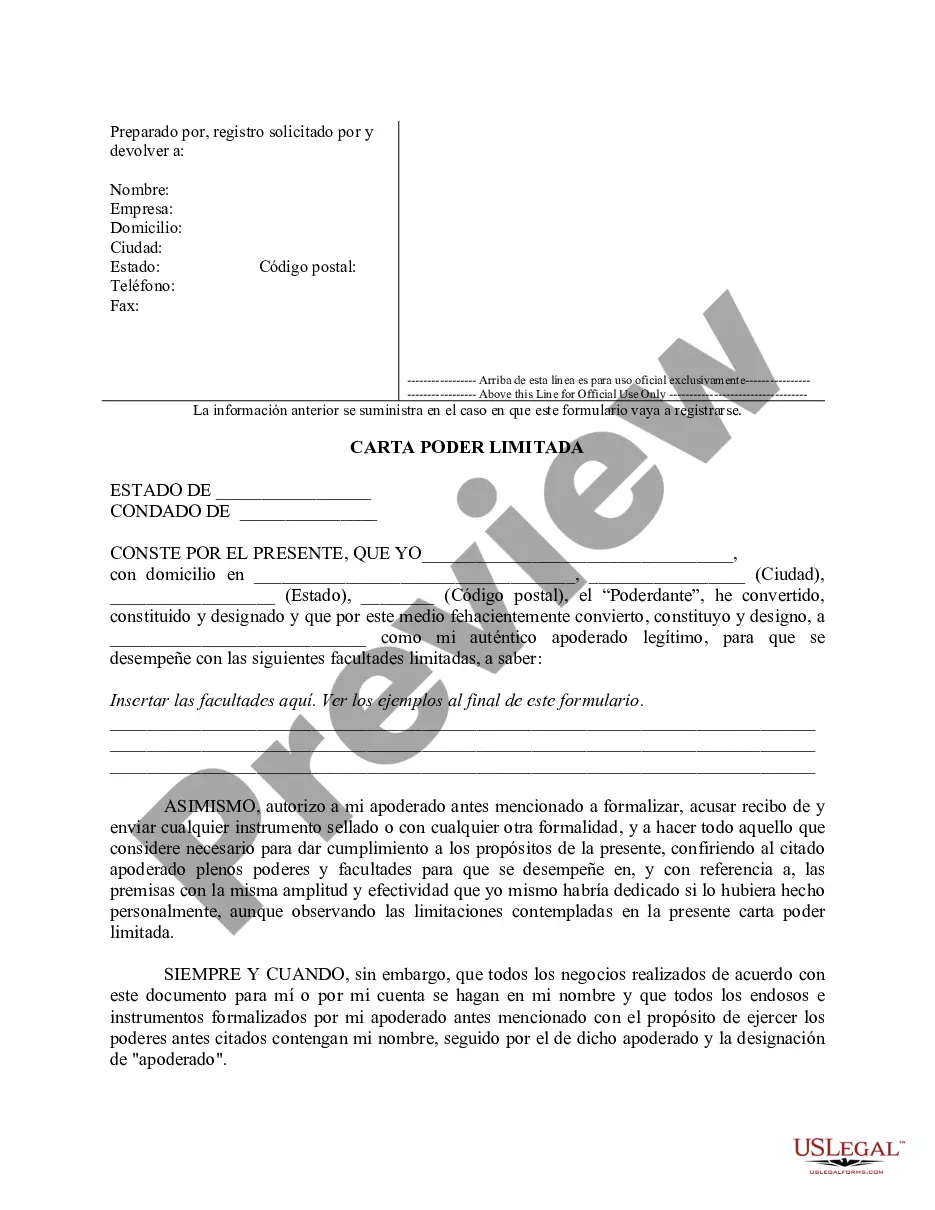
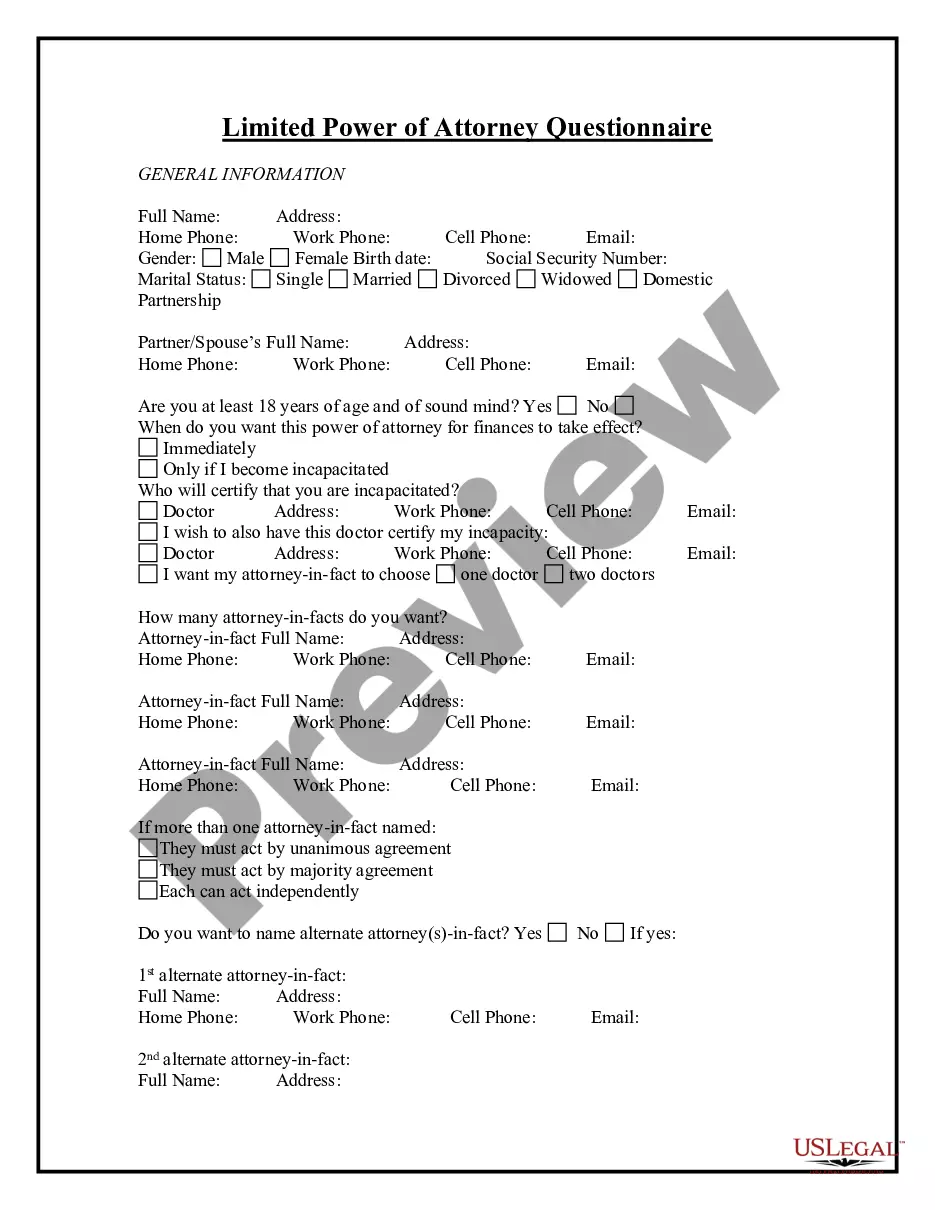
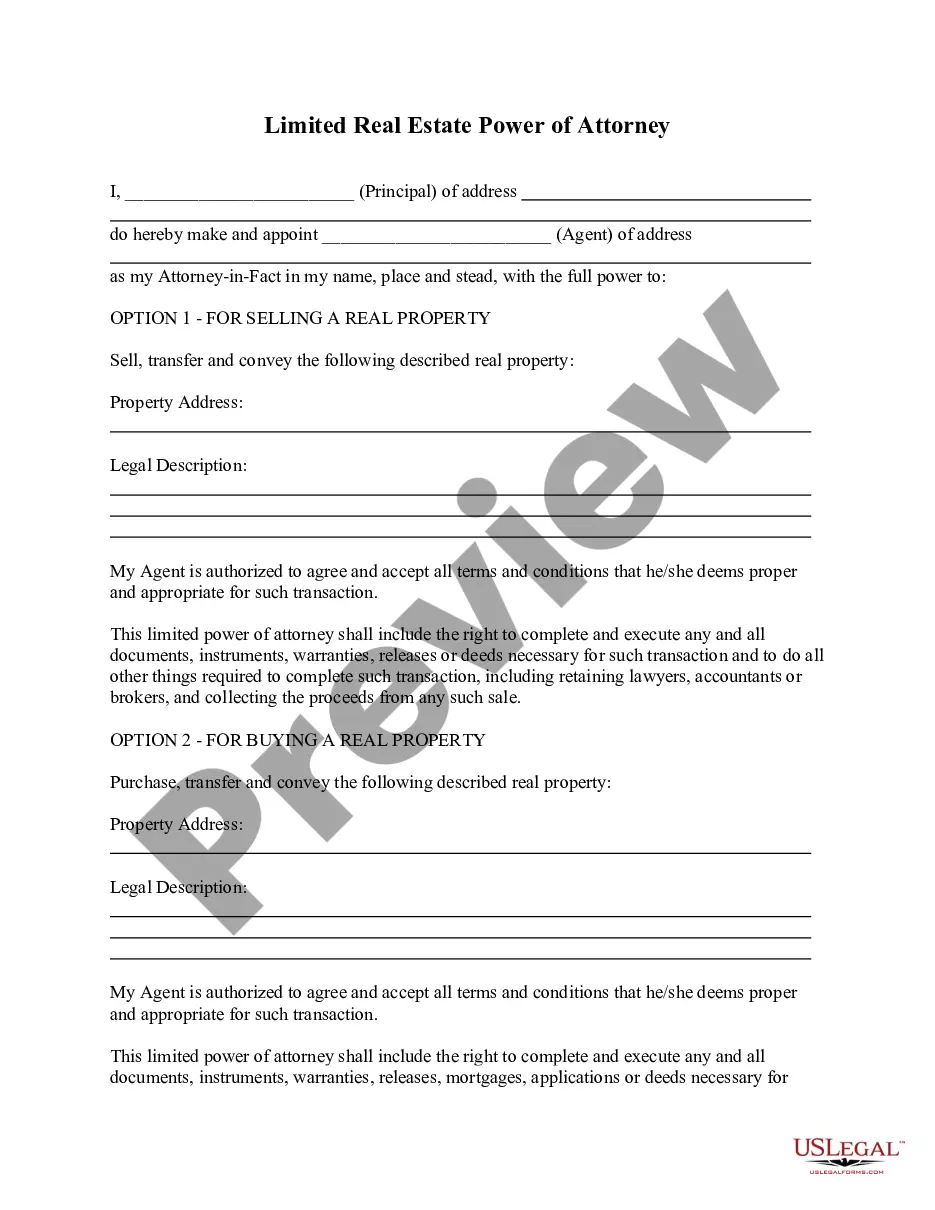
This Limited Power of Attorney allows you to specify certain powers you grant to an agent, distinct from more general power of attorney forms. This particular form is tailored for Massachusetts residents, providing an effective way to delegate authority with defined limitations and responsibilities.
Key parts of this document
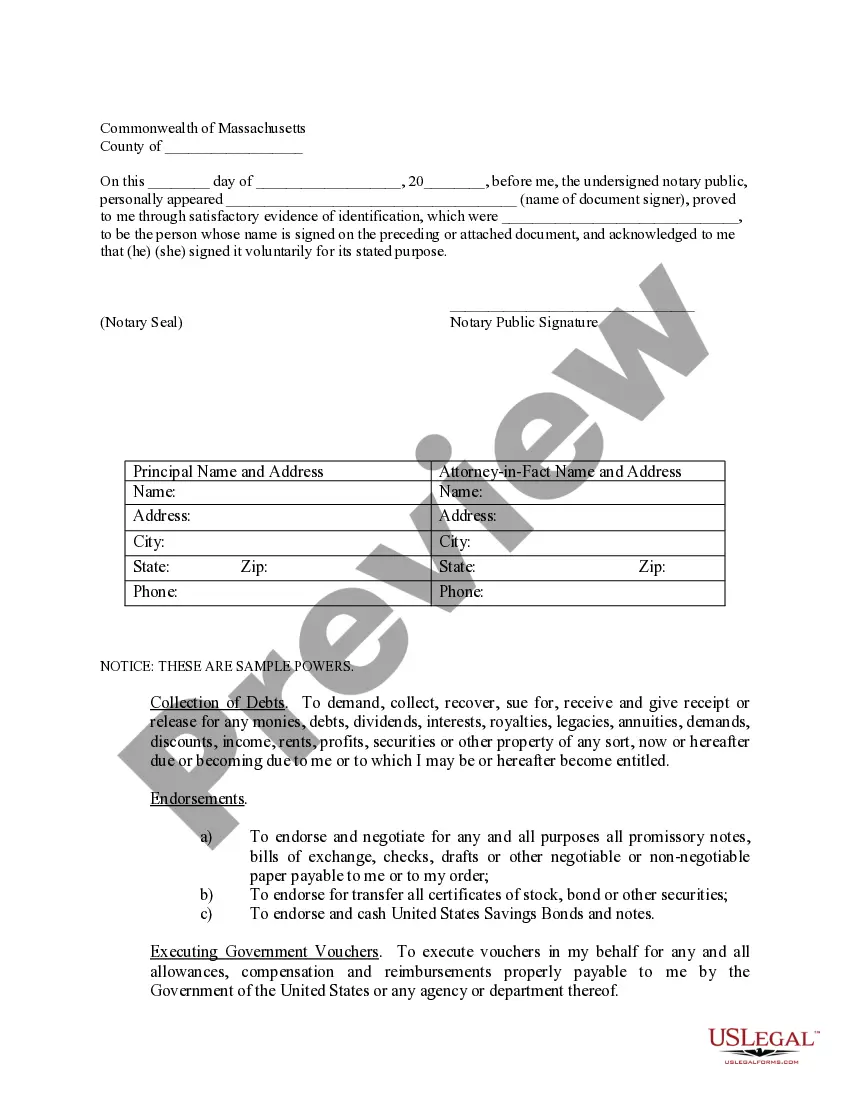
- Principal details: Name and address of the person granting authority.
- Agent details: Name of the person being appointed as the attorney-in-fact.
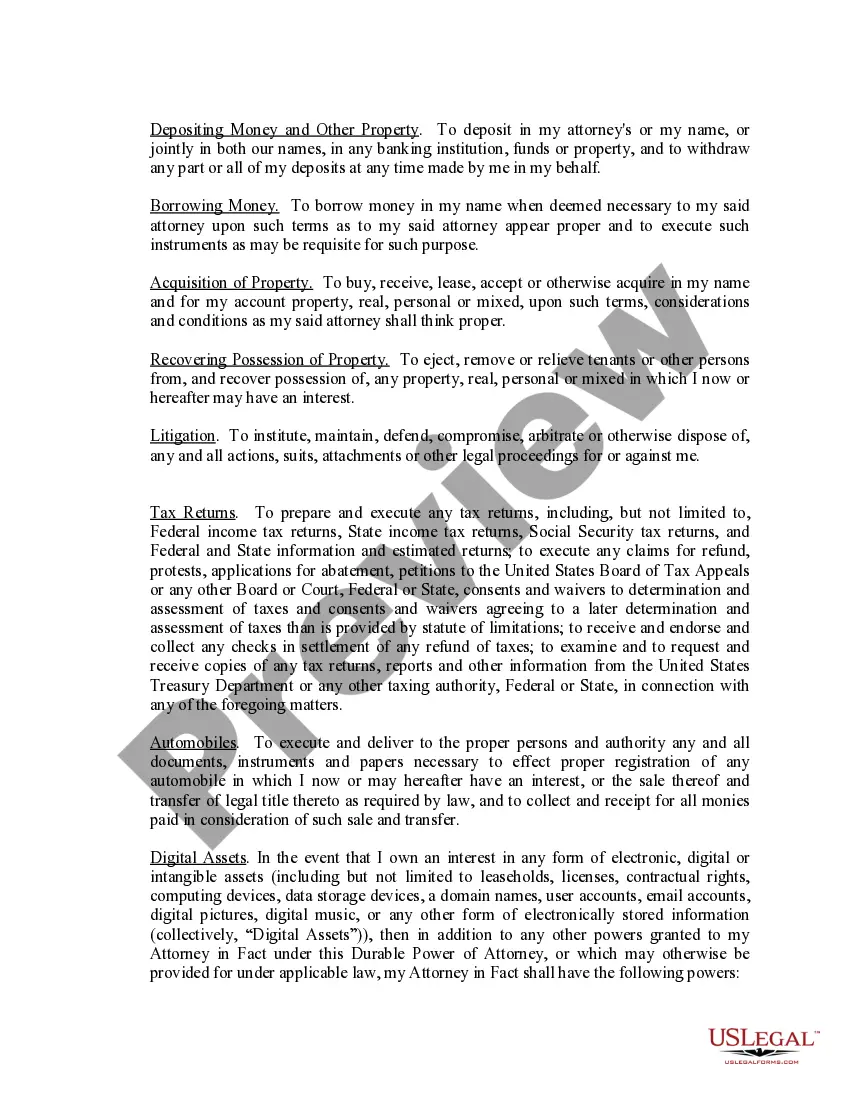
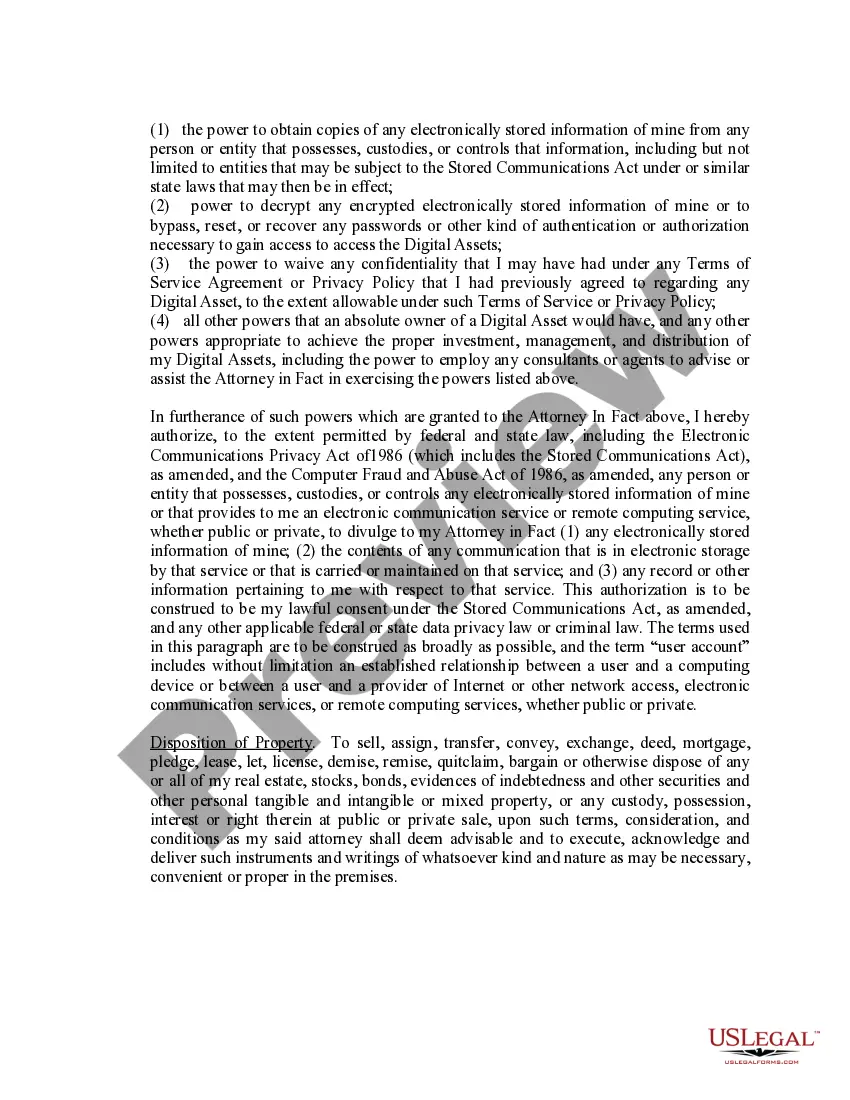
- Specific powers: A section where you can list the powers you wish to grant, including sample powers provided within the form.
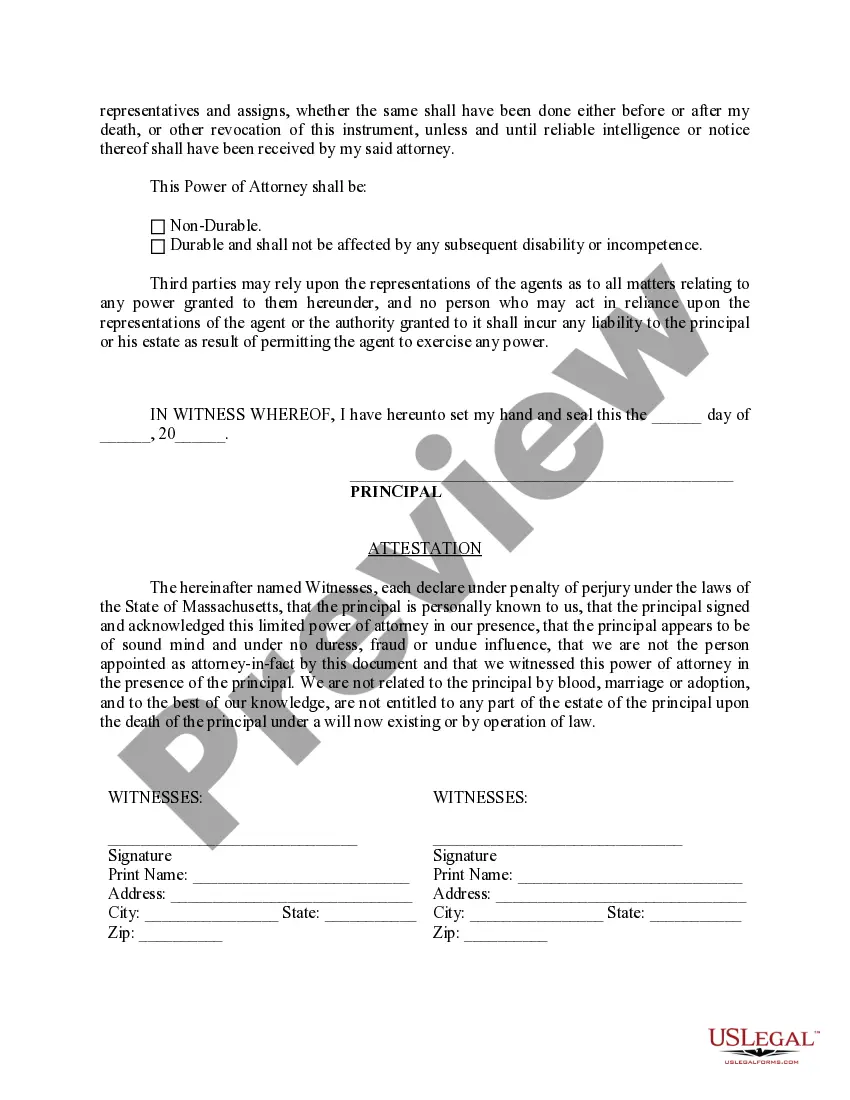
- Durable or non-durable designation: Indicating whether the power of attorney remains valid after the principal's incapacity.
- Witness and notary sections: Required signatures to validate the document.
Common use cases
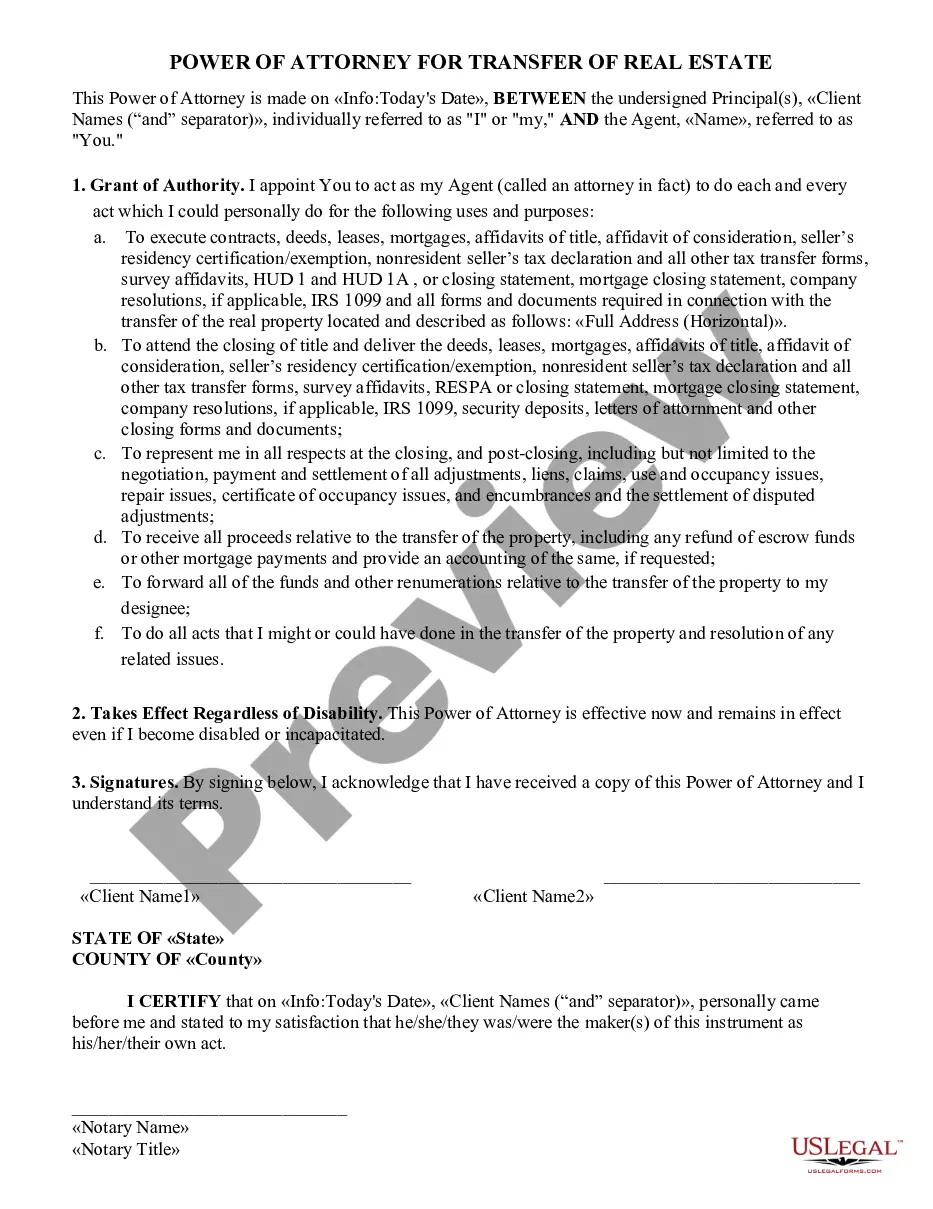
This form is ideal in situations where you want to delegate specific tasks or authority to another person while retaining control over the overall decision-making process. Common scenarios include managing finances during travel, handling real estate transactions, or addressing specific legal or financial matters when you are unable to act personally.
Who needs this form
This form is appropriate for:
- Individuals in Massachusetts who need a trusted person to manage specific affairs.
- People who want to limit the scope of authority granted to their agent.
- Anyone requiring temporary assistance with personal, financial, or legal affairs.
Steps to complete this form
- Identify the parties: Enter the name and address of the principal and the agent.
- Specify the powers: List the specific powers you wish to grant your agent, referring to the sample powers as needed.
- Indicate the durable or non-durable status: Select whether the power of attorney should remain effective despite any future incapacity.
- Gather witness signatures: Ensure that two witnesses complete the attestation section accurately.
- Notarization: If required, complete the notary section, ensuring the validity of the document.
Is notarization required?
To make this form legally binding, it must be notarized. Our online notarization service, powered by Notarize, lets you verify and sign documents remotely through an encrypted video session.
Get your form ready online
Our built-in tools help you complete, sign, share, and store your documents in one place.
Make edits, fill in missing information, and update formatting in US Legal Forms—just like you would in MS Word.
Download a copy, print it, send it by email, or mail it via USPS—whatever works best for your next step.
Sign and collect signatures with our SignNow integration. Send to multiple recipients, set reminders, and more. Go Premium to unlock E-Sign.
If this form requires notarization, complete it online through a secure video call—no need to meet a notary in person or wait for an appointment.
We protect your documents and personal data by following strict security and privacy standards.

Make edits, fill in missing information, and update formatting in US Legal Forms—just like you would in MS Word.

Download a copy, print it, send it by email, or mail it via USPS—whatever works best for your next step.

Sign and collect signatures with our SignNow integration. Send to multiple recipients, set reminders, and more. Go Premium to unlock E-Sign.

If this form requires notarization, complete it online through a secure video call—no need to meet a notary in person or wait for an appointment.

We protect your documents and personal data by following strict security and privacy standards.
Common mistakes to avoid
- Failing to specify or listing vague powers for the agent.
- Not having the form signed and witnessed as required by law.
- Neglecting to review and update the form if circumstances change or new powers are needed.
- Forgetting to specify whether the power is durable or non-durable, which can affect its validity.
Why complete this form online
- Immediate access: Download the form anytime, ensuring you have it when you need it.
- Editable format: Customize the form with specific powers suited to your needs.
- Professional quality: Forms are drafted by licensed attorneys, ensuring legal compliance.
Looking for another form?

Form popularity
FAQ
Limited. A limited power of attorney gives someone else the power to act in your stead for a very limited purpose. General. A general power of attorney is comprehensive and gives your attorney-in-fact all the powers and rights that you have yourself. Durable. Springing.
What Is a Special Power of Attorney?Also known as a limited power of attorney (LPOA), a special power of attorney allows an individual to give another person the ability to make certain legal or financial decisions on their behalf.
First, the legal answer is however long you set it up to last. If you set a date for a power of attorney to lapse, then it will last until that date. If you create a general power of attorney and set no date for which it will expire, it will last until you die or become incapacitated.
The biggest limitation on a power of attorney is that it can only be signed when the principal is of sound mind.If the principal is unable to make decisions, the principal's family will need to go to court to become a court appointed guardian before they can make financial or medical decisions.
A limited power of attorney grants the representative that you choose (the agent or attorney-in-fact) the power to act on your behalf under limited circumstances.Under a general power of attorney, the agent or attorney-in-fact can do anything that you can do.
A limited PoA, amongst other things, grants the PoA holder access and permission to execute trades/orders on your trading account, on your behalf. However, it does not allow the PoA holder to perform withdrawals requests or transfer of funds. All withdrawals must be requested by the authorized signatory of the account.
When you give someone the POA, there are important limitations to the power the agent has. First, your agent must make decisions within the terms of the legal document and can't make decisions that break the agreement, and the agent can be held liable for any fraud or negligence.