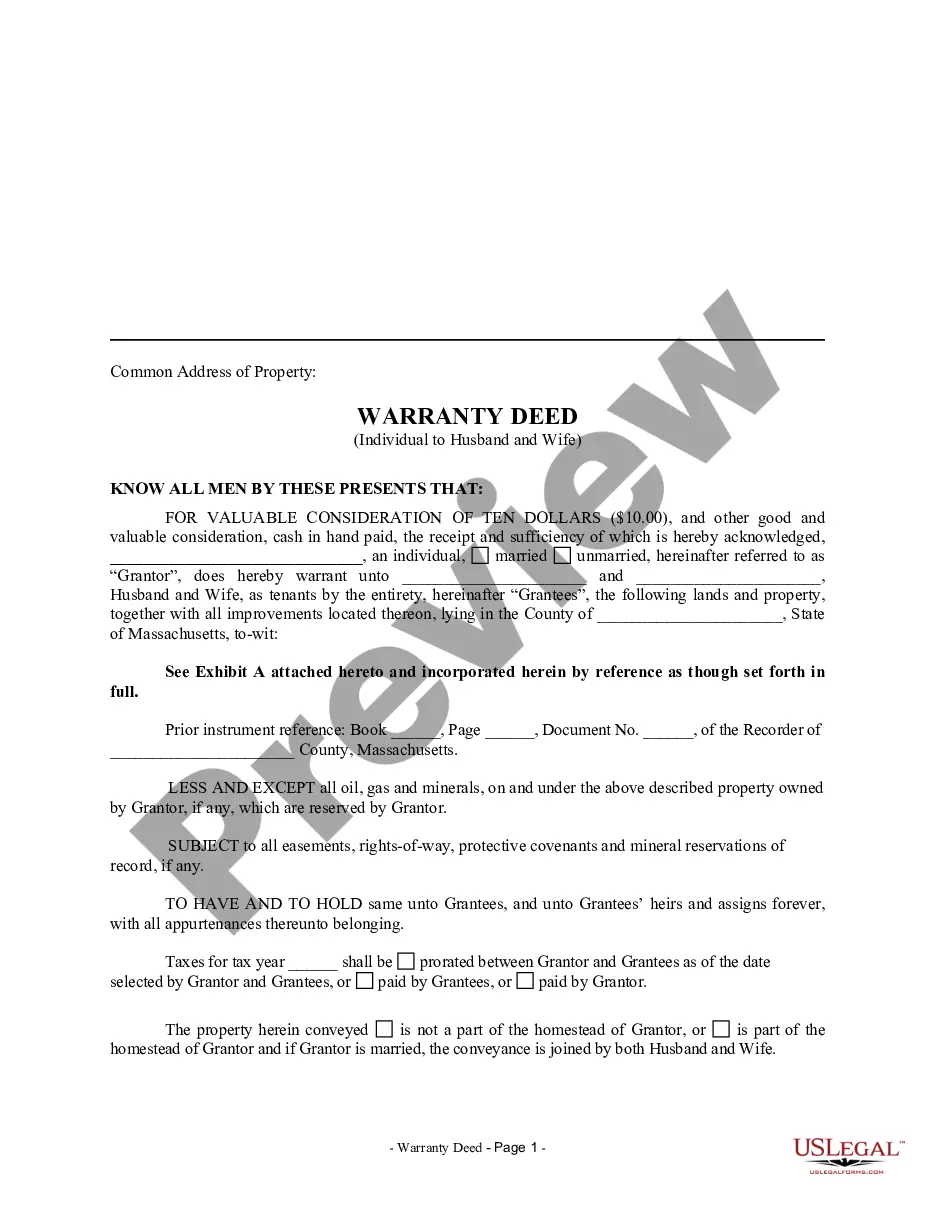
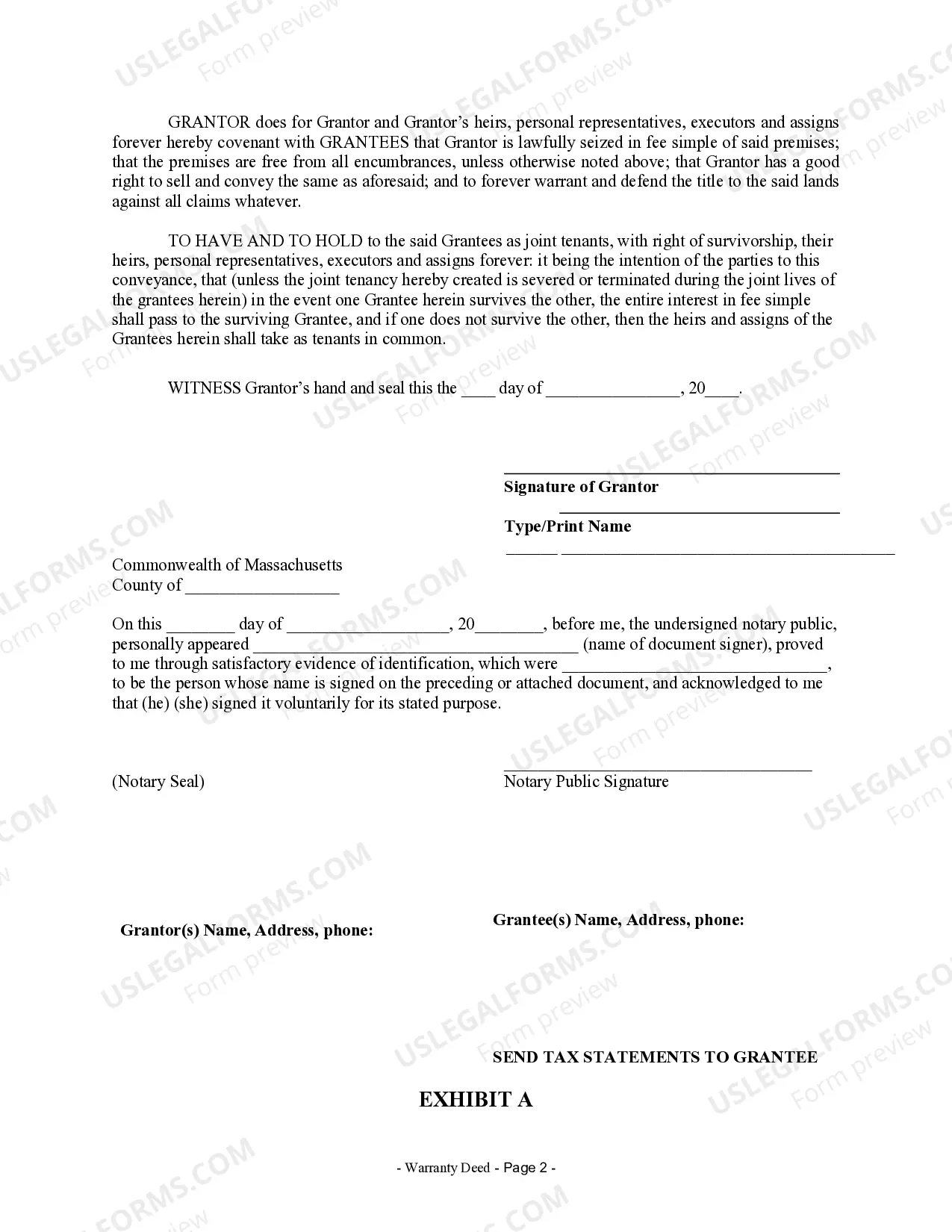
Massachusetts Warranty Deed from Individual to Husband and Wife
About this form
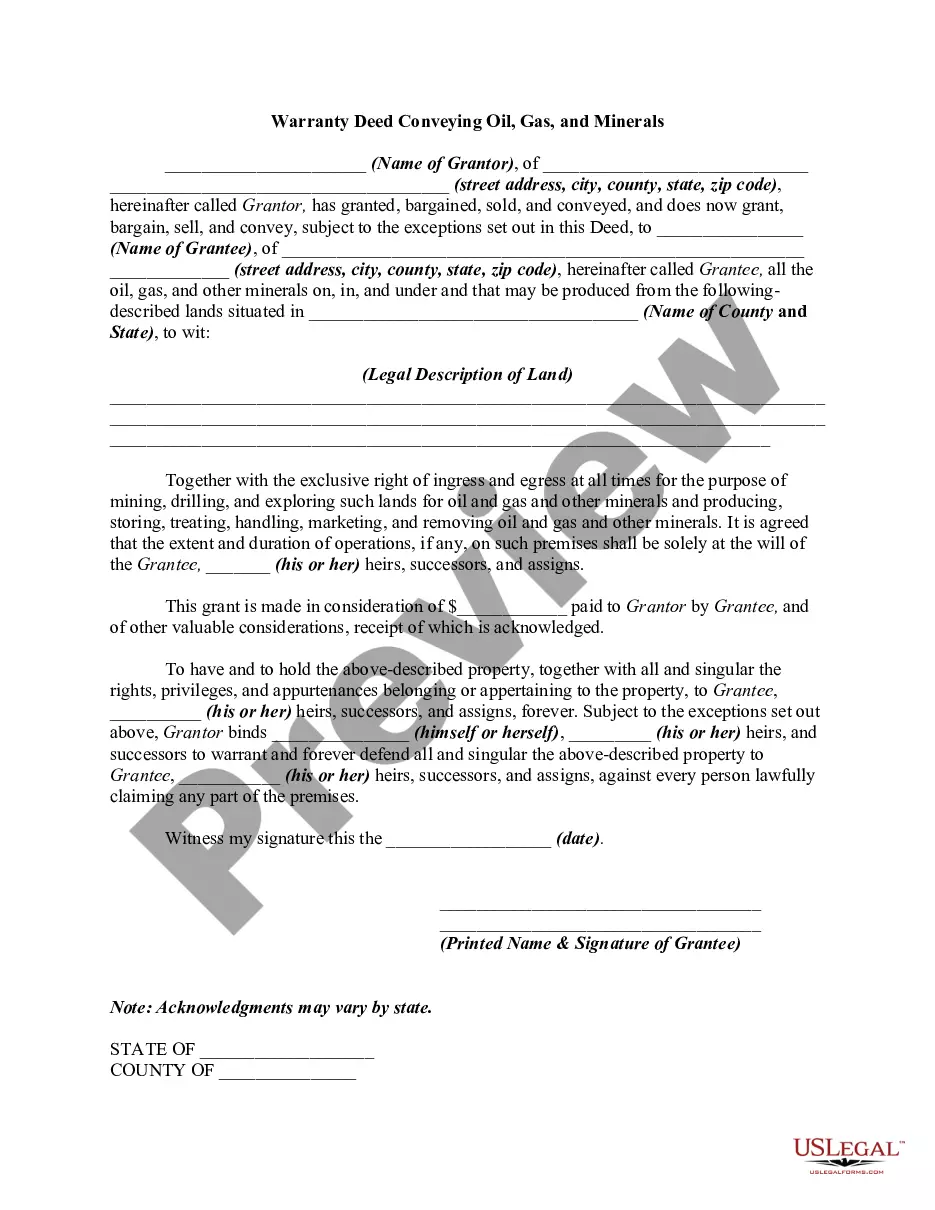
The Warranty Deed from Individual to Husband and Wife is a legal document that transfers ownership of real estate from an individual (the Grantor) to a married couple (the Grantees). This form specifically reserves any rights to oil, gas, and minerals beneath the property, ensuring that the couple takes ownership as joint tenants with rights of survivorship. This legal form is essential for couples looking to acquire property together while providing a structured and legally compliant transfer process.
Key components of this form
- Identification of the Grantor (the individual transferring the property).
- Identification of the Grantees (the husband and wife receiving the property).
- Details regarding the property being transferred, including legal descriptions.
- Reservation clause for oil, gas, and mineral rights.
- Declaration of ownership type (joint tenancy with right of survivorship).
- Signature lines for Grantor and acknowledgment by a notary public.




Situations where this form applies
This warranty deed is appropriate when an individual wishes to transfer property ownership to a married couple. Common scenarios include selling or gifting property to a spouse and ensuring both parties have equal rights to the property, especially if they wish for the surviving spouse to inherit the property automatically upon the otherâs death.
Who this form is for
This form is intended for:
- Property owners looking to transfer real estate to a husband and wife.
- Couples who want to ensure joint ownership with rights of survivorship.
- Individuals wishing to reserve certain rights to oil, gas, and minerals, while transferring their property.
Instructions for completing this form
- Identify the parties involved by entering the names and addresses of the Grantor and Grantees.
- Specify the property being transferred by inserting a legal description or attaching an exhibit.
- Include the reservation of rights clause regarding oil, gas, and minerals, if applicable.
- Decide on the method of ownership for the Grantees (joint tenancy or tenants by the entirety).
- Have the Grantor sign the form in the presence of a notary public for it to be legally valid.
- Ensure that any necessary tax provisions are addressed concerning property taxes for the year of transfer.
Does this document require notarization?
Yes, this form must be notarized to be legally valid. Having a notary public witness the signature of the Grantor adds an essential layer of authenticity, verifying the identities involved in the property transfer. US Legal Forms offers integrated online notarization services available 24/7, allowing you to complete this step securely and conveniently from home.
Get your form ready online
Our built-in tools help you complete, sign, share, and store your documents in one place.
Make edits, fill in missing information, and update formatting in US Legal Forms—just like you would in MS Word.
Download a copy, print it, send it by email, or mail it via USPS—whatever works best for your next step.
Sign and collect signatures with our SignNow integration. Send to multiple recipients, set reminders, and more. Go Premium to unlock E-Sign.
If this form requires notarization, complete it online through a secure video call—no need to meet a notary in person or wait for an appointment.
We protect your documents and personal data by following strict security and privacy standards.

Make edits, fill in missing information, and update formatting in US Legal Forms—just like you would in MS Word.

Download a copy, print it, send it by email, or mail it via USPS—whatever works best for your next step.

Sign and collect signatures with our SignNow integration. Send to multiple recipients, set reminders, and more. Go Premium to unlock E-Sign.

If this form requires notarization, complete it online through a secure video call—no need to meet a notary in person or wait for an appointment.

We protect your documents and personal data by following strict security and privacy standards.
Mistakes to watch out for
- Failing to include a complete legal description of the property.
- Not properly identifying all parties involved in the transaction.
- Overlooking the need for notarization, which may invalidate the deed.
- Forgetting to reserve mineral rights if that is a concern for the Grantor.
- Neglecting to decide on the ownership type, which can complicate inheritance issues.
Benefits of completing this form online
- Convenience of downloading a customizable legal form anytime.
- Access to templates drafted by licensed attorneys, ensuring legal compliance.
- Editability allows for adjustments based on specific real estate details.
- Streamlined process with clear guidance provided for completion.
Quick recap
- The Warranty Deed from Individual to Husband and Wife is essential for legally transferring property to a married couple.
- Ensures that both spouses have rights to the property and guarantees the title's integrity.
- Must be notarized to ensure its effectiveness and legal standing.
Looking for another form?


Form popularity
FAQ
If you live in a common-law state, you can keep your spouse's name off the title the document that says who owns the property.You can put your spouse on the title without putting them on the mortgage; this would mean that they share ownership of the home but aren't legally responsible for making mortgage payments.
What Is the Difference Between a Warranty Deed & a Survivorship Deed?A warranty deed is the most comprehensive and provides the most guarantees. Survivorship isn't so much a deed as a title. It's a way to co-own property where, upon the death of one owner, ownership automatically passes to the survivor.
A Survivorship Deed transfers residential or commercial property from one property owner (the grantor) to another (the grantee) while allowing them to avoid going through probate when they (the grantor) passes away. The parties transferring property in a Survivorship Deed must have full ownership of the property.
In California, all property bought during the marriage with income that was earned during the marriage is deemed "community property." The law implies that both spouses own this property equally, regardless of which name is on the title deed.
Adding someone to your house deed requires the filing of a legal form known as a quitclaim deed. When executed and notarized, the quitclaim deed legally overrides the current deed to your home. By filing the quitclaim deed, you can add someone to the title of your home, in effect transferring a share of ownership.
Special warranties allow the transfer of property title between seller and buyer. The purchase of title insurance can mitigate the risk of prior claims to the special warranty deed.
If you've recently married and already own a home or other real estate, you may want to add your new spouse to the deed for your property so the two of you own it jointly. To add a spouse to a deed, all you have to do is literally fill out, sign and record a new deed in your county recorder's office.
A warranty deed guarantees that: The grantor is the rightful owner of the property and has the legal right to transfer the title.The title would withstand third-party claims to ownership of the property. The grantor will do anything to ensure the grantee's title to the property.
A In order to make your partner a joint owner you will need to add his name at the Land Registry, for which there is a fee of £280 (assuming you transfer half the house to him). You won't, however, have to pay capital gains tax, as gifts between civil partners (and spouses) are tax free.