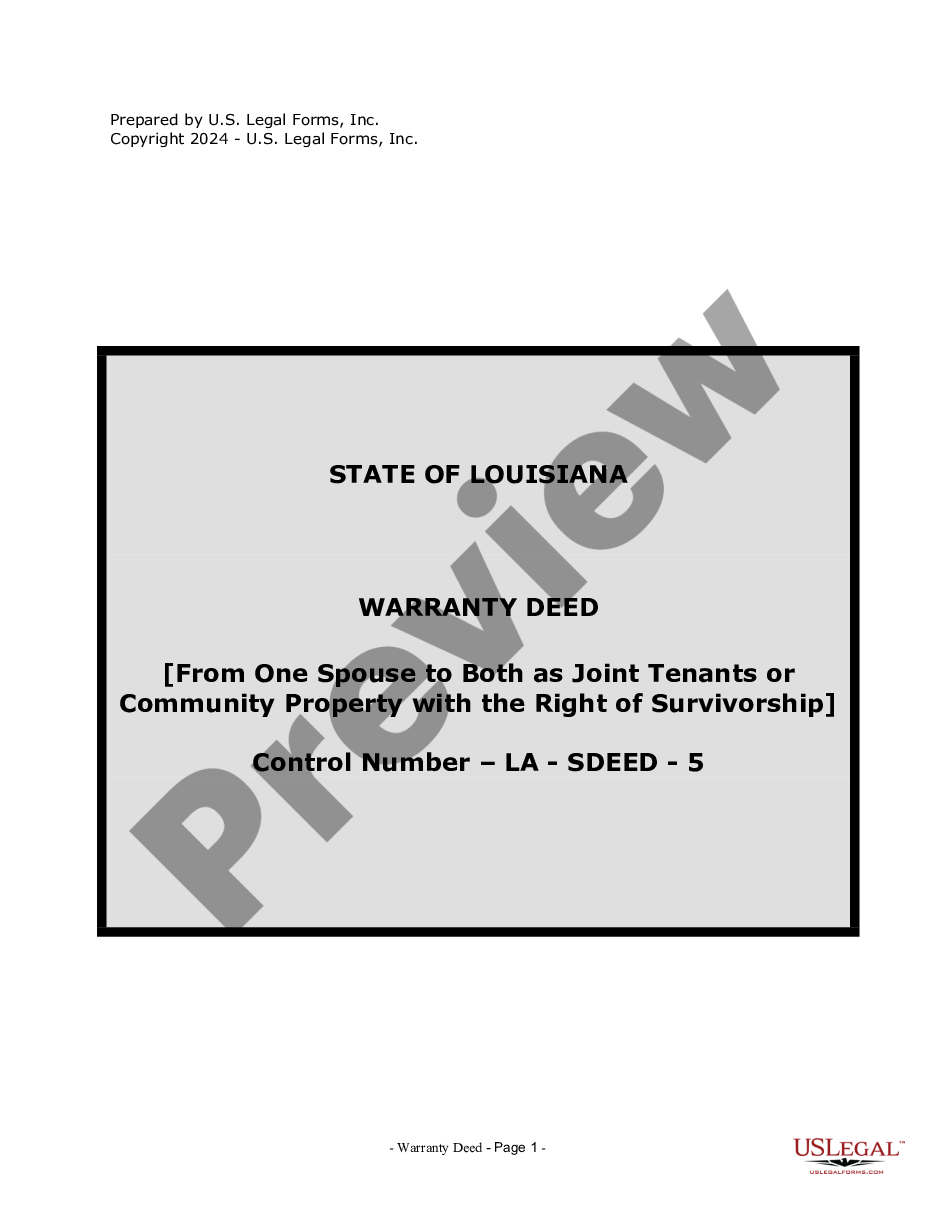
Louisiana Warranty Deed to Separate Property of one Spouse to both as Joint Tenants or as Community Property with Right of Survivorship
Understanding this form
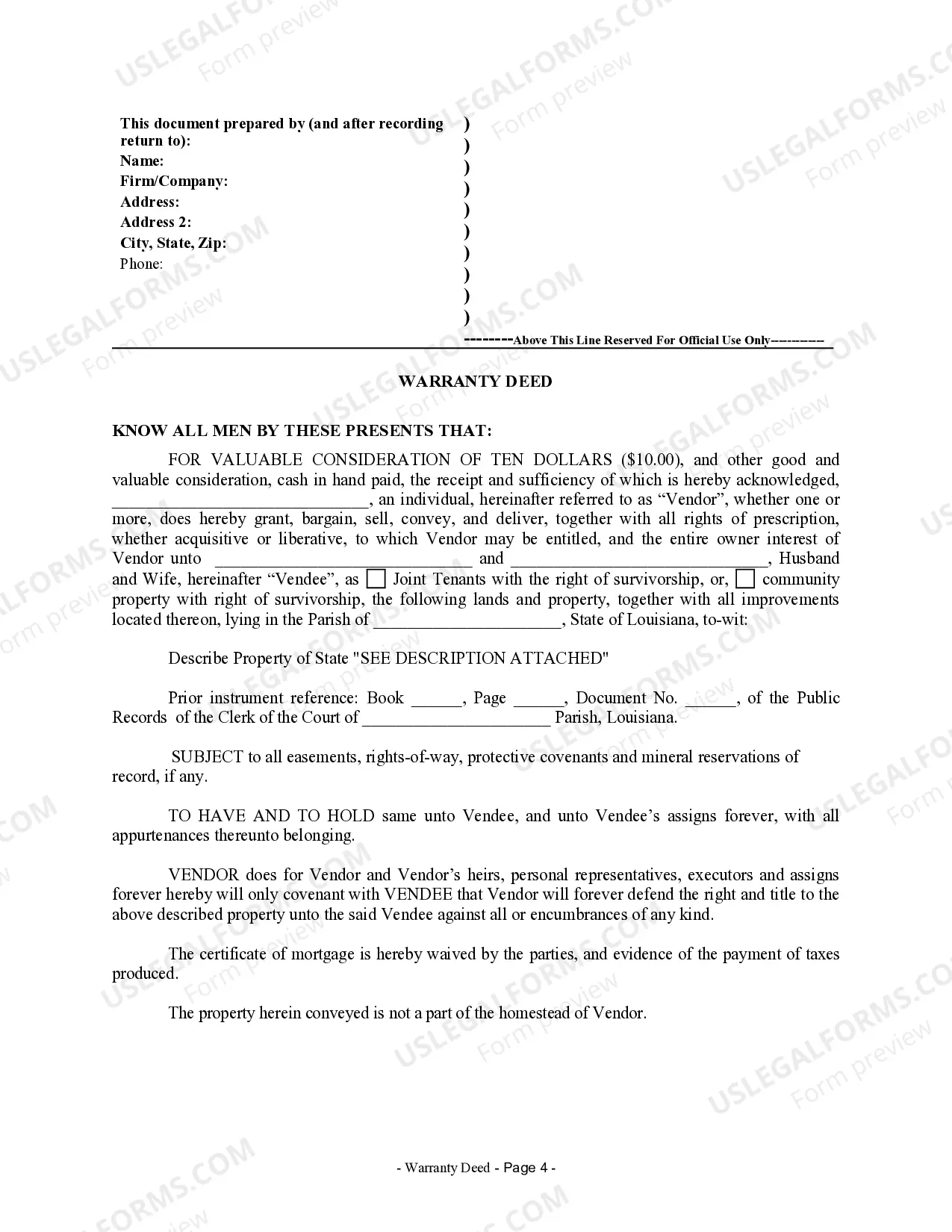
This Warranty Deed is a legal document that allows one spouse to transfer property to themselves and their spouse as joint tenants or as community property with the right of survivorship. This form ensures that both spouses have equal rights to the property and designates how ownership will be treated in the event of one spouse's death. Unlike other property transfer forms, this deed specifically emphasizes survivorship rights, which can be crucial in estate planning for married couples.
What’s included in this form
- Details of the property being transferred.
- Names of the vendor (the transferring spouse) and the vendees (both spouses).
- Covenant clause affirming the vendor's promise to defend property title.
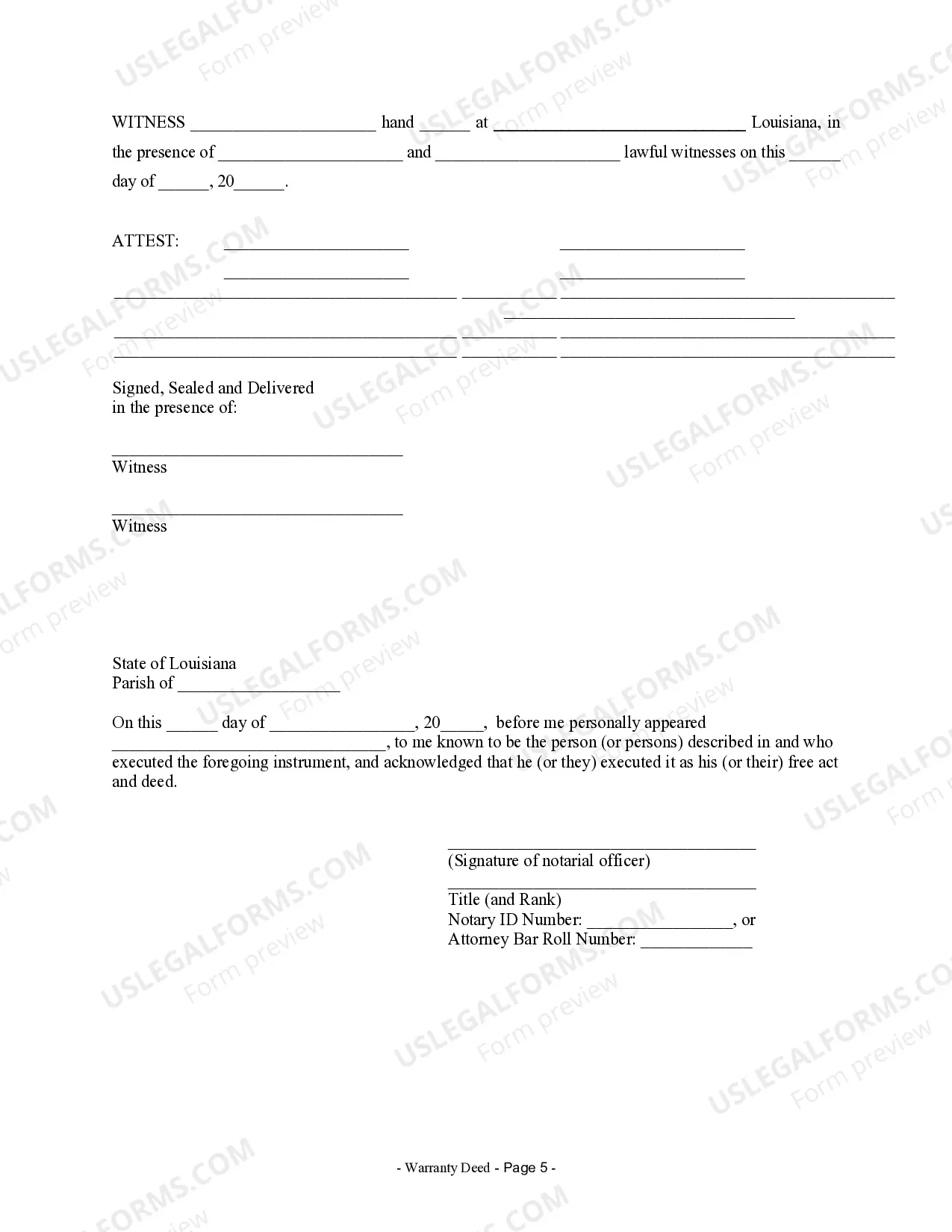
- Signature lines for the vendor and witnesses.
- Notarization clause confirming the authenticity of the transfer.




When to use this form
This form should be used when a spouse wants to formally transfer ownership of property to themselves and their spouse, especially when planning for inheritance and ensuring property rights in the event of death. It is applicable in situations where both parties wish to retain joint ownership or wish to have the property classified as community property to ease the transfer of ownership upon death.
Who this form is for
- Married couples who wish to establish joint ownership of property.
- Individuals looking to ensure survivorship rights concerning property ownership.
- Homeowners considering estate planning options or preparing for future property succession.
Completing this form step by step
- Identify the vendor (the spouse transferring the property) and the vendees (both spouses).
- Clearly describe the property being transferred, including relevant details or references from public records.
- Complete the requisite fields with appropriate dates and signatures (vendor, witnesses, and notary if applicable).
- Ensure that any required changes to the form are made before filling out the form fields.
- Review the completed form for accuracy before finalizing it.
Does this document require notarization?
Yes, this form must be notarized to be legally valid. Notarization verifies the identity of the parties involved and ensures that the transfer is executed willingly. US Legal Forms offers integrated online notarization, ensuring you can complete this process securely via video call without the need to travel.
Get your form ready online
Our built-in tools help you complete, sign, share, and store your documents in one place.
Make edits, fill in missing information, and update formatting in US Legal Forms—just like you would in MS Word.
Download a copy, print it, send it by email, or mail it via USPS—whatever works best for your next step.
Sign and collect signatures with our SignNow integration. Send to multiple recipients, set reminders, and more. Go Premium to unlock E-Sign.
If this form requires notarization, complete it online through a secure video call—no need to meet a notary in person or wait for an appointment.
We protect your documents and personal data by following strict security and privacy standards.

Make edits, fill in missing information, and update formatting in US Legal Forms—just like you would in MS Word.

Download a copy, print it, send it by email, or mail it via USPS—whatever works best for your next step.

Sign and collect signatures with our SignNow integration. Send to multiple recipients, set reminders, and more. Go Premium to unlock E-Sign.

If this form requires notarization, complete it online through a secure video call—no need to meet a notary in person or wait for an appointment.

We protect your documents and personal data by following strict security and privacy standards.
Common mistakes to avoid
- Failing to accurately describe the property being transferred.
- Not including both spouses' names as vendees.
- Omitting signatures from witnesses or not properly notarizing the document.
- Neglecting to check local laws that may affect the deed's enforceability.
Why use this form online
- Convenient access to legal forms from home.
- The ability to edit information easily before printing.
- Ensures that the latest legal standards and requirements are followed.
Key takeaways
- This Warranty Deed facilitates the transfer of property to both spouses, ensuring shared ownership.
- It is essential to complete the form accurately to avoid disputes or complications in the future.
- Notarization is a crucial step in the process to validate the deed legally.
Looking for another form?



Form popularity
FAQ
Overview of Joint Tenants For example, joint tenants must all take title simultaneously from the same deed while tenants in common can come into ownership at different times. Another difference is that joint tenants all own equal shares of the property, proportionate to the number of joint tenants involved.
In estate law, joint tenancy is a special form of ownership by two or more persons of the same property. The individuals, who are called joint tenants, share equal ownership of the property and have the equal, undivided right to keep or dispose of the property. Joint tenancy creates a Right of Survivorship.
One of the main differences between the two types of shared ownership is what happens to the property when one of the owners dies. When a property is owned by joint tenants with survivorship, the interest of a deceased owner automatically gets transferred to the remaining surviving owners.
When a property is owned by joint tenants with survivorship, the interest of a deceased owner automatically gets transferred to the remaining surviving owners. For example, if four joint tenants own a house and one of them dies, each of the three remaining joint tenants ends up with a one-third share of the property.
In California, most married couples hold real property (such as land and buildings) as joint tenants with right of survivorship.For instance, many married couples share real property as joint tenants. This way, upon the death of a spouse, the surviving spouse will own 100% share of the property.
When one joint owner (called a joint tenant, though it has nothing to do with renting) dies, the surviving owners automatically get the deceased owner's share of the joint tenancy property.The surviving joint tenant will automatically own the property after your death.
Property owned in joint tenancy automatically passes, without probate, to the surviving owner(s) when one owner dies. Joint tenancy often works well when couples (married or not) acquire real estate, vehicles, bank accounts, securities, or other valuable property together.
It is very simple to break a joint tenancy. You simply prepare and excute before a notary public a quitclaim deed to yourself and record the quitclaim deed with the County Recorder in the County in which the real property is located.
While the joint tenant with right of survivorship can't will his share in the property to his heir, he can sell his interest in the property before his death. Once a joint tenant sells his share, this ends the joint tenancy ownership involving the share.