Kansas Warranty Deed for Separate or Joint Property to Joint Tenancy
Understanding this form
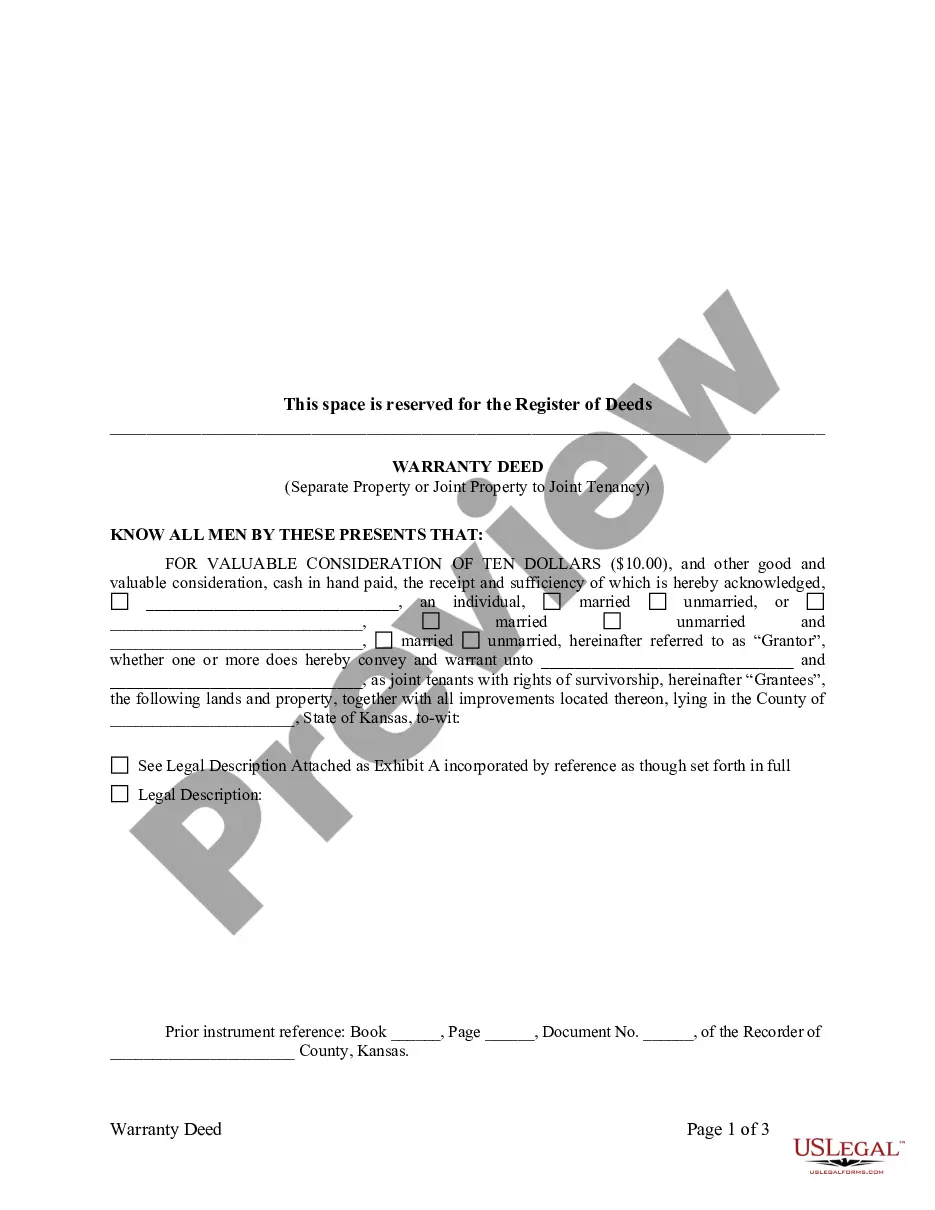
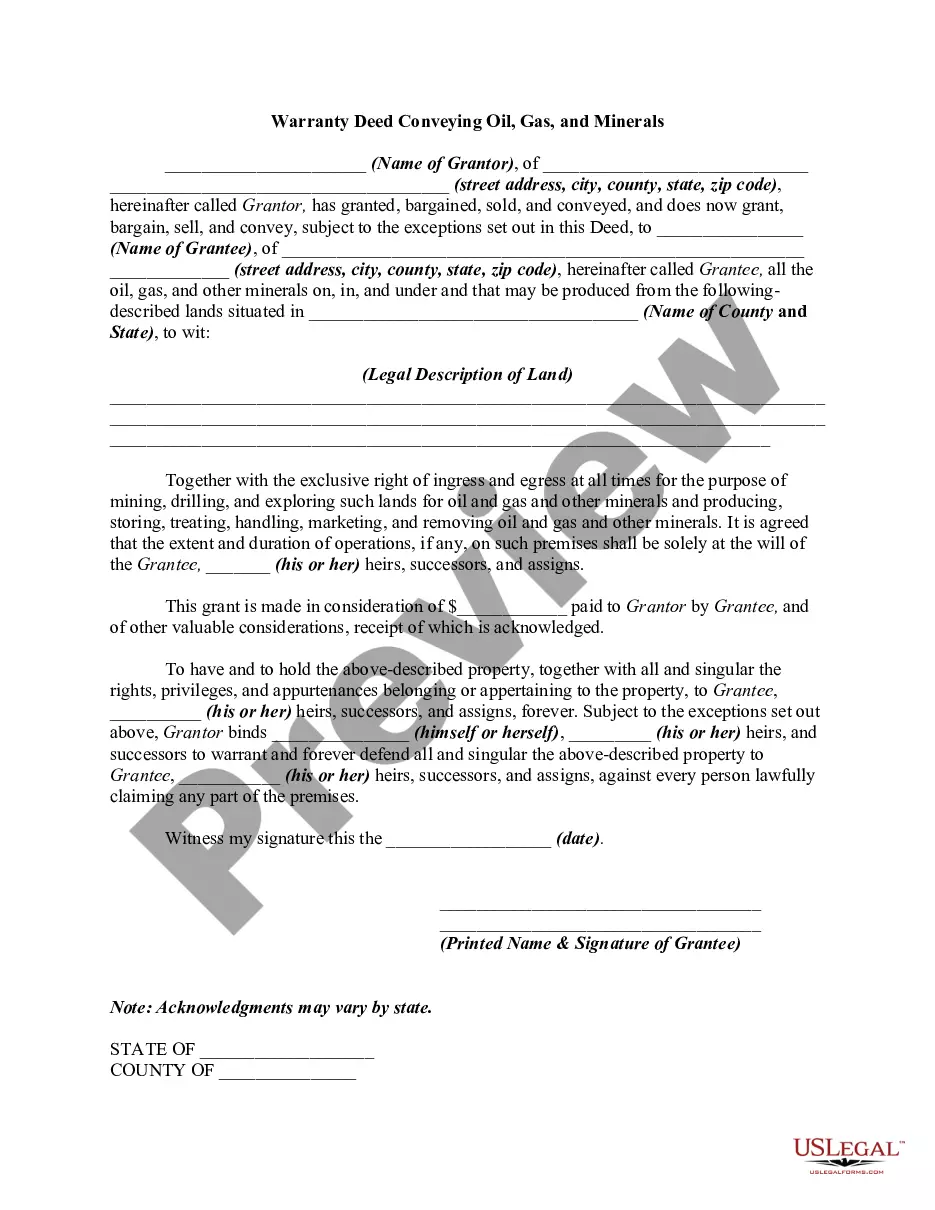
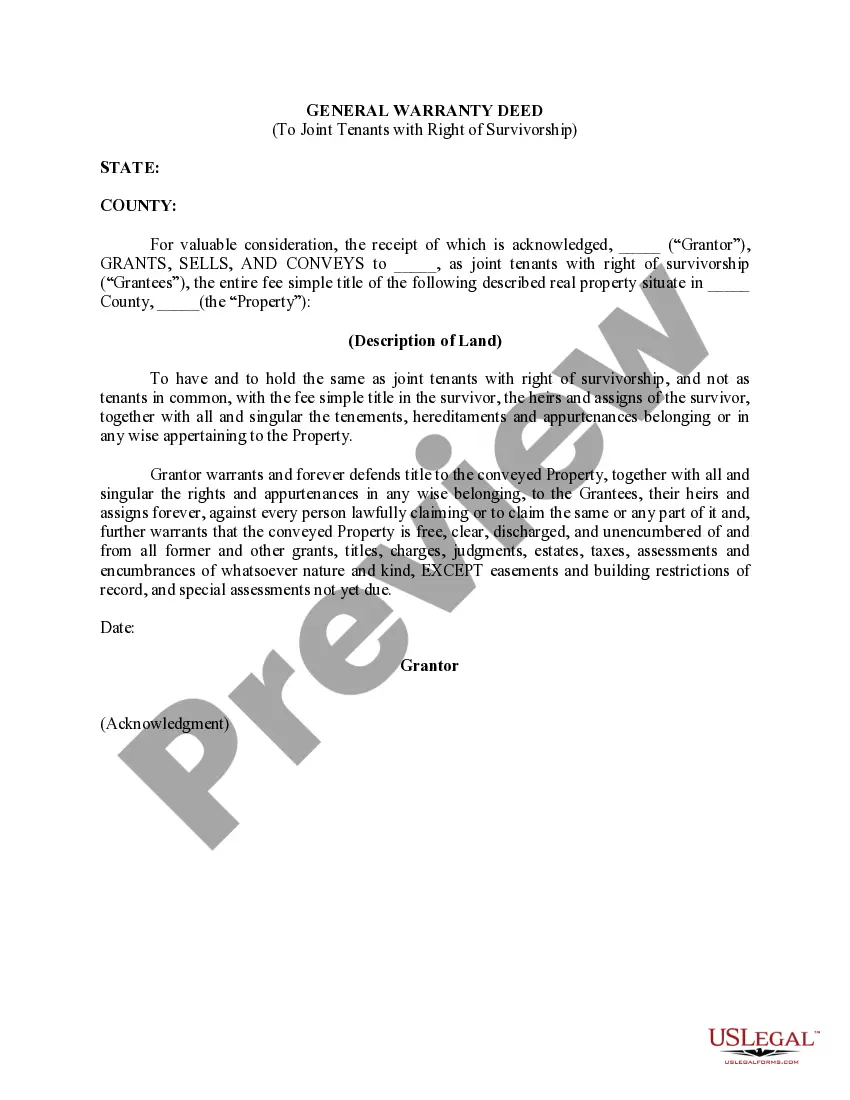
The Warranty Deed for Separate or Joint Property to Joint Tenancy is a legal document used to convert separate or jointly held property into joint tenancy. This deed establishes co-ownership with rights of survivorship, meaning if one owner passes away, the surviving owner automatically inherits the entire property. This form differs from other property transfer documents by specifically focusing on creating a joint tenancy arrangement, which can simplify asset transfer upon death and avoid probate processes.
Key parts of this document
- Identification of the Grantor(s): The person or people transferring the property.
- Identification of the Grantee(s): The person or people receiving the property as joint tenants.
- Property Description: Detailed legal description of the property being conveyed.
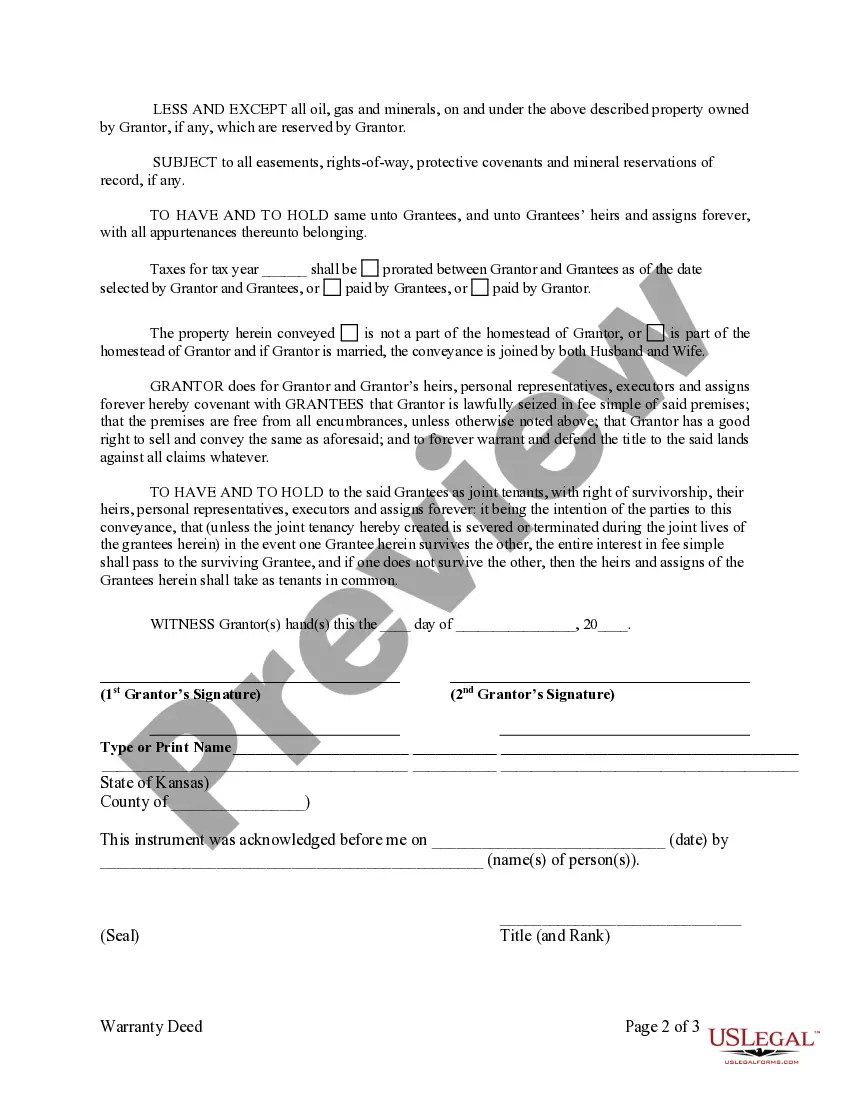
- Transfer of Title: Clauses ensuring the property is free of encumbrances.
- Rights of Survivorship: Provisions specifying that the surviving tenant retains the full property title upon the death of a co-owner.
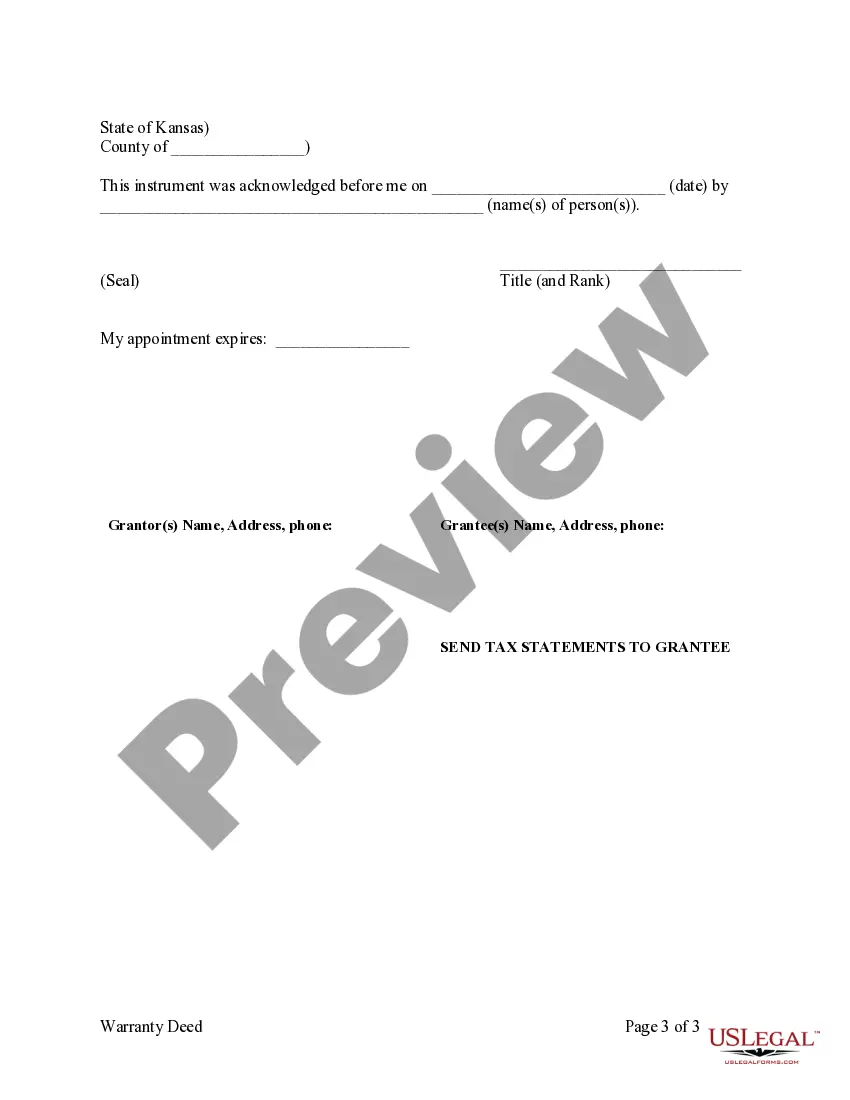
- Notary Acknowledgment: Signature and seal from a notary public verifying the identities of the signers.


Common use cases
This form is needed when two or more people wish to hold property together as joint tenants. It is commonly used among family members, couples, or business partners who want to ensure that their share of the property automatically passes to the surviving tenant without going through the probate process. Situations might include transferring a family home to joint ownership with a spouse or consolidating ownership between siblings.
Who can use this document
This form is intended for:
- Individuals wanting to create a joint tenancy with another person.
- Married couples looking to consolidate property ownership.
- Business partners or co-investors wishing to secure joint ownership of real estate.
- Anyone wanting to ensure their property transfers seamlessly upon their death without probate.
Instructions for completing this form
- Identify the Grantor(s) by providing their names and marital status.
- Specify the Grantee(s) who will receive the property as joint tenants.
- Enter a detailed legal description of the property being transferred.
- Fill in any applicable tax information and provisions related to property taxes.
- Complete the date and provide signatures from all Grantors in the presence of a notary public.
Does this form need to be notarized?
Yes, this form must be notarized to be legally valid. The notarization process ensures that the identities of the signers are confirmed, providing an additional layer of security to the transaction. US Legal Forms offers integrated online notarization services, allowing for secure video calls with notaries available 24/7, eliminating the need for in-person visits.
Get your form ready online
Our built-in tools help you complete, sign, share, and store your documents in one place.
Make edits, fill in missing information, and update formatting in US Legal Forms—just like you would in MS Word.
Download a copy, print it, send it by email, or mail it via USPS—whatever works best for your next step.
Sign and collect signatures with our SignNow integration. Send to multiple recipients, set reminders, and more. Go Premium to unlock E-Sign.
If this form requires notarization, complete it online through a secure video call—no need to meet a notary in person or wait for an appointment.
We protect your documents and personal data by following strict security and privacy standards.

Make edits, fill in missing information, and update formatting in US Legal Forms—just like you would in MS Word.

Download a copy, print it, send it by email, or mail it via USPS—whatever works best for your next step.

Sign and collect signatures with our SignNow integration. Send to multiple recipients, set reminders, and more. Go Premium to unlock E-Sign.

If this form requires notarization, complete it online through a secure video call—no need to meet a notary in person or wait for an appointment.

We protect your documents and personal data by following strict security and privacy standards.
Mistakes to watch out for
- Failing to provide an accurate legal description of the property.
- Not having the document notarized, if required by local regulations.
- Leaving out signatures from necessary Grantors.
- Incorrectly indicating the marital status of Grantors and Grantees.
Advantages of online completion
- Convenient access to a legally drafted document that can be downloaded instantly.
- Editable fields allow for customization specific to your situation.
- Reliable content that complies with state-specific legal requirements.
- Peace of mind knowing that the forms are created by licensed attorneys.
Summary of main points
- A Warranty Deed for Separate or Joint Property to Joint Tenancy creates joint ownership of property with rights of survivorship.
- It is essential for situations where seamless property transfer is desired upon the death of one owner.
- Accurate completion and notarization of the form are crucial for its validity.
- This form is specifically designed to comply with Kansas laws regarding property ownership.
Looking for another form?
Form popularity
FAQ
What Is the Difference Between a Warranty Deed & a Survivorship Deed?A warranty deed is the most comprehensive and provides the most guarantees. Survivorship isn't so much a deed as a title. It's a way to co-own property where, upon the death of one owner, ownership automatically passes to the survivor.
A warranty deed guarantees that: The grantor is the rightful owner of the property and has the legal right to transfer the title.The title would withstand third-party claims to ownership of the property. The grantor will do anything to ensure the grantee's title to the property.
In title law, when we talk about tenants, we're talking about people who own property.When joint tenants have right of survivorship, it means that the property shares of one co-tenant are transferred directly to the surviving co-tenant (or co-tenants) upon their death.
A Survivorship Deed transfers residential or commercial property from one property owner (the grantor) to another (the grantee) while allowing them to avoid going through probate when they (the grantor) passes away. The parties transferring property in a Survivorship Deed must have full ownership of the property.
What Is the Difference Between a Warranty Deed & a Survivorship Deed?A warranty deed is the most comprehensive and provides the most guarantees. Survivorship isn't so much a deed as a title. It's a way to co-own property where, upon the death of one owner, ownership automatically passes to the survivor.
A joint tenant can indeed sever the right of survivorship WITHOUT the consent of the other joint tenants.In order to sever the right of survivorship, a tenant must only record a new deed showing that his or her interest in the title is now held in a Tenancy-in-Common or as Community Property.
Survivorship rights take precedence over any contrary terms in a person's will because property subject to rights of survivorship is not legally part of their estate at death and so cannot be distributed through a will.
With a Survivorship Deed in place, when one of the parties in a joint tenancy dies, the other party (or parties) takes over the deceased party's interest in the property instead of it passing to the deceased's heirs or beneficiaries.