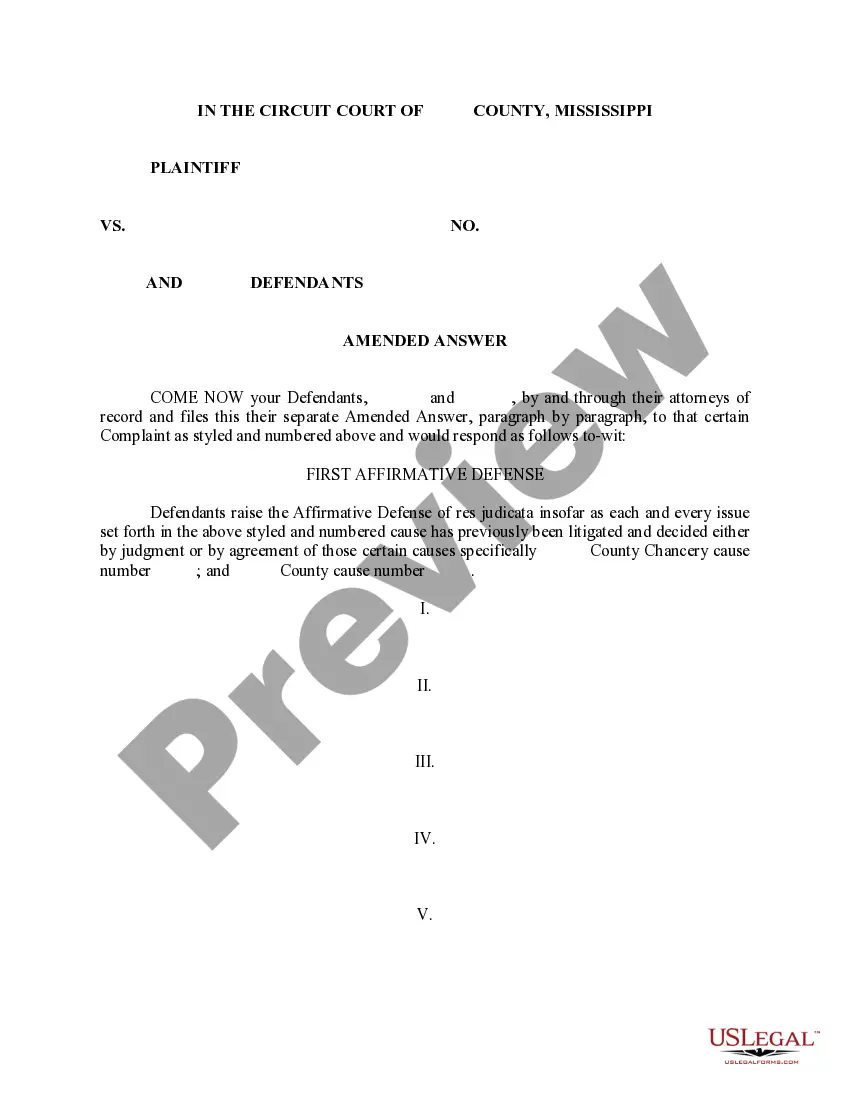
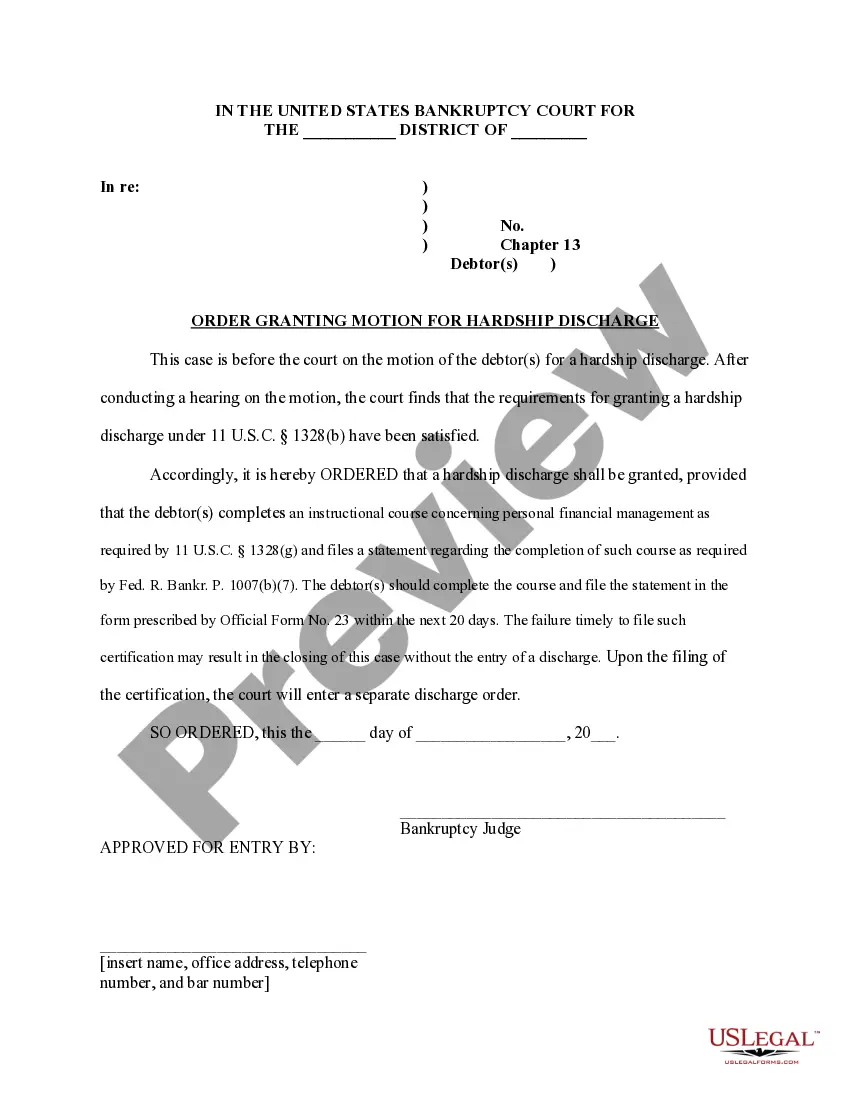
Order granting motion for hardship discharge - Form 23 NOT filed
About this form
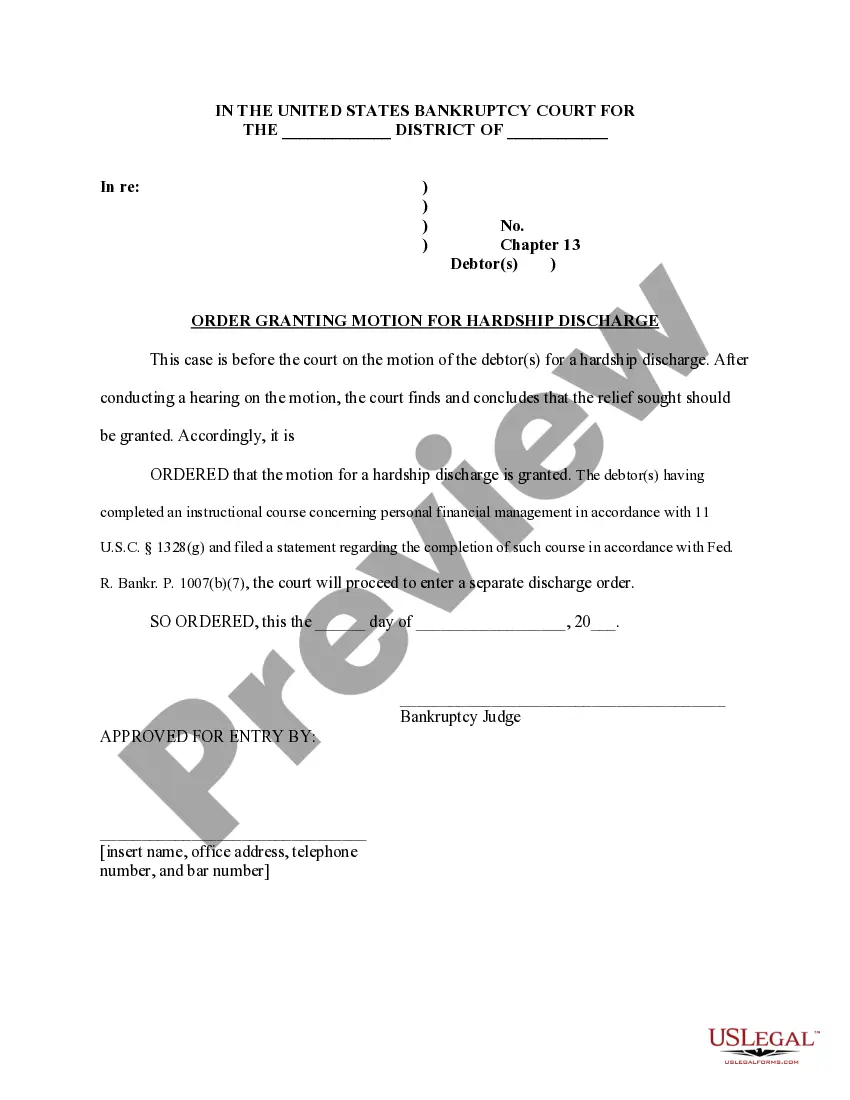
The Order Granting Motion for Hardship Discharge is a legal document used in bankruptcy proceedings, specifically under Chapter 13. This form is issued by the court to formally grant a debtorâs request for a hardship discharge when they cannot complete their payment plan due to certain financial difficulties. Unlike other discharge forms, this one recognizes the debtor's extenuating circumstances and is designed for those who meet specific legal criteria set forth by federal law.
What’s included in this form
- Court details, including jurisdiction and case number.
- Declarations regarding the courtâs findings after the hearing.
- Requirements for the debtor to complete a personal financial management course.
- Deadline for filing a statement of completion of the required course.
- Signature line for the Bankruptcy Judge.
Common use cases
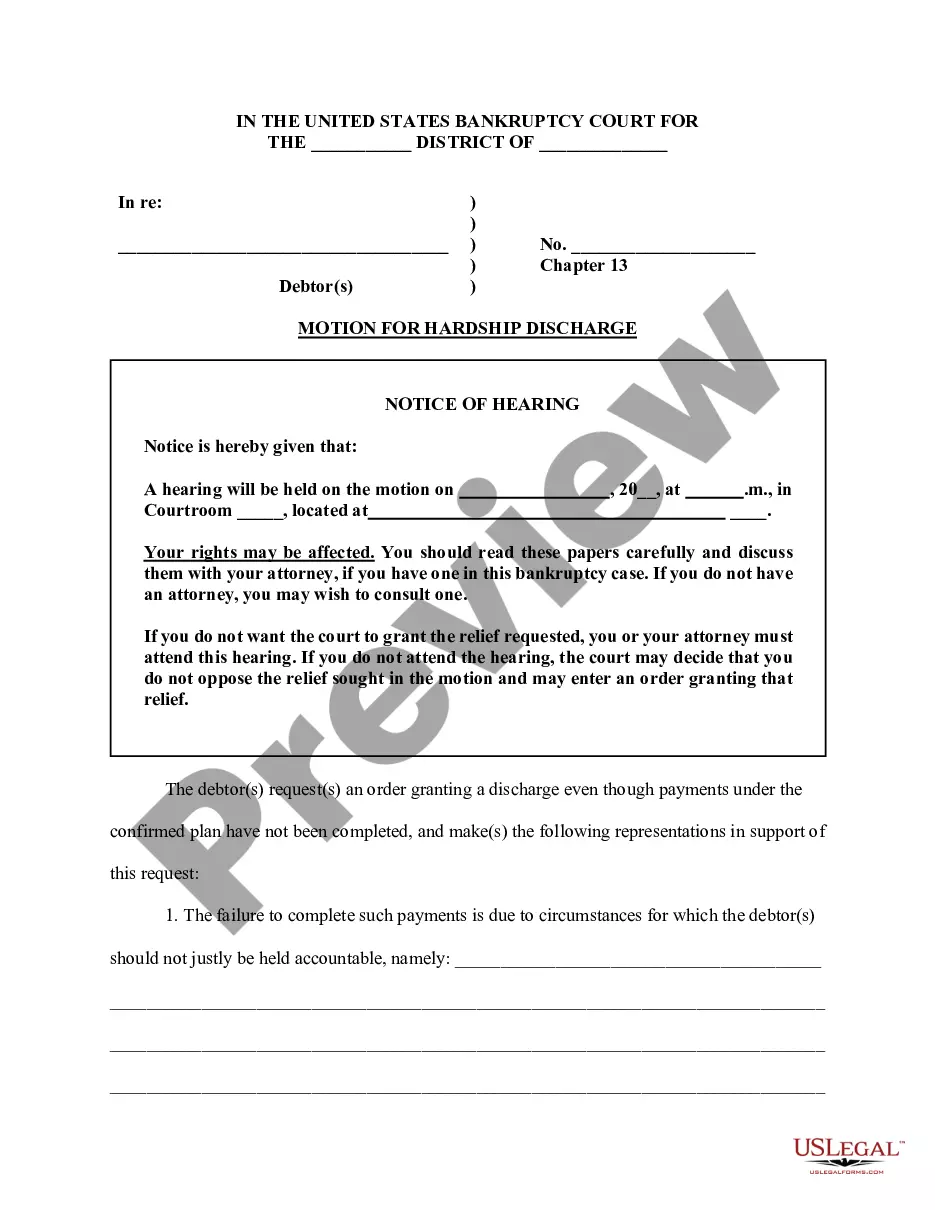
This form is used when a debtor, who has filed for Chapter 13 bankruptcy, cannot fulfill the payment plan due to undue hardship. Situations may include job loss, medical emergencies, or other financial setbacks that disrupt the debtor's ability to keep up with the agreed payments. By filing this motion and obtaining an order for hardship discharge, the debtor may have their debts discharged without completing the full payment plan.
Who needs this form
- Debtors currently under a Chapter 13 bankruptcy plan.
- Individuals experiencing financial hardship that prevents them from completing their payment obligations.
- Those who have already discussed their situation with their attorney and have determined that a hardship discharge is appropriate.
How to prepare this document
- Fill in the name of the District Court in the appropriate fields.
- Include the case number and chapter of bankruptcy at the top of the form.
- After the court hearing, note the findings that justify the hardship discharge.
- Specify the required financial management course completion details.
- Have the Bankruptcy Judge sign and date the order before filing.
Is notarization required?
This form does not typically require notarization unless specified by local law. It's always best to verify whether your particular jurisdiction requires any additional verification for this type of document.
Get your form ready online
Our built-in tools help you complete, sign, share, and store your documents in one place.
Make edits, fill in missing information, and update formatting in US Legal Forms—just like you would in MS Word.
Download a copy, print it, send it by email, or mail it via USPS—whatever works best for your next step.
Sign and collect signatures with our SignNow integration. Send to multiple recipients, set reminders, and more. Go Premium to unlock E-Sign.
If this form requires notarization, complete it online through a secure video call—no need to meet a notary in person or wait for an appointment.
We protect your documents and personal data by following strict security and privacy standards.

Make edits, fill in missing information, and update formatting in US Legal Forms—just like you would in MS Word.

Download a copy, print it, send it by email, or mail it via USPS—whatever works best for your next step.

Sign and collect signatures with our SignNow integration. Send to multiple recipients, set reminders, and more. Go Premium to unlock E-Sign.

If this form requires notarization, complete it online through a secure video call—no need to meet a notary in person or wait for an appointment.

We protect your documents and personal data by following strict security and privacy standards.
Mistakes to watch out for
- Failing to provide sufficient evidence of hardship circumstances.
- Not filing the statement of course completion within the 20-day deadline.
- Neglecting to verify if additional local court requirements apply.
Why use this form online
- Convenience of downloading and completing the form at your own pace.
- Immediate access to necessary legal templates without needing to visit a law office.
- Editable formats allow for easy adjustments based on your situation.
Legal use & context
- This form is legally binding upon being signed by the Bankruptcy Judge.
- It allows for a discharge of debts under specific circumstances without completing a payment plan.
- Understanding the legal context can help in future financial planning and responsibilities.
What to keep in mind
- The Order Granting Motion for Hardship Discharge is essential for debtors facing insurmountable financial difficulties.
- Ensure compliance with all requirements for the course and timely filing to avoid case dismissal.
- Seek legal advice if uncertain about proceeding with this form.
Looking for another form?

Form popularity
FAQ
About 45 days after you've received your discharge, you will receive a document called a Final Decree. It's the document that officially closes your case. Once this document is received, you are no longer in bankruptcy.
The discharge releases the debtor from all debts provided for by the plan or disallowed (under section 502), with limited exceptions. Creditors provided for in full or in part under the chapter 13 plan may no longer initiate or continue any legal or other action against the debtor to collect the discharged obligations.
It's designed so you'll pay the amount you can afford. Therefore, the court will only let you complete your Chapter 13 bankruptcy early under two conditions: You can pay all of your claims, including unsecured debts, in full, or you can prove a financial hardship.
For most filers, a Chapter 7 case will end when you receive your discharge?the order that forgives qualified debt?about four to six months after filing the bankruptcy paperwork.
Terminology can get confusing because "hardship" and "dependency" discharges are often both loosely labeled "hardship." Specifically, a hardship discharge is when the financial needs of family member(s) require more than the military member can provide while remaining in the military.
The bankruptcy trustee will typically be entitled to claim any non-exempt portion of the settlement and distribute it to creditors.
An "Adversary Proceeding" in bankruptcy court has the same meaning as a lawsuit in other courts. This means that one or more "plaintiff(s)" file a "complaint" against one or more "defendant(s)." In many situations an adversary proceeding is required if a plaintiff wants to obtain a particular type of relief.
Since a chapter 12 or chapter 13 plan may provide for payments to be made over three to five years, the discharge typically occurs about four years after the date of filing.