Order granting motion for hardship discharge - Form 23 filed
Overview of this form
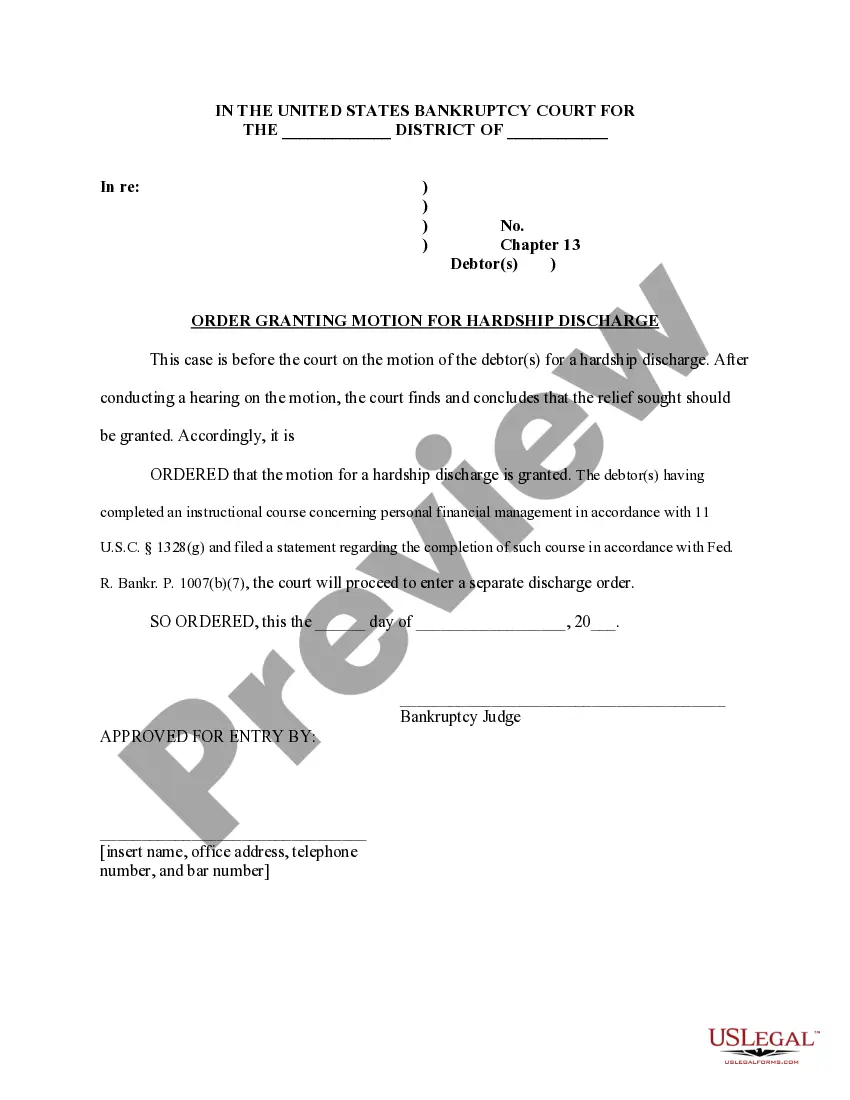
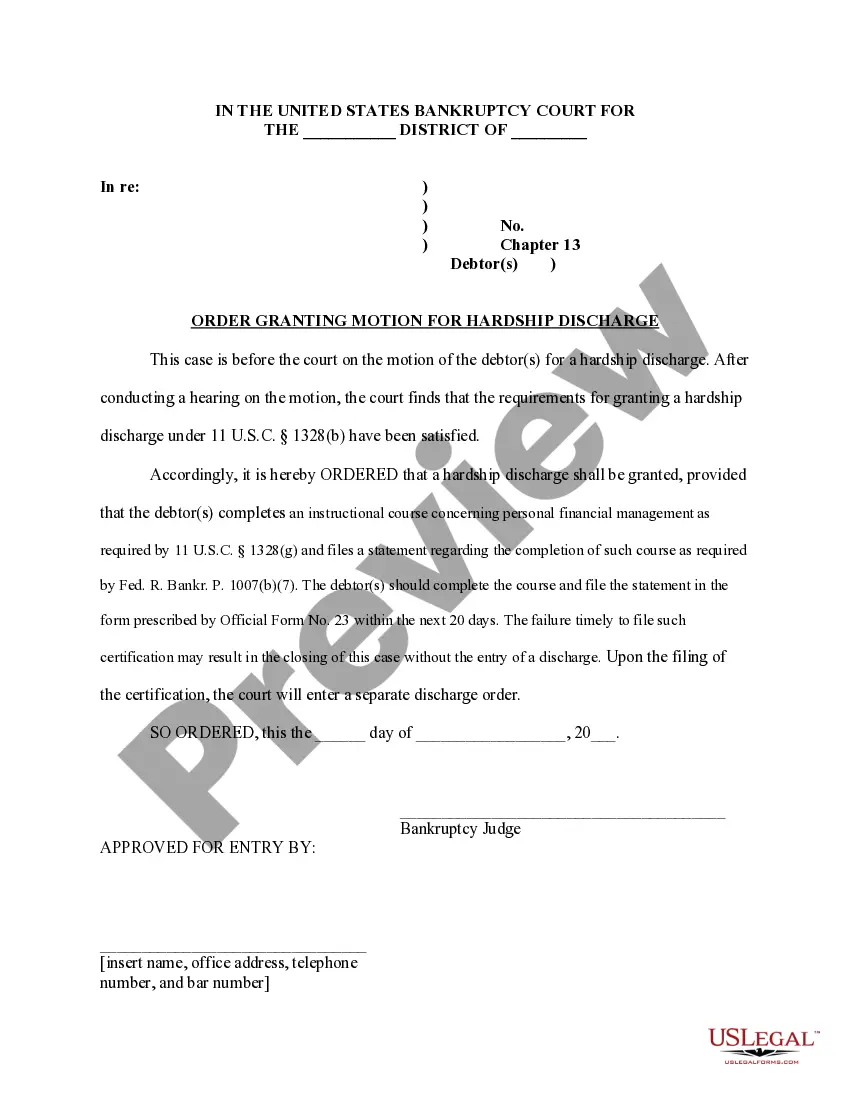
The Order granting motion for hardship discharge is a legal document used in Chapter 13 bankruptcy cases. This order provides a discharge from debts for individuals who can demonstrate that continuing with their repayment plan is no longer feasible due to unforeseen circumstances, such as job loss or medical emergencies. Unlike standard discharges, this order is specifically tailored for individuals facing genuine hardship, allowing them to move forward financially while adhering to legal protocols.
What’s included in this form
- Case information, including the bankruptcy court district and case number.
- Identification of the debtor(s) involved in the bankruptcy proceedings.
- Findings and conclusions of the court regarding the hardship discharge.
- Confirmation of completion of an instructional course on financial management.
- Signature line for the bankruptcy judge, indicating judicial approval.
Situations where this form applies
This form is necessary when a debtor in Chapter 13 bankruptcy wishes to request a hardship discharge due to circumstances that prevent them from completing their repayment plan. Situations such as significant medical expenses, loss of employment, or other financial difficulties may warrant the use of this form. It is crucial to file this order after attending a hearing where the court assesses the merits of the hardship claim.
Who this form is for
This form is intended for:
- Debtors who have filed for Chapter 13 bankruptcy and are unable to maintain their repayment plan.
- Individuals who can substantiate their claim of financial hardship to the bankruptcy court.
- Those who have completed the required financial management course as mandated by law.
Instructions for completing this form
- Enter the relevant bankruptcy court district and case number at the top of the form.
- Fill in the names of the debtor(s) involved in the case.
- Provide details regarding the hearing, including the date and findings of the court.
- Confirm completion of the financial management course by including relevant details as required.
- Have the bankruptcy judge sign the order to finalize the motion granting hardship discharge.
Notarization requirements for this form
This form does not typically require notarization unless specified by local law. It is advisable to check local requirements to ensure all legal aspects are covered during the submission process.
Get your form ready online
Our built-in tools help you complete, sign, share, and store your documents in one place.
Make edits, fill in missing information, and update formatting in US Legal Forms—just like you would in MS Word.
Download a copy, print it, send it by email, or mail it via USPS—whatever works best for your next step.
Sign and collect signatures with our SignNow integration. Send to multiple recipients, set reminders, and more. Go Premium to unlock E-Sign.
If this form requires notarization, complete it online through a secure video call—no need to meet a notary in person or wait for an appointment.
We protect your documents and personal data by following strict security and privacy standards.

Make edits, fill in missing information, and update formatting in US Legal Forms—just like you would in MS Word.

Download a copy, print it, send it by email, or mail it via USPS—whatever works best for your next step.

Sign and collect signatures with our SignNow integration. Send to multiple recipients, set reminders, and more. Go Premium to unlock E-Sign.

If this form requires notarization, complete it online through a secure video call—no need to meet a notary in person or wait for an appointment.

We protect your documents and personal data by following strict security and privacy standards.
Avoid these common issues
- Failing to properly fill out the debtor's information, leading to confusion during review.
- Not attending the court hearing, which is necessary for a valid discharge request.
- Omitting proof of completion of the financial management course.
Why complete this form online
- Convenient access to templates anytime, allowing for flexibility in preparation.
- Editable forms that can be customized to meet specific individual needs.
- Reliable legal documentation drafted by licensed attorneys, ensuring compliance with legal standards.
Main things to remember
- The Order granting motion for hardship discharge is essential for Chapter 13 debtors facing financial obstacles.
- It provides a legal avenue to discharge debts when a payment plan cannot be completed due to unforeseen hardships.
- Accurate completion and adherence to local court rules are vital for successful approval.
Looking for another form?


Form popularity
FAQ
An example of a Hardship Discharge would be if you are married and have children, but your spouse dies, leaving you to the sole parent to children. What is this? In this case, your kids' care takes priority, and the military will grant a Hardship Discharge because it is convenient for the government.
Counselors at the GI Rights Hotline have helped many people in the military get honorably discharged for hardship/dependency. Usually within 4-10 weeks after applying, people are free from their military obligations and able to help their family members.
The bankruptcy trustee will typically be entitled to claim any non-exempt portion of the settlement and distribute it to creditors.
An individual receives a discharge for most of his or her debts in a chapter 7 bankruptcy case. A creditor may no longer initiate or continue any legal or other action against the debtor to collect a discharged debt. But not all of an individual's debts are discharged in chapter 7.
To obtain the hardship discharge the debtor must first show an inability to continue making the scheduled Chapter 13 plan payments. In other words, something has happened to you financially that reduced your income or ability to pay your creditors. The change in finances must be beyond the debtor's control.
Some examples of dischargeable debts in Chapter 13 include credit card debt, medical bills, utility bills, and personal loans. Unsecured Debts ? Unsecured debts are not linked to any collateral, such as utility bills and medical bills.
The discharge is a permanent order prohibiting the creditors of the debtor from taking any form of collection action on discharged debts, including legal action and communications with the debtor, such as telephone calls, letters, and personal contacts.
Terminology can get confusing because "hardship" and "dependency" discharges are often both loosely labeled "hardship." Specifically, a hardship discharge is when the financial needs of family member(s) require more than the military member can provide while remaining in the military.