Kansas Warranty Deed for Husband and Wife Converting Property from Tenants in Common to Joint Tenancy
About this form
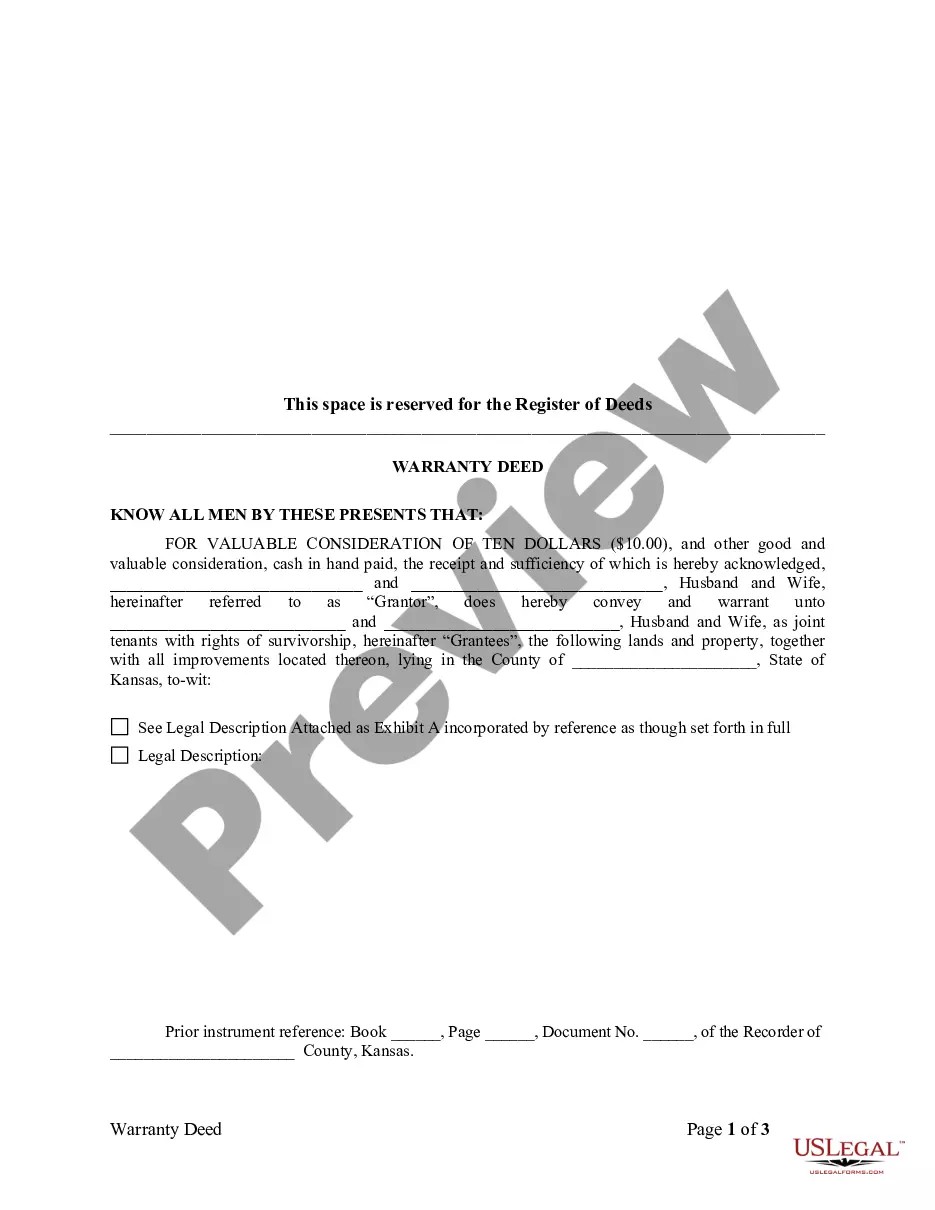
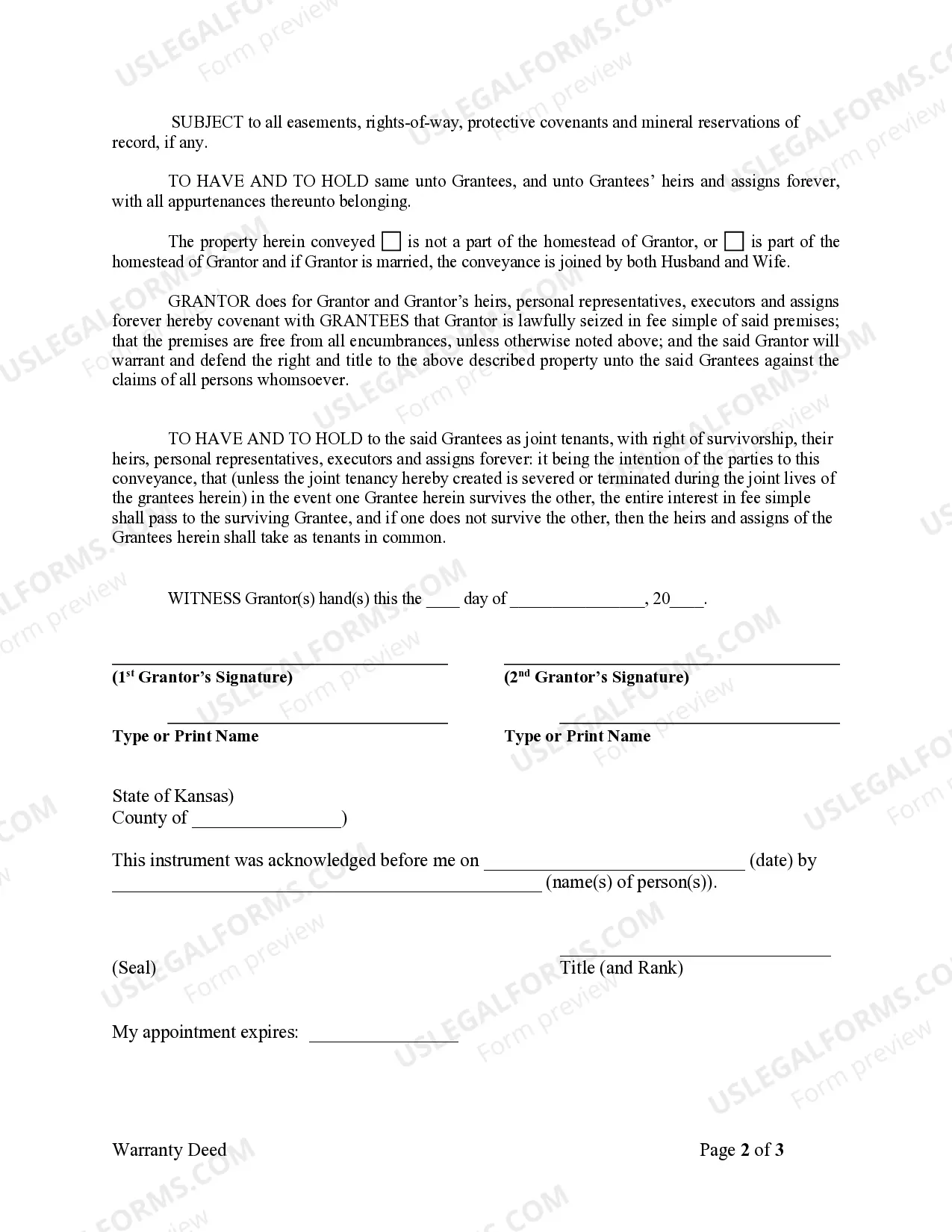
This Warranty Deed for Husband and Wife converting property from tenants in common to joint tenancy is a legal document used to transfer ownership of property. It enables a husband and wife to change their property holding status from tenants in common, where they each own a separate share, to joint tenants, where they own the property together with rights of survivorship. This form ensures that if one spouse passes away, the surviving spouse automatically inherits the property, avoiding lengthy probate processes. This form is important for couples looking to simplify inheritance and property rights.
Key components of this form
- Names of the grantors (husband and wife) and grantees (also husband and wife)
- Full legal description of the property being conveyed
- Statement of the nature of the current ownership (tenants in common)
- Covenants and warranties of the grantors regarding property title
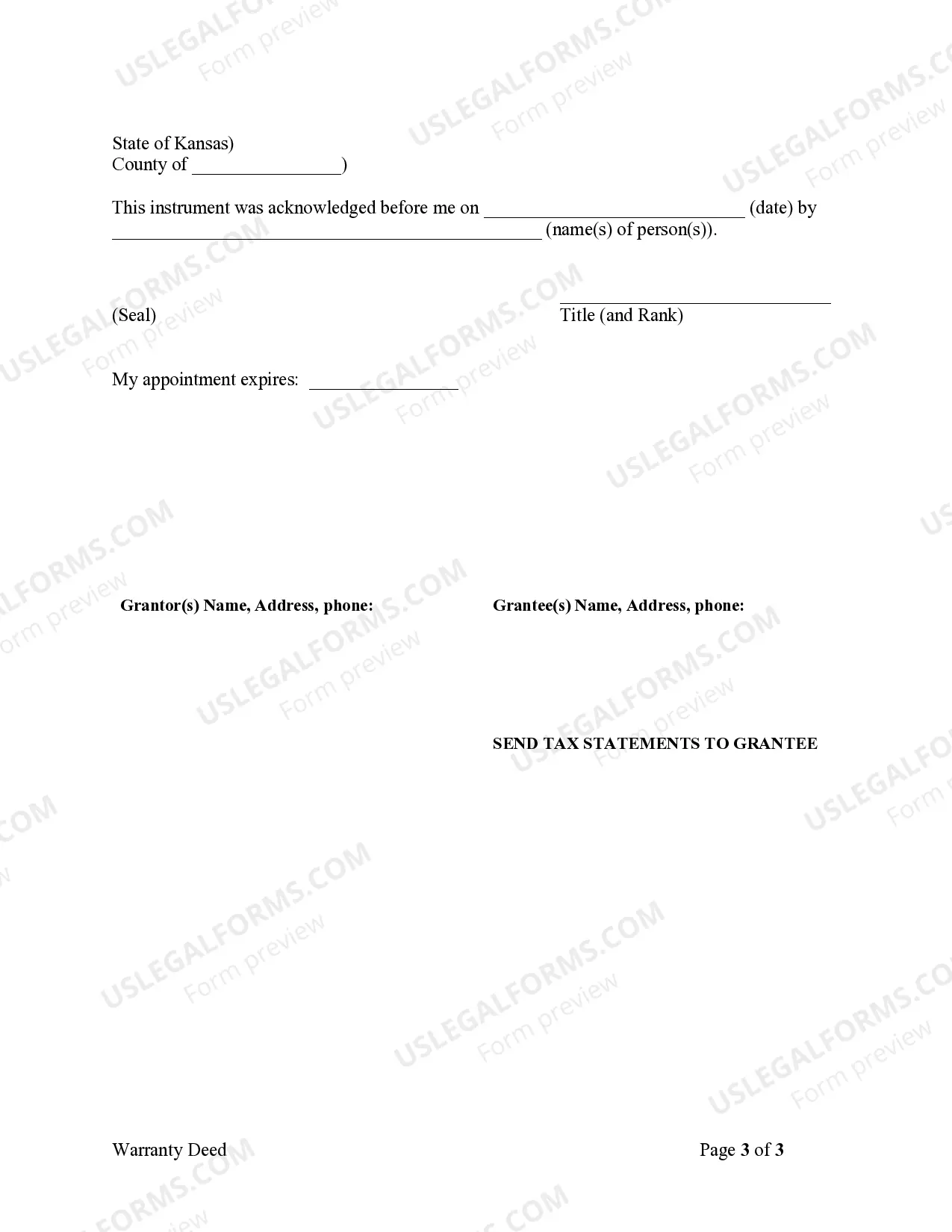
- Notary acknowledgment for the grantors' signatures





When to use this form
This form should be used when a married couple currently holds property as tenants in common and wishes to convert that ownership to joint tenancy. This situation often arises when couples want to ensure that their property will automatically pass to the surviving spouse upon death, simplifying the transfer of property and potentially avoiding probate court. It can be utilized during estate planning or anytime a couple decides to update their property ownership arrangement.
Who can use this document
- Married couples who currently own property as tenants in common
- Couples looking to change their property ownership to joint tenancy
- Individuals seeking to simplify the inheritance process for their spouse
- Those who want to ensure full rights of survivorship in property ownership
Instructions for completing this form
- Identify the grantors and grantees, making sure to include both spouses' full names.
- Provide a complete legal description of the property, ensuring accuracy.
- Indicate whether the property is part of the homestead of the grantors.
- Include the date of acknowledgment and secure a notary's signature.
- Ensure all parties sign where required to complete the transfer.
Is notarization required?
Yes, this form must be notarized to be legally valid. Notarization ensures that the identities of the grantors are verified and that the signatures are authentic. US Legal Forms offers integrated online notarization services, available 24/7 through secure video calls, making the process convenient and ensuring legal equivalence without the need to travel.
Get your form ready online
Our built-in tools help you complete, sign, share, and store your documents in one place.
Make edits, fill in missing information, and update formatting in US Legal Forms—just like you would in MS Word.
Download a copy, print it, send it by email, or mail it via USPS—whatever works best for your next step.
Sign and collect signatures with our SignNow integration. Send to multiple recipients, set reminders, and more. Go Premium to unlock E-Sign.
If this form requires notarization, complete it online through a secure video call—no need to meet a notary in person or wait for an appointment.
We protect your documents and personal data by following strict security and privacy standards.

Make edits, fill in missing information, and update formatting in US Legal Forms—just like you would in MS Word.

Download a copy, print it, send it by email, or mail it via USPS—whatever works best for your next step.

Sign and collect signatures with our SignNow integration. Send to multiple recipients, set reminders, and more. Go Premium to unlock E-Sign.

If this form requires notarization, complete it online through a secure video call—no need to meet a notary in person or wait for an appointment.

We protect your documents and personal data by following strict security and privacy standards.
Common mistakes to avoid
- Failing to enter an accurate legal description of the property.
- Not having both spouses sign the deed if the property is classified as a homestead.
- Leaving out the notary acknowledgment, which is essential for validity.
Why use this form online
- Quick and easy access to legal forms without the need for an appointment.
- Editability allows users to customize the form to fit their specific needs.
- Reliable templates drafted by licensed attorneys, ensuring compliance with legal standards.
Looking for another form?
Form popularity
FAQ
Change from joint tenants to tenants in common You can make this change without the other owners' agreement. A solicitor, conveyancer or legal executive can also make the application for you.
The term joint tenants in common (JTIC) refers to a legal relationship in which two or more people own a piece of property or another asset where no rights of survivorship are afforded to any of the account holders. If one owner dies, the surviving owner doesn't necessarily acquire the rights of the deceased owner.
In order to terminate a joint tenancy, one of the four unities must be destroyed. You may do this by conveying your joint tenancy interest to any third person. This can be done through gift or sale. Upon termination, a tenancy in common is formed between the third person and the remaining co-tenant(s).
It would be simple for us to say that you can simply record a new document putting both of you onto title to the home as joint tenants with rights of survivorship. Usually, when you make a simple change in the title from tenants in common to joint tenants, the taxing authorities will ignore that change.
You may agree with your other co-tenant(s) to sever it. If you cannot agree on how to divide the property, you may terminate your tenancy in common by seeking judicial partition of the property.
Change from tenants in common to joint tenantsYou need the agreement of all the other joint owners to change from being tenants in common to joint tenants. A solicitor, conveyancer or legal executive can also make the application for you.
Sole Ownership If a home is owned by only one person then it is not registered with the Land Registry as either Joint Tenants or Tenants in Common. It is registered as a Sole Owner, you can only be a joint tenant or tenant in common if there is more than one owner of the property.
With a Survivorship Deed in place, when one of the parties in a joint tenancy dies, the other party (or parties) takes over the deceased party's interest in the property instead of it passing to the deceased's heirs or beneficiaries.
A third way to terminate your tenancy in common is through ouster. Ouster is the wrongful dispossession or exclusion of a person entitled to possession of property.Ousting a co-tenant will terminate the tenancy in common.