Indiana Inventory and Condition of Leased Premises for Pre Lease and Post Lease
Understanding this form
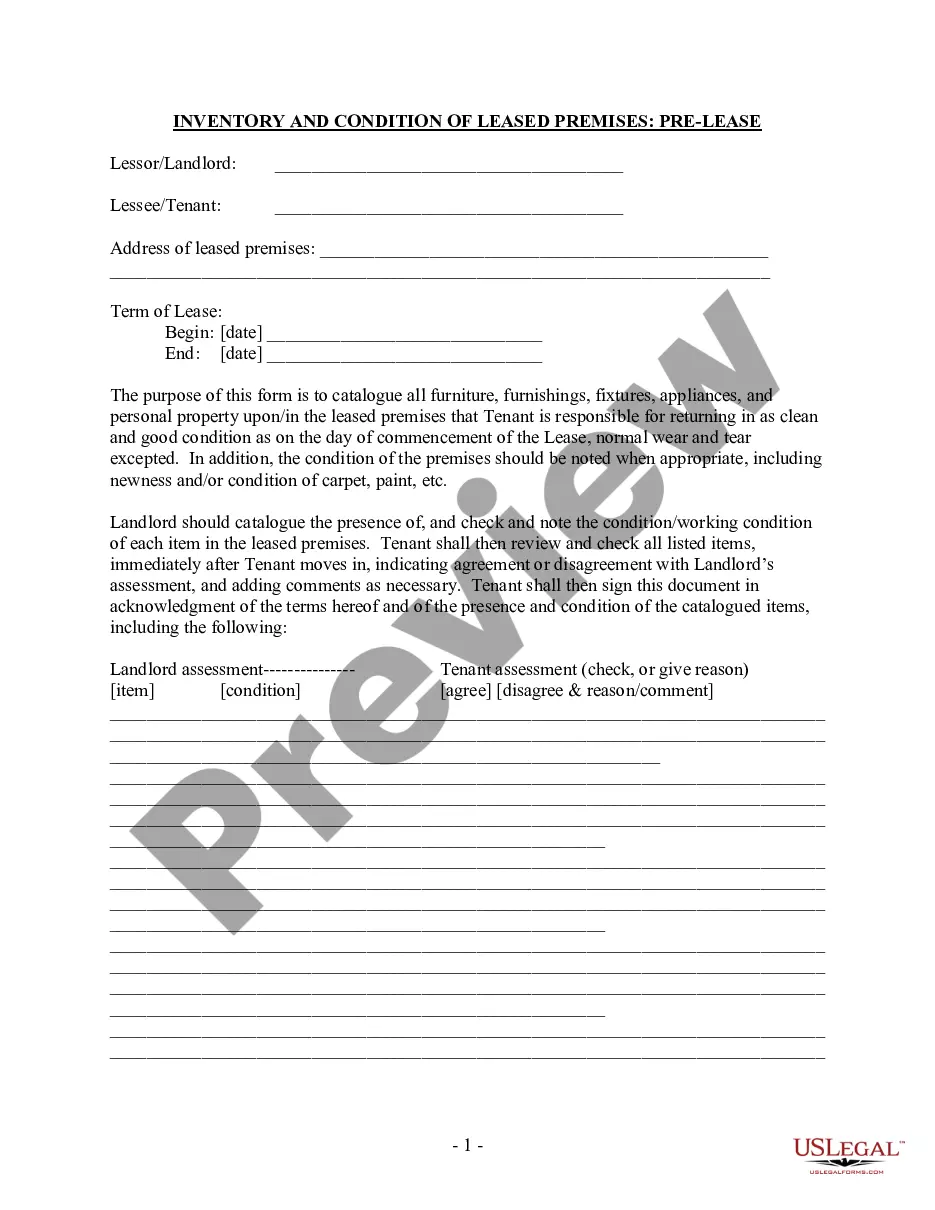
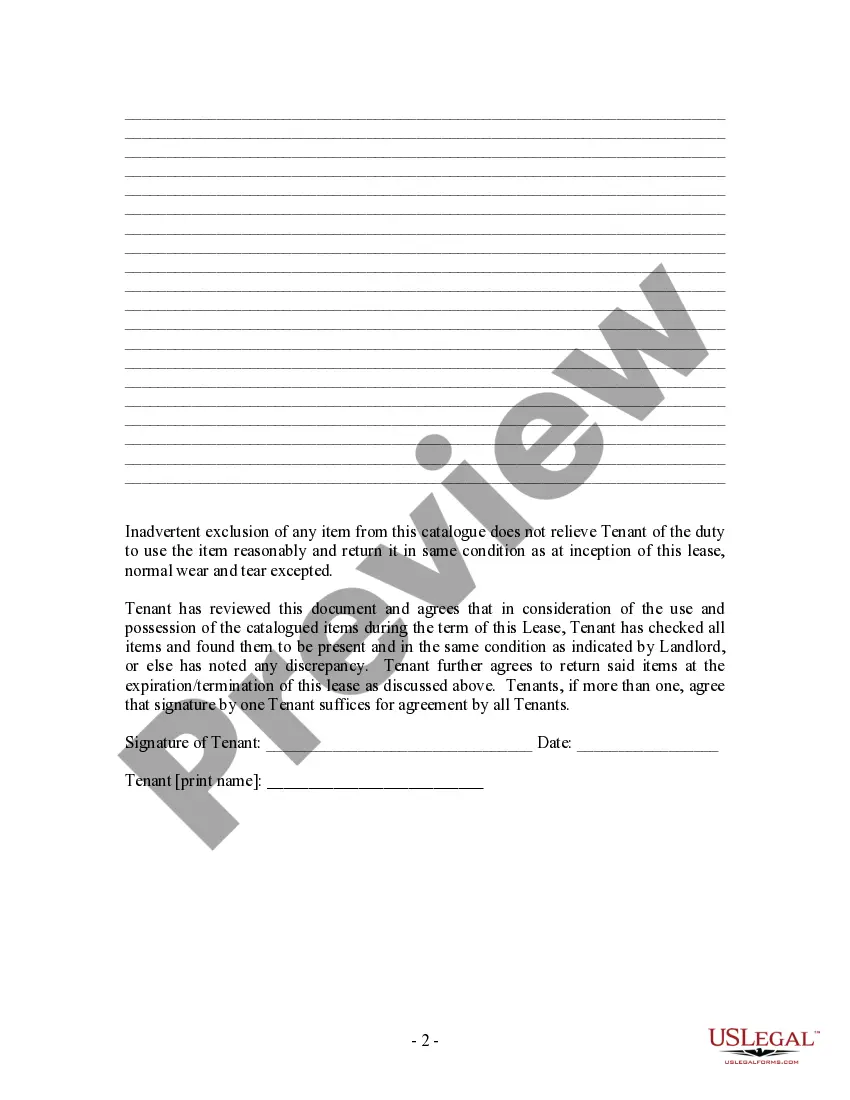
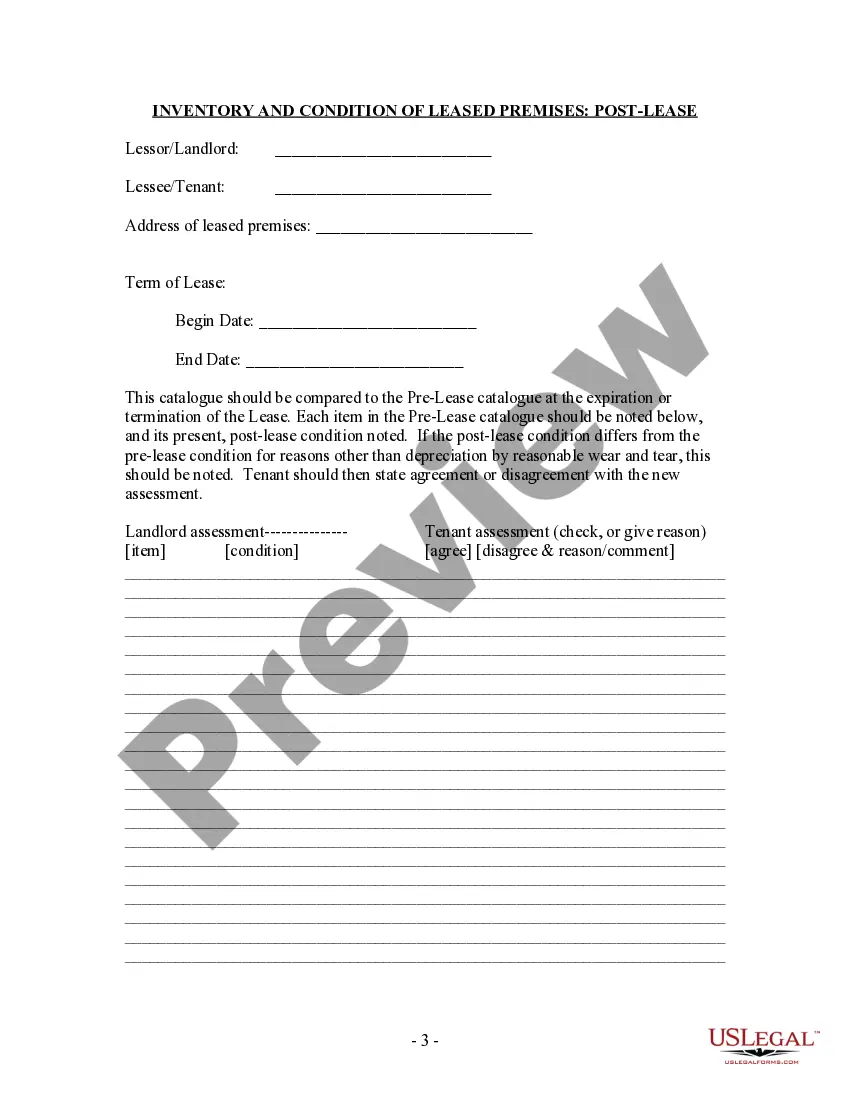
The Inventory and Condition of Leased Premises for Pre Lease and Post Lease is a legal document that helps tenants and landlords record the condition of rental property both before and after the lease term. This form includes a detailed inventory of all furniture, fixtures, and appliances present in the leased premises. It serves to protect both parties by documenting the state of these items, facilitating a clear understanding of any damages or normal wear upon lease termination.
Main sections of this form
- Identification of parties involved: Lessor/Landlord and Lessee/Tenant.
- Address of the leased premises and lease term start and end dates.
- Detailed inventory listing furniture, fixtures, and appliances present in the property.
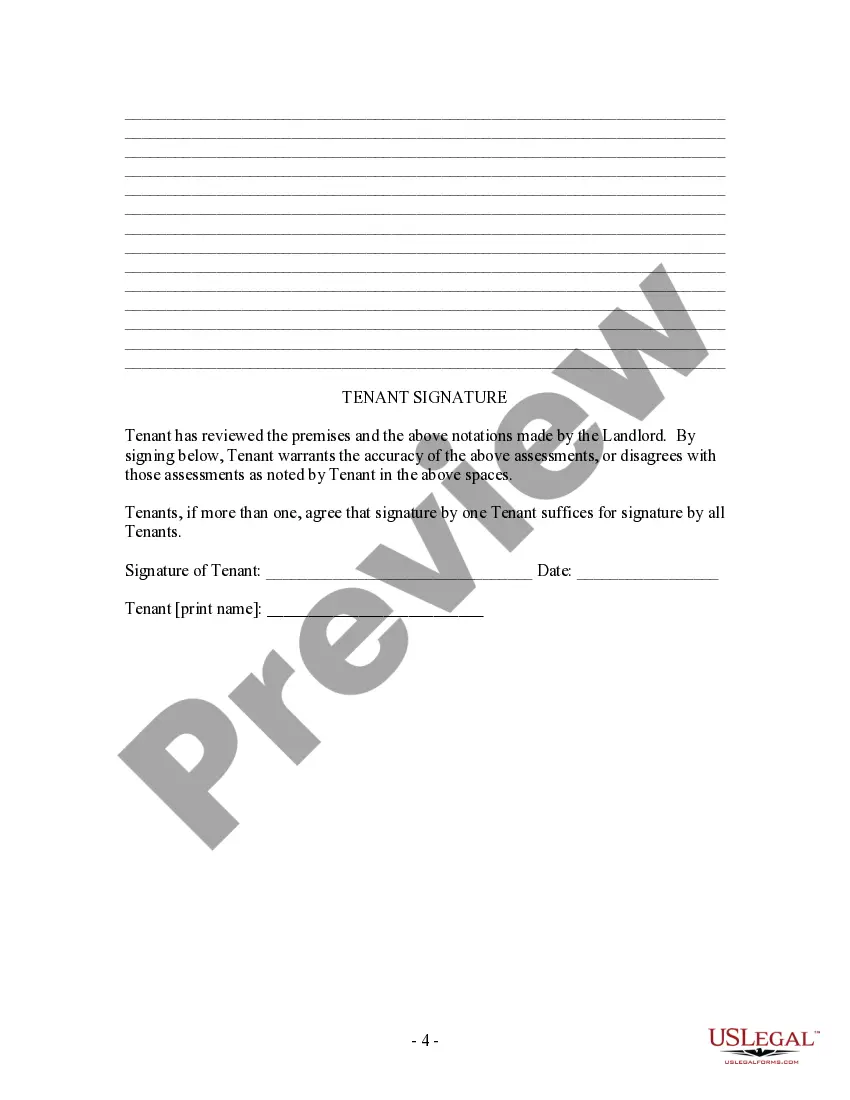
- Assessment of the condition of each item, with space for agreement or disagreement.
- A section for comments or reasons for disagreement with the landlord's assessment.
- A post-lease assessment comparing pre-lease and post-lease conditions.
When this form is needed
This form should be used during the move-in and move-out process of a rental property. It is crucial for tenants to document the condition of the premises and items upon moving in and before moving out. Using this form can help prevent disputes regarding the security deposit and provide a clear record of any issues present at the beginning of the lease term versus those at its conclusion.
Who should use this form
- Tenants renting residential or commercial properties.
- Landlords or property managers overseeing rental properties.
- Real estate professionals involved in lease agreements.
- Anyone seeking to protect their interests regarding leased items.
Instructions for completing this form
- Identify the parties by entering the names of the landlord and tenant.
- Specify the address of the leased premises and the term of the lease, including start and end dates.
- List all furniture, fixtures, and appliances in the provided inventory section with their conditions.
- Have both parties review and agree upon the condition assessments, indicating agreement or disagreement.
- Ensure that both parties sign the document to acknowledge their assessments at both pre-lease and post-lease stages.
Does this document require notarization?
This form does not typically require notarization to be legally valid. However, some jurisdictions or document types may still require it. US Legal Forms provides secure online notarization powered by Notarize, available 24/7 for added convenience.
Get your form ready online
Our built-in tools help you complete, sign, share, and store your documents in one place.
Make edits, fill in missing information, and update formatting in US Legal Forms—just like you would in MS Word.
Download a copy, print it, send it by email, or mail it via USPS—whatever works best for your next step.
Sign and collect signatures with our SignNow integration. Send to multiple recipients, set reminders, and more. Go Premium to unlock E-Sign.
If this form requires notarization, complete it online through a secure video call—no need to meet a notary in person or wait for an appointment.
We protect your documents and personal data by following strict security and privacy standards.

Make edits, fill in missing information, and update formatting in US Legal Forms—just like you would in MS Word.

Download a copy, print it, send it by email, or mail it via USPS—whatever works best for your next step.

Sign and collect signatures with our SignNow integration. Send to multiple recipients, set reminders, and more. Go Premium to unlock E-Sign.

If this form requires notarization, complete it online through a secure video call—no need to meet a notary in person or wait for an appointment.

We protect your documents and personal data by following strict security and privacy standards.
Typical mistakes to avoid
- Failing to complete the inventory thoroughly, leaving out visible items.
- Not documenting the condition of items accurately, leading to disputes later.
- Both parties not signing the form, which can invalidate the agreement.
- Overlooking the importance of comparing post-lease conditions to the pre-lease inventory.
Benefits of using this form online
- Quick access to a professionally drafted legal template, saving time and effort.
- Easy editing and customization to fit specific rental situations.
- Secure download options to keep track of your documents.
- Immediate availability eliminates the need for in-person meetings or appointments.
Legal use & context
- Helps establish proof of condition to support claims for security deposit returns.
- Can be used in legal disputes to demonstrate the agreed-upon state of the property.
- Encourages transparency and accountability between landlords and tenants.
Summary of main points
- The Inventory and Condition of Leased Premises form is essential for documenting the state of rental property.
- Using this form can prevent future disputes about property condition and security deposits.
- Both the tenant and landlord should carefully review and sign the document at both the start and end of the lease term.
Looking for another form?
Form popularity
FAQ
The living will. Durable power of attorney for health care/Medical power of attorney. POLST (Physician Orders for Life-Sustaining Treatment) Do not resuscitate (DNR) orders. Organ and tissue donation.
The DNR guides Emergency Medical Service (EMS) providers and can give EMS permission not to perform cardiopulmonary resuscitation (CPR), whereas a POLST might include a DNR instruction regarding CPR, but provides more instructions regarding additional medical interventions.
The California POLST form is valid in California. If you are traveling to another state, it is a good idea to take both your Advance Directive and your POLST form with you. Both documents, even if not legally binding, will help health care providers know your wishes. How can I find out more about POLST?
A Physician Orders for Scope of Treatment (POST) is a set of medical instructions for health care professionals to recognize and honor a patient's treatment preferences for life-sustaining measures, such as CPR, a breathing tube and feeding tube.
Anyone who has a chronic or life-limiting illness or anyone with advanced age should consider having a POLST document.
The patient's physician must approve of a DNR, confirming the patient's condition by signing the DNR form. Aside from the patient's and physician's signatures, two (2) witnesses are required to make a DNR order valid. Required to Sign Patient, physician and two (2) witnesses.
A do-not-resuscitate order, or DNR order, is a medical order written by a doctor. It instructs health care providers not to do cardiopulmonary resuscitation (CPR) if a patient's breathing stops or if the patient's heart stops beating.
An advance directive is a direction from the patient, not a medical order. In contrast, a POLST form consists of a set of medical orders that applies to a limited population of patients and addresses a limited number of critical medical decisions.
Adults can legally refuse medical treatment, even if that leads to their death. But the medical profession is also clear that doctors cannot be required to give treatment against their clinical judgment, although they should offer patients the chance of a second opinion, if possible.