Idaho Essential Legal Life Documents for Newlyweds
What this form package covers
The Idaho Essential Legal Life Documents for Newlyweds form package provides a comprehensive set of legal documents tailored for newly married couples in Idaho. This package helps couples organize their legal life together and includes state-specific forms necessary for effective estate planning and financial management. By using this form package, newlyweds can ensure they are prepared for various life situations, distinguishing it from other generic legal document packages.
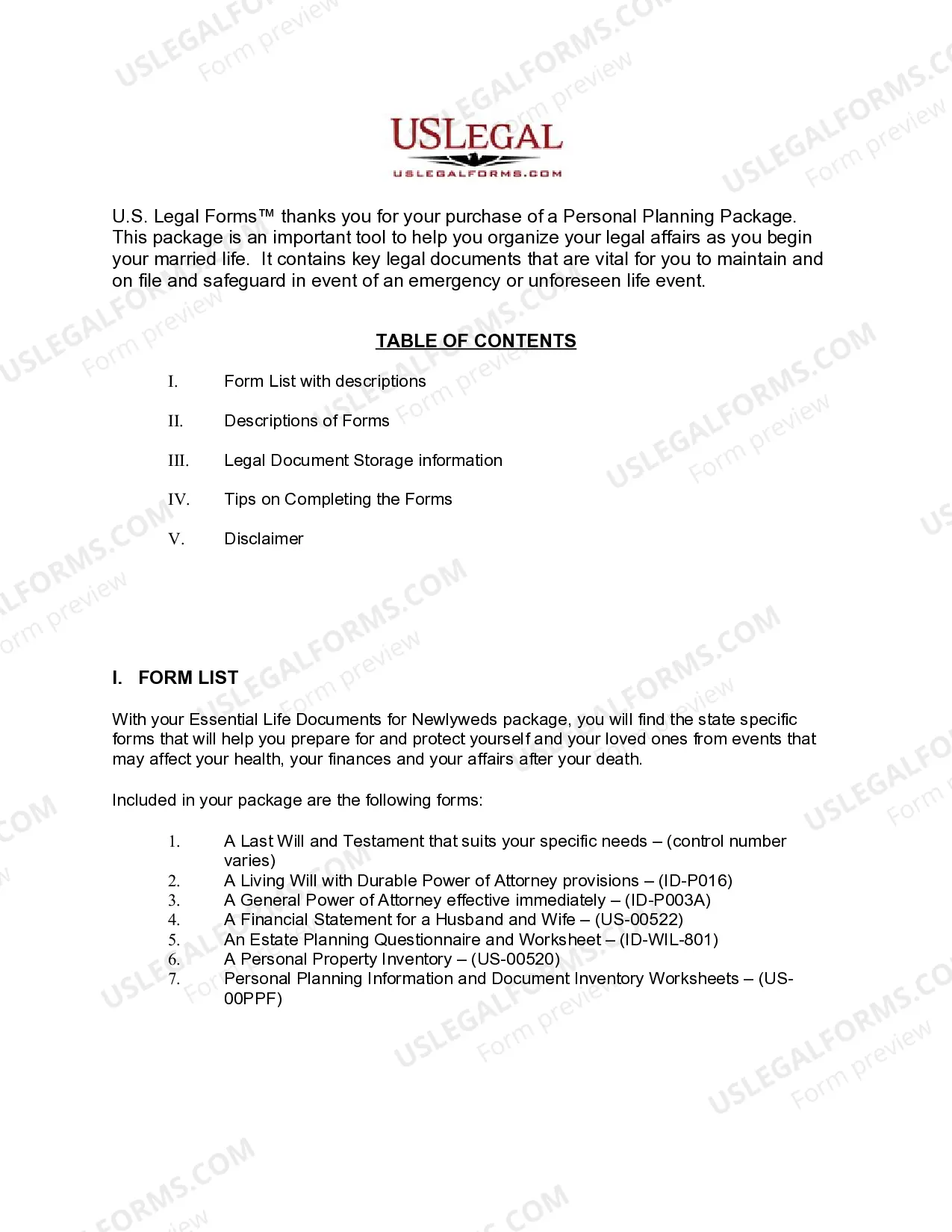
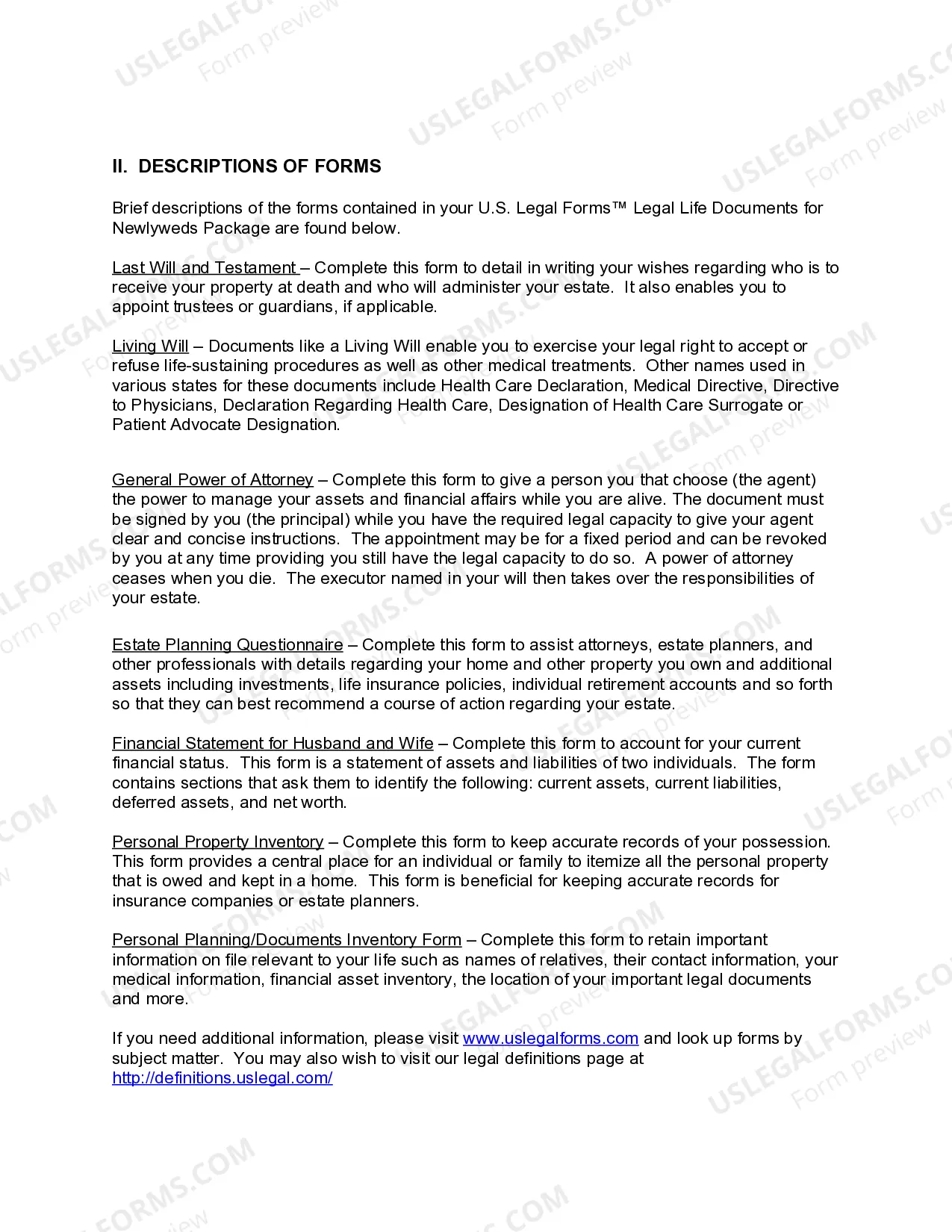
Forms included in this package
- General Durable Power of Attorney for Property and Finances or Financial Effective Immediately
- Statutory Living Will and Durable Power of Attorney for Health Care
- Estate Planning Questionnaire and Worksheets
- Personal Property Inventory
- Financial Statement Form - Husband and Wife Joint
- Personal Planning Information and Document Inventory Worksheets - A Legal Life Document



Situations where these forms applies
This form package is ideal for newlyweds who wish to establish their legal and financial framework as they begin their life together. Use this package when you need to:
- Create a Will to specify how your assets will be distributed after your passing.
- Outline your healthcare wishes through a Living Will.
- Designate a trusted individual to handle your financial matters with a General Power of Attorney.
- Prepare an estate plan to protect your loved ones.
- Document your financial status and personal property inventory.
Who this form package is for
- Newlyweds looking to secure their financial future.
- Couples interested in estate planning and organizing their legal documents.
- Individuals who want to ensure their healthcare and financial decisions are respected.
- Anyone in Idaho wishing to comply with state-specific legal requirements.
Steps to complete these forms
- Review the included forms to understand their purposes and requirements.
- Complete the Will by specifying your asset distribution wishes.
- Fill out the Living Will to clarify your healthcare decisions.
- Designate an agent by filling out the General Power of Attorney, ensuring you have the necessary information.
- Make a comprehensive financial statement to assess your current financial situation.
- Compile an inventory of personal property and important documents using the provided worksheets.
Notarization details for included forms
Forms in this package typically do not require notarization unless required by local law. However, it is important to review each document carefully to determine any specific notarization requirements in Idaho. US Legal Forms also offers integrated online notarization services for added convenience and security.
Get your form ready online
Our built-in tools help you complete, sign, share, and store your documents in one place.
Make edits, fill in missing information, and update formatting in US Legal Forms—just like you would in MS Word.
Download a copy, print it, send it by email, or mail it via USPS—whatever works best for your next step.
Sign and collect signatures with our SignNow integration. Send to multiple recipients, set reminders, and more. Go Premium to unlock E-Sign.
If this form requires notarization, complete it online through a secure video call—no need to meet a notary in person or wait for an appointment.
We protect your documents and personal data by following strict security and privacy standards.

Make edits, fill in missing information, and update formatting in US Legal Forms—just like you would in MS Word.

Download a copy, print it, send it by email, or mail it via USPS—whatever works best for your next step.

Sign and collect signatures with our SignNow integration. Send to multiple recipients, set reminders, and more. Go Premium to unlock E-Sign.

If this form requires notarization, complete it online through a secure video call—no need to meet a notary in person or wait for an appointment.

We protect your documents and personal data by following strict security and privacy standards.
Common mistakes
- Failing to sign documents in the presence of required witnesses.
- Not keeping copies of completed forms in a safe place.
- Neglecting to update your Will following significant life events.
- Forgetting to review changes in laws that may impact your documents.
Why complete this package online
- Convenience of downloading and filling out forms at your own pace.
- Editable forms allow you to customize documents to fit your unique situation.
- Access to reliable legal documents drafted by licensed attorneys.
- Cost savings of up to 40% compared to purchasing forms separately.
Summary of main points
- This form package provides essential legal documents for newlyweds in Idaho.
- It includes a will, living will, powers of attorney, financial statements, and more.
- Documents are tailored to meet Idaho's legal requirements.
- Using this package can enhance your and your spouseâs legal preparedness significantly.
Looking for another form?


Form popularity
FAQ
If each spouse has their own Will, California law allows them to make new Wills after the divorce has been filed and creating the new Will does not violate the Automatic Temporary Restraining Order (ATRO) against changing beneficiaries, selling assets, etc. during a California divorce.
Your Marital Rights right to receive marriage or family rate on health, car and/or liability insurance. right to inherit spouse's property upon death. right to sue for spouse's wrongful death or loss of consortium, and. right to receive spouse's Social Security, pension, worker's compensation, or disability
Will. Revocable Trust. Financial Power of Attorney. Durable Power of Attorney for Healthcare.
The reality is, however, that both you and your spouse should each have your own will, and it should be planned as soon as possible. Some couples think that they can have one joint will together, but this is not a sound approach.
Making one will for two people is usually not advisable because it's irrevocable after the first spouse's death.Even though married couples often have the same goals in mind when making their estate plan, most attorneys advise against joint wills.
Guardianship Documents. Health Care Power of Attorney. Financial Power of Attorney. Living Will. Last Will and Testament. U.S. Legal Services Can Help!
Living will and health-care proxy. These are two different forms, but they serve similar purposes. Will. Durable power of attorney. Estate plan. Home or renter's insurance. Brokerage statements. Credit report. A financial manifesto for couples.
Joint wills are usually created by married couples. They often state that: After one spouse has died, all the couple's property will be left to the surviving spouse; and. After the surviving spouse dies, the remaining property will be left to the couple's children.
Idaho law recognizes handwritten wills, referred to as holographic wills. Material provisions of the will and the signature must be in the handwriting of the person making the will.