Iowa Quitclaim Deed from Corporation to Corporation
About this form
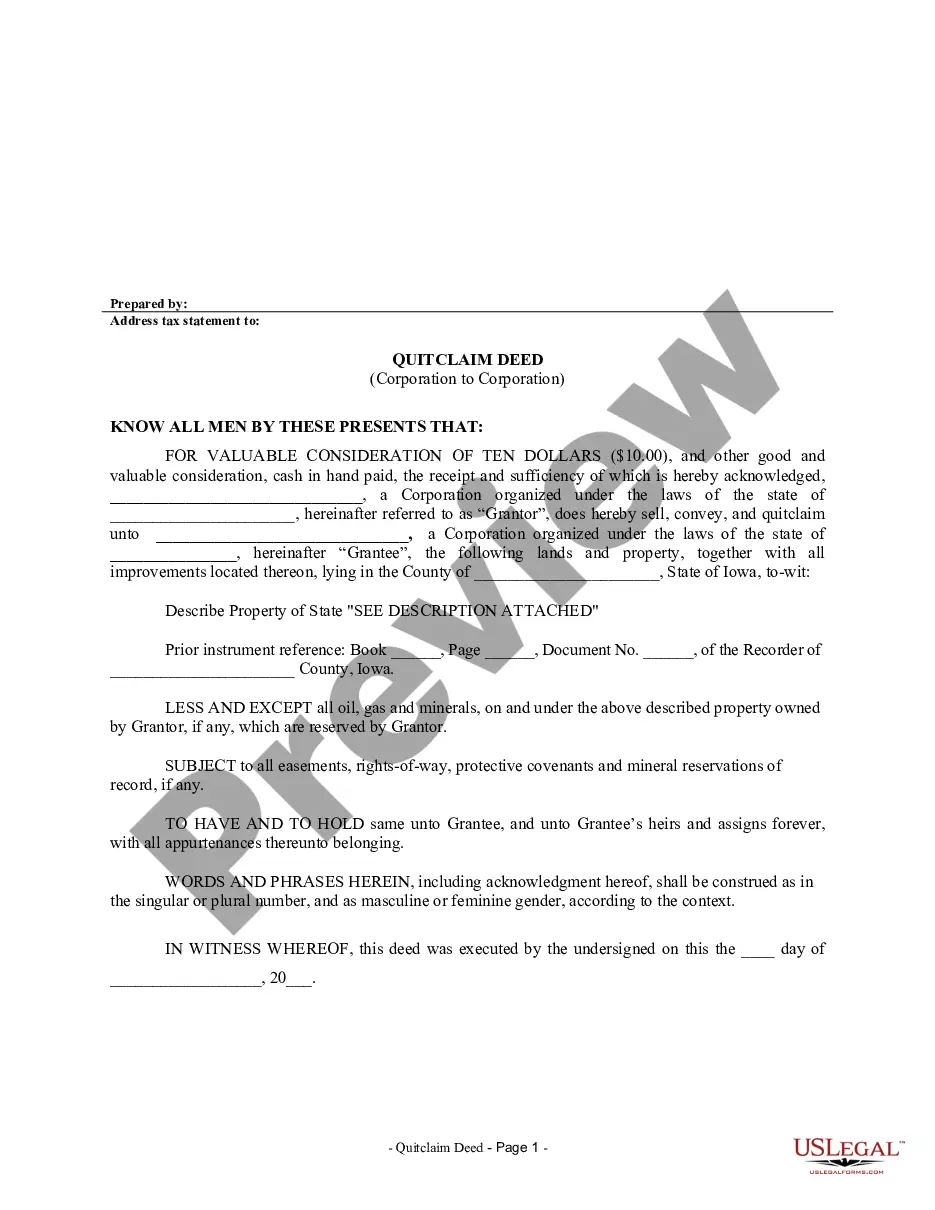
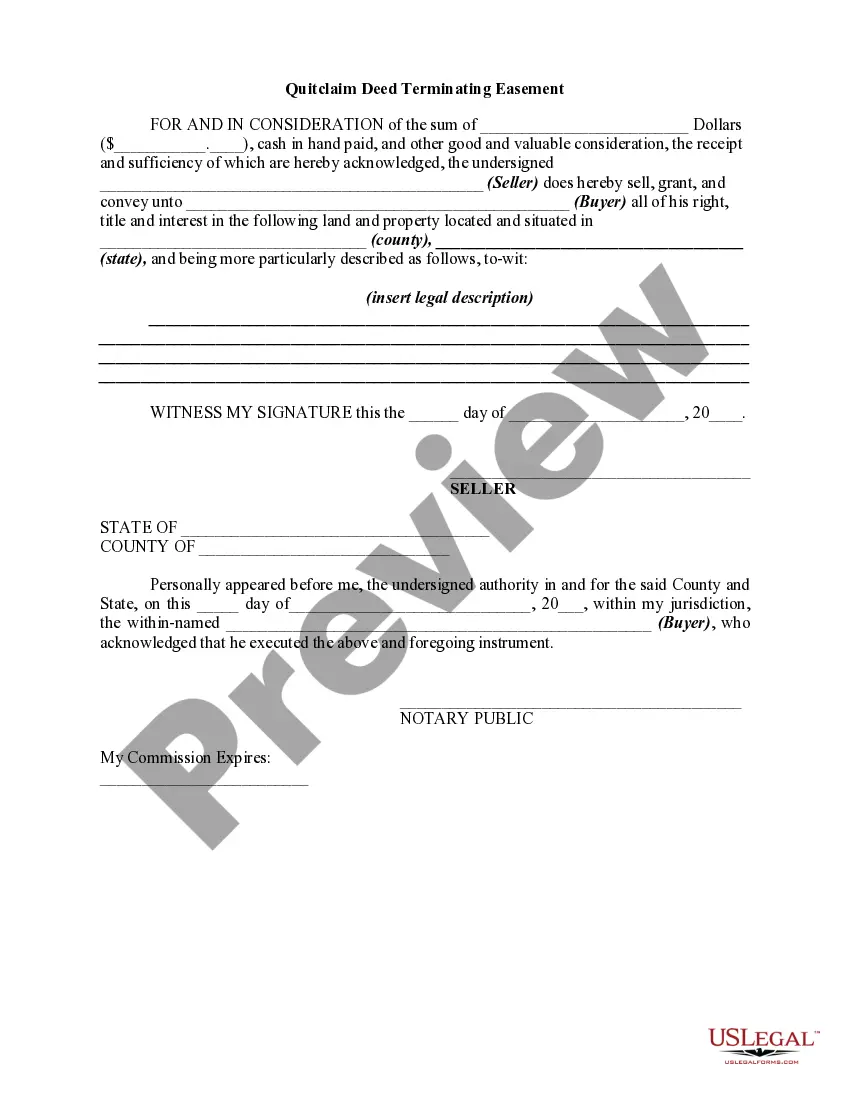
The Quitclaim Deed from Corporation to Corporation is a legal document that allows one corporation (the Grantor) to transfer ownership of property to another corporation (the Grantee). Unlike other property transfer documents, a quitclaim deed does not guarantee that the Grantor holds clear title to the property; it simply conveys whatever interest they may have. This form is essential for corporate transactions involving real estate and complies with all state statutory laws.
What’s included in this form
- Identification of the Grantor and Grantee corporations.
- Property description including specific details of the land being transferred.
- Statement of consideration, typically a nominal amount like ten dollars.
- Reservation clause for oil, gas, and minerals, if applicable.
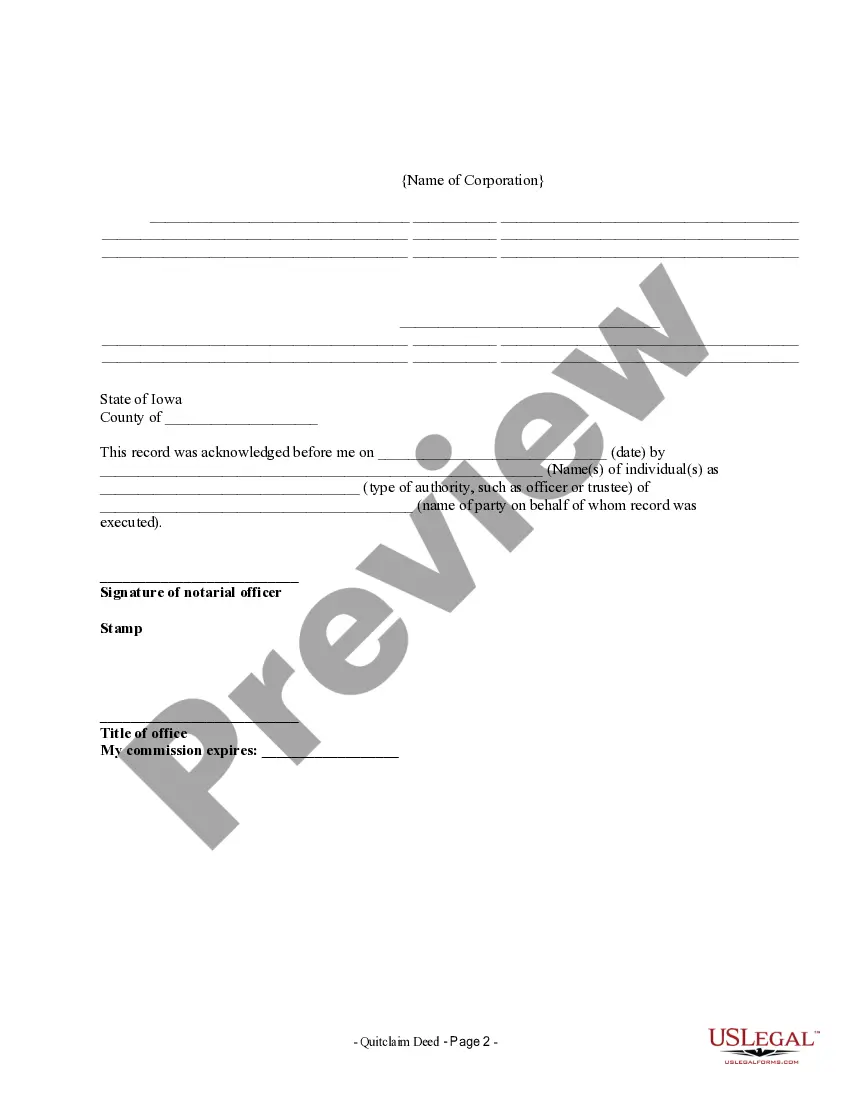
- Signatures of corporate officers and acknowledgment by a notary public.

When this form is needed
This form is used when one corporation wishes to transfer property to another corporation. Situations may include corporate mergers, asset sales, or real estate transactions where a corporation is relinquishing its interest in specific property. It is particularly valuable in business contexts where the transfer of property ownership is necessary without assumptions about existing claims.
Who this form is for
- Corporations involved in real estate transactions.
- Corporate officers responsible for property management.
- Legal entities seeking to simplify the transfer of property rights.
How to complete this form
- Identify the Grantor and Grantee corporations with full names and state information.
- Provide a complete description of the property being transferred.
- Record the consideration amount being paid for the transfer.
- Include any reservations concerning oil, gas, and minerals.
- Have the form signed by authorized corporate officers and notarized.
Does this form need to be notarized?
This document requires notarization to meet legal standards. US Legal Forms provides secure online notarization powered by Notarize, allowing you to complete the process through a verified video call, available 24/7.
Get your form ready online
Our built-in tools help you complete, sign, share, and store your documents in one place.
Make edits, fill in missing information, and update formatting in US Legal Forms—just like you would in MS Word.
Download a copy, print it, send it by email, or mail it via USPS—whatever works best for your next step.
Sign and collect signatures with our SignNow integration. Send to multiple recipients, set reminders, and more. Go Premium to unlock E-Sign.
If this form requires notarization, complete it online through a secure video call—no need to meet a notary in person or wait for an appointment.
We protect your documents and personal data by following strict security and privacy standards.

Make edits, fill in missing information, and update formatting in US Legal Forms—just like you would in MS Word.

Download a copy, print it, send it by email, or mail it via USPS—whatever works best for your next step.

Sign and collect signatures with our SignNow integration. Send to multiple recipients, set reminders, and more. Go Premium to unlock E-Sign.

If this form requires notarization, complete it online through a secure video call—no need to meet a notary in person or wait for an appointment.

We protect your documents and personal data by following strict security and privacy standards.
Avoid these common issues
- Failing to provide a clear property description.
- Not including all necessary signatures and titles from corporate officers.
- Omitting the notary acknowledgment, which is crucial for validity.
Why use this form online
- Convenience of downloading and filling out the form at your own pace.
- Editability allows for customization to meet specific needs.
- Reliability of using forms drafted by licensed attorneys.
Looking for another form?

Form popularity
FAQ
Avoiding a quitclaim deed may be wise when certainty regarding property ownership is essential. This deed does not provide guarantees about the title or the condition of the property, which can lead to disputes later. It is not ideal for selling property, as buyers often prefer warranty deeds that assure clear ownership and protect them from legal claims. If you need a reliable transfer system, consider using services like uslegalforms, which offer guides on the Iowa Quitclaim Deed from Corporation to Corporation and help ensure a secure transaction.
You should avoid using a quitclaim deed when there are loans or liens associated with the property, as it does not clear these obligations. Additionally, if the transfer involves a complex sale or requires guarantees regarding the property’s title, a warranty deed would be more appropriate. Situations requiring formal appraisal values or severance of property interests typically do not suit a quitclaim deed. Therefore, those considering the Iowa Quitclaim Deed from Corporation to Corporation should assess their specific circumstances carefully.
A quitclaim deed is often used to transfer property between entities without warranties, especially in corporate transactions. For instance, when a corporation wishes to transfer an asset to another corporation within the same group, they might utilize the Iowa Quitclaim Deed from Corporation to Corporation. This deed can also be helpful in settling estates or gifting property among family members. Thus, it serves as a simple solution for straightforward property transfers.
A quitclaim deed can be deemed invalid for several reasons, such as lacking a notarized signature or failing to meet state requirements. If the document is not properly executed, meaning that it does not include essential details or signatures, it may not transfer ownership effectively. Additionally, if the property being transferred does not exist or the transferor does not have legal title, the deed is also invalid. Users of the Iowa Quitclaim Deed from Corporation to Corporation should ensure all legal requirements are met to avoid complications.
Corporations often benefit from a quitclaim deed when transferring properties rapidly and without extensive legal processes. This method allows for quick ownership adjustments, which can be essential in business operations. Especially when time is critical, an Iowa Quitclaim Deed from Corporation to Corporation can simplify the transfer of assets. It’s advantageous for parties looking to resolve property disputes or clarify ownership without litigation.
An Iowa quitclaim deed works by transferring whatever interest the grantor has in the property to the grantee. This deed offers no warranties regarding the title, so the grantee accepts the property 'as is.' Both corporations involved must properly execute the deed, which then gets filed with the local county recorder. This process is vital for ensuring a smooth transition of ownership under an Iowa Quitclaim Deed from Corporation to Corporation.
In Iowa, a quitclaim deed allows property to transfer ownership between parties without the guarantee of clear title. The grantor must sign the deed, and it should be notarized to be valid. Additionally, the deed must include a legal description of the property. It’s important to check for any liens or claims on the property before executing an Iowa Quitclaim Deed from Corporation to Corporation.
A corporation conveys real estate by executing a deed that transfers property ownership. This process often involves both drafting and signing a deed, which describes the property and the parties involved. For an Iowa Quitclaim Deed from Corporation to Corporation, this method offers a straightforward way to pass property without warranties. Utilizing services like USLegalForms can streamline this process, ensuring compliance and accuracy in your transactions.
Writing a deed of conveyance requires specific elements to ensure legal validity. Start by State identifying the parties involved, describing the property, and stating the intention to transfer ownership. In the context of an Iowa Quitclaim Deed from Corporation to Corporation, ensure that all forms are compliant with state laws. You can utilize platforms like USLegalForms to access templates and guidance for creating accurate and legally recognized deeds.
When a corporation transfers ownership through a deed, the document must be signed by an authorized officer, usually the president or secretary. This signature represents the corporation's consent to the transfer of property. For an Iowa Quitclaim Deed from Corporation to Corporation, ensuring the correct signatures is vital to uphold the legality of the transaction. It also protects against future disputes regarding ownership.