Georgia Written Revocation of Will
What this document covers
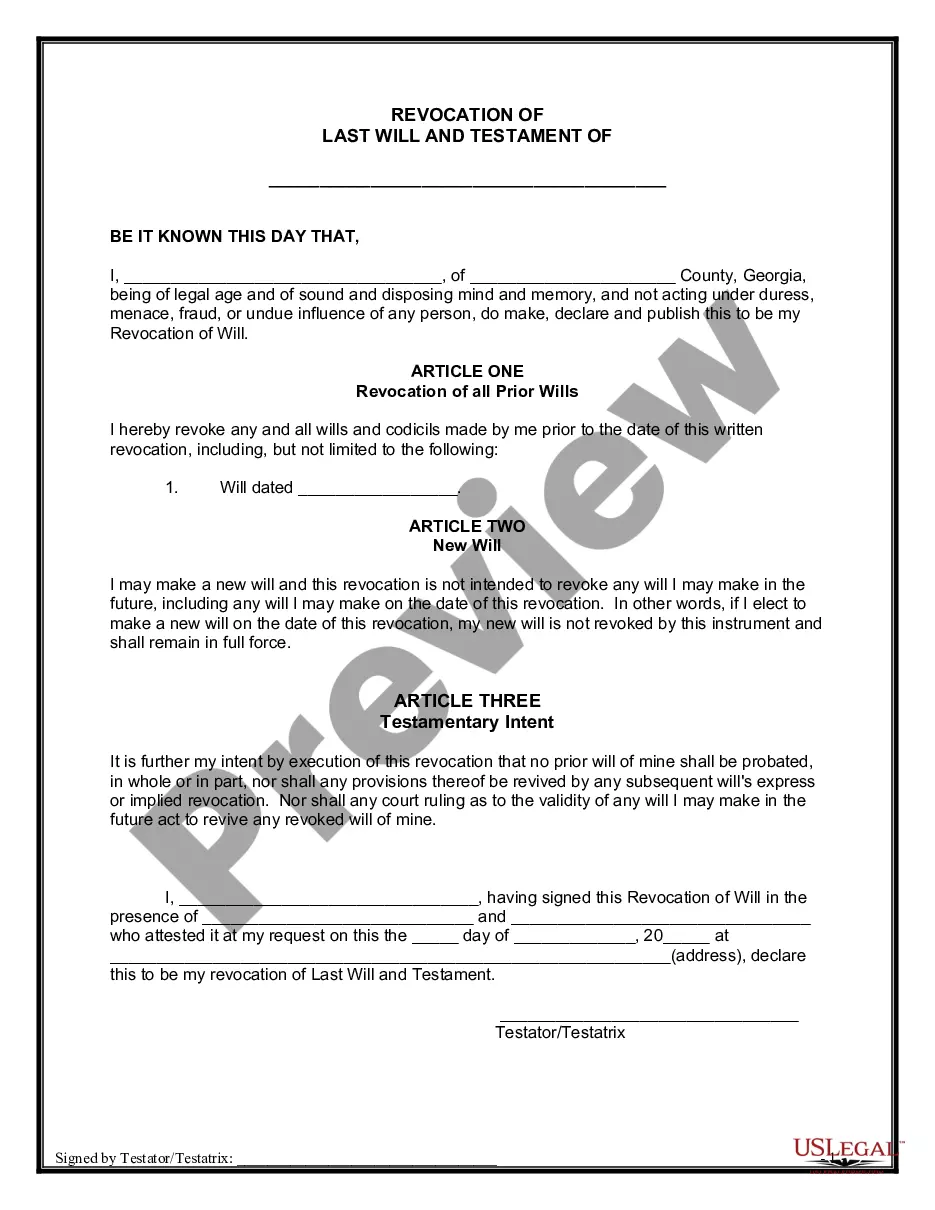
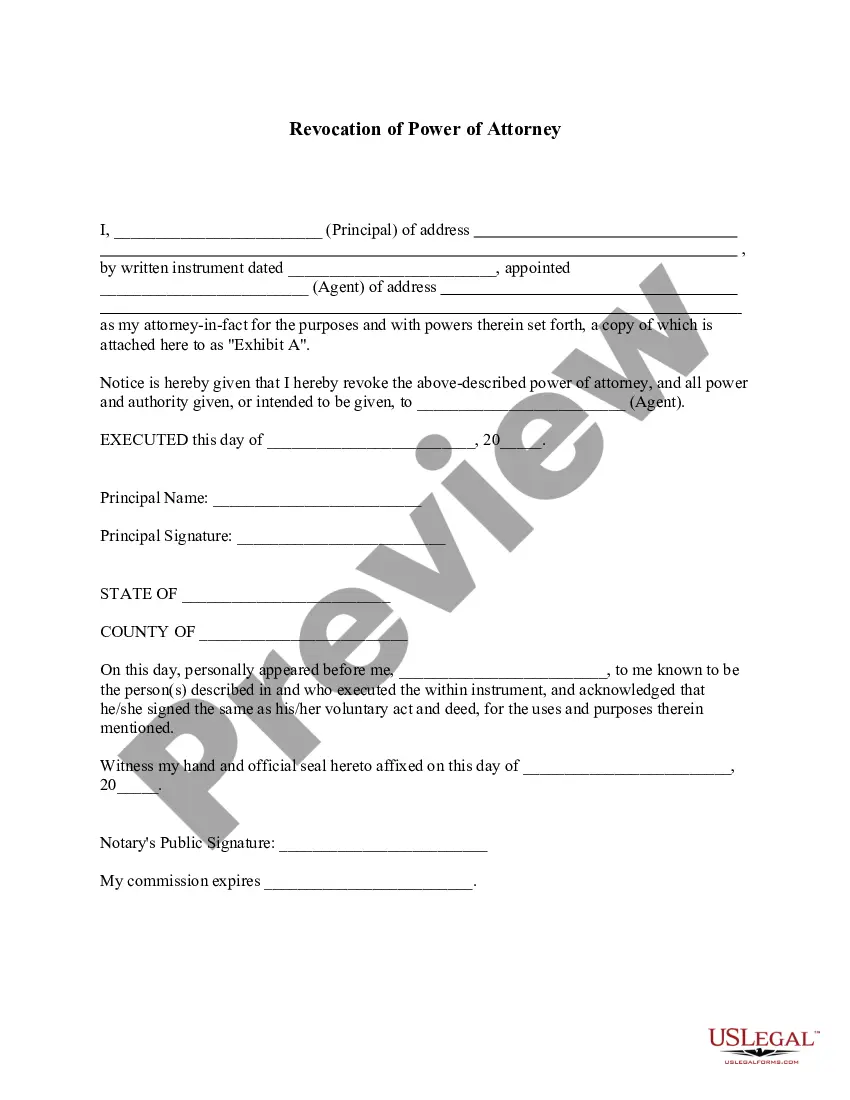
The Written Revocation of Will is a legal document used to formally revoke a previous will. This form is important for clarifying that no prior wills should be considered valid, especially if a new will does not include a revocation clause. It helps eliminate confusion for heirs regarding which will should be probated.
Form components explained
- Declaration of Revoke: Clearly states the intention to revoke prior wills.
- Revocation Clause: Cancels all previous wills and codicils made before this date.
- Future Wills: Clarifies that any new will made in the future is not revoked by this document.
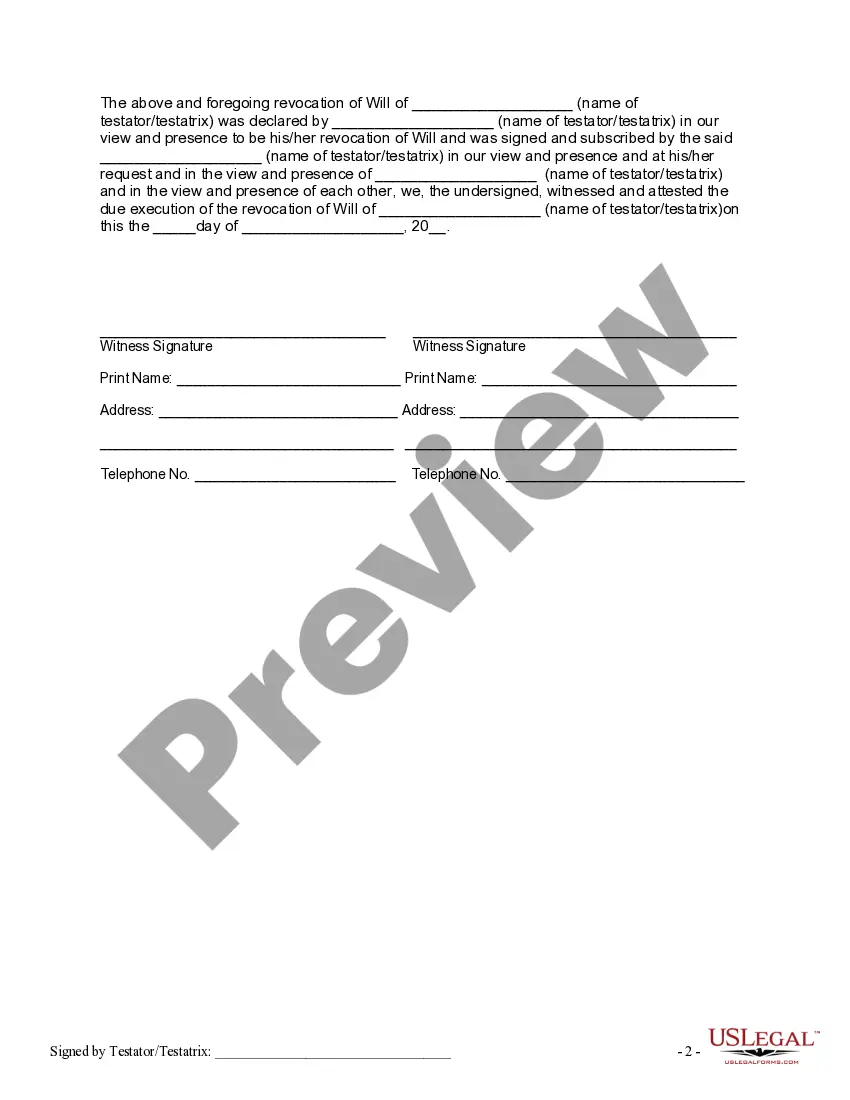
- Witness Attestation: Requires signatures from witnesses who observe the revocation.
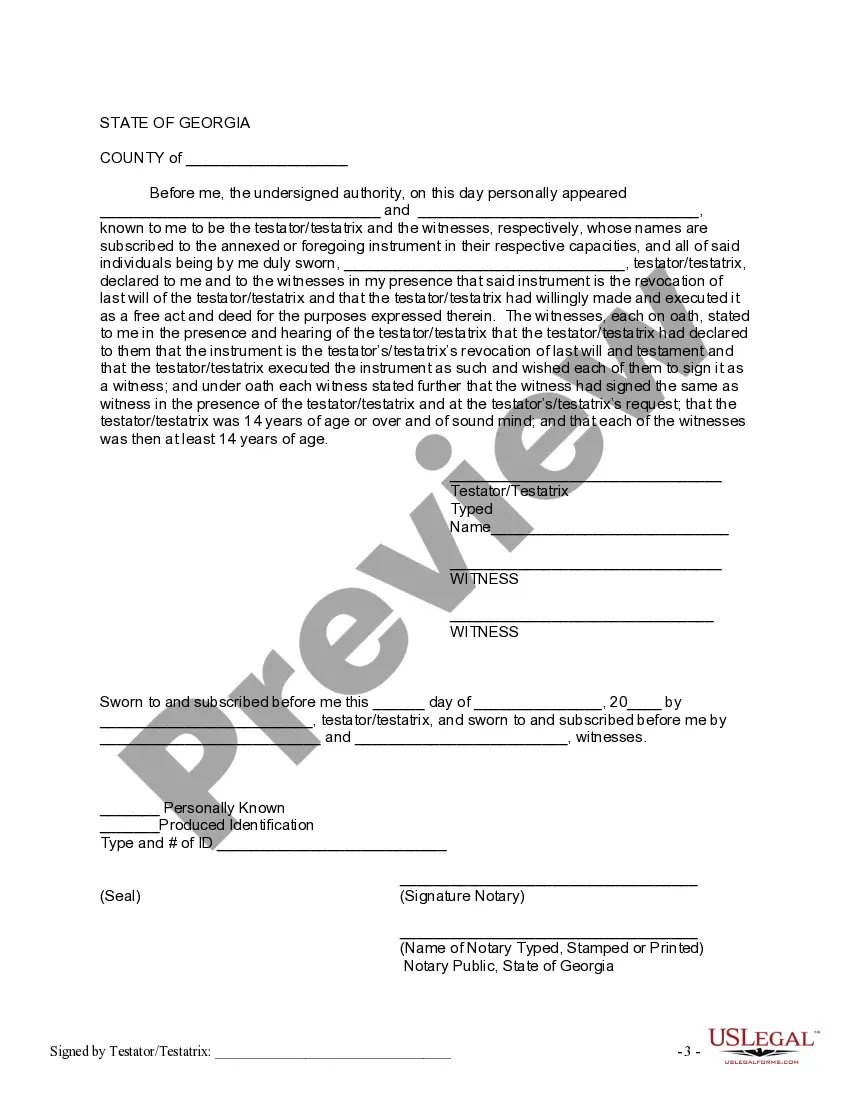
- Notarization: Includes an option for notarization to verify identities and signatures.

Common use cases
This form should be used when an individual wants to revoke an existing will while ensuring that their intentions are clearly documented. It is particularly useful in situations where the testator wishes to prevent any previously written wills from being proven in court, especially when a newly drafted will is not available. It can also help in avoiding disputes among heirs over which will is valid.
Who needs this form
- Individuals who have previously created a will and want to revoke it.
- People drafting a new will who wish to ensure that the old will is not considered.
- Anyone who has concerns about the validity of their previous testamentary documents.
Steps to complete this form
- Enter your name, county, and the date of the revocation at the top of the form.
- Clearly state the intention to revoke by listing all prior wills and codicils.
- Include a statement indicating that any new will made will not be revoked by this form.
- Gather signatures from two witnesses who will attest to the execution of the document.
- If required, have the document notarized to enhance its legal standing.
Notarization requirements for this form
Notarization is required for this form to take effect. Our online notarization service, powered by Notarize, lets you verify and sign documents remotely through an encrypted video session, available 24/7.
Get your form ready online
Our built-in tools help you complete, sign, share, and store your documents in one place.
Make edits, fill in missing information, and update formatting in US Legal Forms—just like you would in MS Word.
Download a copy, print it, send it by email, or mail it via USPS—whatever works best for your next step.
Sign and collect signatures with our SignNow integration. Send to multiple recipients, set reminders, and more. Go Premium to unlock E-Sign.
If this form requires notarization, complete it online through a secure video call—no need to meet a notary in person or wait for an appointment.
We protect your documents and personal data by following strict security and privacy standards.

Make edits, fill in missing information, and update formatting in US Legal Forms—just like you would in MS Word.

Download a copy, print it, send it by email, or mail it via USPS—whatever works best for your next step.

Sign and collect signatures with our SignNow integration. Send to multiple recipients, set reminders, and more. Go Premium to unlock E-Sign.

If this form requires notarization, complete it online through a secure video call—no need to meet a notary in person or wait for an appointment.

We protect your documents and personal data by following strict security and privacy standards.
Avoid these common issues
- Failing to include all previous wills in the revocation statement.
- Not having the document signed by witnesses or notarized when needed.
- Using vague language that may lead to misinterpretation of the revocation intent.
Benefits of completing this form online
- Convenience: Easily accessible and downloadable from anywhere.
- Editable: You can modify the form according to your specific needs before finalizing.
- Reliability: Form templates are drafted by licensed attorneys ensuring legal compliance.
Looking for another form?
Form popularity
FAQ
To revoke a will in Georgia, you need to create a Georgia Written Revocation of Will. This document explicitly states your intention to revoke the existing will and should be signed by you. You must make sure to destroy any copies of the old will to avoid confusion in the future. Utilizing platforms like USLegalForms can simplify this process, ensuring that your revocation is legally sound and effective.
To make a will null and void, you can draft a Georgia Written Revocation of Will that clearly states your intention to invalidate the existing will. It is essential that this document adheres to Georgia’s legal requirements to ensure its validity. Another option is to destroy the will in a manner that demonstrates your intention to revoke it. For a smooth process, consult USLegalForms for guidance on creating an effective revocation.
The three types of revocation include: express revocation, which involves a direct statement in a new will or revocation document; implied revocation, where the creation of a new will effectively cancels the previous one; and physical revocation, which involves destroying the will itself. Understanding these types can guide you in managing your estate planning effectively. Always consider using a Georgia Written Revocation of Will for clarity and legal protection, especially to avoid potential conflicts.
The most effective way to revoke a will is by executing a Georgia Written Revocation of Will that complies with state laws. This document should clearly outline your intention to revoke the previous will and must be signed and dated properly. Another method is physically destroying the old will, but this must be done with clear intent to avoid confusion later. Utilizing tools from USLegalForms can help you create a legally sound revocation to prevent future disputes.
The best way to revoke a will involves drafting a Georgia Written Revocation of Will, which clearly states your intention to nullify the existing will. This document should comply with Georgia state laws to be effective, ensuring that it includes the necessary legal requirements. Alternatively, creating a new will that explicitly revokes the previous one can also be effective. Consulting platforms like USLegalForms can guide you through this process to ensure legal validity.
A revocation of a will typically occurs when the testator, the person who made the will, takes specific actions to demonstrate their intent to cancel it. This can include creating a new will or writing a Georgia Written Revocation of Will that explicitly states the old will is no longer valid. Furthermore, physical acts such as destroying the original document can also serve as a revocation. It's crucial to ensure that any revocation complies with Georgia’s legal standards to avoid disputes.
In general, a beneficiary cannot override an executor’s decisions regarding a will. The executor has a legal duty to follow the instructions laid out in the will, including how to distribute assets according to the deceased’s wishes. If concerns arise, beneficiaries can challenge the executor’s actions in court, particularly if they believe the executor is not fulfilling their responsibilities. Learning about the Georgia Written Revocation of Will can help you understand the roles and responsibilities of each party.
A will may become null and void due to several reasons, including the testator's lack of capacity, improper execution, or the existence of a subsequent valid will. In Georgia, if a will is revoked, its terms are no longer enforceable. Understanding the nuances of what invalidates a will is crucial, which is where resources like a Georgia Written Revocation of Will can help. They guide you in ensuring your estate planning documents maintain their effectiveness.
To write a revocation in Georgia, you need to create a document that clearly states your intent to revoke your previous will. This written revocation should include specific details about the will you are nullifying, such as its date and title. Using a Georgia Written Revocation of Will template can simplify this process and ensure that the necessary legal elements are included. This template is readily available on platforms like U.S. Legal Forms.
In the state of Georgia, a codicil can indeed revoke a will, but only under specific conditions. A codicil is a legal document that modifies an existing will. It must explicitly state the intent to revoke the current will or certain provisions within it. Therefore, if you consider updating your estate plans, a Georgia Written Revocation of Will may provide clarity.