Washington Plumbing Contractor Package
Understanding this form package
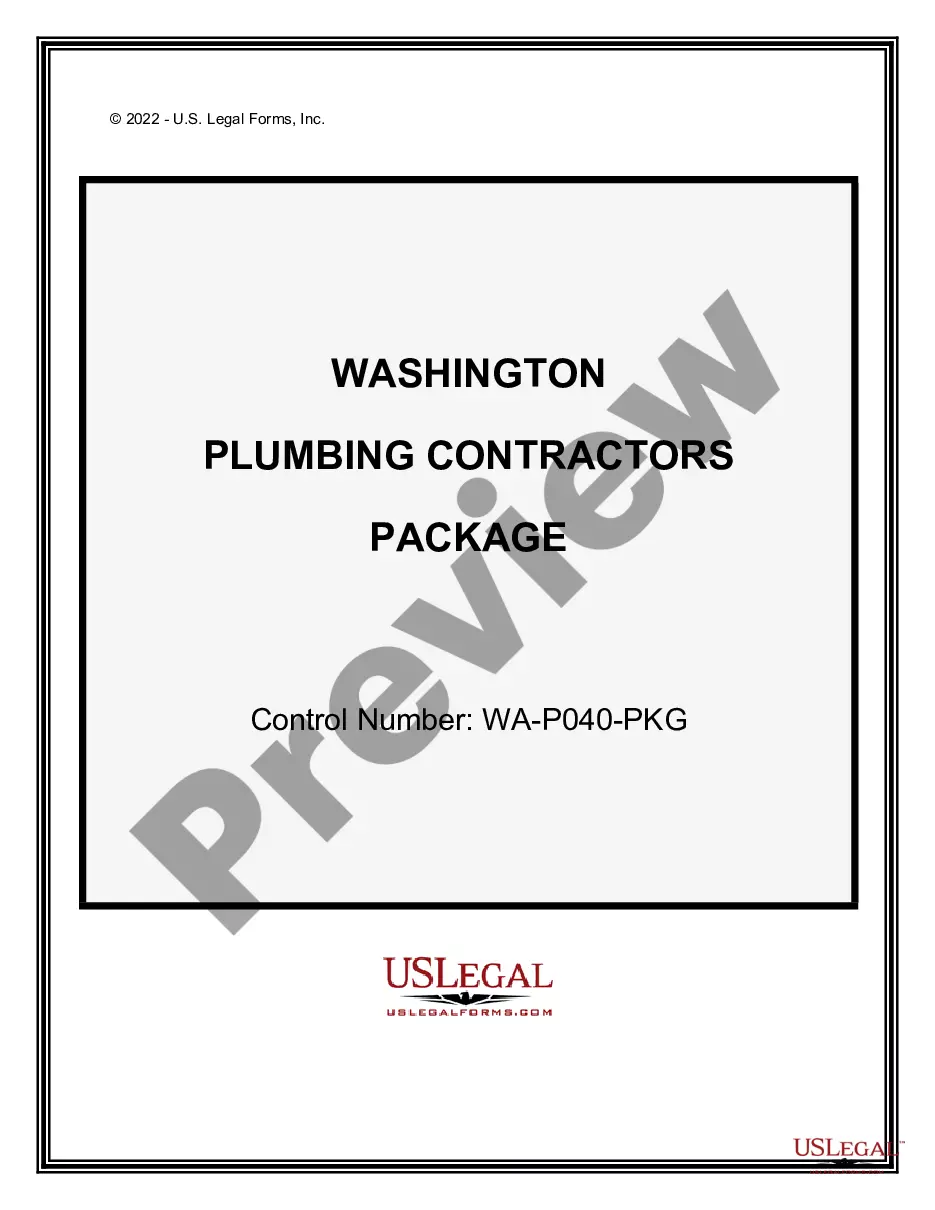
The Washington Plumbing Contractor Package is a comprehensive set of legal forms specifically designed for plumbing contractors operating in Washington state. This package equips contractors with essential documents necessary for managing contracts and addressing potential legal issues that can arise with property owners, suppliers, and subcontractors during projects. With its focus on the plumbing contract that complies with state law, it stands out as a vital resource for those involved in new construction, remodeling, or plumbing repairs.
Forms provided in this package
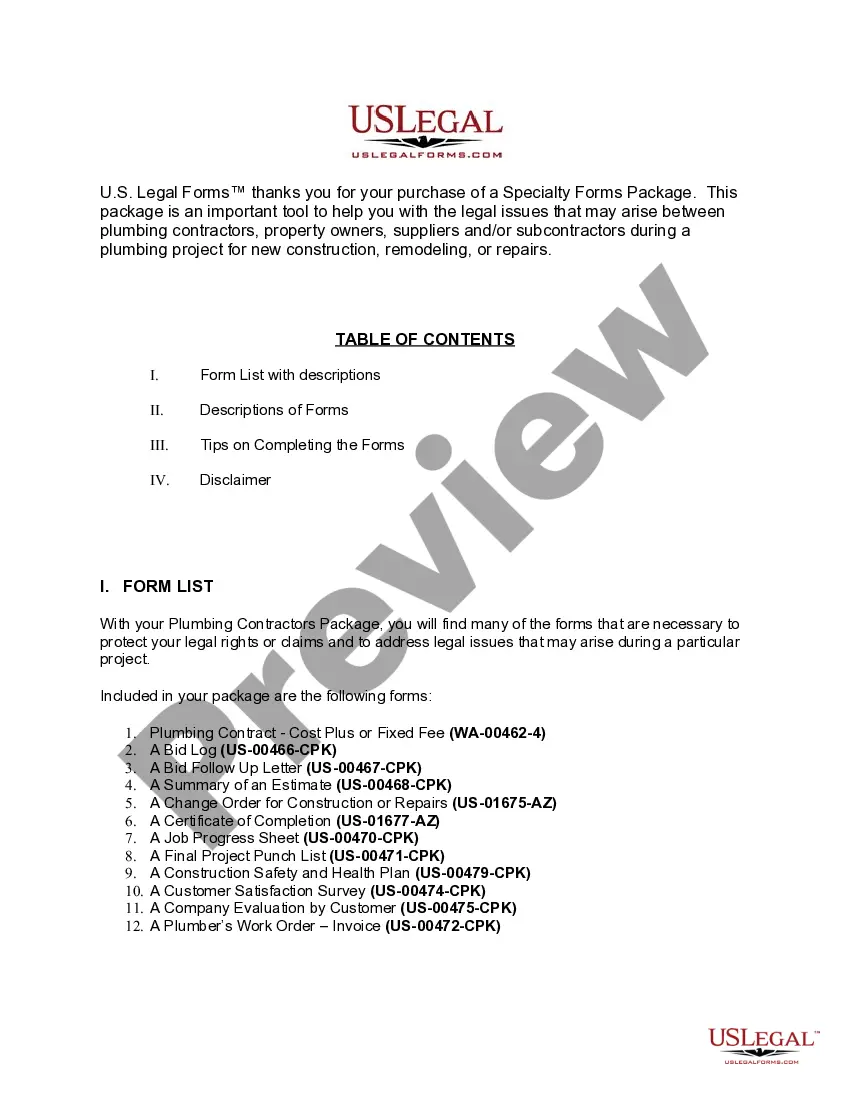
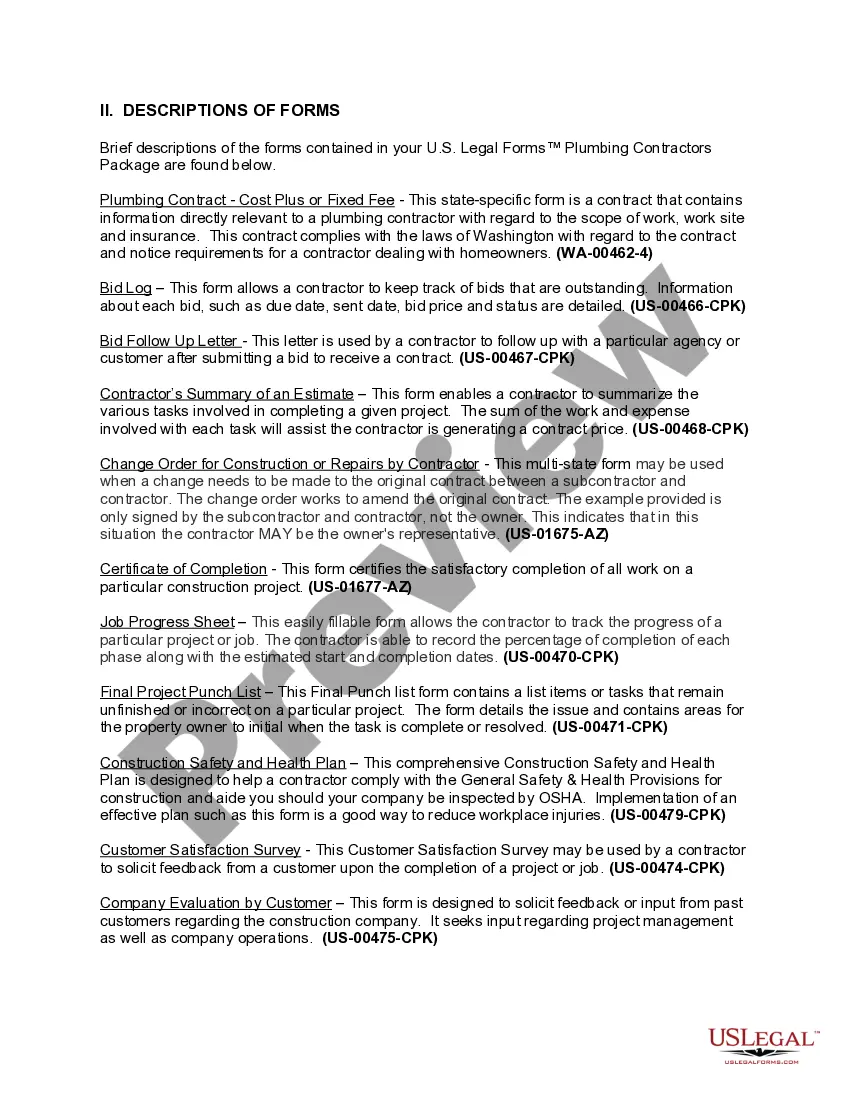
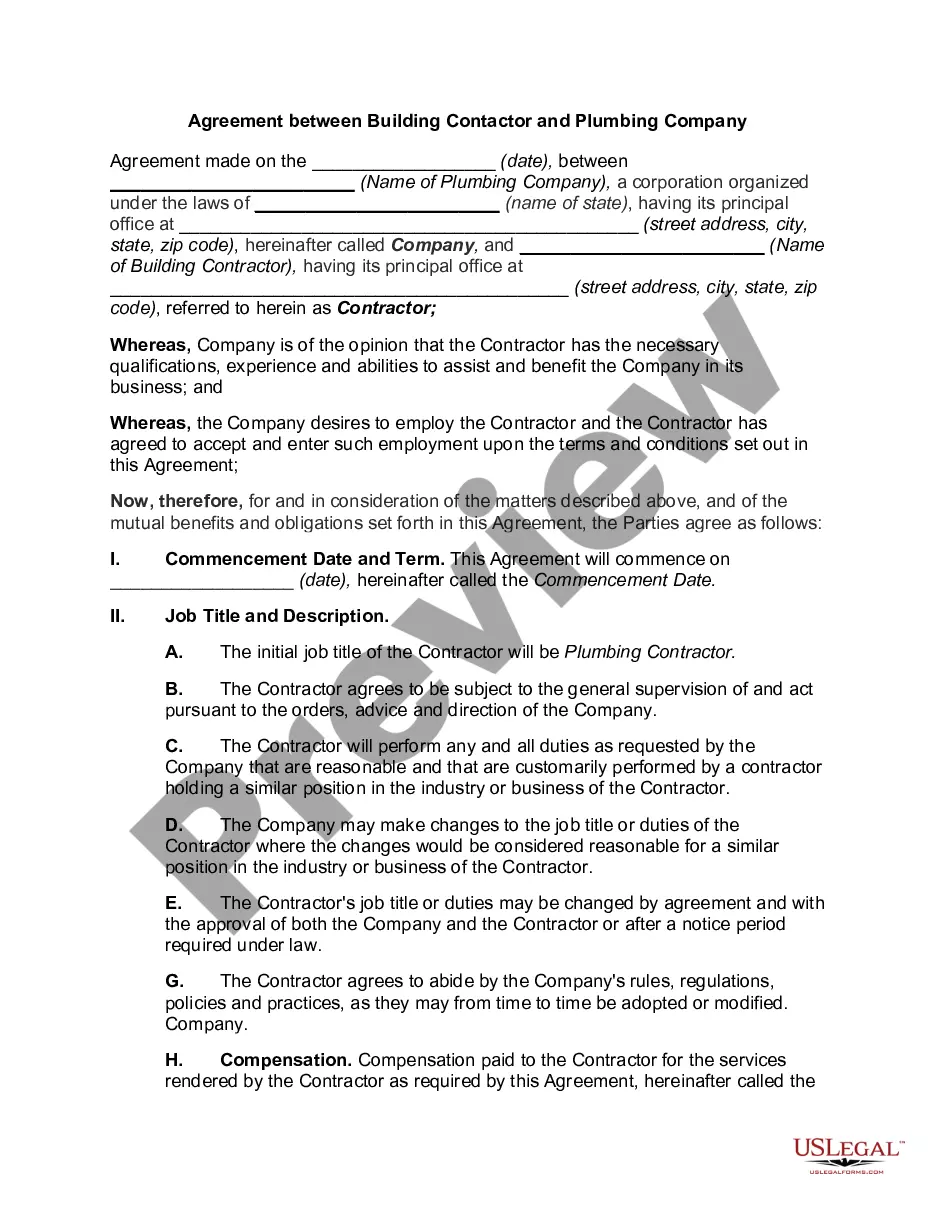
- Plumbing Contract for Contractor
- Contractor's Bid Log
- Contractor's Bid Follow Up Letter
- Contractor's Summary of an Estimate
- Contractor's Job Progress Sheet
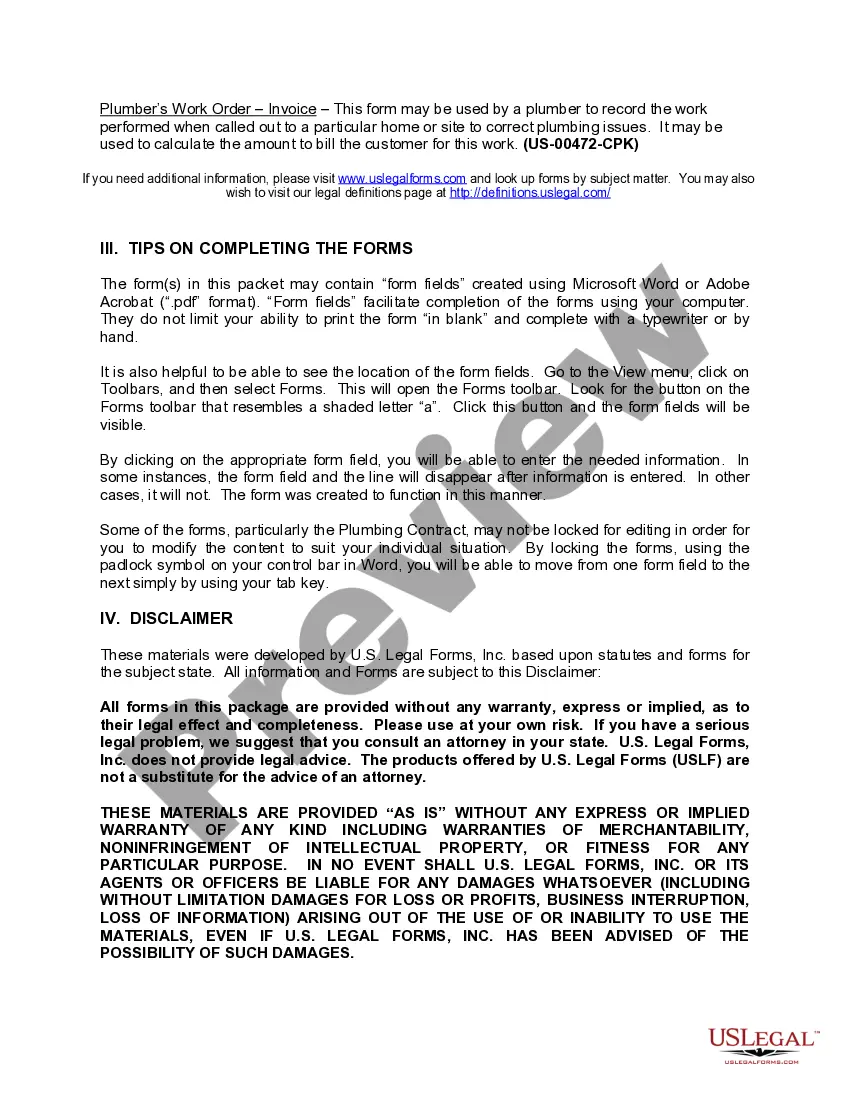
- Plumber's Work Order - Invoice
- Customer Satisfaction Survey
- Construction Company Evaluation by a Customer
- Construction Safety and Health Plan
- Change Order for Construction or Repairs by Contractor
- Certification of Completion by Contractor

When to use this form package
This package is particularly useful in various scenarios, including:
- Engaging in a new plumbing project or renovation where legal documentation is needed.
- Tracking bids and managing contracts with subcontractors and vendors.
- Documenting changes or amendments to existing contracts through change orders.
- Ensuring compliance with safety regulations and maintaining a high level of customer satisfaction.
Who this form package is for
- Licensed plumbing contractors operating in Washington state.
- Property owners looking to hire plumbing services.
- Subcontractors working on plumbing contracts.
- Suppliers providing materials for plumbing projects.
Steps to complete these forms
- Review all included forms to understand their purpose and requirements.
- Identify the parties involved, including contractors, property owners, and subcontractors.
- Fill in all necessary information such as dates, payment terms, and project specifics.
- Obtain required signatures from all parties on key documents, especially the plumbing contract.
- Keep copies of completed forms for your records and ensure compliance with local regulations.
Notarization guidance for this package
Forms in this package usually don’t need notarization, but certain jurisdictions or signing circumstances may require it. US Legal Forms provides a secure online notarization option powered by Notarize, accessible 24/7 from anywhere.
Get your form ready online
Our built-in tools help you complete, sign, share, and store your documents in one place.
Make edits, fill in missing information, and update formatting in US Legal Forms—just like you would in MS Word.
Download a copy, print it, send it by email, or mail it via USPS—whatever works best for your next step.
Sign and collect signatures with our SignNow integration. Send to multiple recipients, set reminders, and more. Go Premium to unlock E-Sign.
If this form requires notarization, complete it online through a secure video call—no need to meet a notary in person or wait for an appointment.
We protect your documents and personal data by following strict security and privacy standards.

Make edits, fill in missing information, and update formatting in US Legal Forms—just like you would in MS Word.

Download a copy, print it, send it by email, or mail it via USPS—whatever works best for your next step.

Sign and collect signatures with our SignNow integration. Send to multiple recipients, set reminders, and more. Go Premium to unlock E-Sign.

If this form requires notarization, complete it online through a secure video call—no need to meet a notary in person or wait for an appointment.

We protect your documents and personal data by following strict security and privacy standards.
Common mistakes to avoid
- Failing to fill in all required fields in the plumbing contract and associated forms.
- Not keeping all parties informed throughout the bidding and contracting process.
- Neglecting to have change orders properly documented and signed.
- Overlooking the importance of a safety and health plan for the project.
Benefits of completing this package online
- Convenience of downloading forms anytime and anywhere.
- Editability allows you to customize forms to fit your specific needs.
- Reliable resources drafted by licensed attorneys, ensuring legal compliance.
Legal use & context
- The forms provided are designed to help establish legally binding agreements between parties.
- Using these forms can help protect your rights and claims in plumbing projects.
- While these forms are thorough, they do not replace the need for legal advice in complex situations.
Summary of main points
- The Washington Plumbing Contractor Package includes vital forms for effective project management.
- Understanding how to use these forms is critical to protecting legal rights during plumbing projects.
- Always double-check for any local legal requirements that may impact form completion.
Looking for another form?

Form popularity
FAQ
A: It's not uncommon for contractors to ask for a down payment up front to secure your spot on their schedule or purchase some of the job materials in advance. Asking for more than half of the project cost up front, though, is a big red flag.I recommend tying payments to progress made during the job.
L&I is the Washington State Department of Labor & Industries. It is a quasi insurance system covering workers hurt on the job. Benefits include medical care, time loss compensation, permanent partial disability, vocational rehabilitation, pensions, and other payments.
If the contractor requests a large sum of money before work has begun, Mozen says you should ask specifically what types of work or materials those payments are covering.Contractors sometimes have other motives, other than purchasing materials, when they ask for large amounts of money in advance, Fowler says.
Avoid companies that require an upfront deposit of more than 10 percent. Try to include language in the contract that holds back a percentage of the total price, called a retainage, until you're sure the work was done well. A 10 percent retainage is common for residential remodeling work.
General contractors can perform most types of construction work.However, contractors working with plumbing, electrical, elevators, mobile home installation, boilers, and asbestos have additional requirements for education, examination, and licensing.
Be sure you need a contractor's license. Register your business with the WA Secretary of State. Register with the Department of Revenue. Get an EIN Number. Get bonded. Obtain proof of insurance. Submit your application.
Estimates, generally, must be professionally reasonable. A 10-20% overage might be considered reasonable, especially if the contractor discovered issues along the way that he couldn't have been aware of initially (for example, mold or flooding).
You shouldn't pay more than 10 percent of the estimated contract price upfront, according to the Contractors State License Board.
L&I is a diverse state agency dedicated to the safety, health, and security of Washington's 3.3 million workers. We help employers meet safety and health standards, and we inspect workplaces when alerted to hazards.