Vermont Written Statement of Claim
Understanding this form
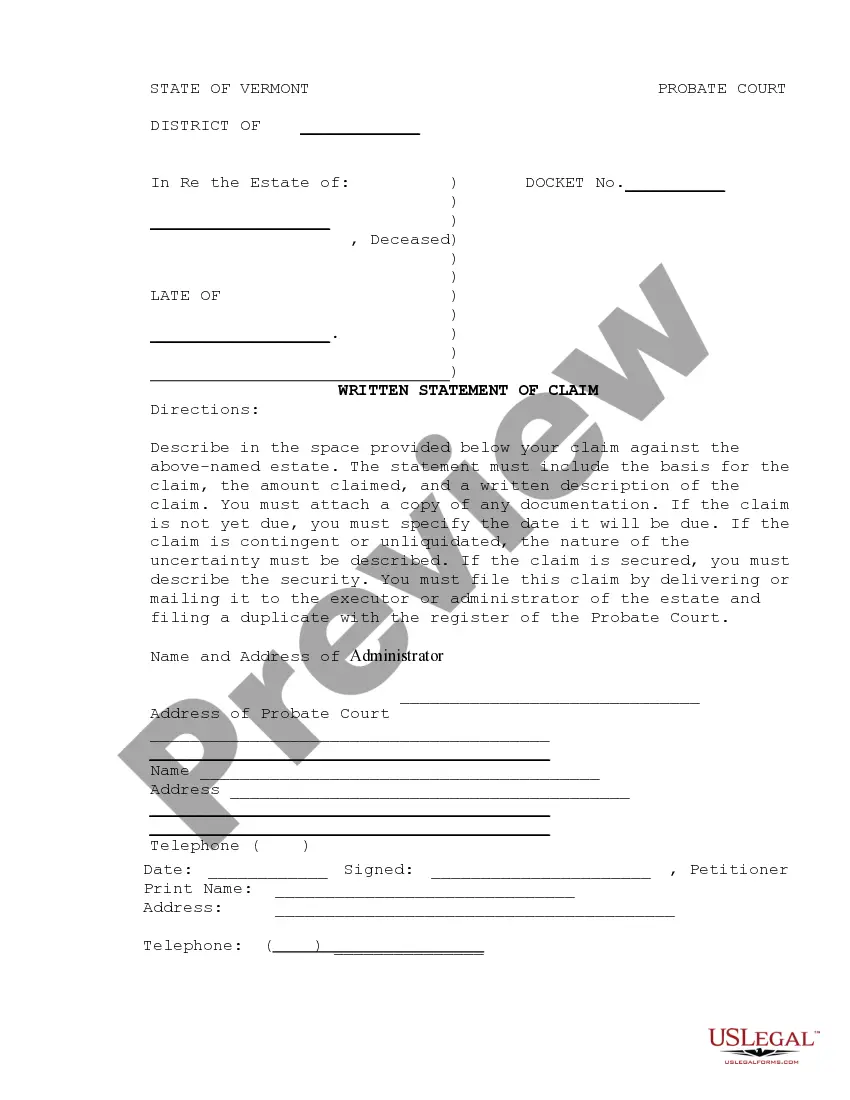
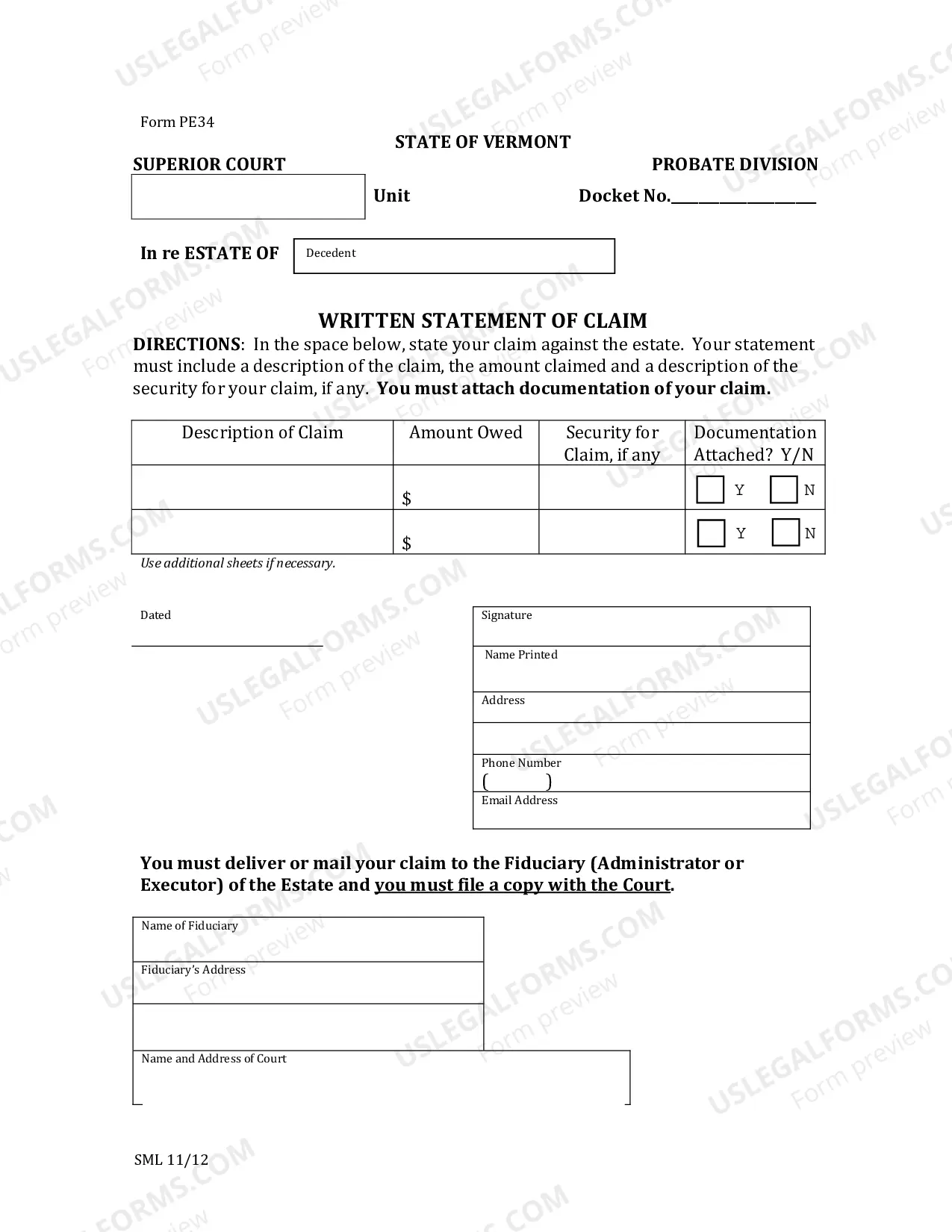
The Written Statement of Claim is a legal document used by creditors to formally notify the estate about their claim. This form serves as an essential tool in probate proceedings, allowing creditors to outline their claims against the estate of a deceased individual. Different from other forms, this statement specifically focuses on documenting the creditor's claim and ensures that it is recorded within the probate court system.
Key parts of this document
- Claim description: Outline the basis and nature of your claim against the estate.
- Amount claimed: Specify the total amount you are seeking.
- Due date: Identify if the claim is not yet due and provide the specific date.
- Contingency details: Describe any uncertainties related to the claim's enforceability.
- Documentation: Attach relevant documents to support your claim.
- Executor notification: Ensure the claim is submitted to the estate's executor or administrator.

Situations where this form applies
You should use the Written Statement of Claim if you are a creditor seeking to claim money or property from an estate currently in probate. This form may be necessary if you have provided goods or services to the deceased, have a legal judgment against the estate, or possess a secured interest in property that the estate owns. Submitting this form ensures that your claim is formally recognized during the estate's settlement process.
Who needs this form
This form is intended for:
- Creditors who have claims against a deceased person's estate.
- Businesses or individuals seeking payment for goods or services rendered.
- Individuals holding secured interests in property belonging to the estate.
- Legal representatives of creditors managing claims on their behalf.
How to prepare this document
- Identify the estate: Confirm the name of the estate you are claiming against.
- Describe your claim: Clearly state the basis of your claim and attach supporting documentation.
- Specify the amount: Detail the total dollar amount being claimed from the estate.
- Indicate due dates: If applicable, mention any due dates for contingent claims.
- Submit the form: Deliver or mail the completed form to the estate's executor or administrator, and file a duplicate with the probate court.
Does this form need to be notarized?
This form does not typically require notarization unless specified by local law. Always check Vermont's specific requirements to ensure compliance with the legal process.
Get your form ready online
Our built-in tools help you complete, sign, share, and store your documents in one place.
Make edits, fill in missing information, and update formatting in US Legal Forms—just like you would in MS Word.
Download a copy, print it, send it by email, or mail it via USPS—whatever works best for your next step.
Sign and collect signatures with our SignNow integration. Send to multiple recipients, set reminders, and more. Go Premium to unlock E-Sign.
If this form requires notarization, complete it online through a secure video call—no need to meet a notary in person or wait for an appointment.
We protect your documents and personal data by following strict security and privacy standards.

Make edits, fill in missing information, and update formatting in US Legal Forms—just like you would in MS Word.

Download a copy, print it, send it by email, or mail it via USPS—whatever works best for your next step.

Sign and collect signatures with our SignNow integration. Send to multiple recipients, set reminders, and more. Go Premium to unlock E-Sign.

If this form requires notarization, complete it online through a secure video call—no need to meet a notary in person or wait for an appointment.

We protect your documents and personal data by following strict security and privacy standards.
Avoid these common issues
- Failing to provide detailed descriptions of the claim.
- Not attaching relevant documentation to support the claim.
- Omitting due dates for contingent claims.
- Submitting the form after the deadline.
- Neglecting to send a copy to the probate court.
Why complete this form online
- Convenience: Easily fill out and download your form from anywhere, at any time.
- Editability: Make necessary adjustments quickly without reprinting paperwork.
- Reliability: Ensure that your form complies with the latest legal standards and requirements.
Main things to remember
- The Written Statement of Claim is essential for creditors to assert their claims against an estate.
- Complete the form accurately with all required details and documentation.
- Adhere to Vermont-specific filing protocols to ensure your claim is legally recognized.
Looking for another form?
Form popularity
FAQ
A claim persuades, argues, convinces, proves, or provocatively suggests something to a reader who may or may not initially agree with you.
Statement of Claim Defined A Statement of Claim is legal notice filed by a person (called the Plaintiff) who seeks a judgement against you in Court. The Plaintiff prepares a Statement of Claim and files it in the Court of Queen's Bench.
After serving your Statement of Claim on all the parties, you must wait for the defendants to file their Statements of Defence. If served in Alberta, the Defendant has 20 days after service of the Statement of Claim to file their Statement of Defence and provide you with a copy.
Login to the Online Registry. Click the New case tab. Click Statement of Claim (UCPR form 3A/3B) Follow the prompts to complete the form fields. Depending on the type of claim, you will have the option to upload a completed PDF version of the form or fill out the form online.
A statement of claim is a court document that sets out how much or what the other party claims you owe them and why they are making the claim. The statement of claim starts a court case.The plaintiff can include the following in their claim: 200b200b200binterest. filing and service fees.
A statement of claim is a summary of the facts supporting your case. If you fail to set out your claim correctly, either the court or the other side can require you to re-issue your statement of claim. This will cause delays to the court hearing your case.
The statement of claim sets out the details of the dispute, including why the applicant is taking legal action, as well as the facts of the case, like the nature and amount of the debt owed and what the creditor is asking for. A statement of claim can usually be served personally or by post.