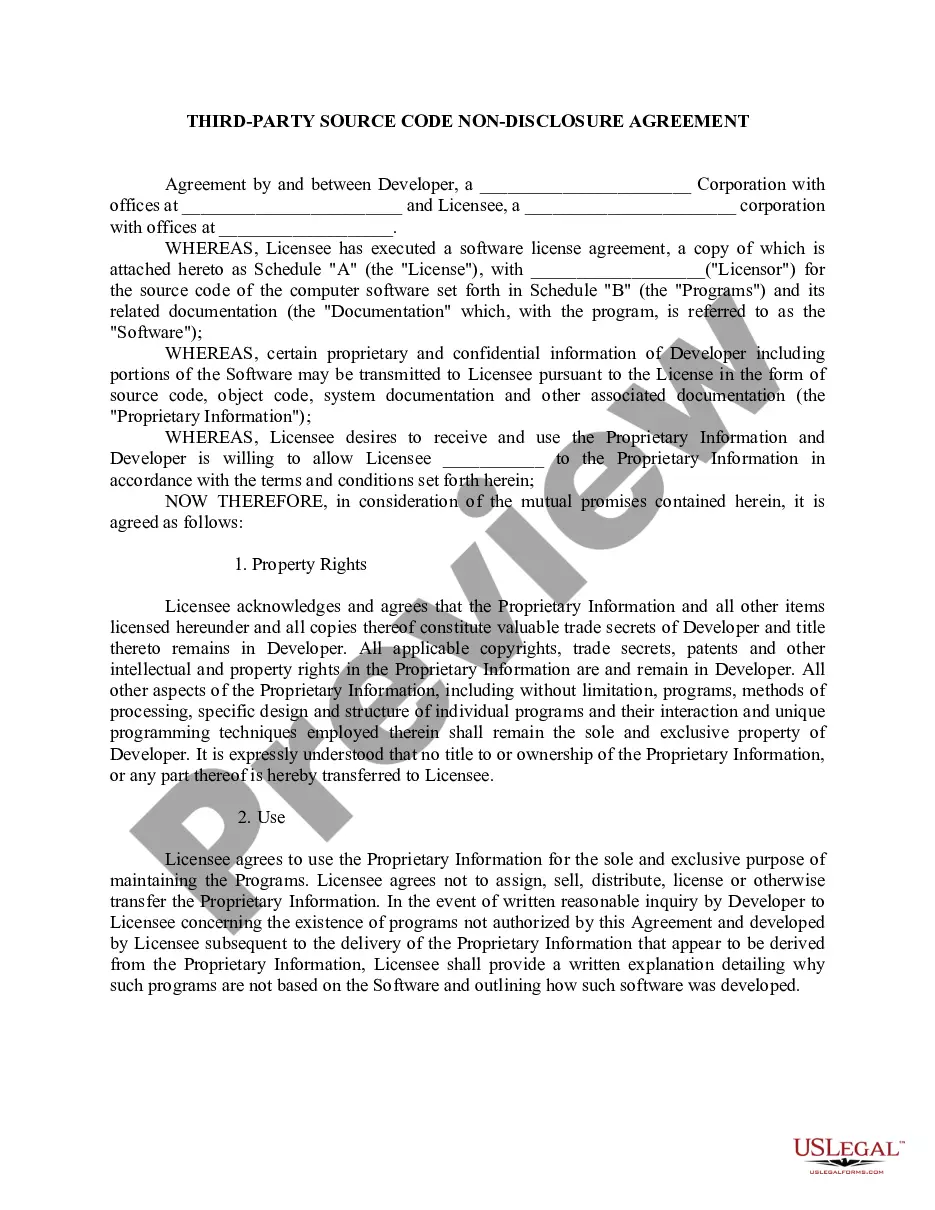
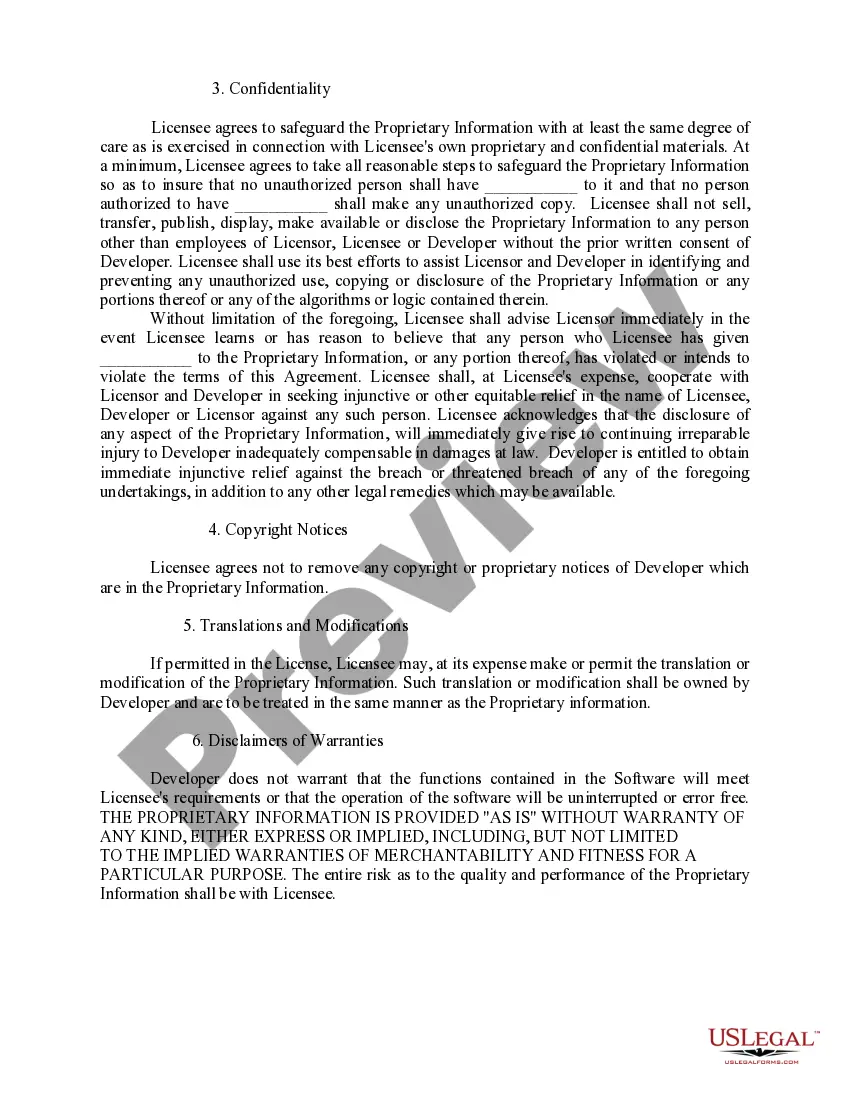
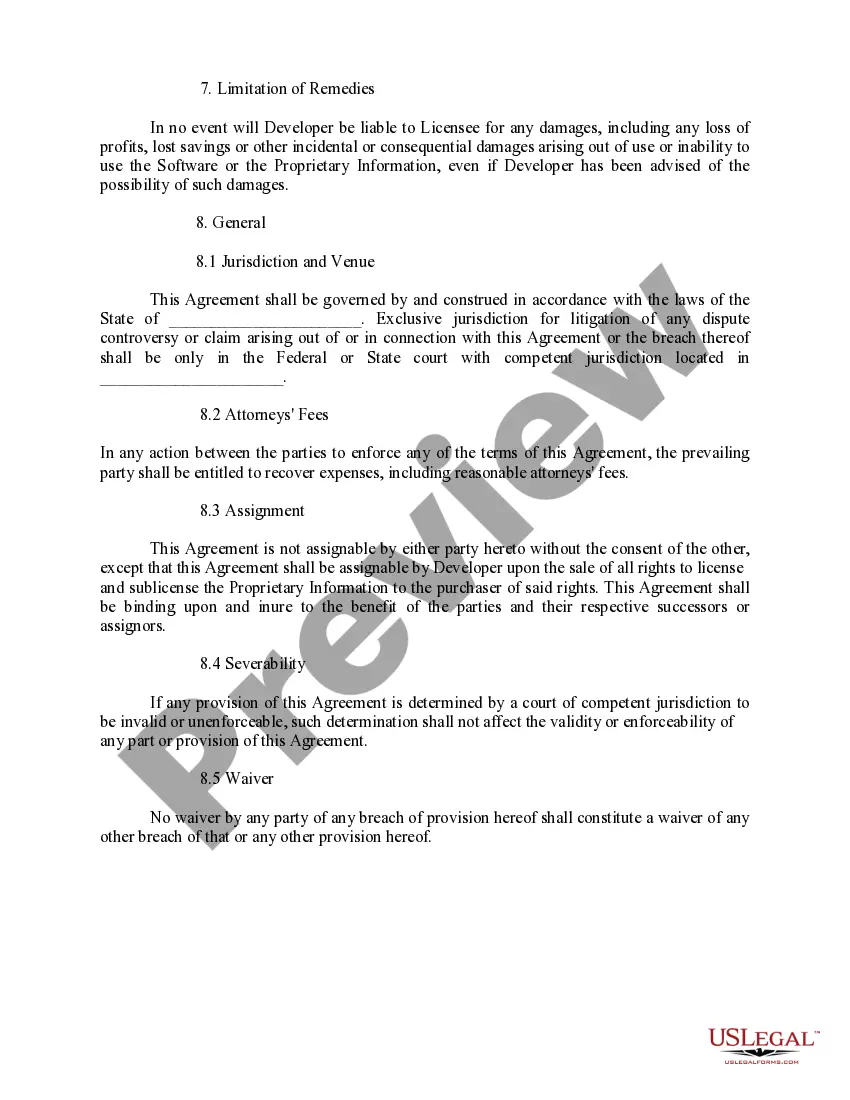
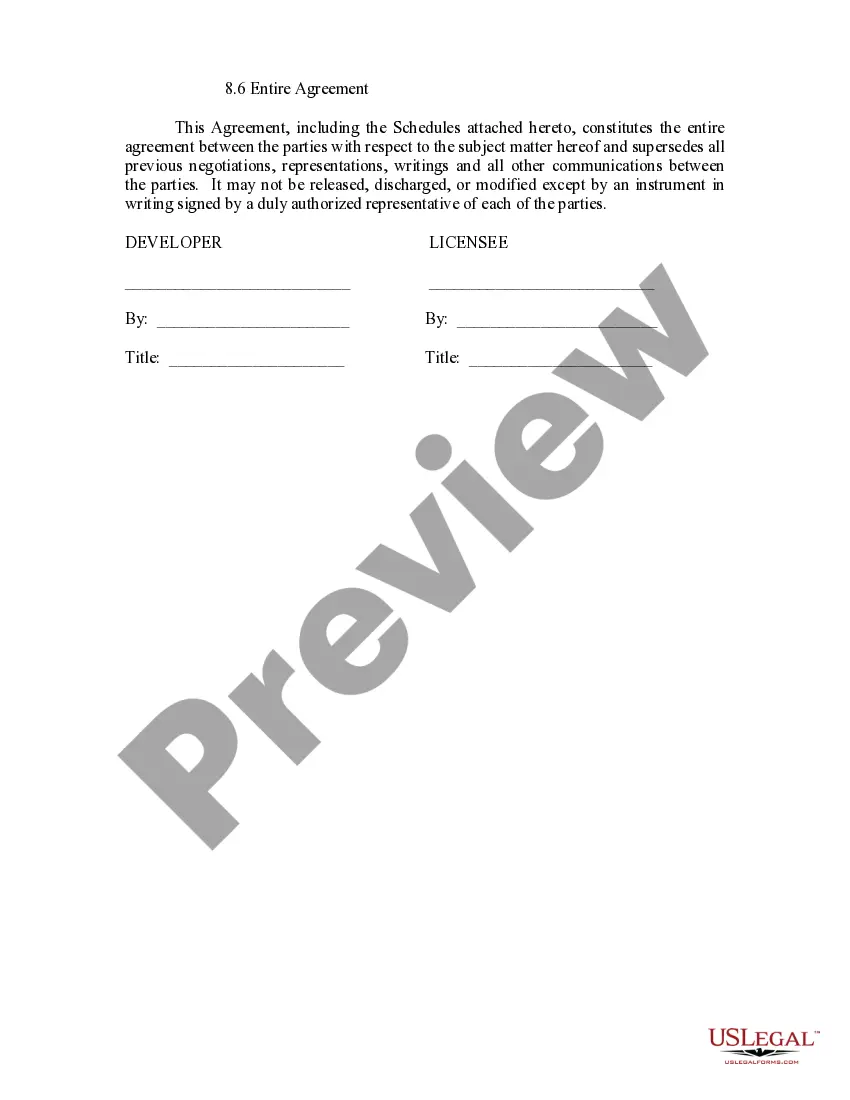
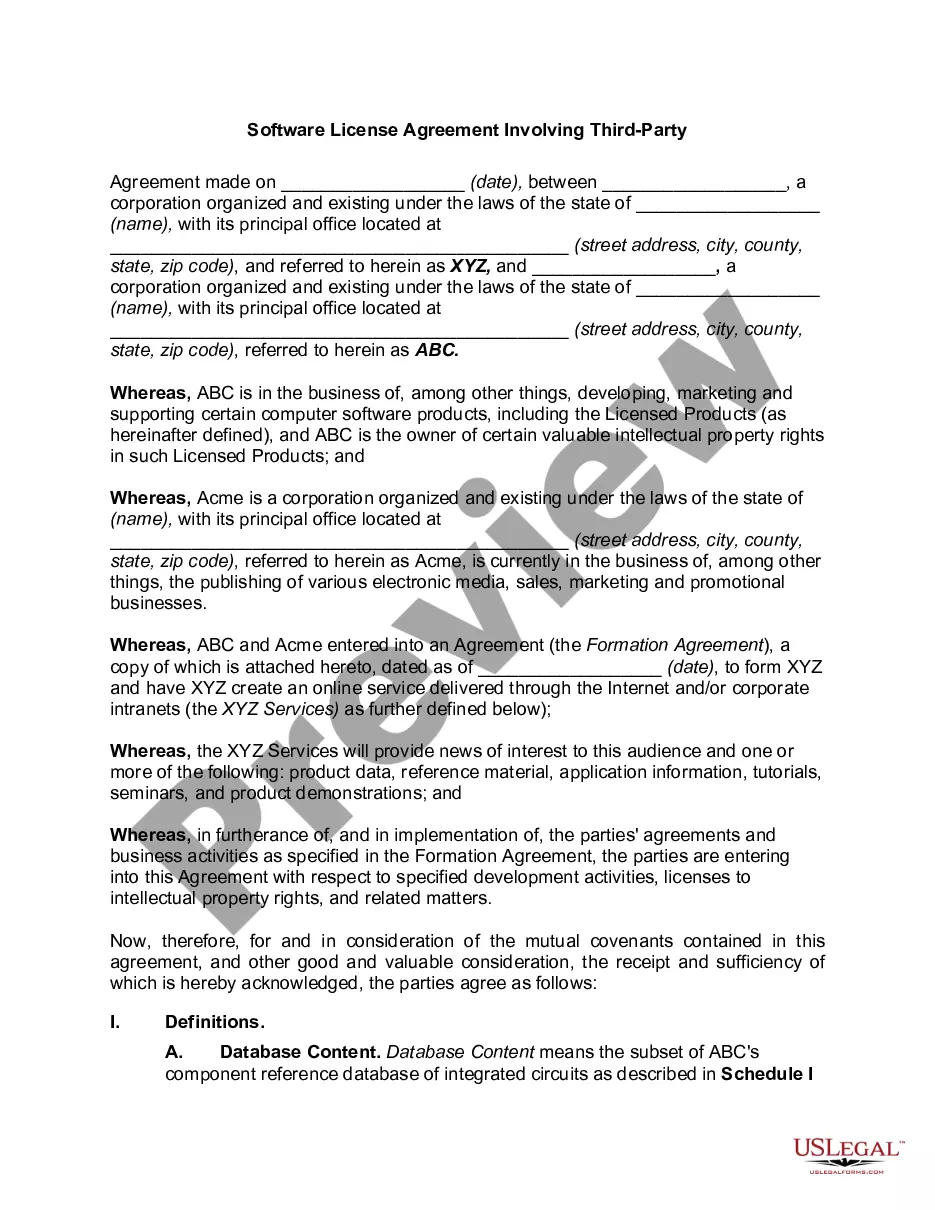
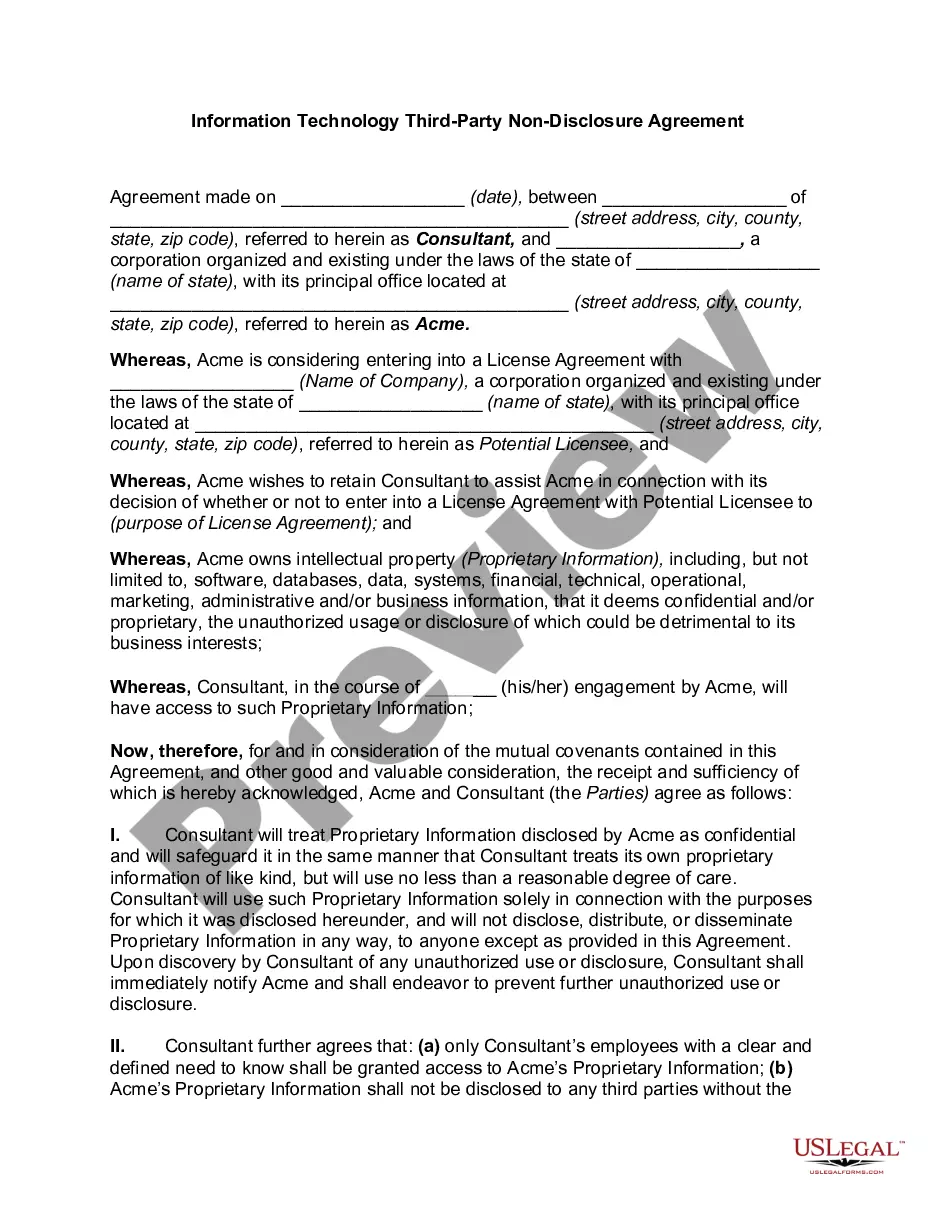
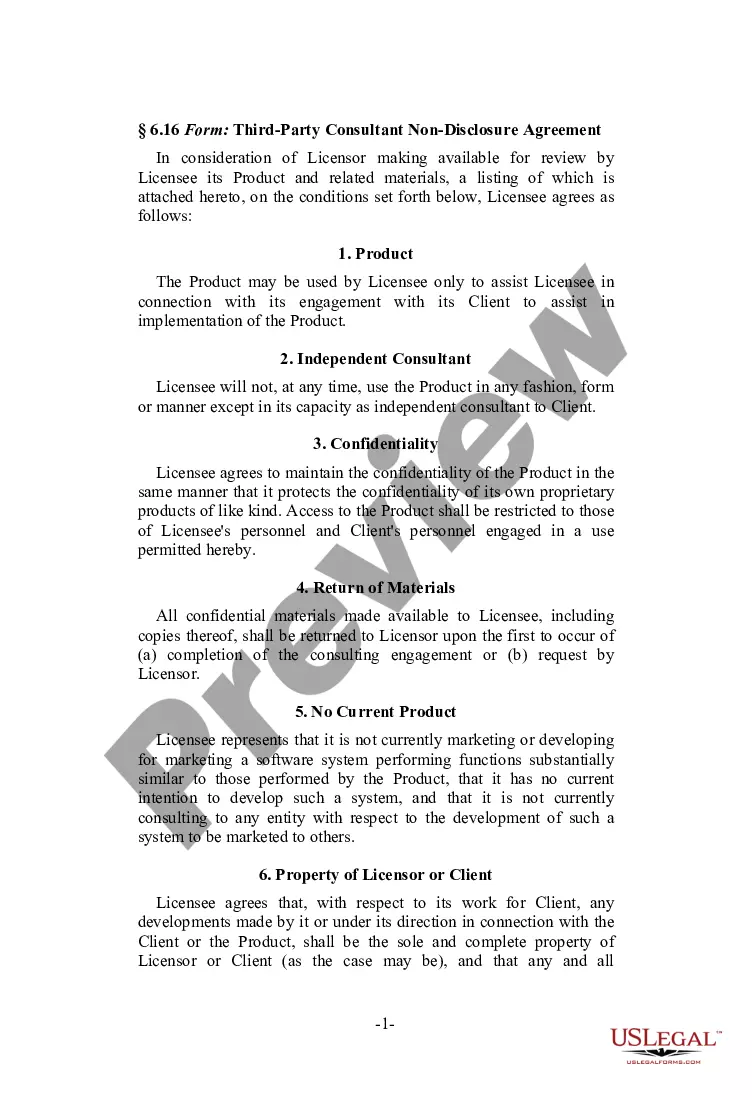
This form is a Third- Party Source Code Non-Disclosure Agreement. The licensee acknowledges and agrees that the proprietary information and all other items licensed under the contract and all copies constitute valuable trade secrets of the developer and title to the information remains in the developer. Also, all applicable copyrights, trade secrets, patents and other intellectual and property rights in the proprietary information are to remain in the developer.
Virginia Third-Party Source Code Nondisclosure Agreement
Category:
State:
Multi-State
Control #:
US-KWP-0001-A
Format:
Word;
Rich Text
Instant download
Description
Free preview
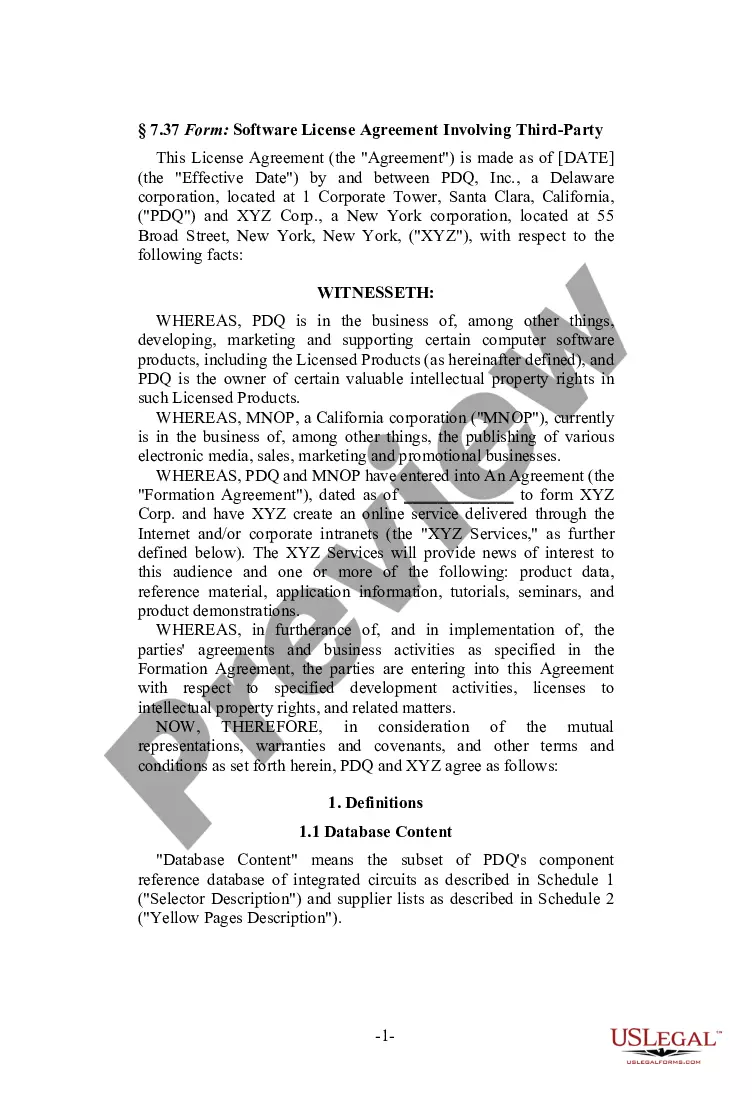
Get your form ready online
Our built-in tools help you complete, sign, share, and store your documents in one place.
Built-in online Word editor
Make edits, fill in missing information, and update formatting in US Legal Forms—just like you would in MS Word.
Export easily
Download a copy, print it, send it by email, or mail it via USPS—whatever works best for your next step.
E-sign your document
Sign and collect signatures with our SignNow integration. Send to multiple recipients, set reminders, and more. Go Premium to unlock E-Sign.
Notarize online 24/7
If this form requires notarization, complete it online through a secure video call—no need to meet a notary in person or wait for an appointment.
Store your document securely
We protect your documents and personal data by following strict security and privacy standards.

Make edits, fill in missing information, and update formatting in US Legal Forms—just like you would in MS Word.

Download a copy, print it, send it by email, or mail it via USPS—whatever works best for your next step.

Sign and collect signatures with our SignNow integration. Send to multiple recipients, set reminders, and more. Go Premium to unlock E-Sign.

If this form requires notarization, complete it online through a secure video call—no need to meet a notary in person or wait for an appointment.

We protect your documents and personal data by following strict security and privacy standards.
Looking for another form?


How to fill out Third-Party Source Code Nondisclosure Agreement?
Are you situated in a location where you frequently require documents for either organizational or personal tasks virtually every workday? There are numerous legitimate document templates available online, but finding ones you can trust is challenging. US Legal Forms offers a vast array of document templates, including the Virginia Third-Party Source Code Nondisclosure Agreement, which are designed to comply with state and federal regulations.
If you are already familiar with the US Legal Forms website and possess an account, simply Log In. After that, you can download the Virginia Third-Party Source Code Nondisclosure Agreement template.
If you do not have an account and wish to start using US Legal Forms, follow these steps: Find the document you need and ensure it is for the correct city/state. Utilize the Preview button to review the form. Check the description to confirm you have selected the right document. If the document is not what you're looking for, use the Search field to locate the form that meets your requirements. Once you find the appropriate document, click Buy now. Select the pricing plan you prefer, fill in the required information to create your account, and pay for the order using your PayPal or credit card. Choose a convenient file format and download your copy.
Avoid altering or deleting any HTML tags. Only synonymize plain text outside of the HTML tags.
- Locate all the document templates you have purchased in the My documents section.
- You can obtain an additional copy of the Virginia Third-Party Source Code Nondisclosure Agreement at any time if necessary.
- Just click the required document to download or print the template.
- Utilize US Legal Forms, one of the largest selections of legal documents, to save time and avoid errors.
- The service provides properly crafted legal document templates that you can use for various purposes.
- Create an account on US Legal Forms and start simplifying your life.
Form popularity
FAQ
Yes, NDAs are legal in Virginia and can provide essential protection for confidential information. However, they must adhere to specific legal standards to be enforceable. By utilizing a properly structured Virginia Third-Party Source Code Nondisclosure Agreement, you can safeguard your intellectual property and ensure compliance with Virginia law.
In Virginia, verbal agreements can be difficult to enforce, particularly in cases involving nondisclosure. While some verbal agreements may hold weight, the lack of written documentation often complicates legal proceedings. To protect your interests more effectively, consider using a written Virginia Third-Party Source Code Nondisclosure Agreement from uslegalforms, which provides clarity and documentation for all parties.
An NDA may be deemed not enforceable for several reasons, including vagueness in defining confidential information or overly broad terms that restrict fair competition. Additionally, if the agreement lacks consideration or mutual assent, it can be challenged in court. To avoid these pitfalls, ensure your Virginia Third-Party Source Code Nondisclosure Agreement is clear, specific, and mutually agreed upon.
Filling out a nondisclosure agreement involves several key steps. First, clearly identify the parties involved and provide their contact information. Next, specify the confidential information covered, the purpose of the disclosure, and the duration of the agreement. Using a template from uslegalforms can simplify the process of creating a Virginia Third-Party Source Code Nondisclosure Agreement, ensuring all necessary elements are included.
Yes, nondisclosure agreements (NDAs) are enforceable in Virginia provided they meet certain legal requirements. For an NDA to be valid, it must clearly define the confidential information and the obligations of the parties. A well-drafted Virginia Third-Party Source Code Nondisclosure Agreement can effectively protect your sensitive information and provide legal recourse if breached.
The 3 hour rule in Virginia refers to a specific guideline concerning the enforcement of nondisclosure agreements. This rule emphasizes that parties should not disclose any confidential information for at least three hours after a meeting or discussion. Understanding this rule can be crucial when drafting a Virginia Third-Party Source Code Nondisclosure Agreement to ensure all parties are adequately protected.
An example of a non-disclosure agreement is the Virginia Third-Party Source Code Nondisclosure Agreement, which protects sensitive information shared between two parties. This type of NDA typically specifies the information being protected, outlines the obligations of both parties, and sets the duration of confidentiality. You can find examples and templates on platforms like uslegalforms, which can help you draft an effective agreement tailored to your specific needs.
Yes, you can write your own non-disclosure agreement, but it is crucial to ensure it meets legal standards. A Virginia Third-Party Source Code Nondisclosure Agreement should include clear definitions of confidential information and the responsibilities of each party. While creating your own NDA may save costs, using a professional template can provide peace of mind and ensure all necessary components are included.
Writing a simple NDA involves a few key steps. Begin by clearly identifying the parties involved, and then define the confidential information that will be covered under the Virginia Third-Party Source Code Nondisclosure Agreement. Include terms about how long the confidentiality obligations will last, and describe what happens in case of a breach. Using a template from a trusted source, like uslegalforms, can simplify the process.
To fill a non-disclosure agreement form, first ensure that you have the correct template for a Virginia Third-Party Source Code Nondisclosure Agreement. Start by entering the names of the parties involved, including their addresses. Next, specify the confidential information that will be protected, and outline the obligations each party has regarding that information. Finally, review the agreement for clarity and sign it to make it legally binding.