Connecticut Complaint (Final Bill for Services)
Overview of this form
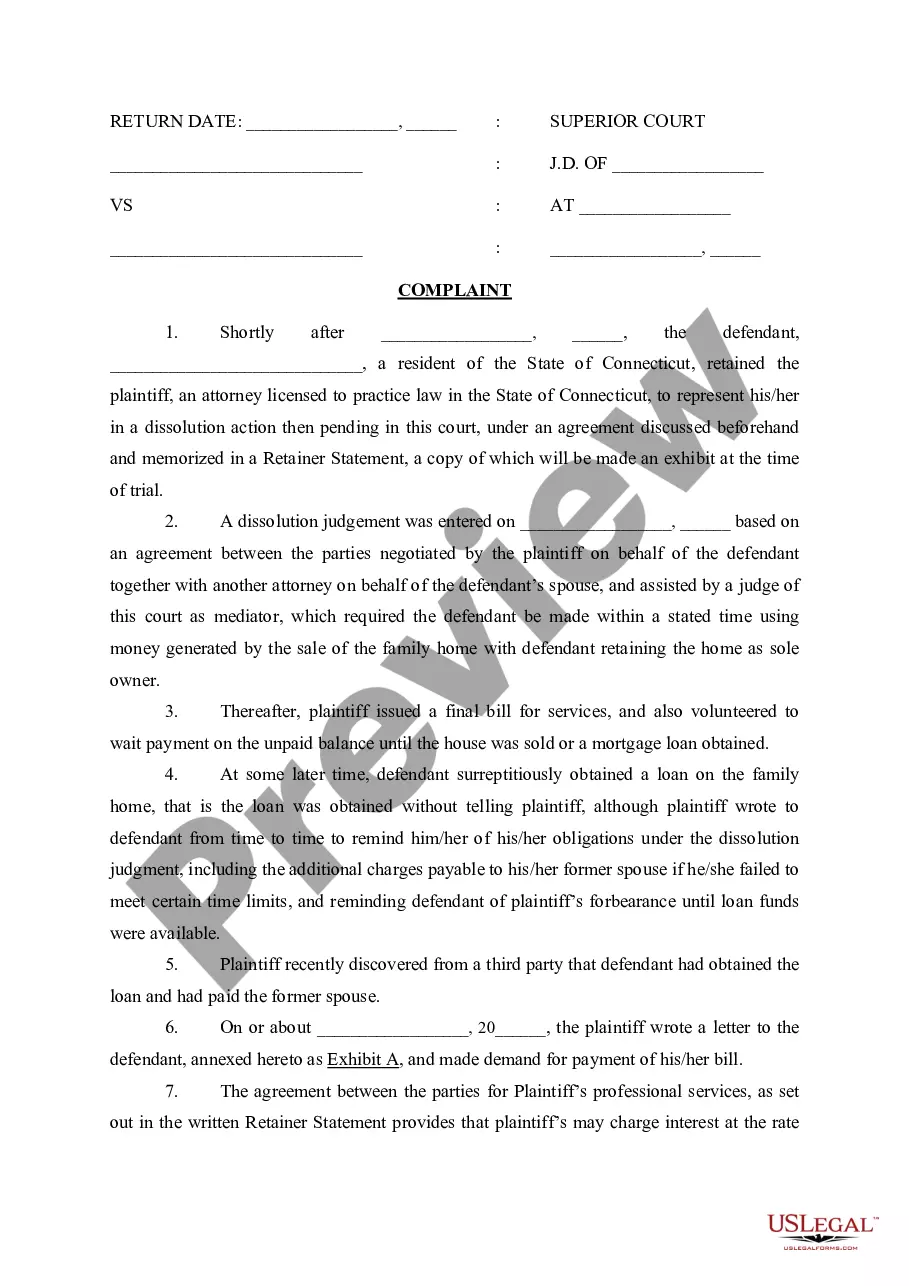
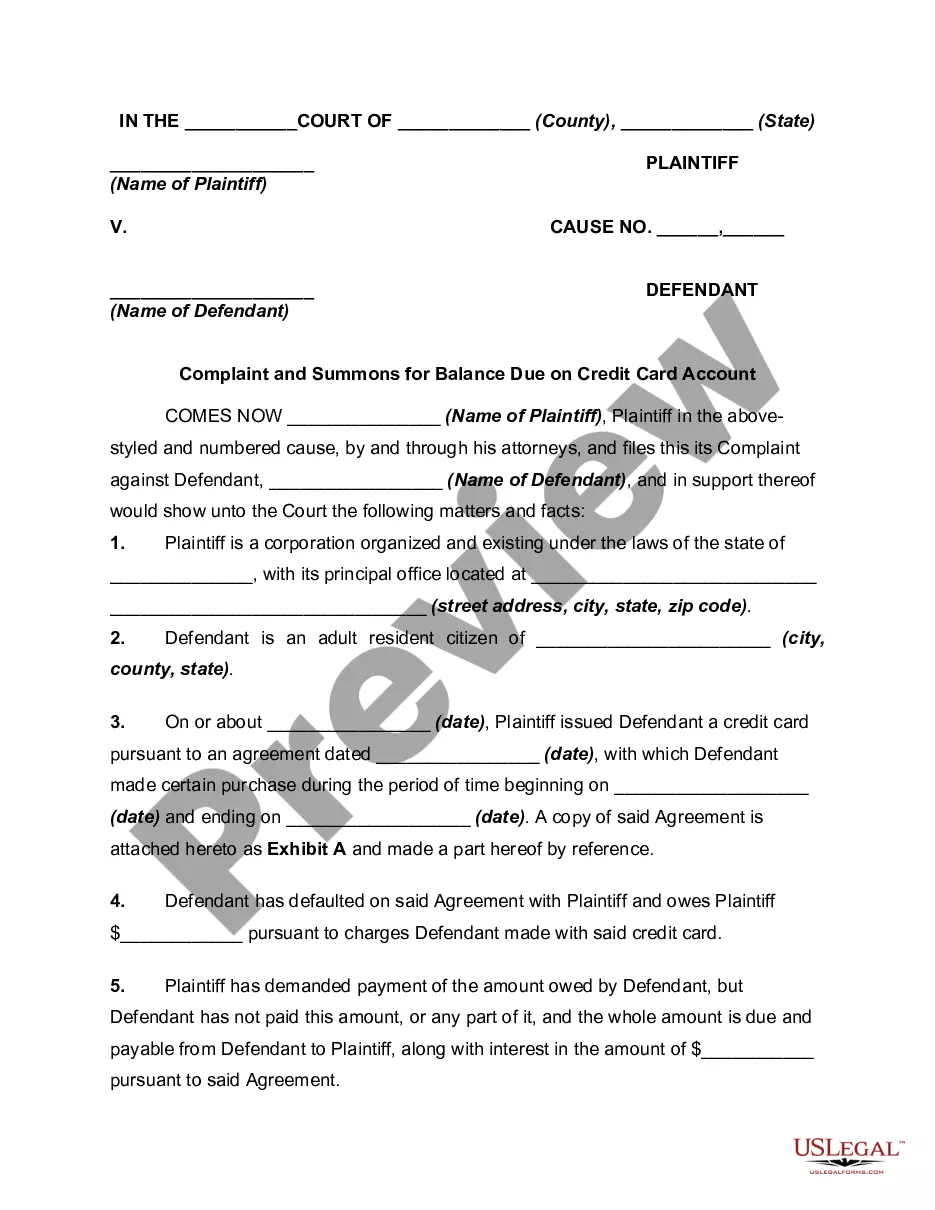
The Complaint (Final Bill for Services) is a legal document submitted to the court to seek payment for unpaid attorney fees related to a Retainer Statement. This form is specifically used in situations where an attorney has provided services in a legal matter, such as a dissolution of marriage, and is owed payment as specified in the initial agreement. It differs from other complaints as it focuses on fees for legal representation rather than general claims or damages.
Key parts of this document
- Parties involved: Identification of the plaintiff (attorney) and defendant (client).
- Retainer Statement reference: Details the agreement between the attorney and client.
- Details of the dissolution judgment: Dates and obligations relevant to the case and fee structure.
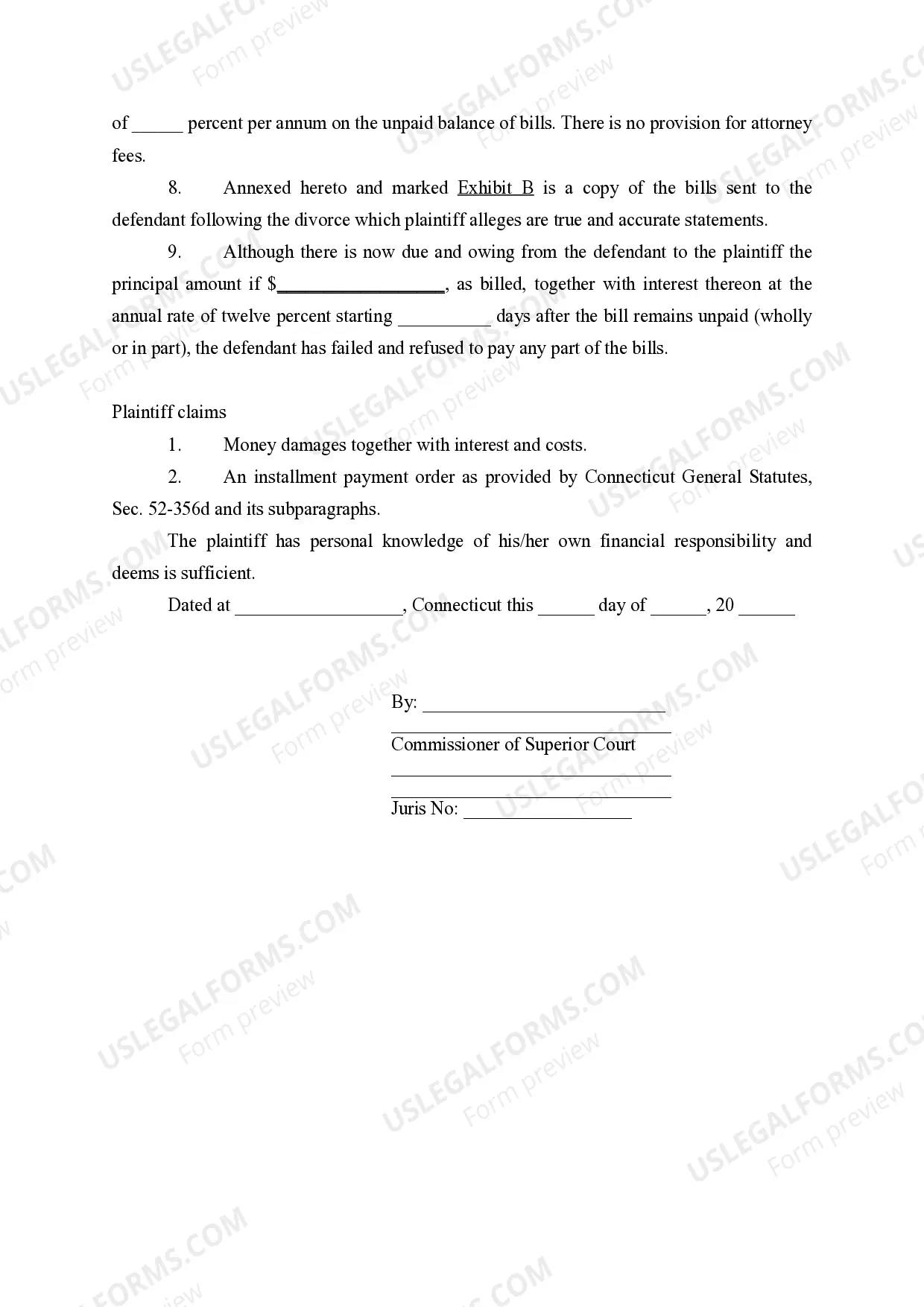
- Payment demand: Records attempts made by the attorney to collect unpaid fees.
- Claim for damages: Specifies the amount owed and interest on unpaid fees.
Situations where this form applies
This form is used when an attorney seeks to enforce payment for services rendered, particularly after a dissolution judgment has been entered and the client has failed to pay the final bill. It is pertinent when a client has retained legal services but has defaulted on payment despite previous agreements and communications about the outstanding balance.
Who needs this form
- Attorneys who have provided legal services under a retainer agreement and are owed payment.
- Clients involved in a legal dissolution who have not fulfilled their payment obligations.
- Representatives or legal aides managing collections for unpaid legal fees on behalf of attorneys.
Completing this form step by step
- Identify the parties: Fill in the names and addresses of both the plaintiff and defendant.
- Enter relevant dates: Specify the dates when the retainer was signed, the judgment was entered, and the demand for payment was made.
- Detail the payment amount: State the total amount due, including any interest calculations.
- Attach relevant exhibits: Include copies of the Retainer Statement and bills as referenced in the complaint.
- Sign and date the form: Ensure it is signed by the plaintiff or their authorized representative as required by the jurisdiction.
Is notarization required?
This form does not typically require notarization unless specified by local law. Ensure to check local requirements to confirm any notarization needs prior to submission.
Get your form ready online
Our built-in tools help you complete, sign, share, and store your documents in one place.
Make edits, fill in missing information, and update formatting in US Legal Forms—just like you would in MS Word.
Download a copy, print it, send it by email, or mail it via USPS—whatever works best for your next step.
Sign and collect signatures with our SignNow integration. Send to multiple recipients, set reminders, and more. Go Premium to unlock E-Sign.
If this form requires notarization, complete it online through a secure video call—no need to meet a notary in person or wait for an appointment.
We protect your documents and personal data by following strict security and privacy standards.

Make edits, fill in missing information, and update formatting in US Legal Forms—just like you would in MS Word.

Download a copy, print it, send it by email, or mail it via USPS—whatever works best for your next step.

Sign and collect signatures with our SignNow integration. Send to multiple recipients, set reminders, and more. Go Premium to unlock E-Sign.

If this form requires notarization, complete it online through a secure video call—no need to meet a notary in person or wait for an appointment.

We protect your documents and personal data by following strict security and privacy standards.
Typical mistakes to avoid
- Failing to include all required exhibits, such as the Retainer Statement and final bills.
- Not specifying the correct amount due or miscalculating interest.
- Missing signatures or dates which can invalidate the complaint.
Benefits of completing this form online
- Instant access to professionally drafted forms that are up to date with legal standards.
- Easy customization options to meet specific legal needs and requirements.
- Convenient downloading and printing options for immediate use.
Looking for another form?

Form popularity
FAQ
To file a consumer complaint in Connecticut, you can visit the Connecticut Department of Consumer Protection's website. Here, you can access the necessary forms and guidelines to ensure your complaint is comprehensive. Clearly stating your issue and including supporting documents will strengthen your Connecticut Complaint (Final Bill for Services). Once submitted, you can track the progress of your complaint directly through their platform.
Filing a consumer complaint initiates an official process where your concerns are reviewed and investigated. This can lead to resolution for your specific issue and often helps protect other consumers by highlighting potential problems. Your action in submitting a Connecticut Complaint (Final Bill for Services) helps to hold businesses accountable. It also encourages improvements in service and compliance with regulations.
To file a complaint with the Connecticut Department of Public Health (CT DPH), you need to provide detailed information about the issue. This includes your contact information, specifics about the incident, and any relevant documentation. Submitting this information allows CT DPH to begin investigating your Connecticut Complaint (Final Bill for Services) effectively. You can file online or call their office for assistance.
The CT Consumer Data Protection Act is legislation aimed at protecting consumer personal data from misuse. This Act mandates transparency and accountability from businesses regarding how they handle consumer information. If you feel your data has been mishandled, you may consider filing a Connecticut Complaint (Final Bill for Services) to address these privacy concerns.
The four main types of consumer protection include product safety, fair advertising, privacy rights, and the right to redress. Each type aims to ensure businesses treat consumers fairly, providing a channel for filing a Connecticut Complaint (Final Bill for Services) when necessary. Having this knowledge helps you navigate your rights effectively.
To file a complaint against a business in Connecticut, you can visit the Connecticut Department of Consumer Protection's website. They provide a straightforward process for submitting a Connecticut Complaint (Final Bill for Services), including guidelines on documentation needed. It’s essential to provide clear details about your experience to facilitate a thorough investigation.
The Consumer Protection Act offers a variety of protections, including the right to fair treatment, accurate advertising, and the opportunity to challenge unfair business practices. If you believe you are a victim, you can submit a Connecticut Complaint (Final Bill for Services) to initiate an investigation. The Act aims to ensure that businesses operate ethically and transparently.
The Consumer Protection Act in Connecticut is a law designed to safeguard consumers from unfair and deceptive practices. It provides a framework for individuals to file complaints, including a Connecticut Complaint (Final Bill for Services), against businesses that violate consumer rights. This law empowers consumers by encouraging them to report wrongdoings and seek justice.
To report a business for non-payment, start by documenting all relevant details, including contracts, invoices, and communications. Next, you can report to regulatory bodies or file a grievance through the appropriate channels in Connecticut. Utilizing tools, such as a Connecticut Complaint (Final Bill for Services), can also streamline the process of holding businesses accountable.
The four types of complaints include service complaints, product complaints, billing complaints, and warranty complaints. Each type of complaint can help businesses identify areas for improvement and ensure better customer experiences. When you encounter these issues, consider lodging a Connecticut Complaint (Final Bill for Services) to facilitate addressing your concerns.