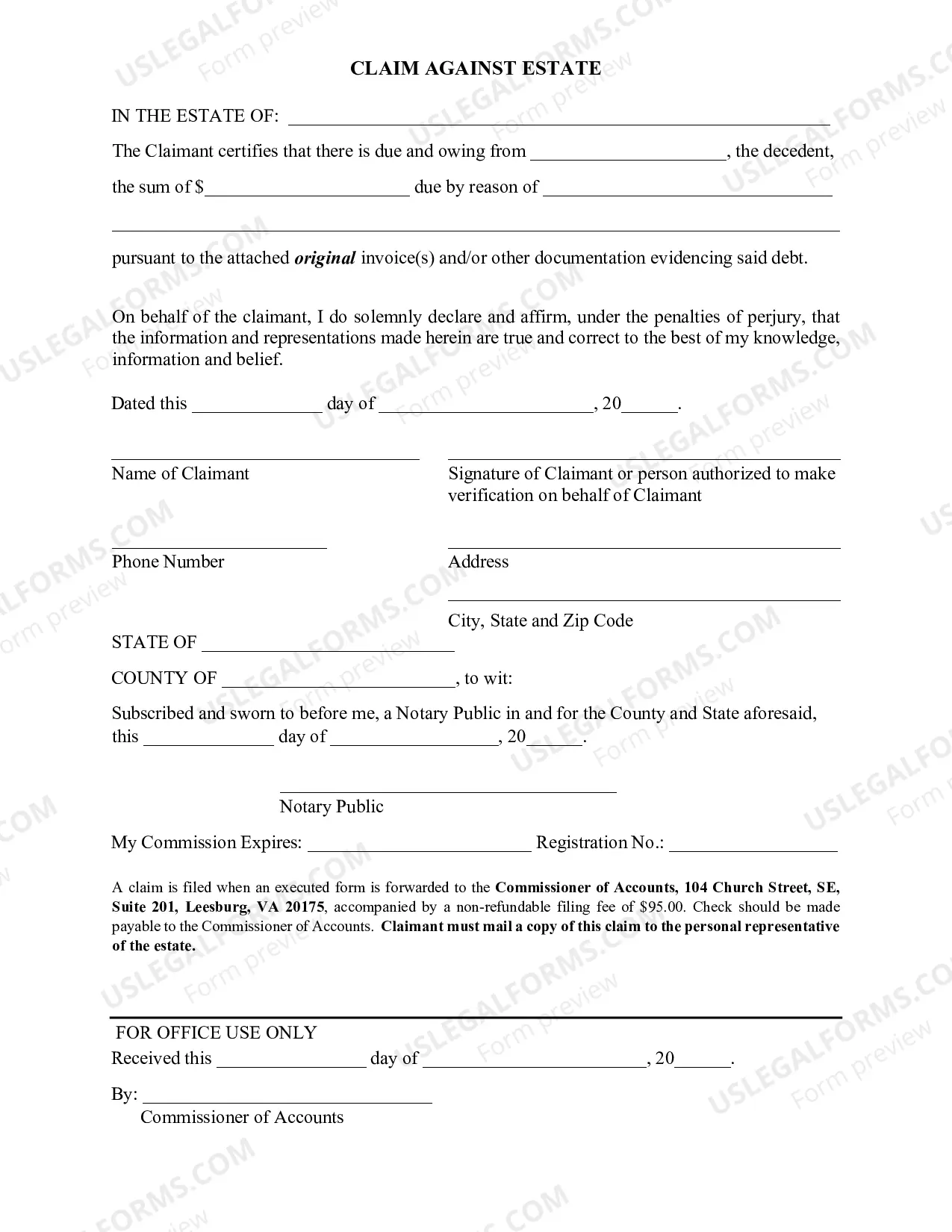
A Virginia Claim Against Estate is a legal document that is filed in the circuit court in the county or city where the estate of the decedent is located. It is used to make a claim against the estate of a deceased person for an unpaid debt or other obligation. The Virginia Claim Against Estate can be filed by a creditor, an heir, or a third party such as a lien holder or other claimant. There are three different types of Virginia Claim Against Estate: 1) General Claim Against Estate, 2) Specific Claim Against Estate, and 3) Conflict Claim Against Estate. A General Claim Against Estate is a claim that is made against the estate for a debt or obligation that existed prior to the decedent's death. This type of claim can be made by a creditor, an heir, or a third party. A Specific Claim Against Estate is a claim that is made against the estate for a specific debt or obligation that is identified in the claim. This type of claim can also be made by a creditor, an heir, or a third party. A Conflict Claim Against Estate is a claim that is made against the estate for a debt or obligation that is in dispute between two or more parties. This type of claim can also be made by a creditor, an heir, or a third party.
Virginia Claim Against Estate
Description
Get your form ready online
Our built-in tools help you complete, sign, share, and store your documents in one place.
Make edits, fill in missing information, and update formatting in US Legal Forms—just like you would in MS Word.
Download a copy, print it, send it by email, or mail it via USPS—whatever works best for your next step.
Sign and collect signatures with our SignNow integration. Send to multiple recipients, set reminders, and more. Go Premium to unlock E-Sign.
If this form requires notarization, complete it online through a secure video call—no need to meet a notary in person or wait for an appointment.
We protect your documents and personal data by following strict security and privacy standards.

Make edits, fill in missing information, and update formatting in US Legal Forms—just like you would in MS Word.

Download a copy, print it, send it by email, or mail it via USPS—whatever works best for your next step.

Sign and collect signatures with our SignNow integration. Send to multiple recipients, set reminders, and more. Go Premium to unlock E-Sign.

If this form requires notarization, complete it online through a secure video call—no need to meet a notary in person or wait for an appointment.

We protect your documents and personal data by following strict security and privacy standards.
Looking for another form?

How to fill out Virginia Claim Against Estate?
Preparing official paperwork can be a real stress unless you have ready-to-use fillable templates. With the US Legal Forms online library of formal documentation, you can be confident in the blanks you find, as all of them correspond with federal and state regulations and are examined by our experts. So if you need to complete Virginia Claim Against Estate, our service is the perfect place to download it.
Getting your Virginia Claim Against Estate from our library is as easy as ABC. Previously authorized users with a valid subscription need only sign in and click the Download button after they locate the proper template. Later, if they need to, users can get the same document from the My Forms tab of their profile. However, even if you are new to our service, signing up with a valid subscription will take only a few moments. Here’s a quick guideline for you:
- Document compliance verification. You should attentively review the content of the form you want and make sure whether it suits your needs and fulfills your state law regulations. Previewing your document and reviewing its general description will help you do just that.
- Alternative search (optional). If there are any inconsistencies, browse the library using the Search tab on the top of the page until you find a suitable blank, and click Buy Now when you see the one you need.
- Account creation and form purchase. Create an account with US Legal Forms. After account verification, log in and select your preferred subscription plan. Make a payment to continue (PayPal and credit card options are available).
- Template download and further usage. Choose the file format for your Virginia Claim Against Estate and click Download to save it on your device. Print it to complete your paperwork manually, or use a multi-featured online editor to prepare an electronic version faster and more effectively.
Haven’t you tried US Legal Forms yet? Sign up for our service now to get any formal document quickly and easily any time you need to, and keep your paperwork in order!
Form popularity
FAQ
What is probate? Probate is when the court supervises the processes that transfer legal title of property from the estate of the person who has died (the "decedent") to his or her beneficiaries.
Ing to the UPC, close relatives always come first in the order of inheritance. Generally speaking, the surviving spouse is first in line to inherit, with children and grandchildren next in line. If the surviving spouse has any minor children, they may inherit the whole estate.
The creditor holding such debt may file a claim for such debt with the commissioner of accounts pursuant to § 64.2-552 on or before the later of one year after the qualification of the personal representative of the decedent's estate or six months after the personal representative gives such written notice to the
With a will, all surviving heirs receive a portion of the estate. Typically this comes in the form of cash endowments, stocks, real estate, and property. The inheritance may be distributed to children, grandchildren, and other heirs as determined by the stipulations of the will.
This involves: finding all the financial documentation belonging to the person who died. sending a copy of the death certificate to the organisations that hold the money of the person who has died.opening a bank account on behalf of the estate. finding out details of money owed to the estate.
Any person who seeks to prove that he has a debt or demand against the decedent or the decedent's estate shall file his claim in writing with the commissioner of accounts, who shall endorse upon it the date of the filing and sign the endorsement in his official character.
Typically, fees ? such as fiduciary, attorney, executor, and estate taxes ? are paid first, followed by burial and funeral costs. If the deceased member's family was dependent on him or her for living expenses, they will receive a ?family allowance? to cover expenses. The next priority is federal taxes.
The creditor period is one year after the qualification of a personal representative but reduces to six months after the representative provides written notice of the death.