Plugging Requirements
Understanding this form
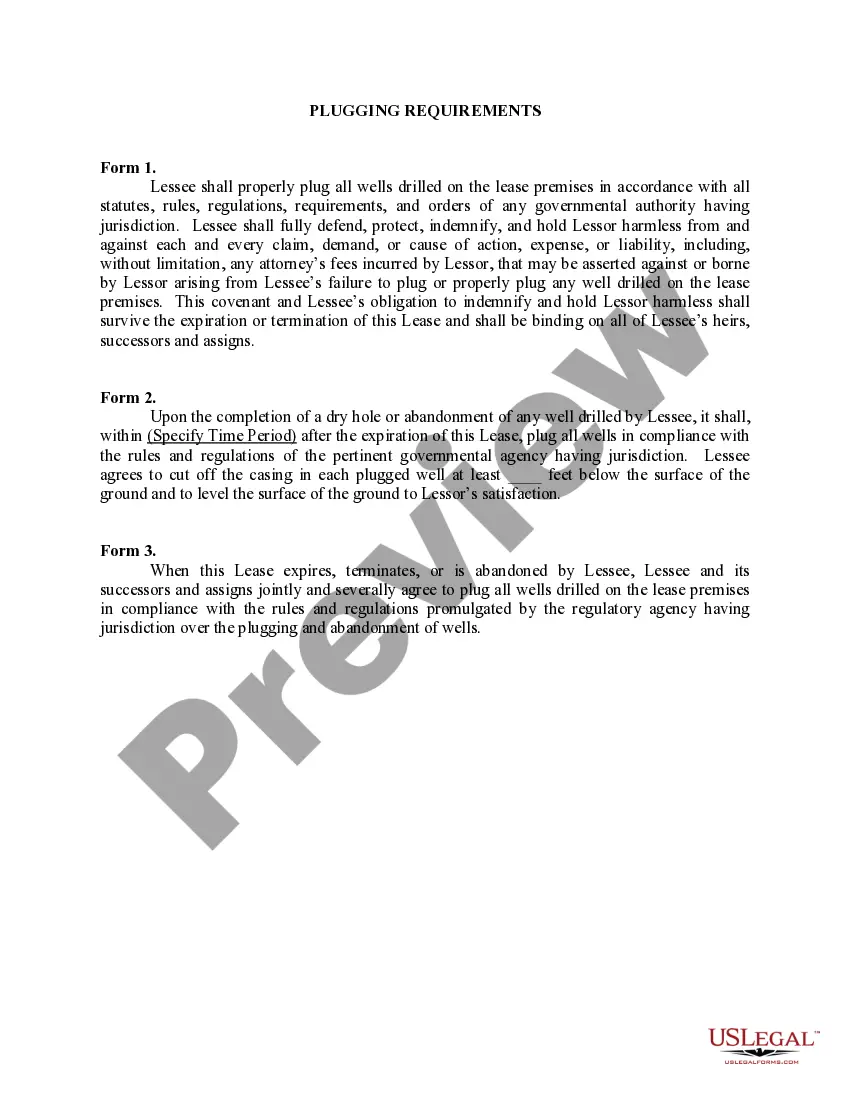
The Plugging Requirements form is a lease rider that specifies the obligations of the Lessee regarding well plugging during oil and gas lease transactions. This form ensures that additional provisions are included to address the Lessor's concerns or limitations on Lessee's rights, providing more protection for the Lessor compared to standard lease agreements. It is essential for those engaging in oil and gas leases to ensure compliance with state regulations about well plugging and abandonment responsibilities.
What’s included in this form
- Obligation of the Lessee to properly plug all wells on the lease premises.
- Indemnification clause protecting the Lessor from claims related to the Lessee's failure to plug wells.
- Requirements for cutting off casing and leveling the ground upon well abandonment.
- Provision stating that obligations survive lease expiration or termination.

When to use this form
This form should be used when entering into an oil and gas lease where specific conditions about well plugging need to be established. It is particularly useful if there are concerns about environmental impacts or liability related to well abandonment. Additionally, this form is beneficial when the Lessor seeks to protect their interests in ensuring that wells are properly decommissioned after use.
Who this form is for
- Lessors entering into oil and gas lease agreements.
- Lessee companies looking to formalize obligations regarding well plugging.
- Landowners concerned about the environmental impact of drilling activities.
- Attorneys or legal representatives involved in lease negotiations.
Steps to complete this form
- Identify the parties involved in the lease agreement: the Lessor and Lessee.
- Specify the property description and details of the lease.
- Clearly state the time period for plugging wells after completion or abandonment.
- Indicate the required depth for cutting off the casing for each plugged well.
- Ensure all necessary signatures are collected to validate the agreement.
Is notarization required?
This form does not typically require notarization unless specified by local law. It is advisable to check state regulations to ensure compliance with any notarization requirements for lease agreements involving oil and gas operations.
Get your form ready online
Our built-in tools help you complete, sign, share, and store your documents in one place.
Make edits, fill in missing information, and update formatting in US Legal Forms—just like you would in MS Word.
Download a copy, print it, send it by email, or mail it via USPS—whatever works best for your next step.
Sign and collect signatures with our SignNow integration. Send to multiple recipients, set reminders, and more. Go Premium to unlock E-Sign.
If this form requires notarization, complete it online through a secure video call—no need to meet a notary in person or wait for an appointment.
We protect your documents and personal data by following strict security and privacy standards.

Make edits, fill in missing information, and update formatting in US Legal Forms—just like you would in MS Word.

Download a copy, print it, send it by email, or mail it via USPS—whatever works best for your next step.

Sign and collect signatures with our SignNow integration. Send to multiple recipients, set reminders, and more. Go Premium to unlock E-Sign.

If this form requires notarization, complete it online through a secure video call—no need to meet a notary in person or wait for an appointment.

We protect your documents and personal data by following strict security and privacy standards.
Common mistakes to avoid
- Failing to clearly define the obligations regarding well plugging.
- Not specifying the time frame for the completion of plugging tasks.
- Ignoring local regulations that may modify standard language in the form.
Benefits of using this form online
- Convenient access to legal forms at any time.
- Editable templates that allow for customization based on specific needs.
- Reliable legal foundation drafted by licensed attorneys, ensuring proper language and compliance.
Legal use & context
- This form is enforceable as long as it complies with applicable local laws and regulations regarding oil and gas lease agreements.
- It is advisable to seek legal counsel to address specific concerns about the plugging requirements based on jurisdiction.
Key takeaways
- The Plugging Requirements form is essential for outlining Lessee responsibilities.
- It provides critical protections for Lessors regarding well abandonment.
- Ensure you comply with specific state regulations when using this form.
Looking for another form?

Form popularity
FAQ
Some cost $20,000. Some cost more than $1,ooo,ooo. These prices do not include reclamation or site prep if needed. If you have a shallow well (less than 10002032 deep), have good well records, and the well was recently in production (i.e. the perfect well), you may very well get it plugged for $20,000-$25,000.
A well is plugged by setting mechanical or cement plugs in the wellbore at specific intervals to prevent fluid flow. The plugging process usually requires a workover rig and cement pumped into the wellbore.
There are more than 6,200 abandoned oil and gas wells in Texas, according to the Texas Railroad Commission, which oversees oil and gas companies operating in the state.
Over this time, more than 1.165 million wells have been drilled, producing 25.2 billion barrels of oil and 214 trillion cubic feet of gas. A massive hydrocarbon-producing region, the Permian Basin features a diverse combination of conventional and unconventional plays as well as multiple production horizons.
Total capital costs per well in the onshore regions considered in the study from $4.9 million to $8.3 million, including average completion costs that generally fell in the range of $ 2.9 million to $ 5.6 million per well. However, there is considerable cost variability between individual wells.
The two main oil sources in Texas are the Eagle Ford Shale and Permian Basin. The top oil towns in Texas include big names, such as Houston and Dallas, as well as the underrated Midland, Texas.
Oil industry experts estimate that the cost to plug and abandon a modern U.S. shale well is $33,000 per well. Industry cost data from outside the U.S. (there is no available U.S. industry cost data) indicates that actual costs may be an order of magnitude higher on average.
The cost of a routine abandonment of a typical well in the United States is about $5,000 (~Texas average cost in year 2000). If a well has developed a leak that allows gas to flow up the outside of the well casing, finding and correcting the leak can push the cost of abandonment beyond $100,000.