Sample Final Warning
What this document covers
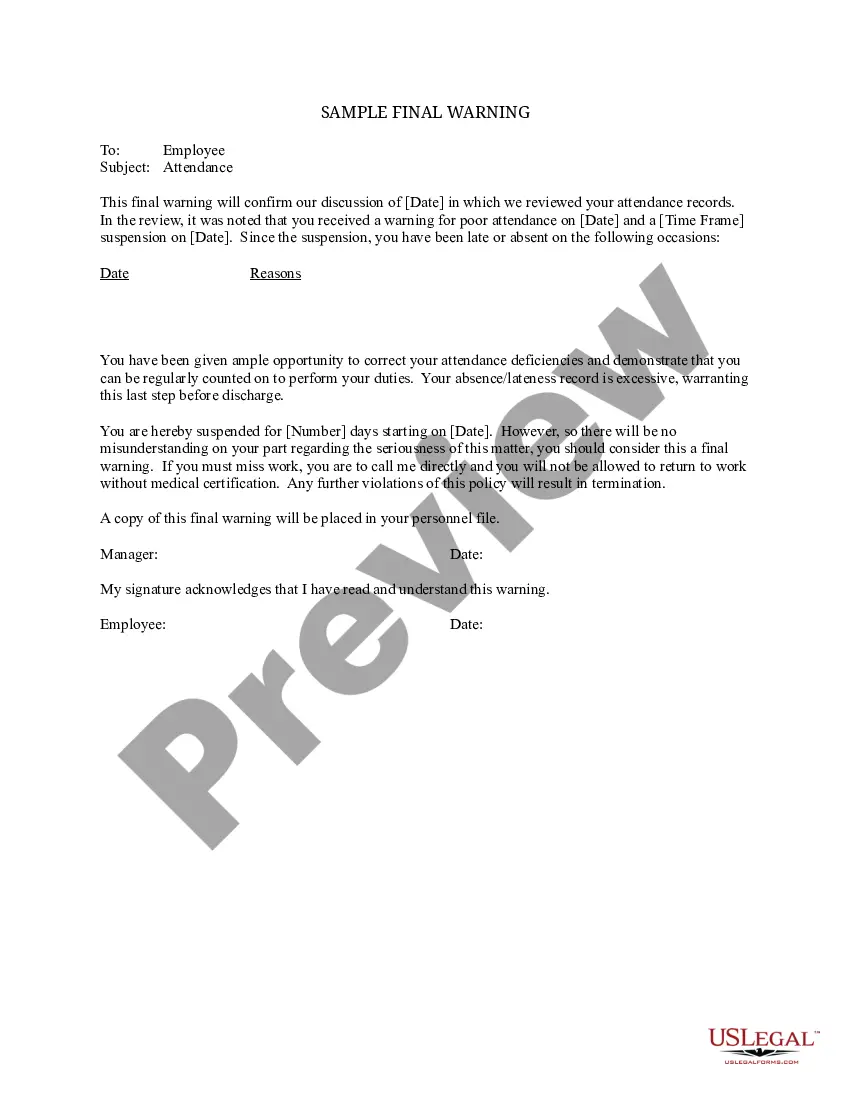
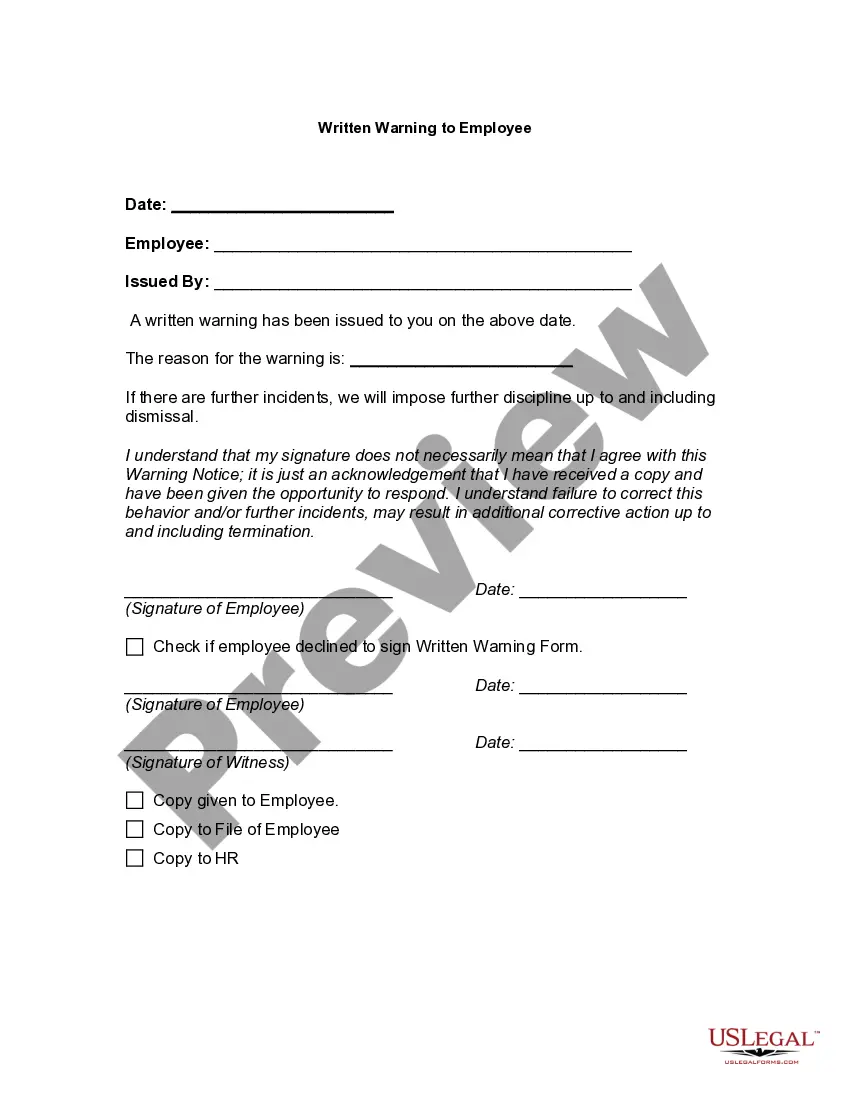
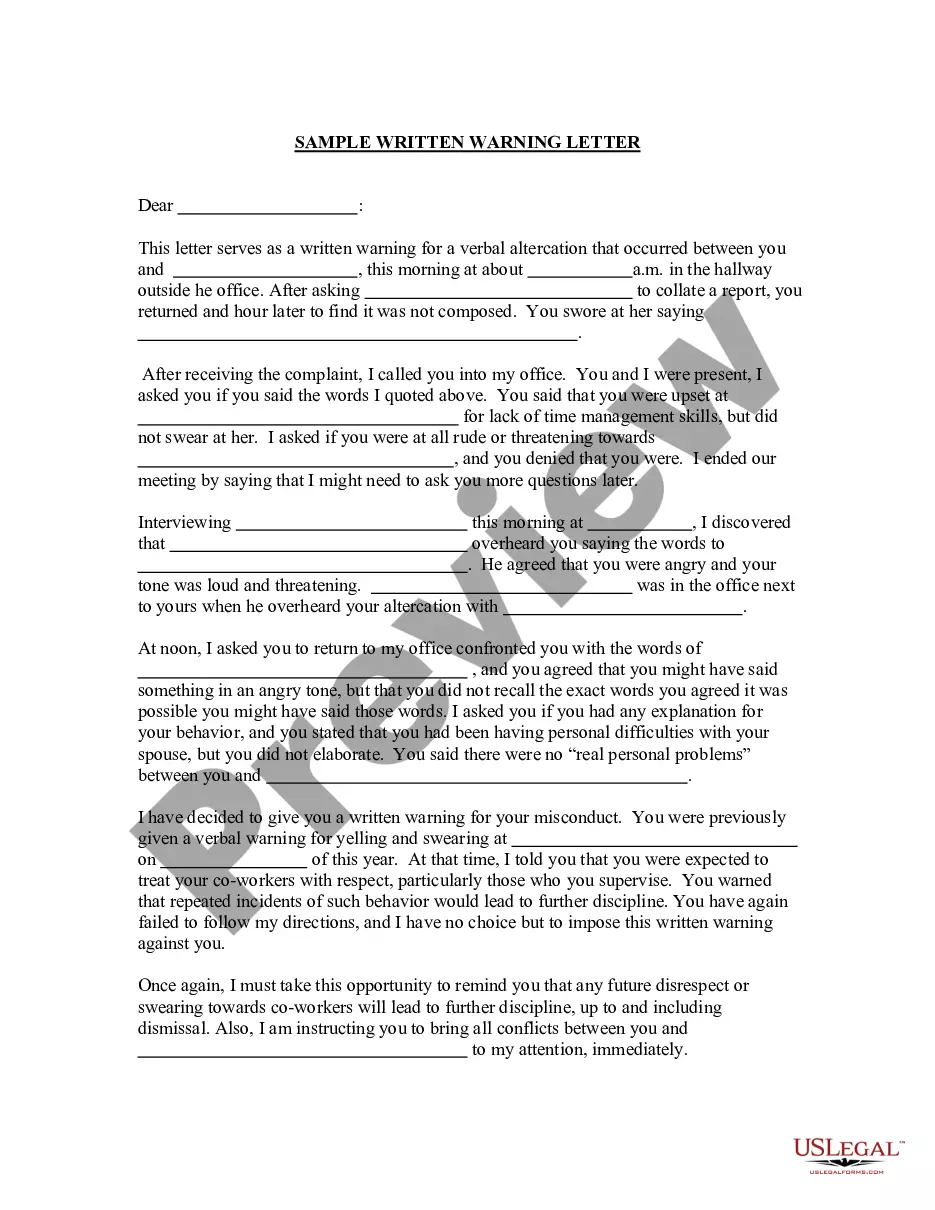
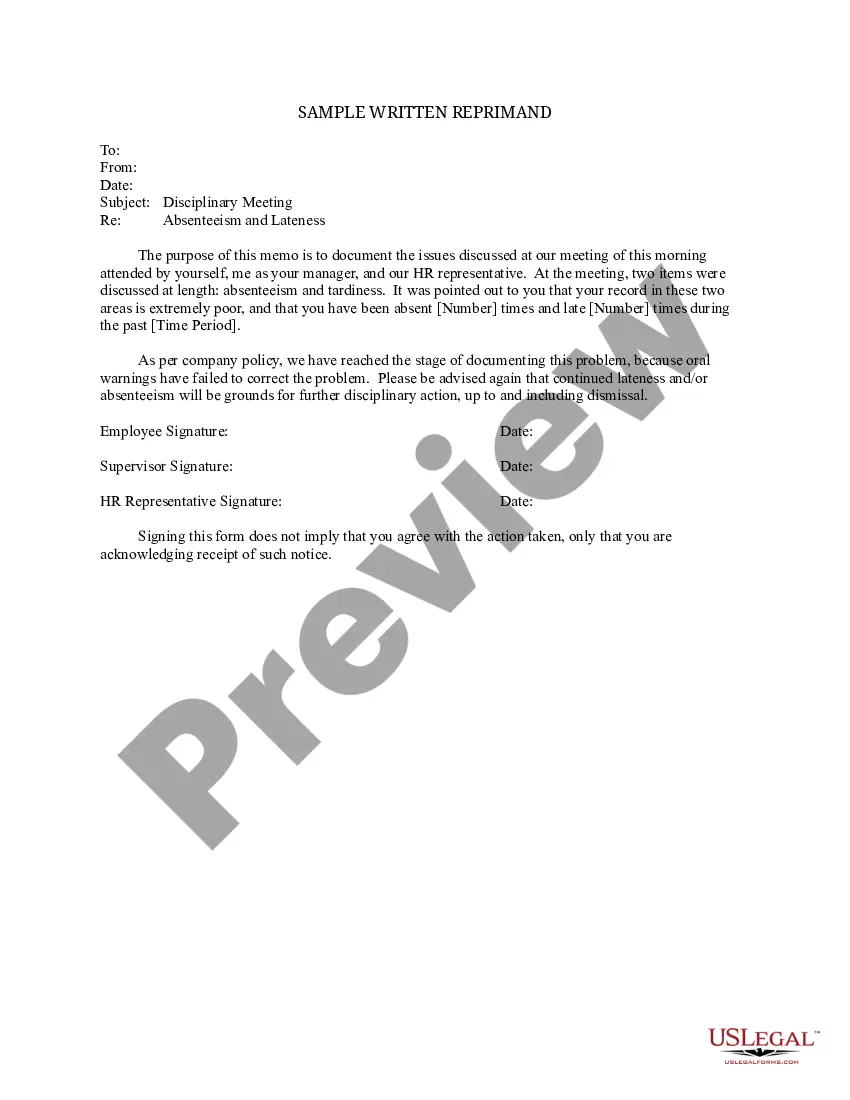
The Sample Final Warning is a crucial document used by employers to formally address ongoing performance or behavior issues with an employee. This final warning serves as a last opportunity for the employee to correct their actions before facing further disciplinary actions, including suspension or termination. Unlike other disciplinary forms, this document explicitly outlines the specific violations that have occurred and the expected improvements moving forward.
Key components of this form
- Date of the warning notification.
- Subject of the warning (e.g., attendance issues).
- Details of previous warnings and incidents leading to this final warning.
- Duration of the suspension and any applicable dates.
- Guidelines for further violations and the consequences thereof.
- Signatures of both manager and employee for acknowledgment.
When to use this form
This form should be used when an employee has repeatedly failed to meet established performance standards after prior warnings. It is typically issued in situations where there have been multiple infractions, such as consistent tardiness or absenteeism, that have not improved despite earlier discussions and warnings. Utilizing this final warning gives the employee a clear understanding of their position and the dire consequences of continued violations.
Who needs this form
- Employers or managers who need to document a final warning.
- HR professionals responsible for employee disciplinary actions.
- Businesses implementing performance improvement plans.
- Any organization requiring formal documentation of employee infractions.
Steps to complete this form
- Enter the date when the warning is issued.
- Specify the reason for the warning, detailing past incidents and previous warnings.
- Identify the duration and dates of any suspension enforced.
- Outline the consequences of further infractions clearly.
- Have the manager and employee sign and date the form to acknowledge receipt and understanding.
Does this form need to be notarized?
Notarization is generally not required for this form. However, certain states or situations might demand it. You can complete notarization online through US Legal Forms, powered by Notarize, using a verified video call available anytime.
Get your form ready online
Our built-in tools help you complete, sign, share, and store your documents in one place.
Make edits, fill in missing information, and update formatting in US Legal Forms—just like you would in MS Word.
Download a copy, print it, send it by email, or mail it via USPS—whatever works best for your next step.
Sign and collect signatures with our SignNow integration. Send to multiple recipients, set reminders, and more. Go Premium to unlock E-Sign.
If this form requires notarization, complete it online through a secure video call—no need to meet a notary in person or wait for an appointment.
We protect your documents and personal data by following strict security and privacy standards.

Make edits, fill in missing information, and update formatting in US Legal Forms—just like you would in MS Word.

Download a copy, print it, send it by email, or mail it via USPS—whatever works best for your next step.

Sign and collect signatures with our SignNow integration. Send to multiple recipients, set reminders, and more. Go Premium to unlock E-Sign.

If this form requires notarization, complete it online through a secure video call—no need to meet a notary in person or wait for an appointment.

We protect your documents and personal data by following strict security and privacy standards.
Common mistakes to avoid
- Failing to document previous warnings which can lead to confusion.
- Using vague language that does not clearly outline the issues.
- Not providing adequate time for the employee to improve after the warning.
- Skipping the signature section, which is essential for acknowledgment.
Why complete this form online
- Convenience of instant download and access from any device.
- Editable fields allow customization to fit each specific case.
- Reliable legal framework created by licensed attorneys ensures compliance.
Legal use & context
- A Sample Final Warning is an essential tool for employers to document performance issues formally.
- This document helps demonstrate that the employer has followed due process before considering termination.
- Filing this warning can protect the employer legally if the situation escalates to termination.
Looking for another form?

Form popularity
FAQ
Your employer is allowed to give any type of warning that they think is appropriate. For example, in a case of theft or violence they might decide to go straight to a final warning - or even dismissal.This might happen if your employer has treated a simple telling off as an official verbal warning.
In cases of serious misconduct or poor performance, the employer does not have to give a first written warning and can instead go straight to a final written warning. For example, where the employee's actions have, or could, cause serious harm to the business.The employer should make this clear to the employee.
Warnings do expire and are usually only valid for specific periods of time. It is generally accepted that a verbal or first warning is valid for 3 months, a second warning for 6 months and a final written warning is valid for 12 months. The employee should sign receipt of the warning.
How long does a final written warning last? Typically it lasts a set period of around 3 to 6 months, and a final one lasts around 12 months. However, these are only guidelines, and ultimately it is at the employer's discretion.
Step 1: Identify and consider the problem. Clearly identify the performance or conduct issue. Step 2: Meet with the employee. Generally, meeting with the employee is important for: Step 3: Create your letter of warning. The warning letter should include: Step 4: Provide the employee with the letter of warning.
In cases of serious misconduct or poor performance, the employer does not have to give a first written warning and can instead go straight to a final written warning. For example, where the employee's actions have, or could, cause serious harm to the business.The employer should make this clear to the employee.
Explain why certain actions are a concern or problem for the business. Let the employee know he or she is valued by the company, and that you would like to help resolve the issue. Ask for input. Ask the employee for ideas about how the situation or performance can be improved.
Address the concerned employee in the letter. State the issue you want to address in the letter. Explain the corrective measures for their behavior or, their poor performance. State why you want him/her to take actions on their behavior or, improve their performances positively.
Explain why certain actions are a concern or problem for the business. Let the employee know he or she is valued by the company, and that you would like to help resolve the issue. Ask for input. Ask the employee for ideas about how the situation or performance can be improved.