Favored Nations
What is this form?
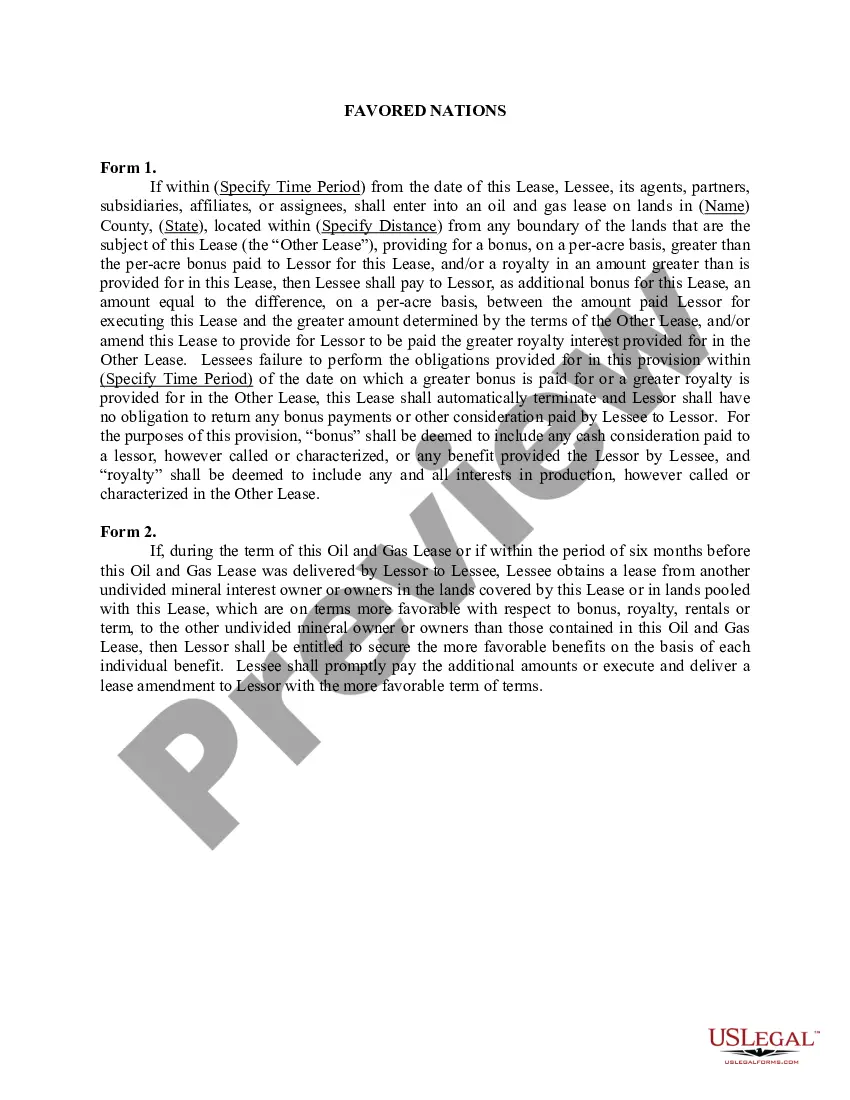
The Favored Nations lease rider form is designed for use in oil and gas lease transactions. It allows lessors to negotiate better terms by including provisions that ensure they receive bonuses or royalties equal to or greater than those granted in other leases. This form sets the framework for lessors to protect their financial interests when entering into specific lease agreements.
Form components explained
- Options for specifying time periods and distances for determining applicable lease agreements.
- Clauses detailing additional bonuses or royalties based on comparisons with other leases.
- Conditions for lease termination if obligations are not met by the lessee.
- Provisions allowing the lessor to secure more favorable terms from the lessee in certain scenarios.
When to use this form
This form should be used when entering into an oil and gas lease and specific concerns arise regarding the terms being offered. It is particularly important if there is a chance that the lessee may secure leases on better terms in the vicinity. This form allows the lessor to protect their right to receive fair compensation.
Intended users of this form
This form is intended for:
- Property owners looking to lease their mineral rights.
- Individuals or entities engaged in oil and gas leasing.
- Those who wish to ensure they are not disadvantaged in lease negotiations compared to other mineral interest owners.
Instructions for completing this form
- Identify the parties involved in the lease agreement.
- Specify the time period for the obligations in the provisions.
- Enter the geographical area where the lease applies, including county and state details.
- Detail the conditions for the bonus and royalty adjustments based on other leases.
- Ensure all parties sign and date the document appropriately to execute the agreement.
Does this document require notarization?
This form does not typically require notarization unless specified by local law. Always verify the legal requirements in your jurisdiction to ensure compliance with local regulations.
Get your form ready online
Our built-in tools help you complete, sign, share, and store your documents in one place.
Make edits, fill in missing information, and update formatting in US Legal Forms—just like you would in MS Word.
Download a copy, print it, send it by email, or mail it via USPS—whatever works best for your next step.
Sign and collect signatures with our SignNow integration. Send to multiple recipients, set reminders, and more. Go Premium to unlock E-Sign.
If this form requires notarization, complete it online through a secure video call—no need to meet a notary in person or wait for an appointment.
We protect your documents and personal data by following strict security and privacy standards.

Make edits, fill in missing information, and update formatting in US Legal Forms—just like you would in MS Word.

Download a copy, print it, send it by email, or mail it via USPS—whatever works best for your next step.

Sign and collect signatures with our SignNow integration. Send to multiple recipients, set reminders, and more. Go Premium to unlock E-Sign.

If this form requires notarization, complete it online through a secure video call—no need to meet a notary in person or wait for an appointment.

We protect your documents and personal data by following strict security and privacy standards.
Common mistakes to avoid
- Failing to specify the time period for lease obligations.
- Not providing accurate geographical details for the lease agreement.
- Overlooking required signatures from all parties involved.
- Neglecting to compare lease terms with existing agreements properly.
Benefits of completing this form online
- Convenience of downloading and filling out the form at your own pace.
- Editability to customize provisions based on your specific needs.
- Access to professionally drafted templates by licensed attorneys.
- Secure storage of your legal documents on the platform.
Legal use & context
- This form provides legal avenues for lessors to secure good faith terms from lessees.
- Ensures enforceability of favorable terms in the event of subsequent leases.
Quick recap
- The Favored Nations form protects the lessor's interests in oil and gas leases.
- It allows for adjustments to bonuses and royalties based on future lease agreements.
- Understand and properly execute all sections to ensure the form's enforceability.
Looking for another form?

Form popularity
FAQ
This term has several meanings. In the context of: Finance. Business jargon for the concept that the first party will be entitled to at least as favorable terms as a second party in specified circumstances.
China's MFN status was made permanent on December 27, 2001. All of the former Soviet states, including Russia, were granted MFN status in 1996.Since 1998, the term normal trade relations (NTR) has replaced most favoured nation in all U.S. statutes.
The MFN status proclaimed in the GATT has been granted to about 180 countries.
Most favored nation clauses (MFNs), sometimes also referred to as most favored customer clauses, are agreements in which a supplier agrees to treat a particular customer no worse than all other customers (see Standard Clause, General Contract Clauses, Most Favored Customer (www.practicallaw.com/8-510-7389)).
A most-favored-nation (MFN) clause requires a country to provide any concessions, privileges, or immunities granted to one nation in a trade agreement to all other World Trade Organization member countries. Although its name implies favoritism toward another nation, it denotes the equal treatment of all countries.
Updated November 30, 2020. The Balance / Julie Bang. Most-favored-nation (MFN) status is an economic position in which a country enjoys the best trade terms given by its trading partner. That means it receives the lowest tariffs, the fewest trade barriers, and the highest import quotas (or none at all).
This is an industry term which means that you are getting equal contractual treatment to others on the project billing, accommodations, and any other contractual provision. This is not required by SAG-AFTRA and must be separately negotiated between Performer and Producer.
A most-favored-nation (MFN) clause requires a country to provide any concessions, privileges, or immunities granted to one nation in a trade agreement to all other World Trade Organization member countries. Although its name implies favoritism toward another nation, it denotes the equal treatment of all countries.