Geoscience Operations on the Contract Area
What is this form?
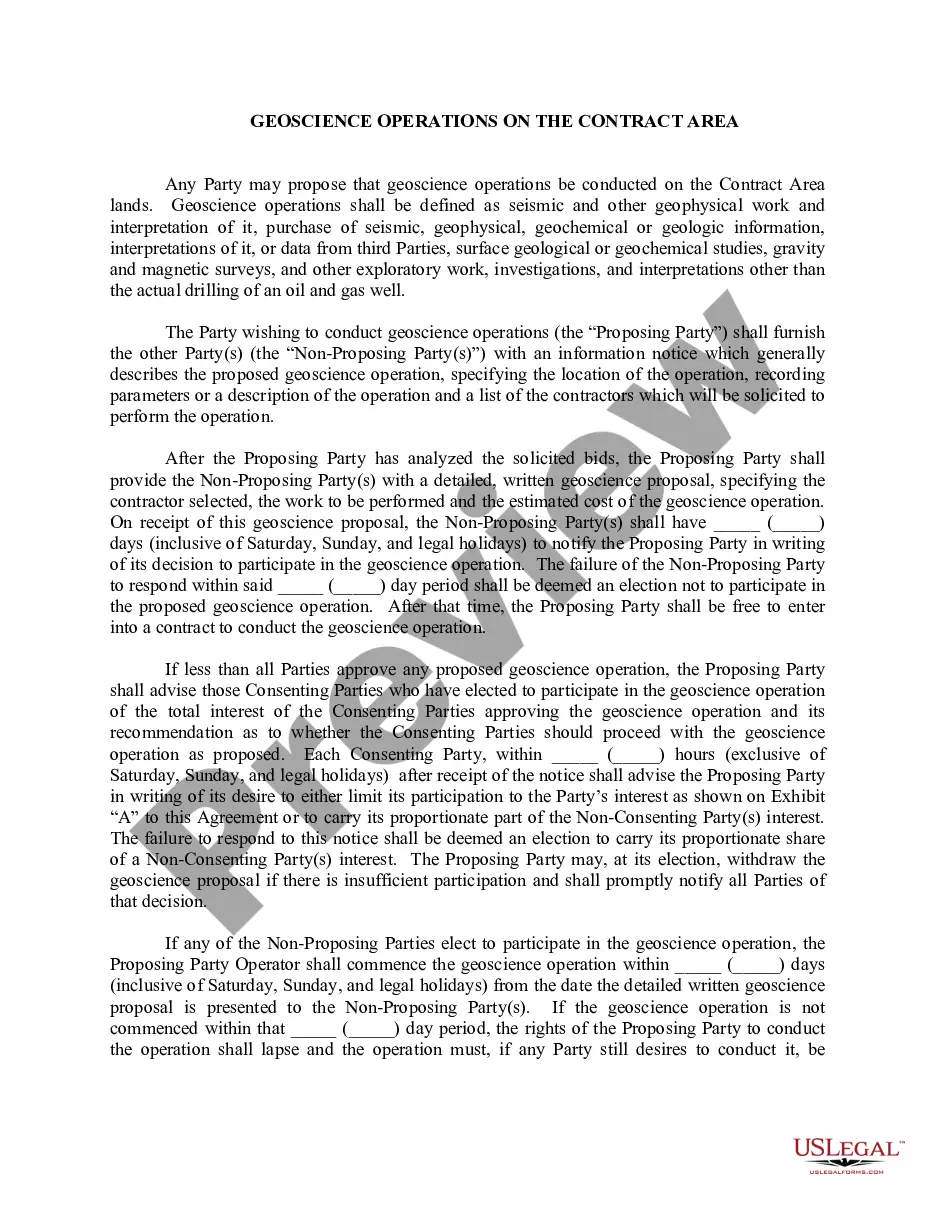
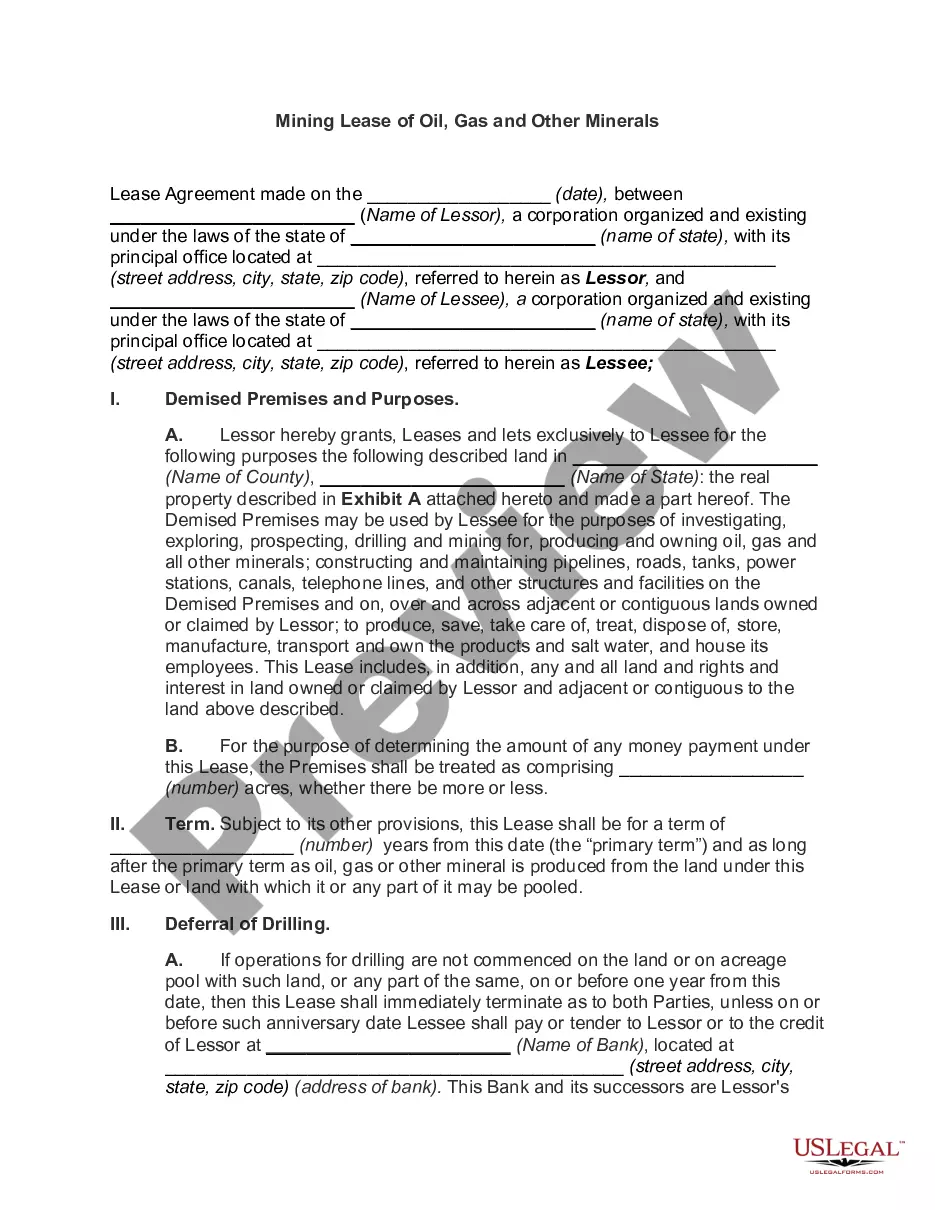
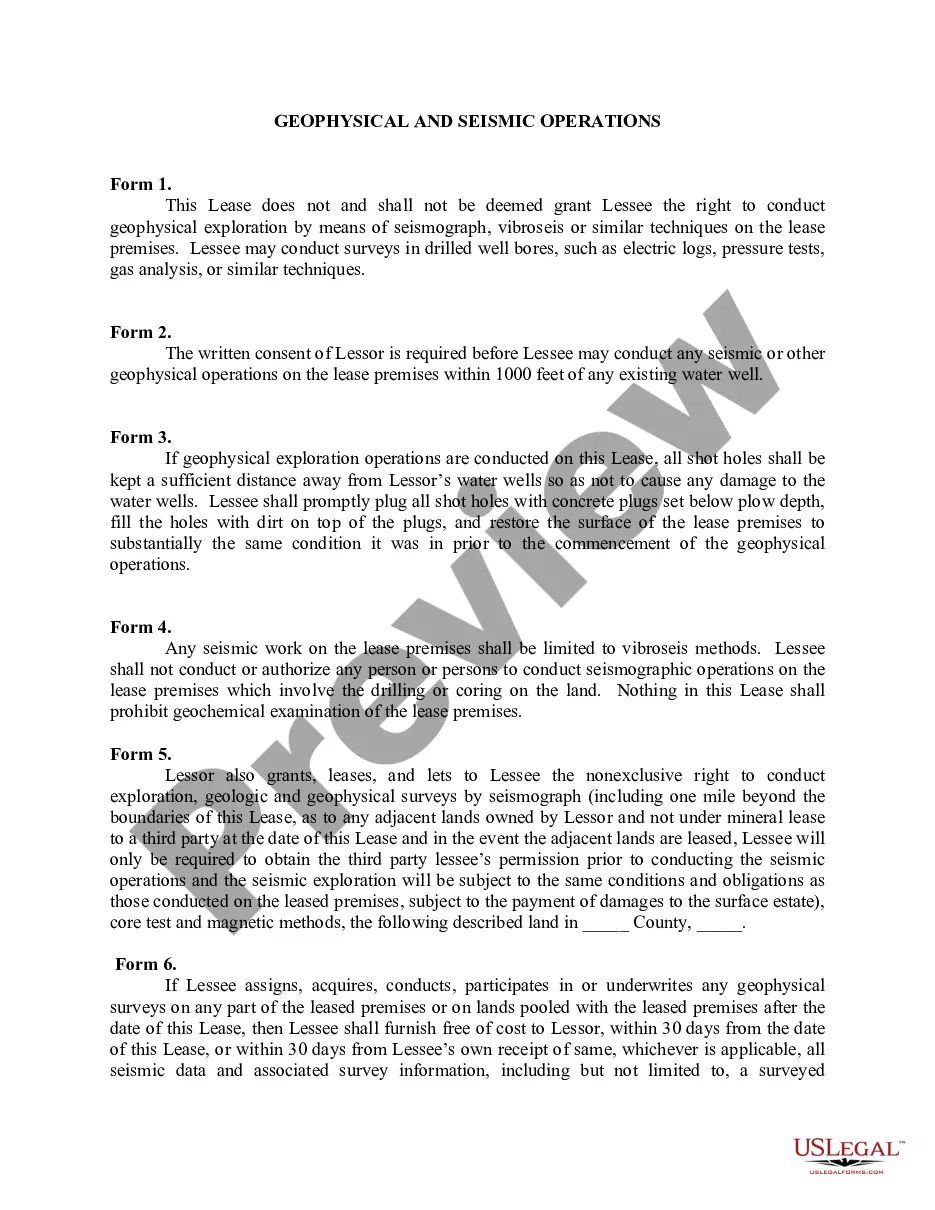
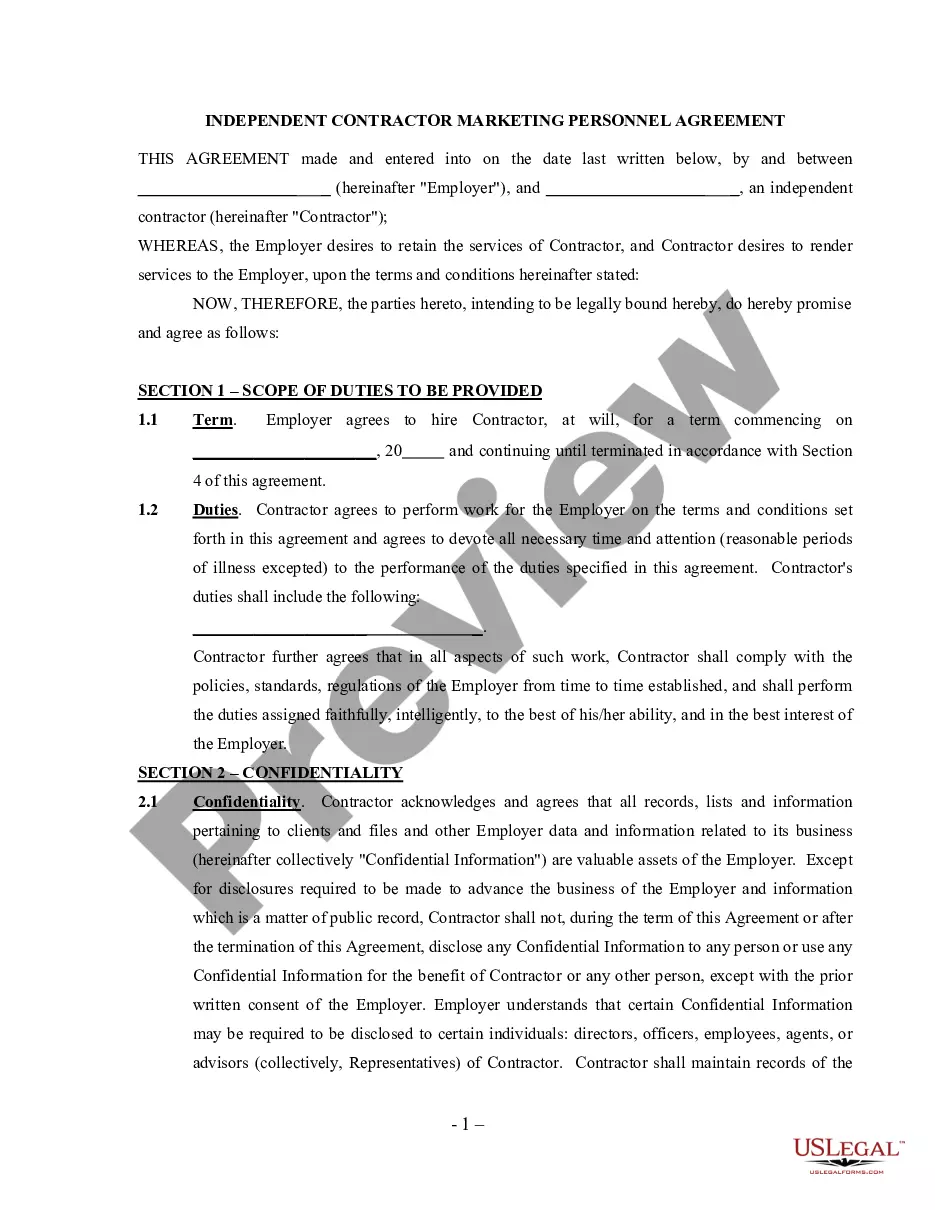
The Geoscience Operations on the Contract Area form is a legal document that allows any party involved to propose geoscience operations on designated lands. This form serves to outline the process for coordinating seismic and other geophysical studies without undertaking drilling activities. Unlike similar forms which may include drilling rights, this form focuses specifically on the preliminary exploratory work necessary to evaluate land potential.
Main sections of this form
- Definition of geoscience operations, including types of studies and investigations allowed.
- Process for one party to propose operations, including requirements for sending an information notice to other parties.
- Timeline for responding to proposals and the implications of non-response.
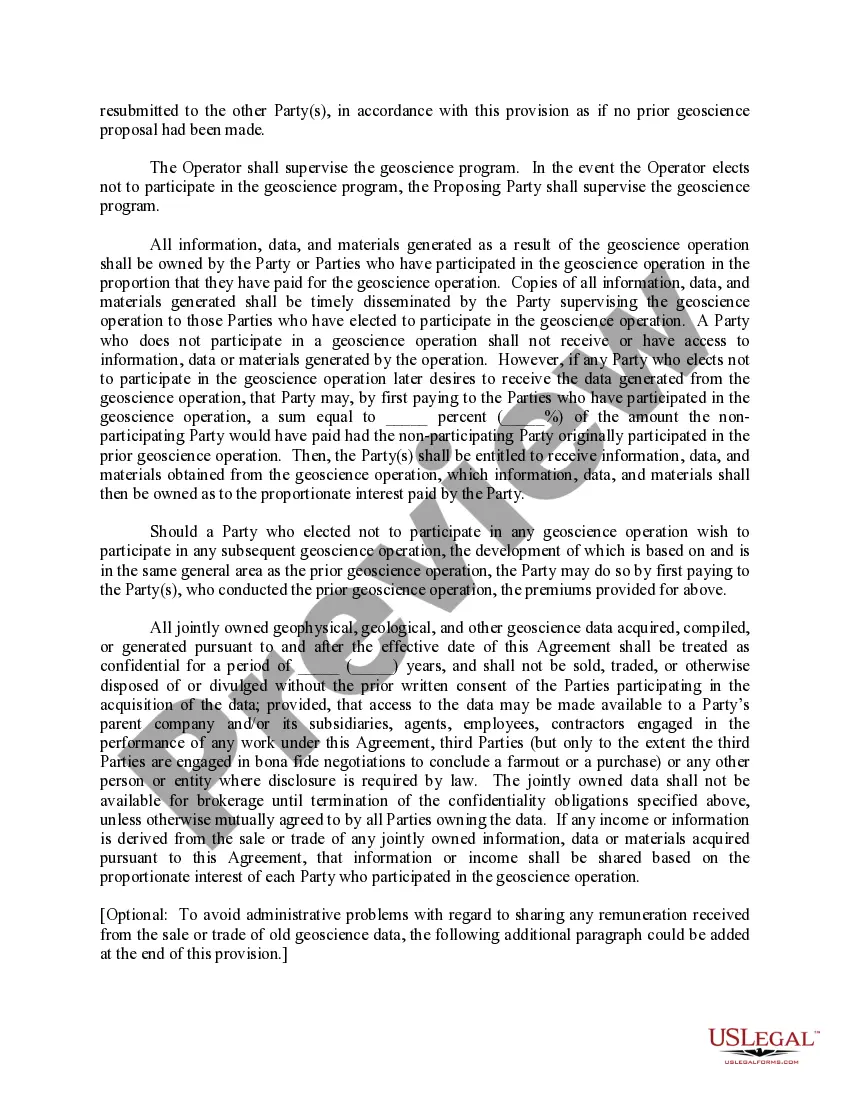
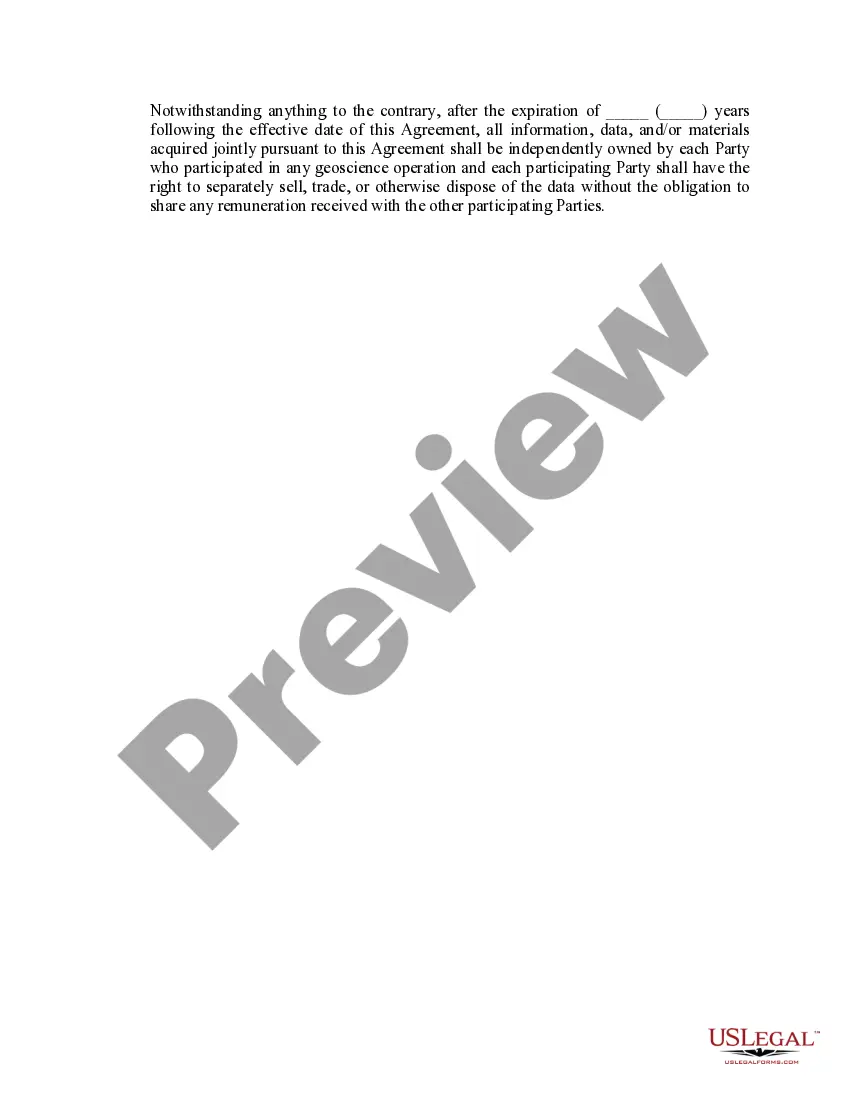
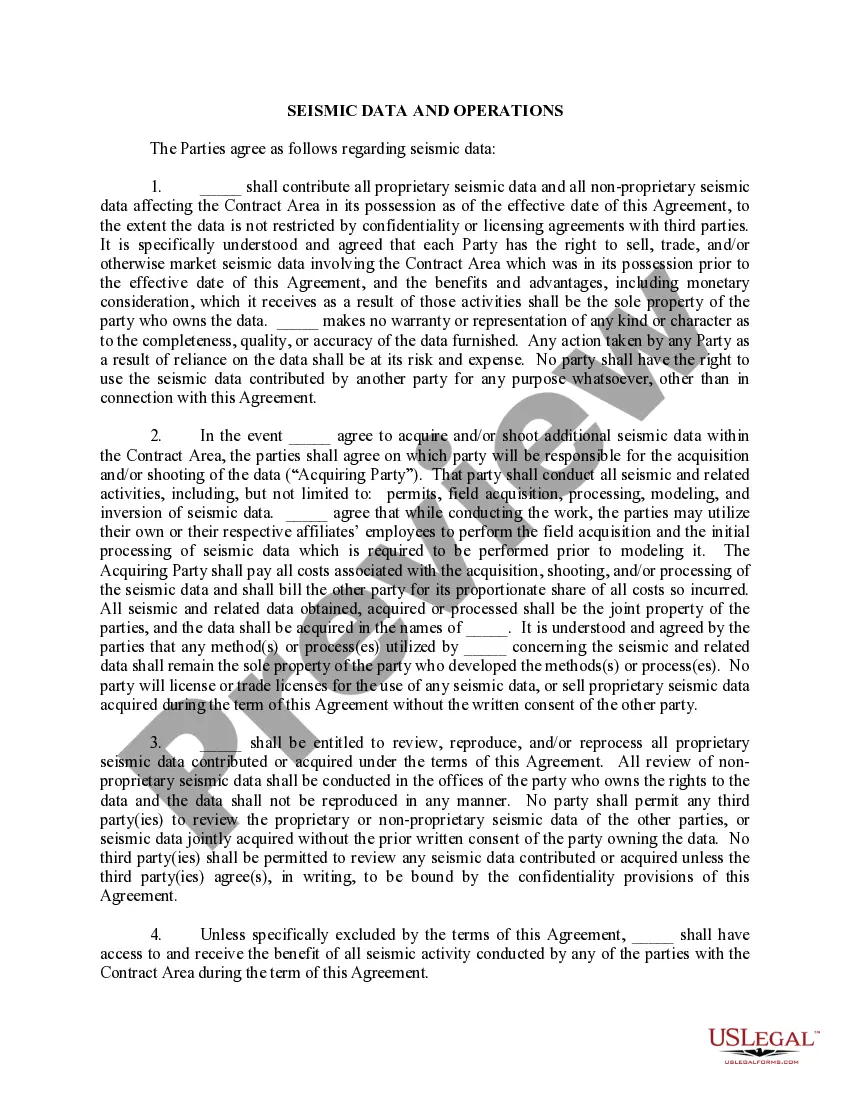
- Ownership and sharing of data generated from geoscience operations.
- Confidentiality of jointly owned geophysical data and terms of their potential sale or trade.
- Conditions under which parties can elect to opt into or out of operations.
When this form is needed
This form is essential when parties involved in an oil and gas agreement wish to conduct geoscience operations on land that has been designated as a Contract Area. It is particularly useful in scenarios where preliminary explorations are needed to assess geological data without commencing drilling. Use this form when proposing seismic studies, surface geological surveys, or acquiring third-party geophysical information.
Who can use this document
- Oil and gas companies seeking to conduct geoscience operations in a designated contract area.
- Landowners involved in agreements pertaining to resource exploration and extraction.
- Legal teams managing contracts related to geoscience studies.
- Any party wishing to collaborate on exploration that requires prior approval from other stakeholders.
How to prepare this document
- Identify the proposing party and non-proposing parties involved in the operations.
- Provide a clear description of the proposed geoscience operation, including its location and parameters.
- Detail the contractors who will be solicited for the work and include an estimate of the operation's costs.
- Specify the deadlines for responses from non-proposing parties regarding their decision to participate.
- Include clauses regarding the ownership of generated data and confidentiality agreements.
Does this document require notarization?
Notarization is not commonly needed for this form. However, certain documents or local rules may make it necessary. Our notarization service, powered by Notarize, allows you to finalize it securely online anytime, day or night.
Get your form ready online
Our built-in tools help you complete, sign, share, and store your documents in one place.
Make edits, fill in missing information, and update formatting in US Legal Forms—just like you would in MS Word.
Download a copy, print it, send it by email, or mail it via USPS—whatever works best for your next step.
Sign and collect signatures with our SignNow integration. Send to multiple recipients, set reminders, and more. Go Premium to unlock E-Sign.
If this form requires notarization, complete it online through a secure video call—no need to meet a notary in person or wait for an appointment.
We protect your documents and personal data by following strict security and privacy standards.

Make edits, fill in missing information, and update formatting in US Legal Forms—just like you would in MS Word.

Download a copy, print it, send it by email, or mail it via USPS—whatever works best for your next step.

Sign and collect signatures with our SignNow integration. Send to multiple recipients, set reminders, and more. Go Premium to unlock E-Sign.

If this form requires notarization, complete it online through a secure video call—no need to meet a notary in person or wait for an appointment.

We protect your documents and personal data by following strict security and privacy standards.
Typical mistakes to avoid
- Failing to provide a complete description of the proposed geoscience operation.
- Not specifying deadlines for responses and other key timelines.
- Neglecting to include details about data ownership and confidentiality.
- Assuming all parties will approve the proposal without clear communication and follow-up.
Benefits of using this form online
- Convenience of downloading and completing the form at your own pace.
- Editability allows for customization based on the specific needs of your operation.
- Reliability, as forms are drafted by licensed attorneys to adhere to legal standards.
Looking for another form?
Form popularity
FAQ
Geoscience (also called Earth Science) is the study of Earth.Geoscience uses tools and techniques from other science fields as well, such as chemistry, physics, biology, and math!
Communication skills. Geoscientists write reports and research papers. Critical-thinking skills. Interpersonal skills. Outdoor skills. Physical stamina. Problem-solving skills.
The job outlook for geoscientists is good. The BLS expects employment to grow faster than the average for all occupations through 2024.
Geological exploration is the process of finding commercially viable mineral resource and the objective is to locate it in the shortest possible time and at the lowest possible cost.
Geoscience (also called Earth Science) is the study of Earth. Geoscience includes so much more than rocks and volcanoes, it studies the processes that form and shape Earth's surface, the natural resources we use, and how water and ecosystems are interconnected.
As entry-level Geoscientist positions typically require a Bachelor's Degree in Geosciences or a related field, the path to becoming a Geoscientist should take about four years. Many Geoscientists also choose to join professional organizations for networking and career opportunities.
What Geoscientists Do. Petroleum geologists (a type of geoscientist) search for oil and gas deposits that are suitable for commercial extraction. Geoscientists study the physical aspects of the Earth, such as its composition, structure, and processes, to learn about its past, present, and future.
Geoscientist: They are involved in interpreting geophysical, geochemical and geological data to develop models of the subsurface of the earth. They collect information in the field, from seismic and well data from other sources and monitor the acquisition of data to ensure consistent quality.
A geologist studies the earth, its structure, composition and the different earth processes. Operation geologists work in different industries, including oil extraction, mineral mining and architectural engineering. The job of an operations geologist puts him in close contact with engineers and other geoscientists.