Indemnities
About this form
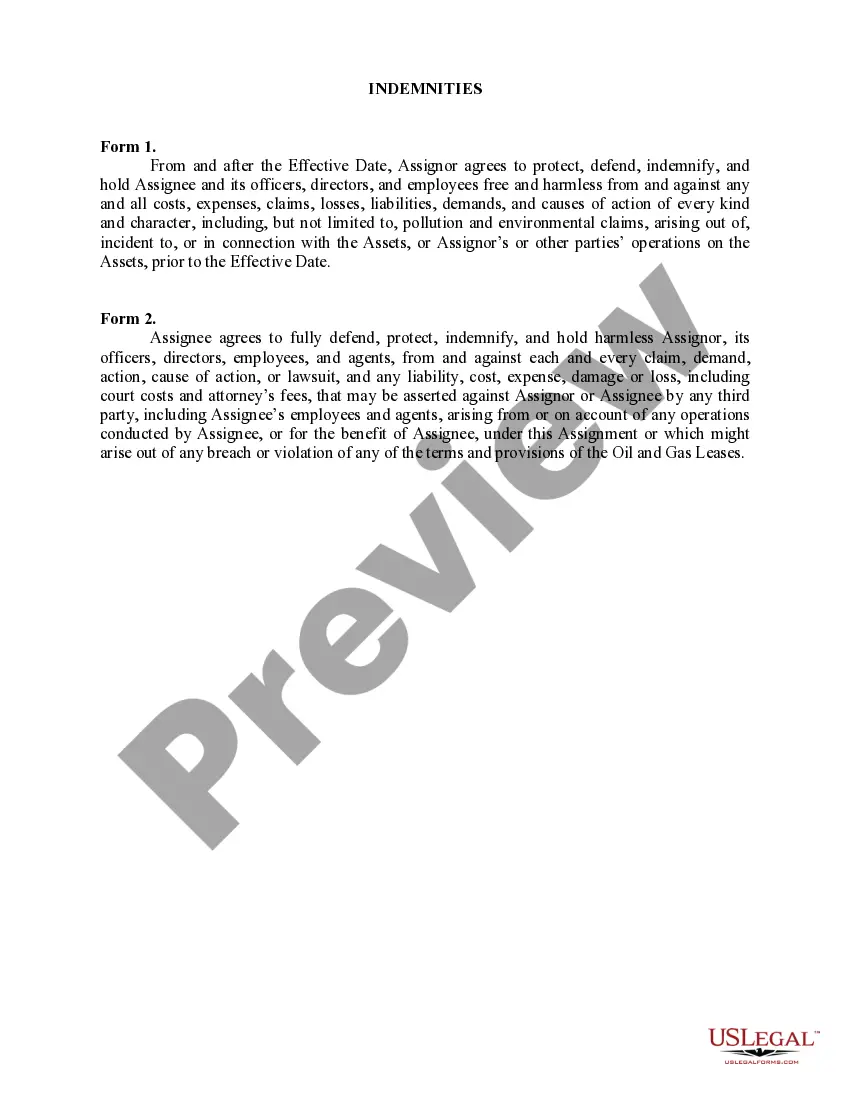
The Indemnities form is a legal document used to establish an agreement between an assignor and an assignee regarding indemnification rights. This form defines the responsibilities of each party to protect and defend the other against any claims or liabilities that may arise in connection with their operations. Unlike other forms that may focus solely on agreements or contracts, this form specifically addresses the mutual indemnification obligations of the parties involved.
Key components of this form
- Effective Date: The date when the indemnity obligations commence.
- Assignor's Obligations: Details of the assignor's duty to protect and defend the assignee against claims.
- Assignee's Obligations: Outlines the assignee's commitments to indemnify the assignor against third-party claims.
- Exclusions: Specifies any limitations on liability, particularly concerning environmental claims.
- Legal Fees: Addresses who bears the costs of legal defenses and related expenses.
When this form is needed
This form is useful in various scenarios, including business transactions involving asset transfers, particularly in fields like real estate or oil and gas leases. You should use the Indemnities form when parties need to outline their indemnification responsibilities and protect themselves from potential legal claims arising from their operations on or related to specified assets.
Intended users of this form
- Businesses engaging in asset transfers or assignments.
- Individuals involved in real estate or oil and gas agreements.
- Parties concerned about liability from operational claims.
Instructions for completing this form
- Identify the parties: Clearly specify the names and roles of the assignor and assignee.
- Enter the Effective Date: Provide the date on which the indemnity obligations begin.
- Outline the obligations: Detail the indemnification responsibilities of each party.
- Include exclusions and limitations: State any exceptions to liability that should apply.
- Signatures: Ensure all parties sign to validate the agreement.
Does this form need to be notarized?
In most cases, this form does not require notarization. However, some jurisdictions or signing circumstances might. US Legal Forms offers online notarization powered by Notarize, accessible 24/7 for a quick, remote process.
Get your form ready online
Our built-in tools help you complete, sign, share, and store your documents in one place.
Make edits, fill in missing information, and update formatting in US Legal Forms—just like you would in MS Word.
Download a copy, print it, send it by email, or mail it via USPS—whatever works best for your next step.
Sign and collect signatures with our SignNow integration. Send to multiple recipients, set reminders, and more. Go Premium to unlock E-Sign.
If this form requires notarization, complete it online through a secure video call—no need to meet a notary in person or wait for an appointment.
We protect your documents and personal data by following strict security and privacy standards.

Make edits, fill in missing information, and update formatting in US Legal Forms—just like you would in MS Word.

Download a copy, print it, send it by email, or mail it via USPS—whatever works best for your next step.

Sign and collect signatures with our SignNow integration. Send to multiple recipients, set reminders, and more. Go Premium to unlock E-Sign.

If this form requires notarization, complete it online through a secure video call—no need to meet a notary in person or wait for an appointment.

We protect your documents and personal data by following strict security and privacy standards.
Common mistakes to avoid
- Leaving out the Effective Date, which can lead to disputes over when indemnity responsibilities begin.
- Failing to clearly define the scope of indemnity, leaving room for misinterpretation.
- Not including signatures from all relevant parties, which may render the form invalid.
Benefits of using this form online
- Convenient access: Download the form anytime and complete it at your convenience.
- Editability: Make necessary changes easily based on your specific situation.
- Reliability: Forms are drafted by licensed attorneys to meet legal standards.
Looking for another form?

Form popularity
FAQ
An indemnity is a promise by one party to compensate another for the loss suffered as a consequence of a specific event, called the 'trigger event'. The trigger event can be anything defined by the parties, including: a breach of contract. a party's fault or negligence.
Definition: Indemnity means making compensation payments to one party by the other for the loss occurred. Description: Indemnity is based on a mutual contract between two parties (one insured and the other insurer) where one promises the other to compensate for the loss against payment of premiums.
A hold harmless agreement (also known as an indemnity agreement or waiver of liability) is a good idea any time you want to shift risk from one party to another. You can protect other people from being sued by taking on the liability yourself as well.
A typical example is an insurance company wherein the insurer or indemnitor agrees to compensate the insured or indemnitee for any damages or losses he/she may incur during a period of time.
Indemnity is compensation paid by one party to another to cover damages, injury or losses.An example of an indemnity would be an insurance contract, where the insurer agrees to compensate for any damages that the entity protected by the insurer experiences.
Indemnity is a comprehensive form of insurance compensation for damages or loss. In this type of arrangement, one party agrees to pay for potential losses or damages caused by another party.
Title the letter as a "Letter of Indemnity" to make it clear what the document is about. Include a statement that the agreement will be governed by the laws of the specific state (where the agreement would be taken to court). Begin the letter confirming the contract already in place with the other party.
Company/Business/Individual Name shall fully indemnify, hold harmless and defend _______ and its directors, officers, employees, agents, stockholders and Affiliates from and against all claims, demands, actions, suits, damages, liabilities, losses, settlements, judgments, costs and expenses (including but not