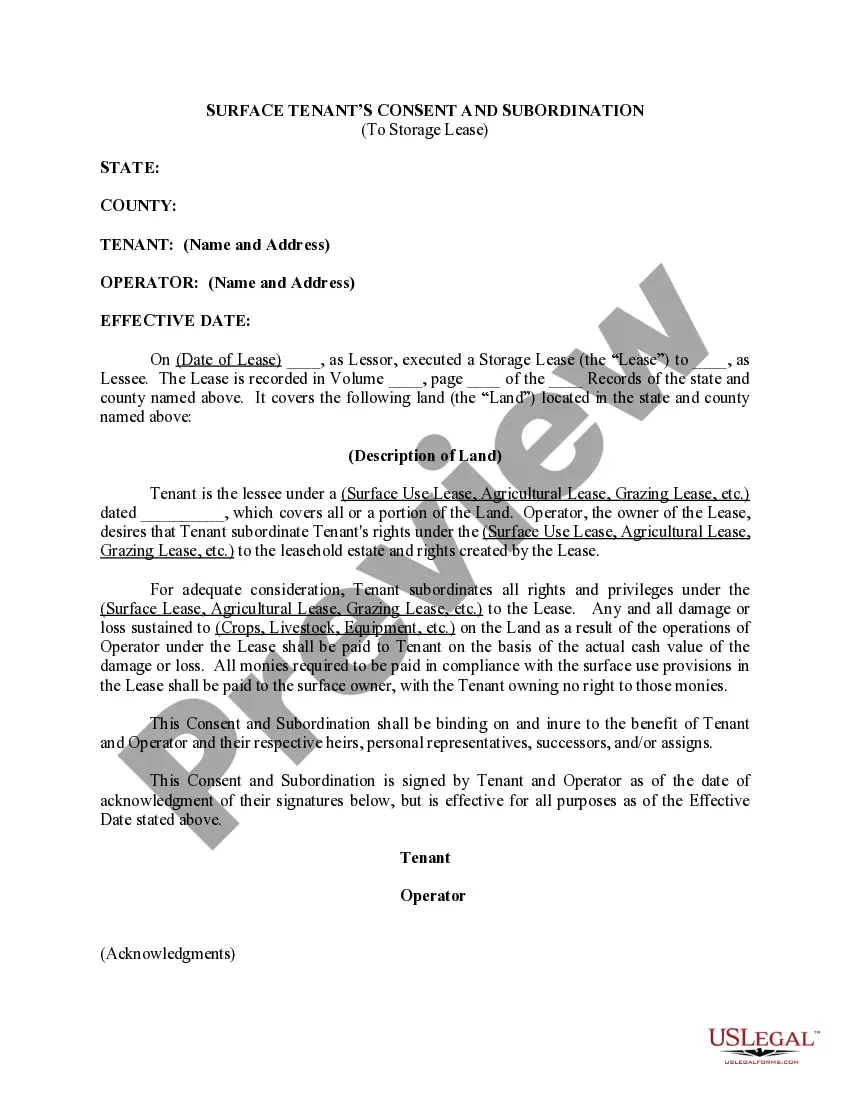
Surface Tenant's Consent and Subordination (to Storage Lease)
Understanding this form
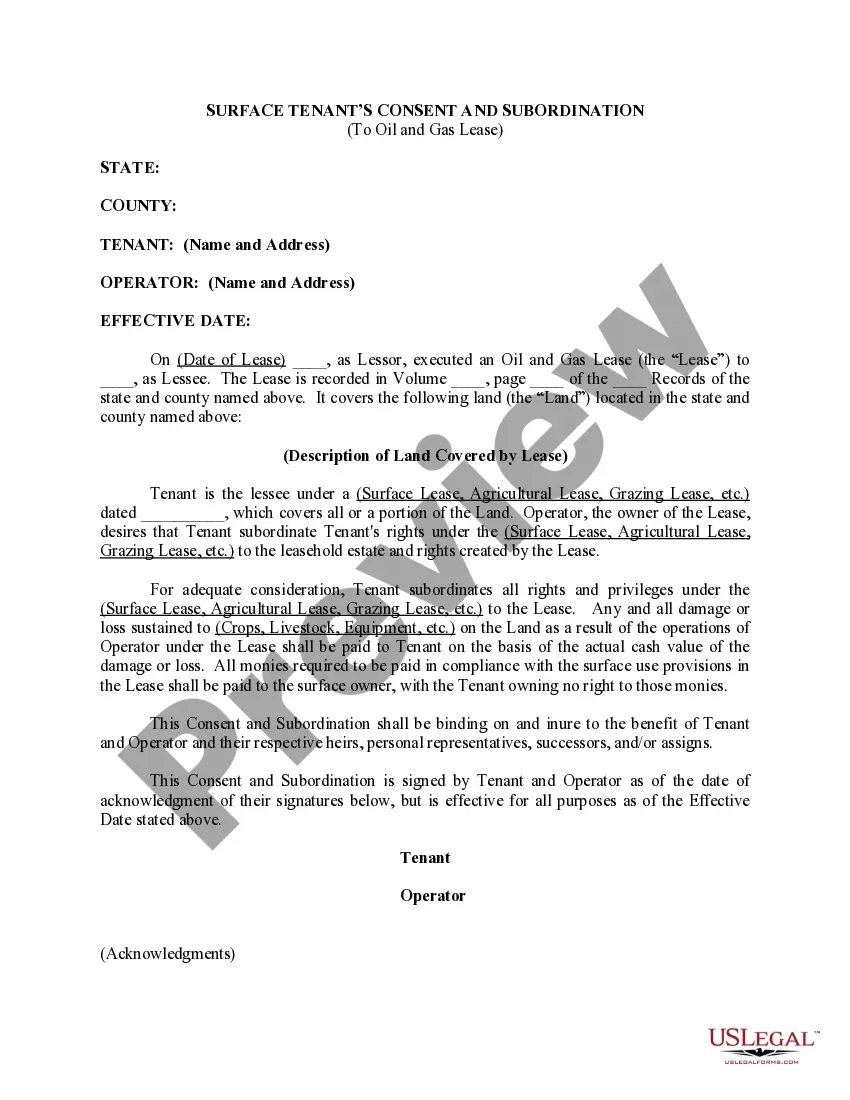
The Surface Tenant's Consent and Subordination form is a legal document that allows a surface tenant to agree to subordinate their rights under an existing lease to a new storage lease. This form is essential for clarifying the relationship between the surface tenant and the operator, ensuring that the operatorâs rights take precedence over the tenantâs lease. It is distinct from other lease agreements as it specifically addresses the subordination of tenant rights and obligations related to storage operations on the property.
Key parts of this document
- Identification of the parties involved: Tenant and Operator.
- Description of the storage lease and relevant land details.
- Statement of tenant's consent to subordinate their rights.
- Details on the compensation for any damage to crops, livestock, or equipment.
- Binding nature of the consent and subordination for heirs and successors.
When to use this form
This form should be used when a surface tenant needs to formally consent to the subordination of their rights in relation to a new storage lease executed by the operator. It is applicable in situations where the operatorâs interests may conflict with those of the surface tenant or when the operator requires clear prioritization of their leasehold rights.
Who can use this document
- Surface tenants who have existing leases and need to acknowledge a new storage lease.
- Operators who have established a new lease and seek to ensure their leasehold rights are prioritized.
- Landowners and legal representatives facilitating lease agreements between tenants and operators.
How to complete this form
- Identify the parties involved: both tenant and operator, including their names and addresses.
- Specify the details of the storage lease, including its effective date and the land description.
- Document the consent by having the tenant sign to subordinate their rights under prior leases.
- Include terms regarding the compensation for any damages incurred due to operations under the storage lease.
- Ensure that the acknowledgment of signatures is completed for legal validity.
Does this form need to be notarized?
This form does not typically require notarization unless specified by local law. It's recommended to check state-specific regulations to determine if notarization is necessary in your jurisdiction.
Get your form ready online
Our built-in tools help you complete, sign, share, and store your documents in one place.
Make edits, fill in missing information, and update formatting in US Legal Forms—just like you would in MS Word.
Download a copy, print it, send it by email, or mail it via USPS—whatever works best for your next step.
Sign and collect signatures with our SignNow integration. Send to multiple recipients, set reminders, and more. Go Premium to unlock E-Sign.
If this form requires notarization, complete it online through a secure video call—no need to meet a notary in person or wait for an appointment.
We protect your documents and personal data by following strict security and privacy standards.

Make edits, fill in missing information, and update formatting in US Legal Forms—just like you would in MS Word.

Download a copy, print it, send it by email, or mail it via USPS—whatever works best for your next step.

Sign and collect signatures with our SignNow integration. Send to multiple recipients, set reminders, and more. Go Premium to unlock E-Sign.

If this form requires notarization, complete it online through a secure video call—no need to meet a notary in person or wait for an appointment.

We protect your documents and personal data by following strict security and privacy standards.
Typical mistakes to avoid
- Failing to accurately describe the land covered by the lease.
- Omitting the effective date of the storage lease.
- Not including all necessary parties or signatures.
- Neglecting to address compensation for damages thoroughly.
Advantages of online completion
- Convenience of accessing and downloading the form anytime.
- Editable templates that can be customized to meet specific needs.
- Reliability of forms drafted by licensed attorneys.
- Time-efficient process without the need for in-person visits.
Summary of main points
- The Surface Tenant's Consent and Subordination form is essential for defining rental rights in storage lease contexts.
- It helps to mitigate conflicts between surface tenants and operators by establishing clear terms.
- Completing the form accurately ensures compliance with legal requirements and protects all parties involved.
Looking for another form?


Form popularity
FAQ
The subordination, non-disturbance and attornment agreement (commonly abbreviated as an SNDA agreement) is the document that the landlord, tenant and lender often employ to resolve how their rights do and will intersect.
A subordination agreement prioritizes collateralized debts, ranking one behind another for purposes of collecting repayment from a debtor in the event of foreclosure or bankruptcy. A second-in-line creditor collects only when and if the priority creditor has been fully paid.
A nondisturbance clause is a provision in a mortgage contract that ensures that a rental agreement between the tenant and the landlord will continue under any circumstances. This is done primarily to protect the renter from eviction by the mortgagor if the property is foreclosed upon by the lender.
Subordination clauses in mortgages refer to the portion of your agreement with the mortgage company that says their lien takes precedence over any other liens you may have on your property.The primary lien on a house is usually a mortgage. However, it's also possible to have other liens.
A subordination clause is a clause in an agreement which states that the current claim on any debts will take priority over any other claims formed in other agreements made in the future. Subordination is the act of yielding priority.
Subordination is the process of ranking home loans (mortgage, HELOC or home equity loan) by order of importance. When you have a home equity line of credit, for example, you actually have two loans your mortgage and HELOC.Through subordination, lenders assign a lien position to these loans.
In a lease subordination clause, the tenant is agreeing to allow his/her interest to be subordinated to the lender's. A sample subordination agreement is commonly requested of new tenants.The attornment agreement has the tenant agree to continue lease obligations to a new landlord in the event of a foreclosure.
In the case of commercial property changing hands, an attornment clause in a subordination, non-disturbance, and attornment (SNDA) agreement requires the tenant to acknowledge a new owner as their landlord and to continue paying rent regardless of whether the property changes hands through a normal sale or a
A subordinate clause has a subject and a verb, but it cannot stand alone as a complete sentence. Let's look at some examples;When she was sick (she=subject; was=verb) Because mom said so (mom=subject; said=verb)