Partial Release of Easement and Agreement (Pipeline Easement)
What is this form?
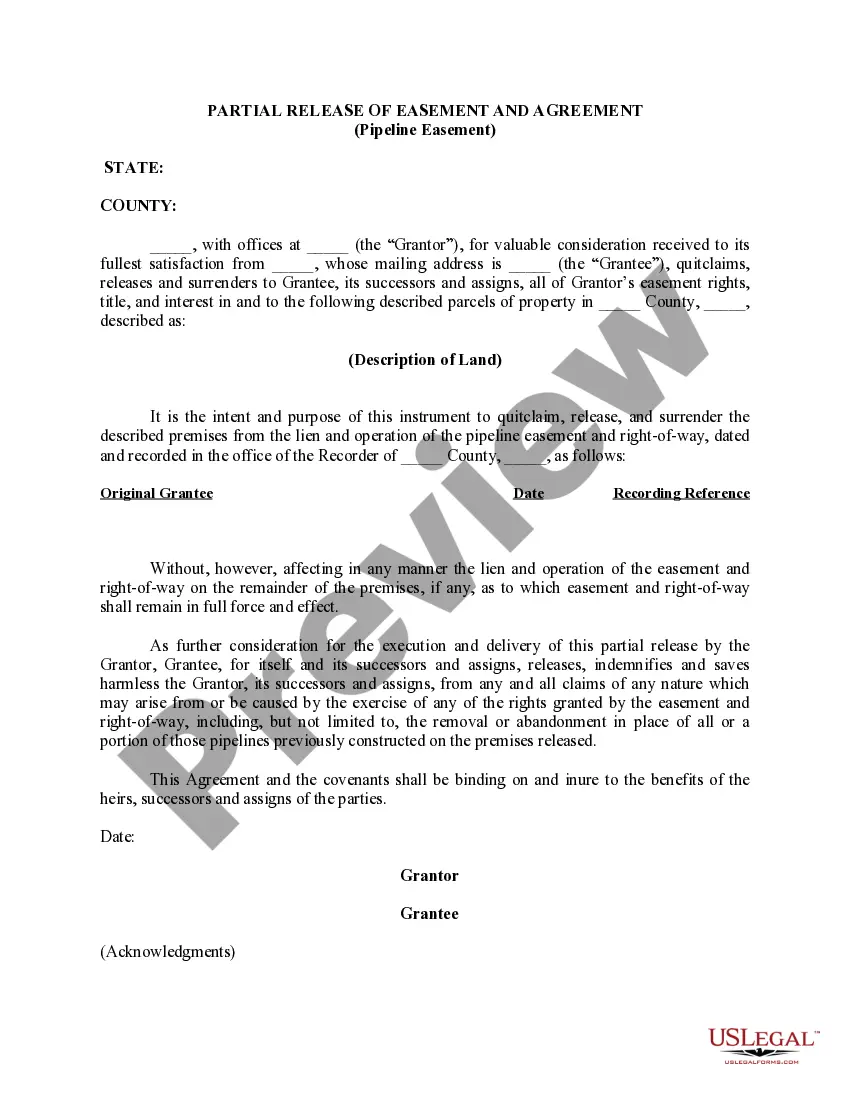
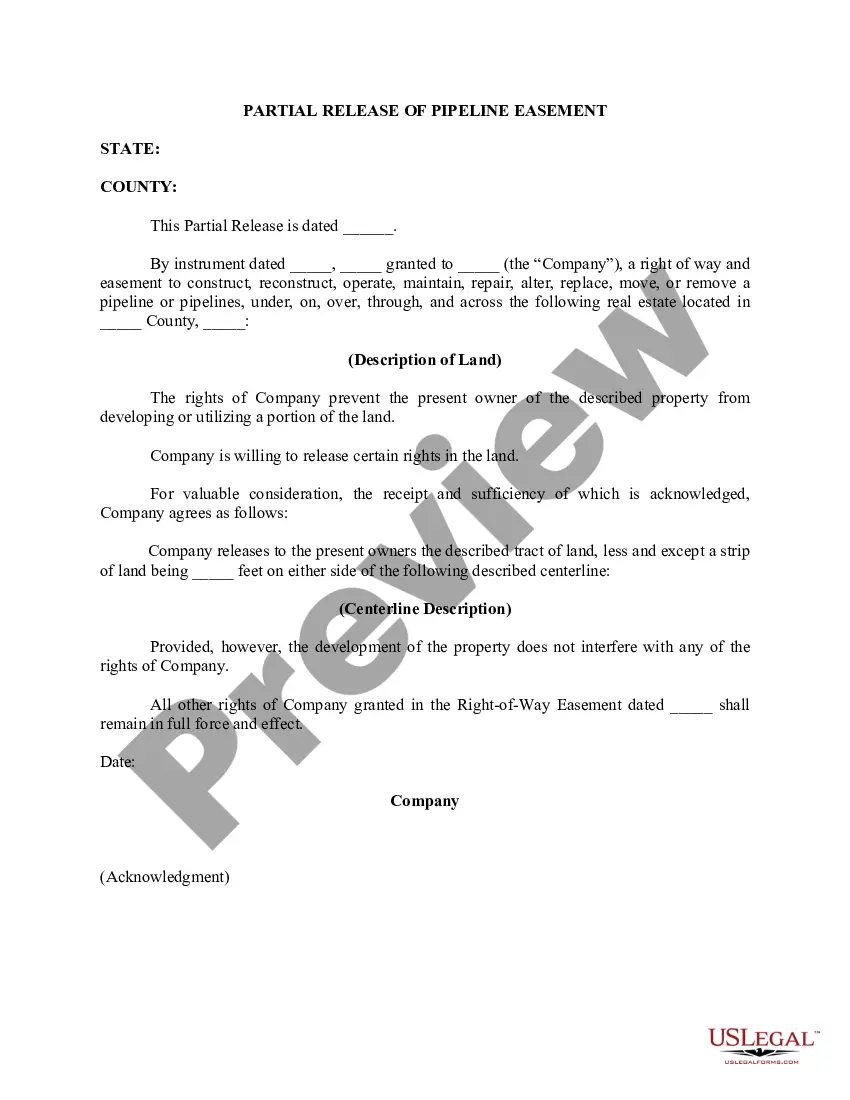
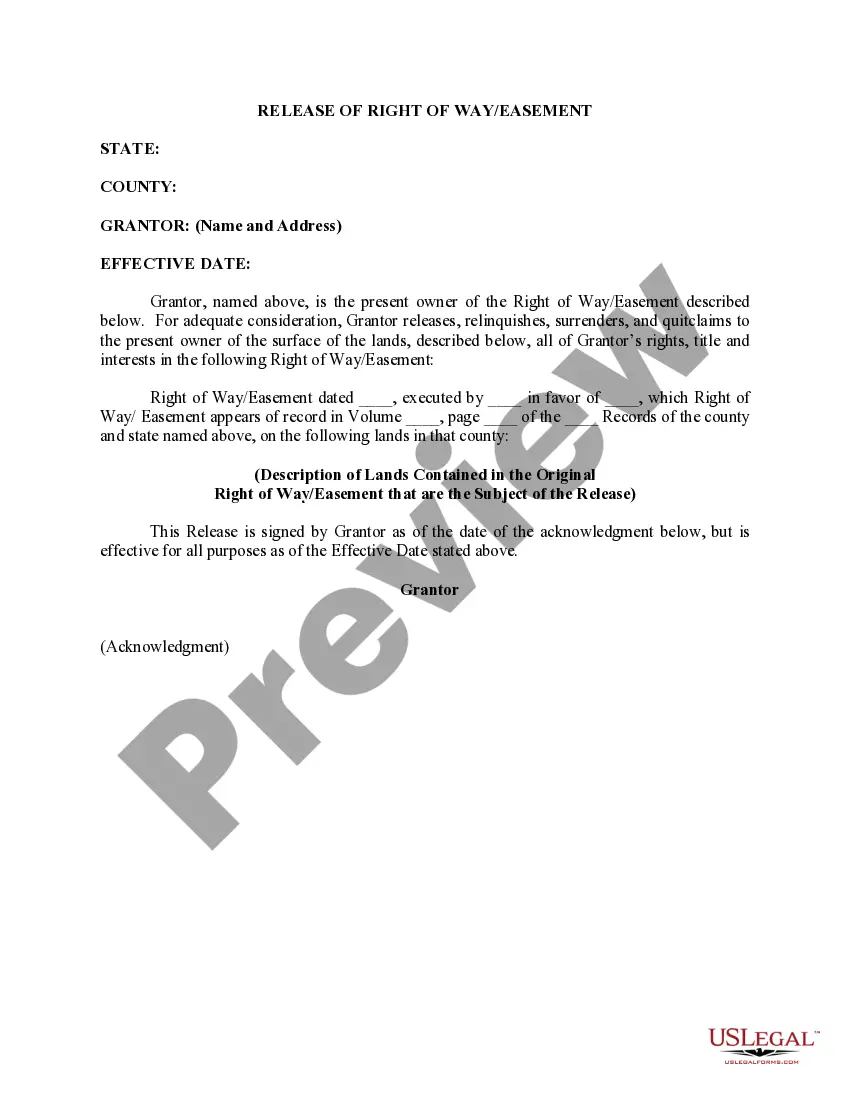
The Partial Release of Easement and Agreement (Pipeline Easement) is a legal document used to partially release an existing pipeline easement on specified property. Unlike full easement releases, this form allows the Grantor to retain some rights while relinquishing their interest in specific land parcels to a Grantee. This form ensures that the easement on the remainder of the property remains intact, making it essential for property owners involved in easement negotiations or adjustments.
What’s included in this form
- Identification of Grantor and Grantee, including their addresses.
- Description of the land parcels subject to the partial release.
- Citation of the original easement agreement, including recording details.
- Stipulations regarding the release of rights and responsibilities tied to the easement.
- Indemnification clause protecting the Grantor from future claims related to the easement.
- Signatures of both parties with acknowledgment section for legal validation.
Situations where this form applies
This form is necessary when a property owner (Grantor) wishes to release a portion of easement rights corresponding to specific land parcels while maintaining easements on their remaining property. It may be used when negotiations with a pipeline company lead to changes in easement boundaries or when the Grantor wants to settle issues related to existing pipeline operations on their land.
Who needs this form
- Property owners looking to modify existing pipeline easement agreements.
- Pipeline companies negotiating the terms of easements with landowners.
- Real estate attorneys representing clients in easement transactions.
- Land use planners involved in land development and utility placement.
Steps to complete this form
- Identify the parties involved: the Grantor and Grantee.
- Provide the mailing addresses for both parties.
- Describe the specific land parcels affected by the easement release.
- Reference the original easement, including recording details.
- Include the date of execution and have both parties sign the form.
- If necessary, complete the acknowledgment section to validate the document.
Notarization requirements for this form
This form does not typically require notarization unless specified by local law. However, obtaining notarization can enhance the document's legal validity and provide an additional layer of security for all parties involved.
Get your form ready online
Our built-in tools help you complete, sign, share, and store your documents in one place.
Make edits, fill in missing information, and update formatting in US Legal Forms—just like you would in MS Word.
Download a copy, print it, send it by email, or mail it via USPS—whatever works best for your next step.
Sign and collect signatures with our SignNow integration. Send to multiple recipients, set reminders, and more. Go Premium to unlock E-Sign.
If this form requires notarization, complete it online through a secure video call—no need to meet a notary in person or wait for an appointment.
We protect your documents and personal data by following strict security and privacy standards.

Make edits, fill in missing information, and update formatting in US Legal Forms—just like you would in MS Word.

Download a copy, print it, send it by email, or mail it via USPS—whatever works best for your next step.

Sign and collect signatures with our SignNow integration. Send to multiple recipients, set reminders, and more. Go Premium to unlock E-Sign.

If this form requires notarization, complete it online through a secure video call—no need to meet a notary in person or wait for an appointment.

We protect your documents and personal data by following strict security and privacy standards.
Typical mistakes to avoid
- Failing to accurately describe the land parcels in question.
- Omitting the reference to the original easement agreement.
- Not having the required signatures from both parties.
- Neglecting to fill out the acknowledgment section, if required.
Why use this form online
- Convenience of accessing forms anytime, enabling quick edits and downloads.
- Reliability of using attorney-drafted templates, ensuring legal integrity.
- Easy customizability to fit specific circumstances without the need for legal expertise.
What to keep in mind
- The form allows for partial release of easement rights while maintaining existing rights on the property.
- Proper completion requires clear identification of all parties and property details.
- Using this form can facilitate easier property transactions and clarity in easement agreements.
Looking for another form?


Form popularity
FAQ
Key Takeaways. A partial release is a mortgage provision that allows some of the collateral to be released from a mortgage after the borrower pays a certain amount of the loan. Lenders require proof of payment, a survey map, appraisal, and a letter outlining the reason for the partial release.
How much money should landowners get when an oil or gas pipeline crosses their land? As it stands, landowners receive a one-time payment roughly based on the length of the pipeline, with rates varying from $5 to $50 per foot or more for a Marcellus or Utica shale pipeline right-of-way agreement.
An easement is a limited right to use another person's land for a stated purpose. Examples of easements include the use of private roads and paths, or the use of a landowner's property to lay railroad tracks or electrical wires.
An easement is a nonpossessory right to use and/or enter onto the real property of another without possessing it. It is "best typified in the right of way which one landowner, A, may enjoy over the land of another, B".
There are eight ways to terminate an easement: abandonment, merger, end of necessity, demolition, recording act, condemnation, adverse possession, and release.
Generally speaking, an easement is a more serious property right; it is the legal right to use someone else's land for a particular purpose. Easements are often recorded at the county clerk's office and encumber your property's title.Here, however, you probably do not need to take the step of granting an easement.
If you are approved for the partial mortgage release, you will receive notification within two to six weeks.
An easement deed allows a party that is not the owner to use a portion of the land. It is a written agreement between two parties that spells out what part of the property is available for access and how it may be used. Since you are granting an easement to your land, you can set any terms and conditions you like.
Give the document a simple title: Grant of Easement is sufficient. Identify the parties. You need to explain who the parties are to the agreement. The person granting the easement to his property is the Grantor and the person gaining access to the property is the Grantee.