Notice of Final Payment Under Communication Systems Right of Way Easement
Overview of this form
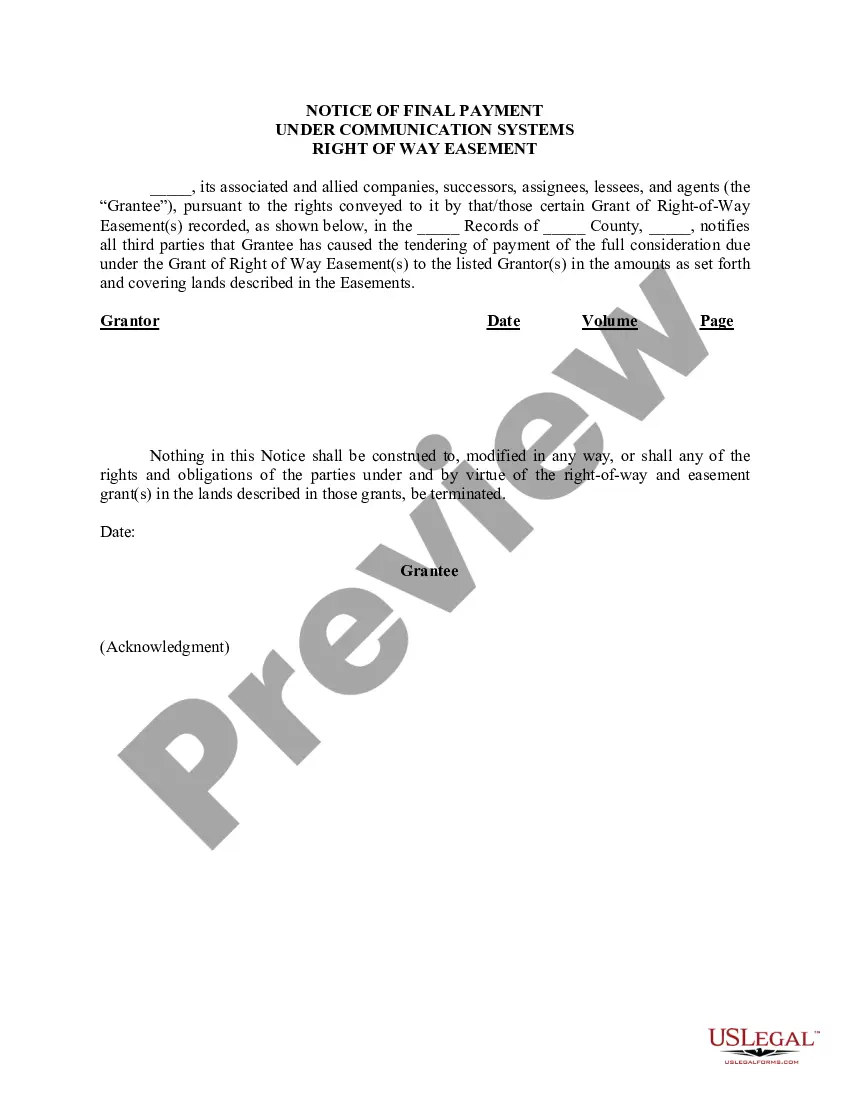
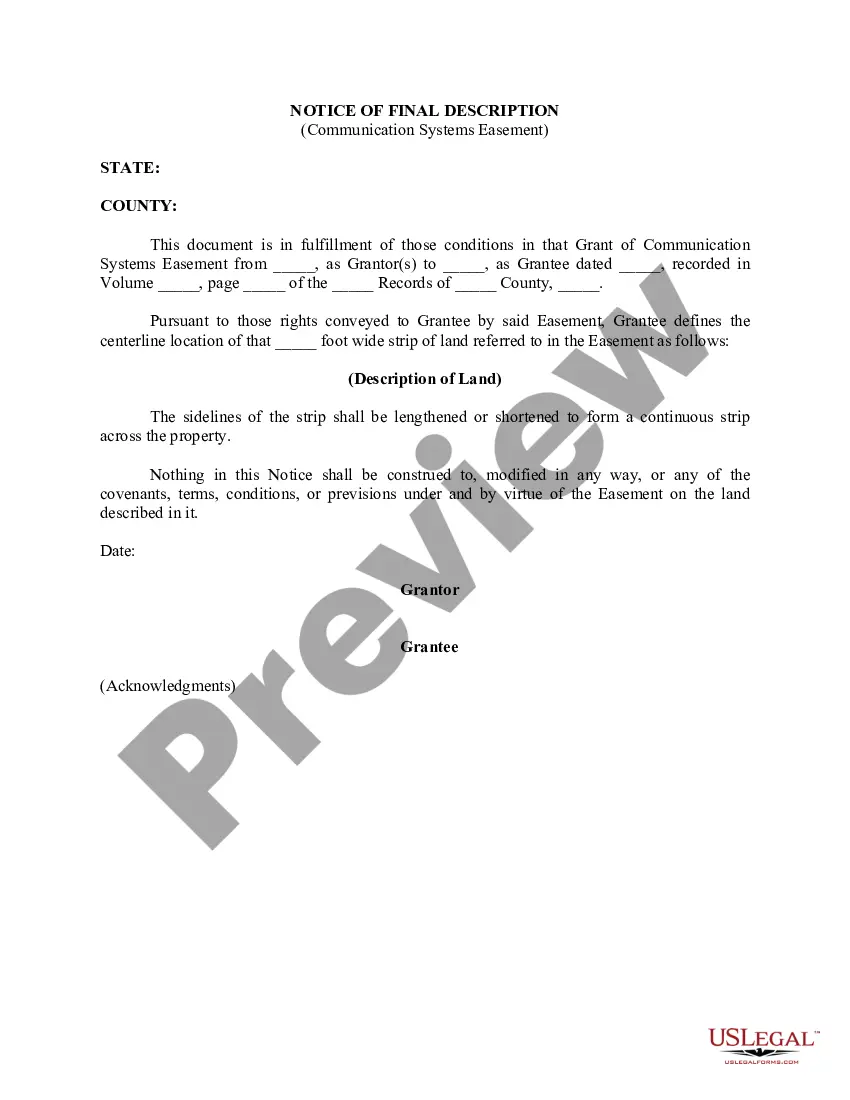
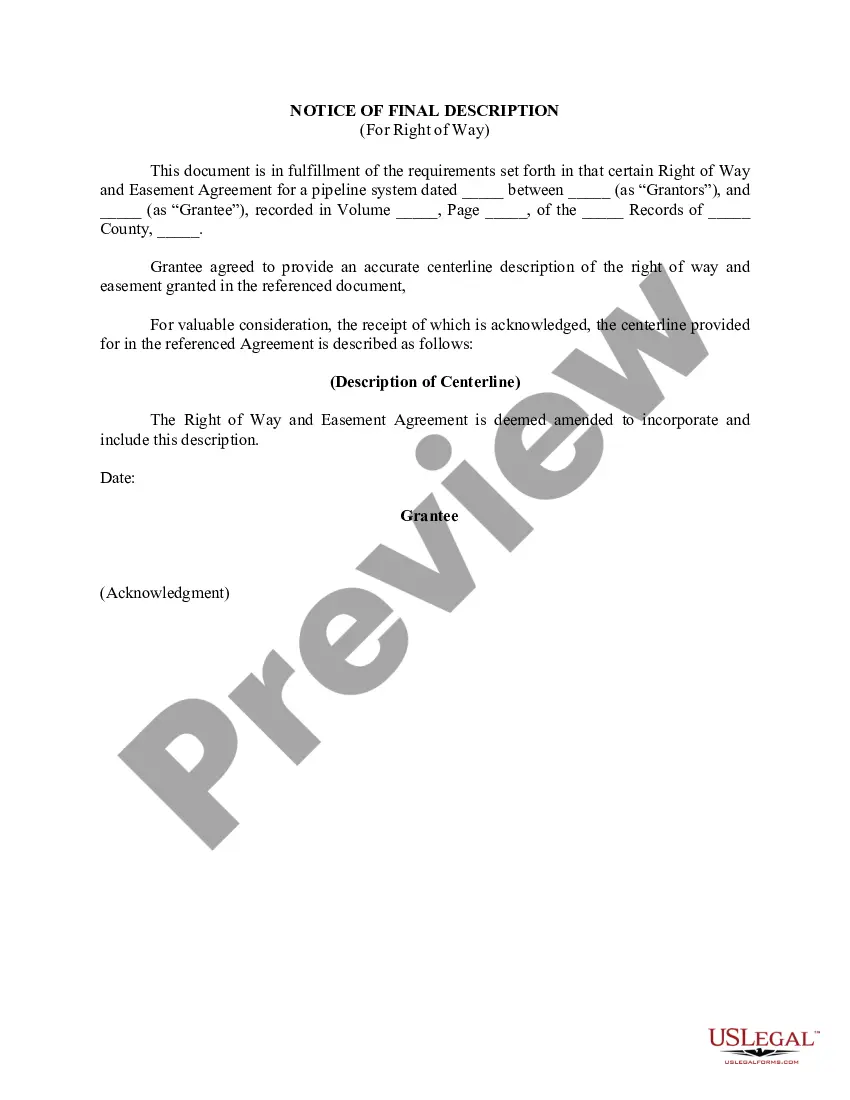
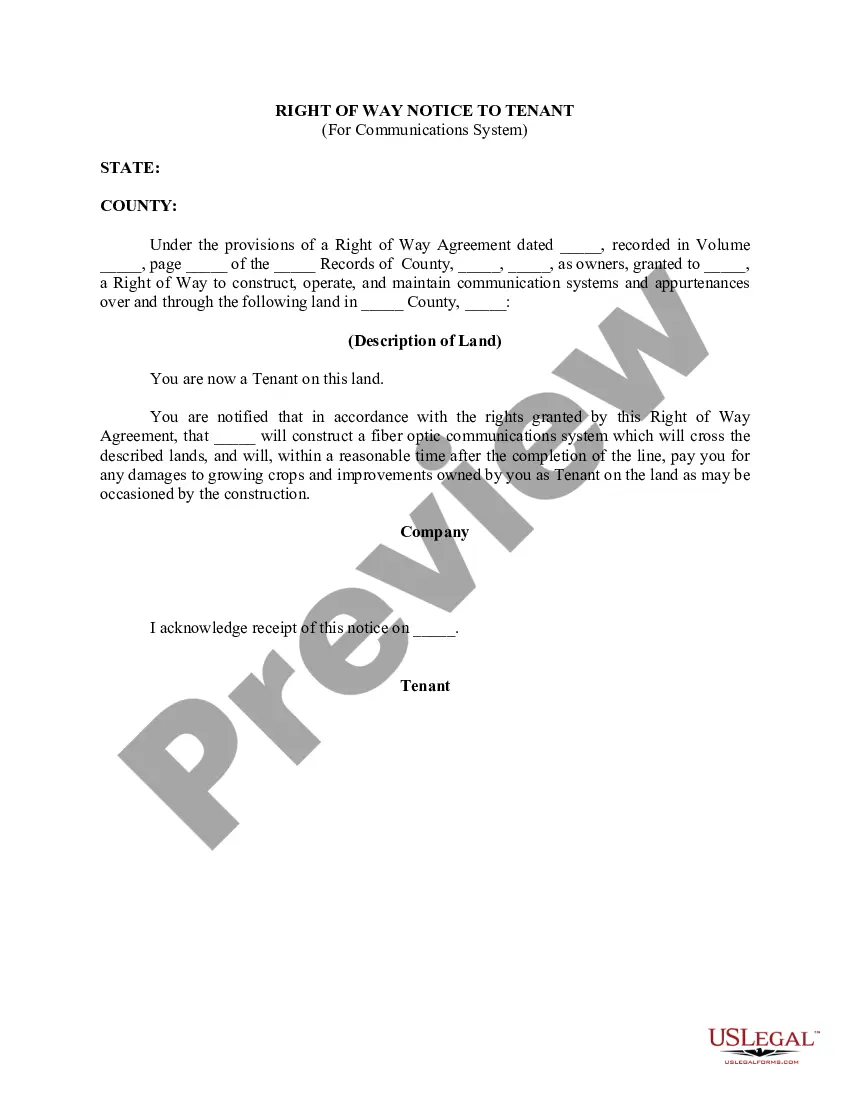
The Notice of Final Payment Under Communication Systems Right of Way Easement is a legal document that informs parties of the completion of payment related to a right-of-way easement for communication systems. This form signifies that the grantee has fulfilled the financial obligations under the easement agreement, which differentiates it from similar forms that may address ongoing payments or different aspects of easement agreements.
Key parts of this document
- Identification of the grantee and grantor, including associated companies and successors.
- Date of notification and specifics regarding the recorded Grant of Right-of-Way Easement.
- Detailed breakdown of the payment amounts to each grantor.
- Confirmation that the notice does not alter the rights and obligations dictated by the easement agreements.
When to use this document
This form should be used when the grantee has completed the payment obligations under a communication systems right-of-way easement. It serves to officially notify all relevant parties that payment has been made, thereby indicating the conclusion of their financial responsibilities related to the easement.
Intended users of this form
- Property owners acting as grantors in a right-of-way easement agreement.
- Companies that have been granted right-of-way access for communication systems.
- Legal representatives handling matters related to easements.
How to prepare this document
- Identify the grantee and provide their contact information.
- Specify the date of the notice and reference the recorded Grant of Right-of-Way Easement.
- List all grantors along with the amounts paid to each one.
- Include a declaration that the notice does not alter the existing rights and obligations.
- Affix the signature of the grantee or an authorized representative to acknowledge the notification.
Does this document require notarization?
Notarization is generally not required for this form. However, certain states or situations might demand it. You can complete notarization online through US Legal Forms, powered by Notarize, using a verified video call available anytime.
Get your form ready online
Our built-in tools help you complete, sign, share, and store your documents in one place.
Make edits, fill in missing information, and update formatting in US Legal Forms—just like you would in MS Word.
Download a copy, print it, send it by email, or mail it via USPS—whatever works best for your next step.
Sign and collect signatures with our SignNow integration. Send to multiple recipients, set reminders, and more. Go Premium to unlock E-Sign.
If this form requires notarization, complete it online through a secure video call—no need to meet a notary in person or wait for an appointment.
We protect your documents and personal data by following strict security and privacy standards.

Make edits, fill in missing information, and update formatting in US Legal Forms—just like you would in MS Word.

Download a copy, print it, send it by email, or mail it via USPS—whatever works best for your next step.

Sign and collect signatures with our SignNow integration. Send to multiple recipients, set reminders, and more. Go Premium to unlock E-Sign.

If this form requires notarization, complete it online through a secure video call—no need to meet a notary in person or wait for an appointment.

We protect your documents and personal data by following strict security and privacy standards.
Mistakes to watch out for
- Failing to accurately list all grantors and payment amounts.
- Incomplete or incorrect reference to the recorded easement details.
- Not signing the form, which may invalidate the notice.
Benefits of completing this form online
- Convenience of filling out and downloading the form at your own pace.
- Edit and customize the form easily to suit your specific situation.
- Access to reliable templates drafted by licensed attorneys, ensuring legal compliance.
Looking for another form?
Form popularity
FAQ
Each segment will contain numbers and letters indicating the direction from North that the line proceeds as well as the distance to the next point. For example, a segment may have the notation N 15° 302032 452033 E on one side of the line and the notation 166.252032 on the other side of the line.
A property easement is generally written and recorded with the local assessor's office. The documented easement will show up when a title search is conducted and it stays there indefinitely, unless both parties agree to remove it.
You can terminate an easement by release. A release is a surrender of a right or interest, such as an easement. Only the person holding the right can release it, such as the owner of the dominant estate in an easement appurtenant or the holder of an easement in gross.
An easement is a "nonpossessory" property interest that allows the holder of the easement to have a right of way or use property that they do not own or possess. An easement doesn't allow the easement holder to occupy the land or to exclude others from the land unless they interfere with the easement holder's use.
Thus, the simplest method by which an owner can prevent an easement from being acquired on his or her property is by giving his consent to the other person's use. Once permission is given, the use by the neighbor (or the neighbor's tenant) is not adverse.
What are Easements and Rights-of-Way? Easements are nonpossessory interests in real property. More simply, an easement is the right to use another's property for a specific purpose. Rights-of-way are easements that specifically grant the holder the right to travel over another's property.
There are eight ways to terminate an easement: abandonment, merger, end of necessity, demolition, recording act, condemnation, adverse possession, and release.
III. Vacating or Reopening a Public Way or Easement. Anytime after the municipality closes the public way or easement, a property owner may commence an action to either vacate (i.e., foreclose) the municipality's right to reopen the closed public way or easement or to have the closed public way or easement reopened.
The party gaining the benefit of the easement is the dominant estate (or dominant tenement), while the party granting the benefit or suffering the burden is the servient estate (or servient tenement). For example, the owner of parcel A holds an easement to use a driveway on parcel B to gain access to A's house.