Notice of Final Description (Communication Systems Easement)
Understanding this form
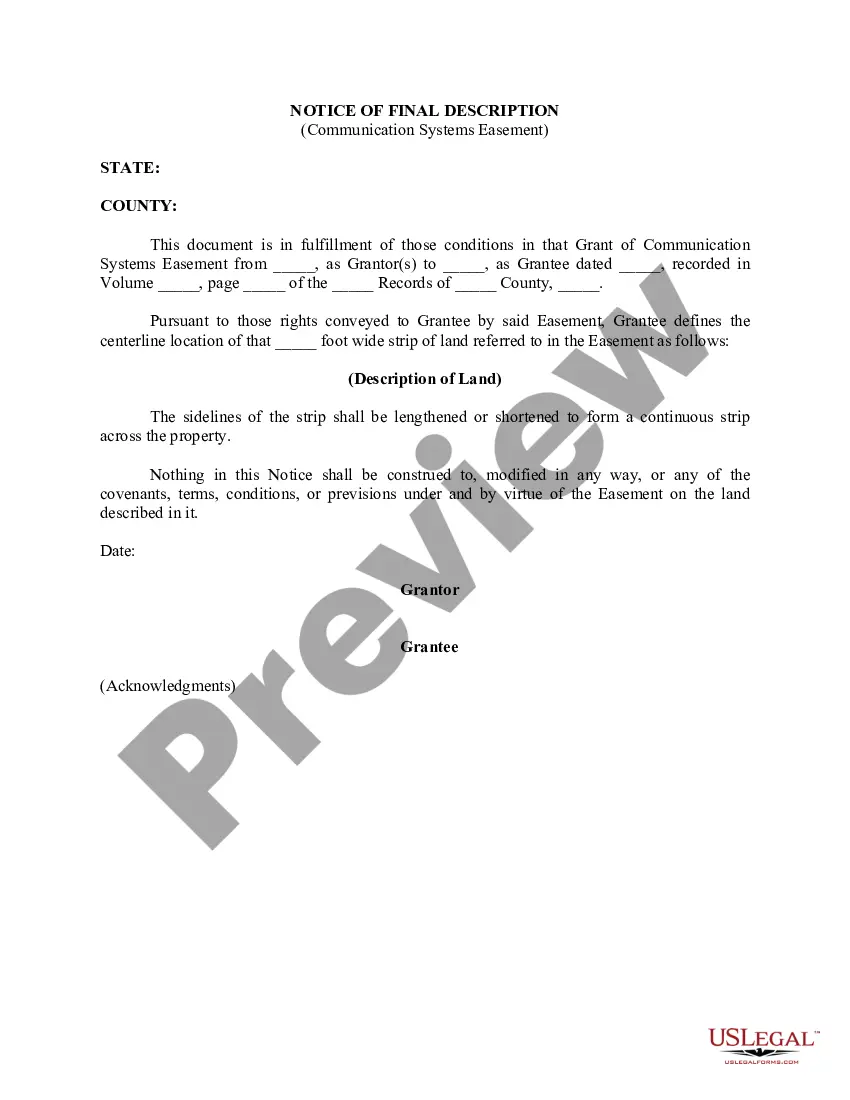
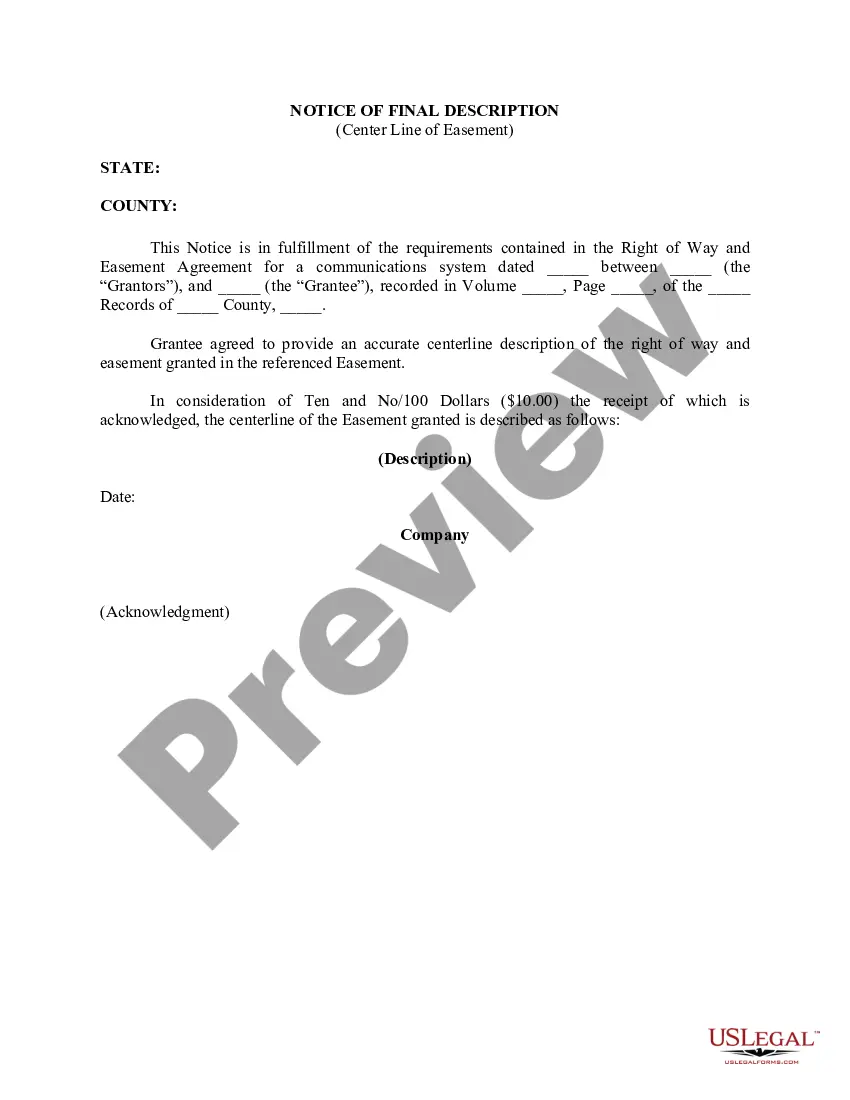
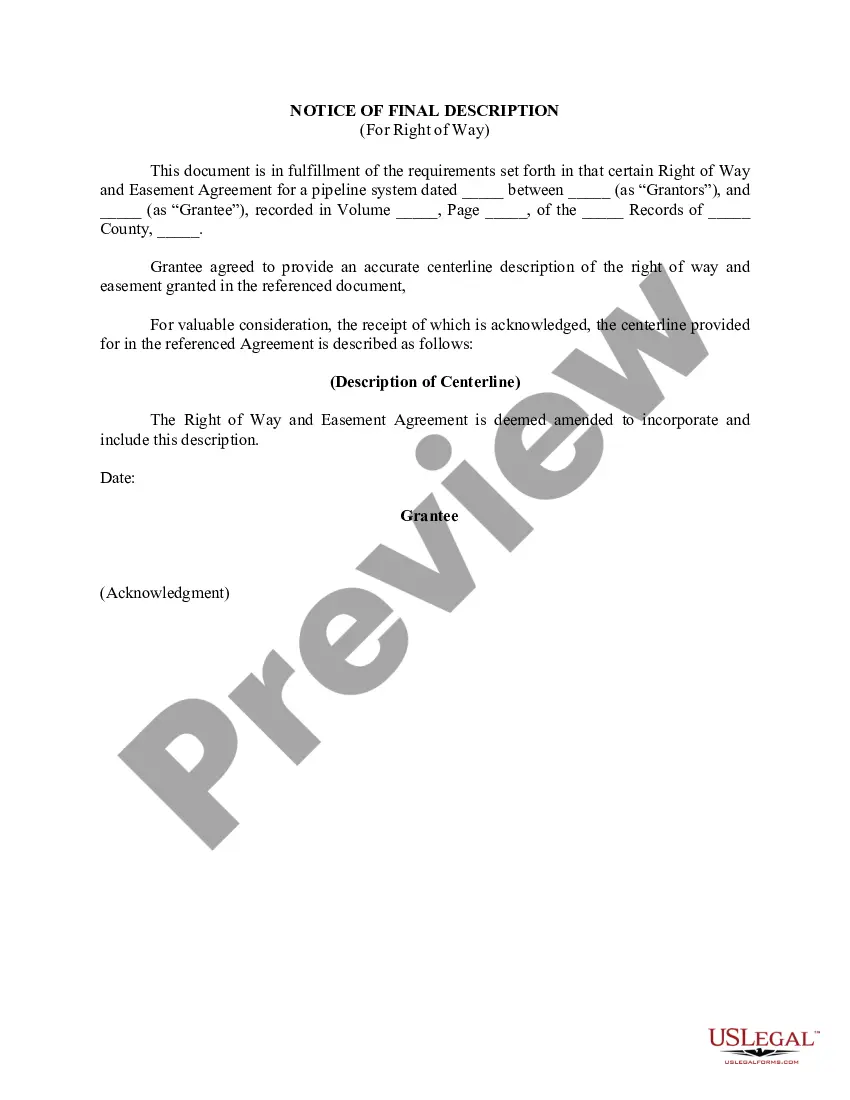
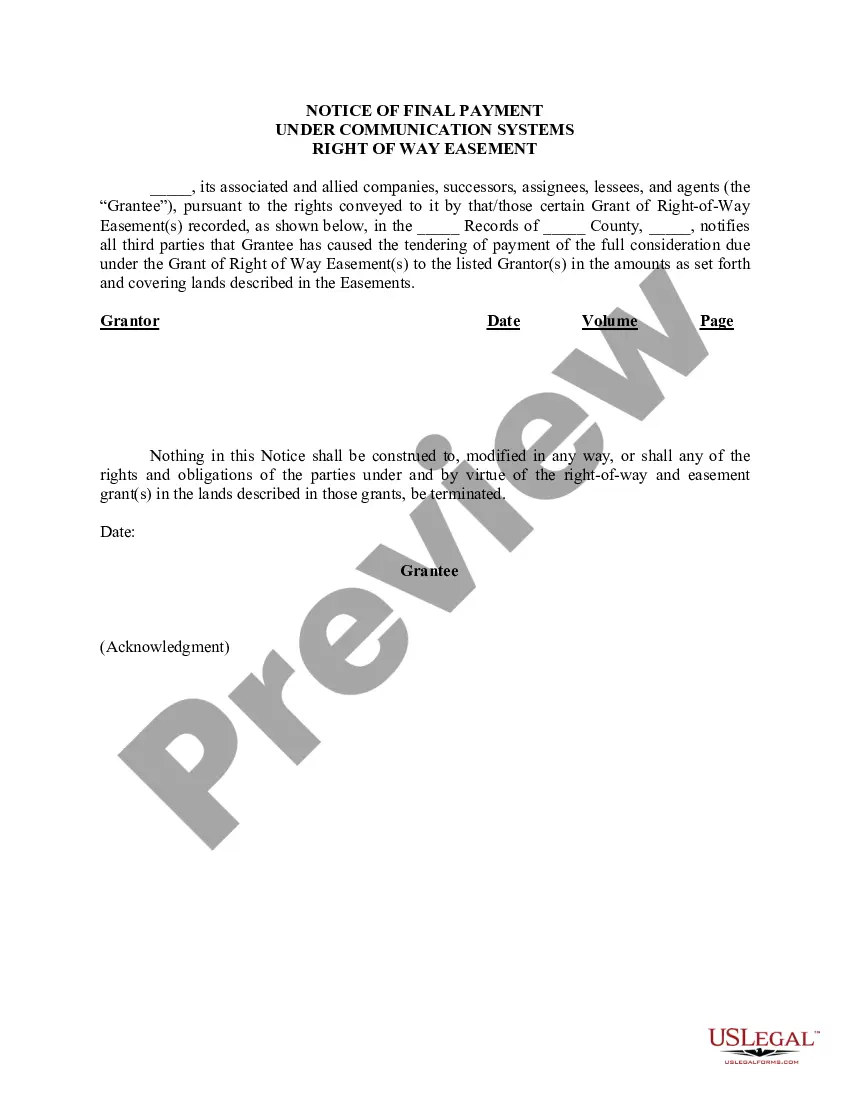
The Notice of Final Description for Communication Systems Easement is a legal document used to define the specific location of a communication systems easement on a parcel of land. This form serves as an official record that outlines the dimensions and centerline of the easement area, differentiating it from other easement notices by focusing specifically on the final description of the easement's location. It is essential for ensuring that all parties have a clear understanding of the easement's boundaries as established in the initial grant.
Form components explained
- Identification of the grantor(s) and grantee(s).
- Reference to the original grant of easement document, including recording details.
- Definition of the centerline location of the easement.
- Clarification of the width of the easement strip.
- Statement confirming that the notice does not modify existing easement conditions.
- Spaces for signatures of the grantor and grantee, along with dates.
When to use this document
This form is used after the initial grant of a communication systems easement has been established. It is typically required when a precise location for the easement needs to be documented to avoid disputes over land use. Use this form when you need to formally define the easement location for legal records, especially when installing or maintaining communication systems that rely on designated strips of land.
Who this form is for
- Property owners who are granting a communication systems easement.
- Companies or individuals receiving rights to use a portion of land for communication systems.
- Real estate attorneys assisting clients in easement formalities.
- Land developers or contractors who require documented easement specifications.
Steps to complete this form
- Identify and enter the names of the grantor(s) and grantee(s).
- Provide the details of the original grant of easement, including dates and recording information.
- Clearly define the centerline location along with the specified width of the easement.
- Verify that the description aligns with existing easement documents and does not alter any terms.
- Have both parties sign and date the document to validate the notice.
Does this document require notarization?
This document requires notarization to meet legal standards. US Legal Forms provides secure online notarization powered by Notarize, allowing you to complete the process through a verified video call, available 24/7.
Get your form ready online
Our built-in tools help you complete, sign, share, and store your documents in one place.
Make edits, fill in missing information, and update formatting in US Legal Forms—just like you would in MS Word.
Download a copy, print it, send it by email, or mail it via USPS—whatever works best for your next step.
Sign and collect signatures with our SignNow integration. Send to multiple recipients, set reminders, and more. Go Premium to unlock E-Sign.
If this form requires notarization, complete it online through a secure video call—no need to meet a notary in person or wait for an appointment.
We protect your documents and personal data by following strict security and privacy standards.

Make edits, fill in missing information, and update formatting in US Legal Forms—just like you would in MS Word.

Download a copy, print it, send it by email, or mail it via USPS—whatever works best for your next step.

Sign and collect signatures with our SignNow integration. Send to multiple recipients, set reminders, and more. Go Premium to unlock E-Sign.

If this form requires notarization, complete it online through a secure video call—no need to meet a notary in person or wait for an appointment.

We protect your documents and personal data by following strict security and privacy standards.
Common mistakes
- Failing to accurately describe the easement location, leading to potential disputes.
- Not including all required signatures, which may invalidate the notice.
- Using outdated or incorrect information from the original easement grant.
- Neglecting to follow state-specific formatting requirements.
Why use this form online
- Convenience of downloading and completing the form at your own pace.
- Editability to customize the document to your specific needs before finalization.
- Access to legally vetted templates drafted by licensed attorneys.
- Secure storage and easy retrieval of forms when needed.
Looking for another form?
Form popularity
FAQ
An easement is a "nonpossessory" property interest that allows the holder of the easement to have a right of way or use property that they do not own or possess.If the easement only benefits an individual personally, not as an owner of a particular piece of land, the easement is known as "in gross."
An easement is a limited right to use another person's land for a stated purpose. Examples of easements include the use of private roads and paths, or the use of a landowner's property to lay railroad tracks or electrical wires.
An easement is a property right that provides its holder with a non-possessory interest on another person's land.If there are only personal individual benefits from an easement the term used is in gross. The majority of easements are affirmative, this means that they authorise the use of another person's land.
If an authority has an easement registered over your land, they have the right to access the easement to maintain or repair the easement land or their equipment on the land.
An easement deed allows a party that is not the owner to use a portion of the land. It is a written agreement between two parties that spells out what part of the property is available for access and how it may be used. Since you are granting an easement to your land, you can set any terms and conditions you like.
Give the document a simple title: Grant of Easement is sufficient. Identify the parties. You need to explain who the parties are to the agreement. The person granting the easement to his property is the Grantor and the person gaining access to the property is the Grantee.
Generally speaking, an easement is a more serious property right; it is the legal right to use someone else's land for a particular purpose. Easements are often recorded at the county clerk's office and encumber your property's title.Here, however, you probably do not need to take the step of granting an easement.
An easement is a limited right to use another person's land for a stated purpose. Examples of easements include the use of private roads and paths, or the use of a landowner's property to lay railroad tracks or electrical wires.
An easement is a nonpossessory right to use and/or enter onto the real property of another without possessing it. It is "best typified in the right of way which one landowner, A, may enjoy over the land of another, B".