Natural Gas Storage Lease
Overview of this form
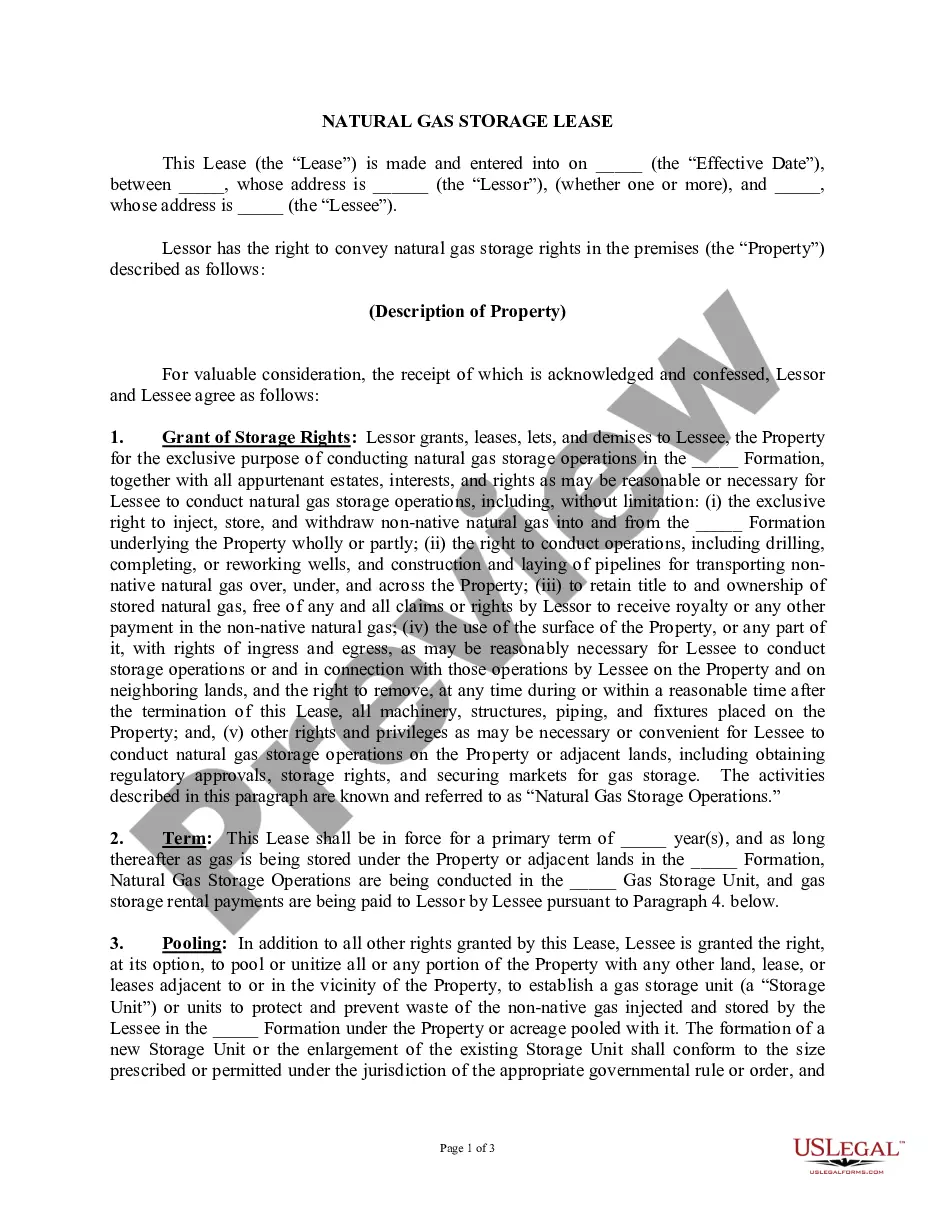
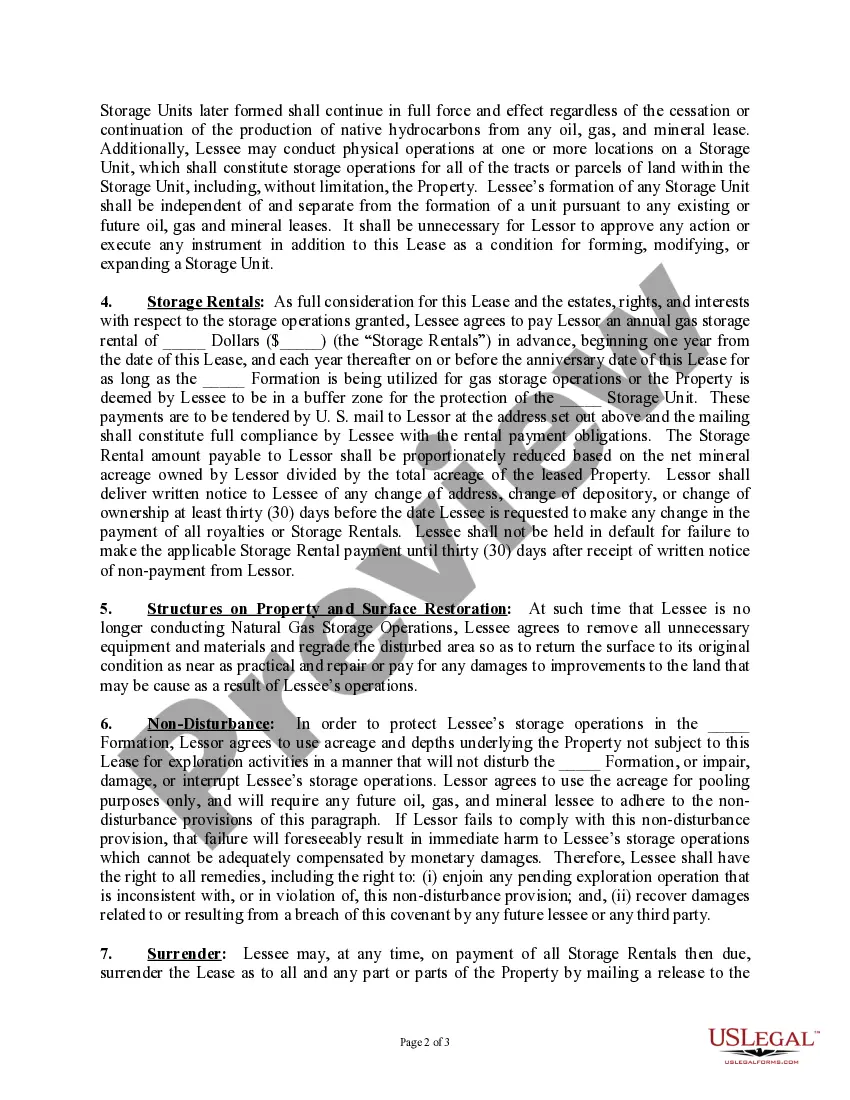
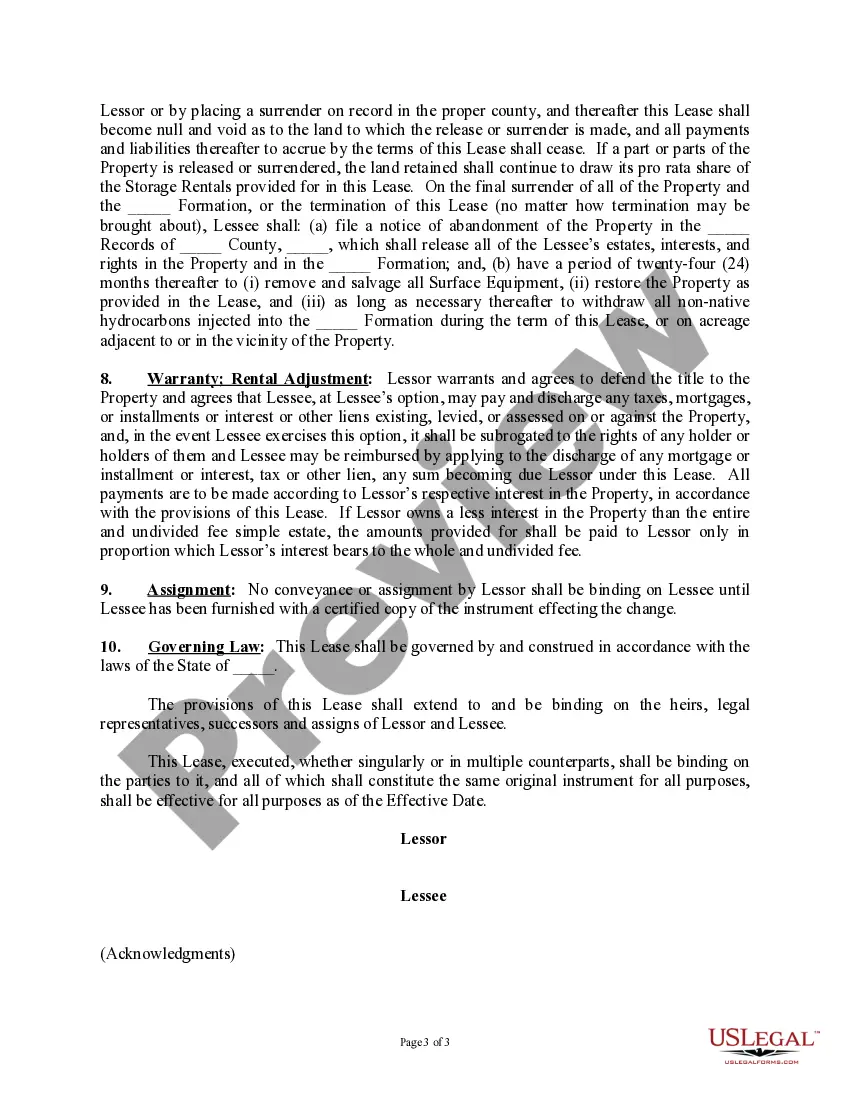
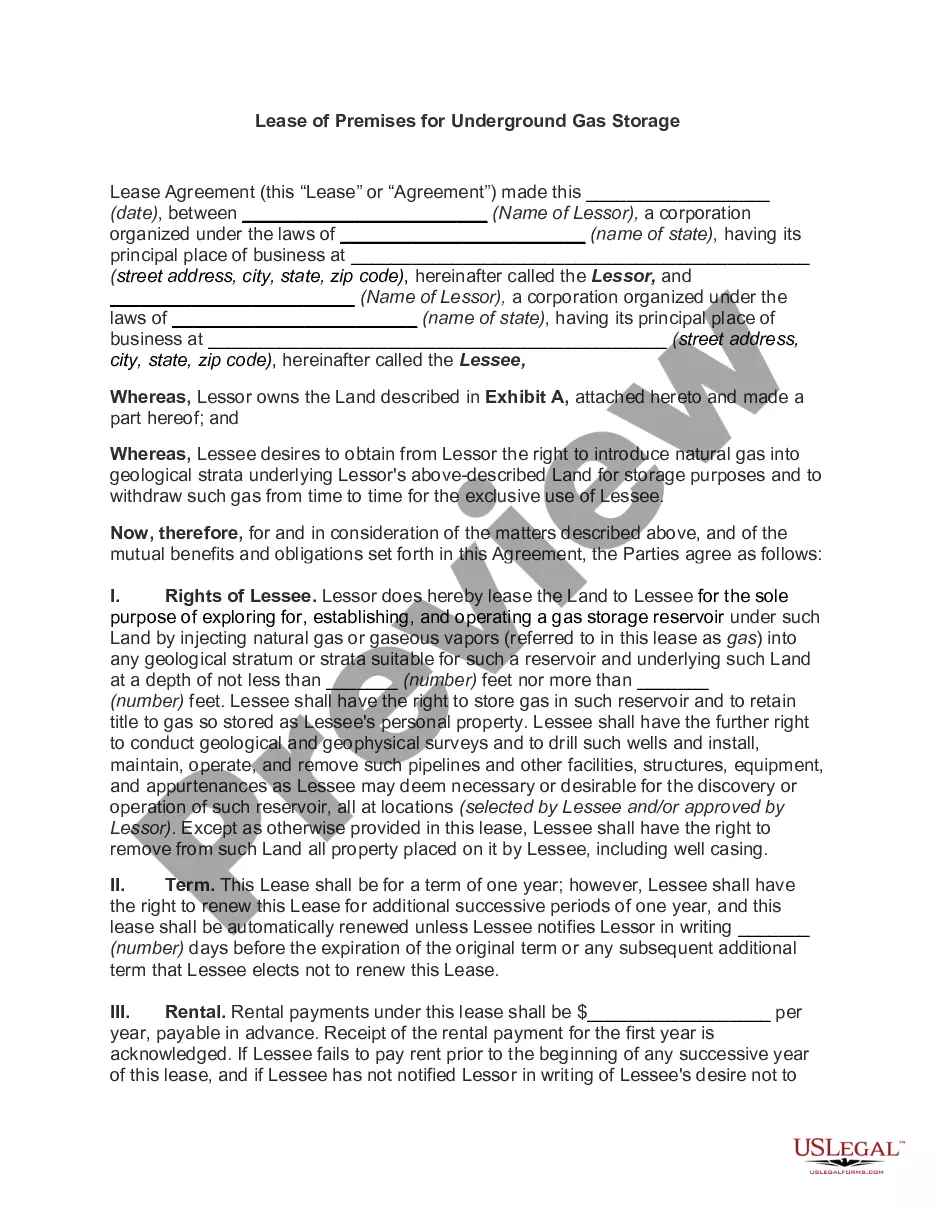
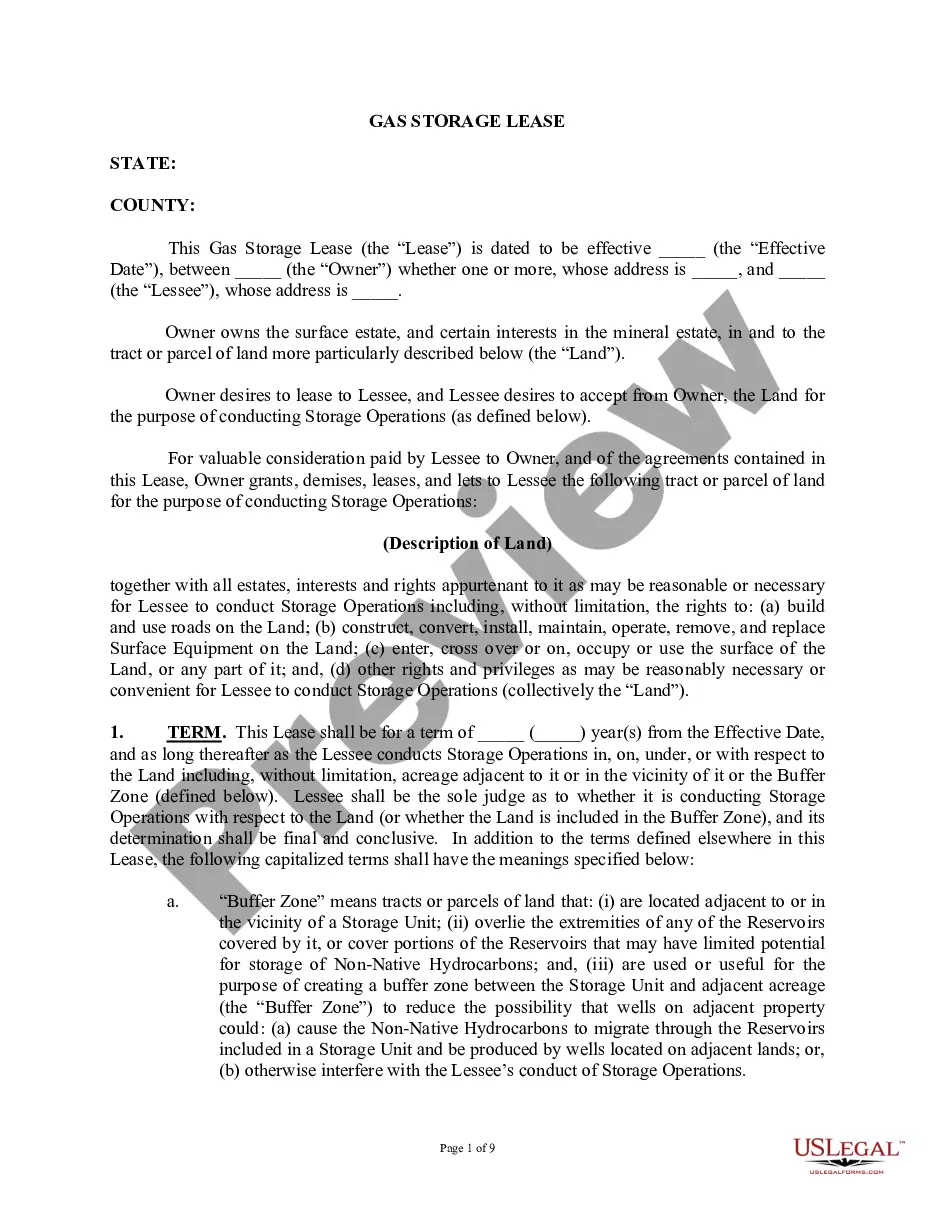
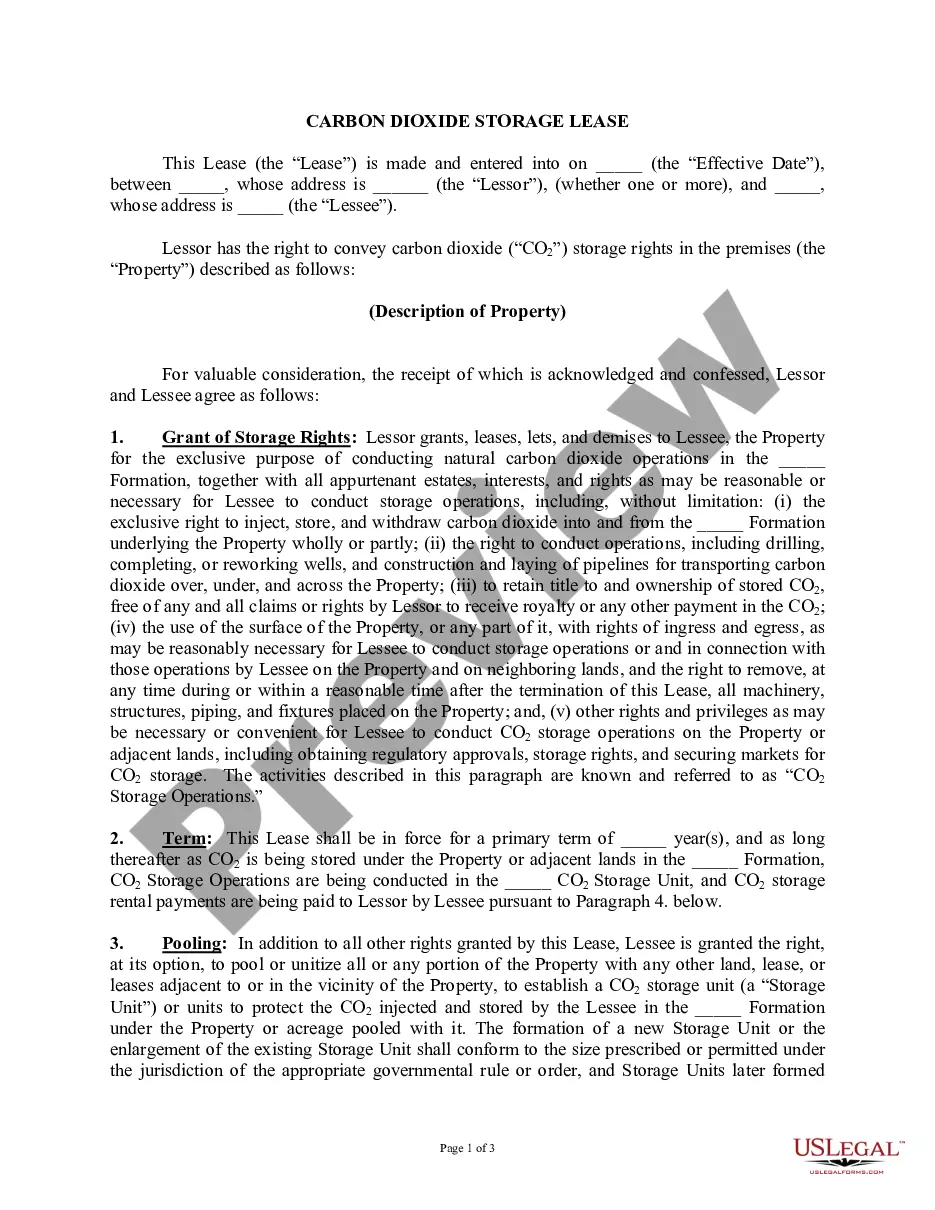
The Natural Gas Storage Lease is a legal document that grants a party, known as the lessee, the right to store natural gas on specified property owned by another party, referred to as the lessor. This form details the relationships, rights, and responsibilities of both parties involved in natural gas storage operations. It differs from other lease agreements by focusing specifically on the storage aspects within designated geological formations rather than general land leasing or commercial property agreements.
Main sections of this form
- Grant of storage rights to the lessee, allowing for natural gas storage operations.
- Term of the lease, specifying the duration and conditions for continuation.
- Pooling rights, enabling the lessee to combine resources with adjacent properties.
- Storage rental payments, detailing the compensation structure for the lessor.
- Non-disturbance clause to protect lessee's operations from exploration activities by the lessor.
- Termination and surrender procedures for concluding the lease agreements.
When to use this form
This form is essential for parties involved in the natural gas industry who wish to lease land for storage purposes. It should be utilized when a lessor is willing to grant rights for storing natural gas beneath their property and when a lessee seeks to ensure their rights for natural gas operations are legally secured. Common scenarios include natural gas companies looking to manage storage capacity or property owners negotiating contracts for gas storage rights.
Who should use this form
This form is intended for:
- Lessors who own property suitable for natural gas storage.
- Lessees seeking to establish or expand natural gas storage operations.
- Legal representatives assisting clients in drafting or negotiating storage lease agreements.
- Energy companies managing natural gas resources and infrastructure.
Completing this form step by step
- Identify the parties involved by entering the names and addresses of the lessor and lessee.
- Specify the effective date of the lease and the term duration.
- Describe the property by providing clear details regarding the land involved in the lease.
- Outline the storage rights being granted to the lessee and any additional terms regarding rental payments.
- Review and adjust the agreement as necessary to ensure compliance with any state-specific rules before signing.
Does this document require notarization?
This form does not typically require notarization to be legally valid. However, some jurisdictions or document types may still require it. US Legal Forms provides secure online notarization powered by Notarize, available 24/7 for added convenience.
Get your form ready online
Our built-in tools help you complete, sign, share, and store your documents in one place.
Make edits, fill in missing information, and update formatting in US Legal Forms—just like you would in MS Word.
Download a copy, print it, send it by email, or mail it via USPS—whatever works best for your next step.
Sign and collect signatures with our SignNow integration. Send to multiple recipients, set reminders, and more. Go Premium to unlock E-Sign.
If this form requires notarization, complete it online through a secure video call—no need to meet a notary in person or wait for an appointment.
We protect your documents and personal data by following strict security and privacy standards.

Make edits, fill in missing information, and update formatting in US Legal Forms—just like you would in MS Word.

Download a copy, print it, send it by email, or mail it via USPS—whatever works best for your next step.

Sign and collect signatures with our SignNow integration. Send to multiple recipients, set reminders, and more. Go Premium to unlock E-Sign.

If this form requires notarization, complete it online through a secure video call—no need to meet a notary in person or wait for an appointment.

We protect your documents and personal data by following strict security and privacy standards.
Common mistakes
- Failing to accurately describe the property, leading to disputes over boundaries.
- Not specifying the duration of the lease, which can create uncertainty for both parties.
- Omitting essential details regarding rental payments or rights, which may lead to financial misunderstandings.
- Neglecting to review state regulations that may affect the lease terms.
Advantages of online completion
- Convenience of downloading and editing the lease agreement at your convenience.
- Access to templates drafted by licensed attorneys ensures legal compliance.
- Time-saving by avoiding the need for in-person legal consultations.
- Ease of use, with straightforward guidance on filling in complex lease terms.
Looking for another form?

Form popularity
FAQ
Compressed natural gas or CNG is simply natural gas mainly comprised of methane that is stored under high pressures (while remaining in its gaseous form), mainly as a means to transport it, or as storage for later use as vehicle fuel.
The natural gas pressure of the gas line leading to the home ranges from approximately 1/4 psi to 60 psi, depending on the number of homes or businesses served by the line. This compares to pressures of up to 1,500 psi for large-volume pipelines used to move the gas from the well fields to the local utilities.
LNG is generally stored in large-volume above-ground low-pressure (less than 5 pounds per square inch gauge) tanks.
Natural gas is usually stored underground, in large storage reservoirs. There are three main types of underground storage: depleted gas reservoirs, aquifers, and salt caverns.LNG allows natural gas to be shipped and stored in liquid form, meaning it takes up much less space than gaseous natural gas.
For many years, almost all oil and gas leases reserved a 1/8th royalty. Today, the royalty fraction is negotiable, and is usually between 1/8th and 1/4th. Bonus. The bonus is the amount paid to the Lessor as consideration for his/her execution of the lease.
To keep natural gas a liquid, it requires a room temperature and maintains a pressure of about 32,000 kPa. Household metal tanks cannot resist this pressure.
It is most commonly held in inventory underground under pressure in three types of facilities. These underground facilities are depleted reservoirs in oil and/or natural gas fields, aquifers, and salt cavern formations. Natural gas is also stored in liquid or gaseous form in aboveground tanks.
Natural gas from out-of-state production basins is delivered into California via the interstate natural gas pipeline system.The state's natural gas utilities operate over 100,000 miles of transmission and distribution pipelines, and thousands more miles of service lines.