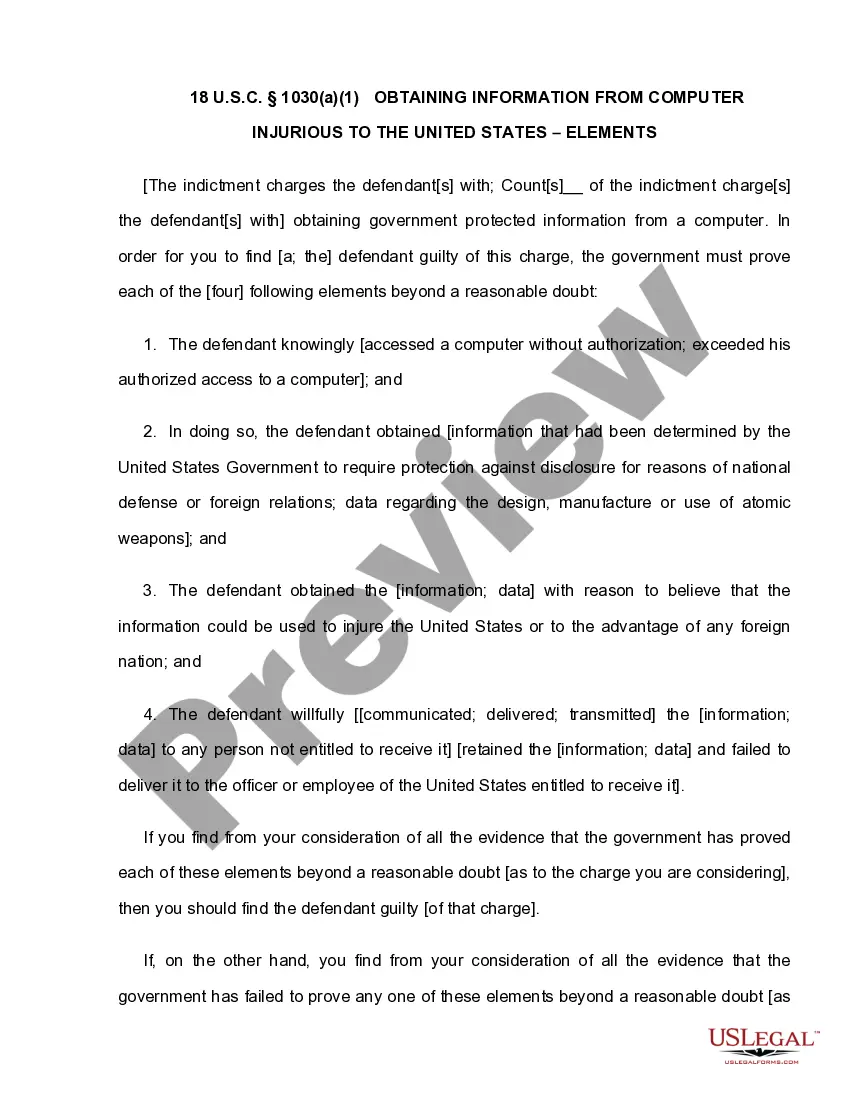
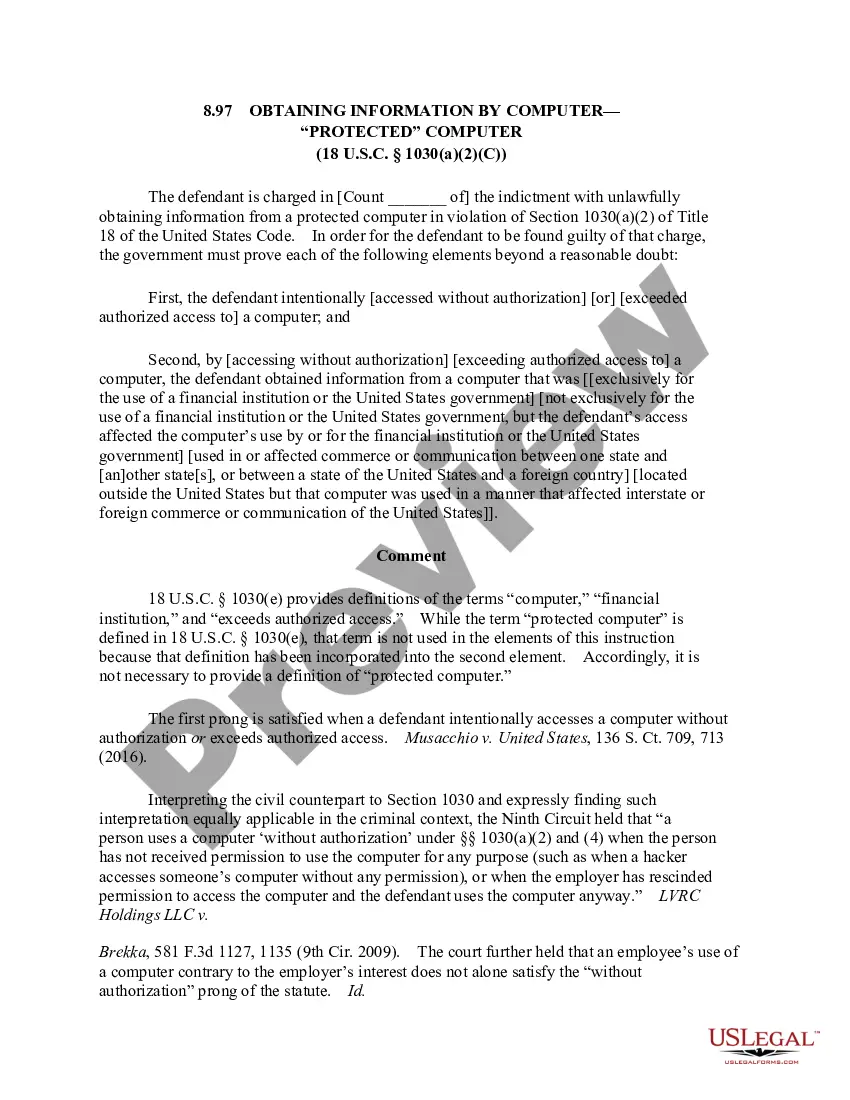
8.95 Obtaining Information by Computer-Injurious to United States or Advantageous to Foreign Nation (18 U.S.C. Sec. 1030(a)(1))


Does this document require notarization?
In most cases, this form does not require notarization. However, some jurisdictions or signing circumstances might. US Legal Forms offers online notarization powered by Notarize, accessible 24/7 for a quick, remote process.
Get your form ready online
Our built-in tools help you complete, sign, share, and store your documents in one place.
Make edits, fill in missing information, and update formatting in US Legal Forms—just like you would in MS Word.
Download a copy, print it, send it by email, or mail it via USPS—whatever works best for your next step.
Sign and collect signatures with our SignNow integration. Send to multiple recipients, set reminders, and more. Go Premium to unlock E-Sign.
If this form requires notarization, complete it online through a secure video call—no need to meet a notary in person or wait for an appointment.
We protect your documents and personal data by following strict security and privacy standards.

Make edits, fill in missing information, and update formatting in US Legal Forms—just like you would in MS Word.

Download a copy, print it, send it by email, or mail it via USPS—whatever works best for your next step.

Sign and collect signatures with our SignNow integration. Send to multiple recipients, set reminders, and more. Go Premium to unlock E-Sign.

If this form requires notarization, complete it online through a secure video call—no need to meet a notary in person or wait for an appointment.

We protect your documents and personal data by following strict security and privacy standards.
Looking for another form?
Form popularity
FAQ
Federal law provides that first time offenders caught violating the CFAA may be punished with criminal fines of up to $5,000 per crime, imprisonment from 1 to 10 years, or a combination of both.
§1030. Fraud and related activity in connection with computers. (C) intentionally accesses a protected computer without authorization, and as a result of such conduct, causes damage and loss.
Federal law provides that first time offenders caught violating the CFAA may be punished with criminal fines of up to $5,000 per crime, imprisonment from 1 to 10 years, or a combination of both.
The Computer Fraud and Abuse Act of 1986 makes it a crime for anyone to access without authorization a computer or computer system used by a financial institution, US government agency, or any organization or individual involved in interstate or foreign commerce or communication.
Federal Law In 1986, Congress passed the Computer Fraud and Abuse Act (CFAA), the federal statute that prohibits unauthorized computer access. Under federal law, unauthorized computer access describes the act of: Knowingly accessing a computer without authorization to obtain: Financial information.