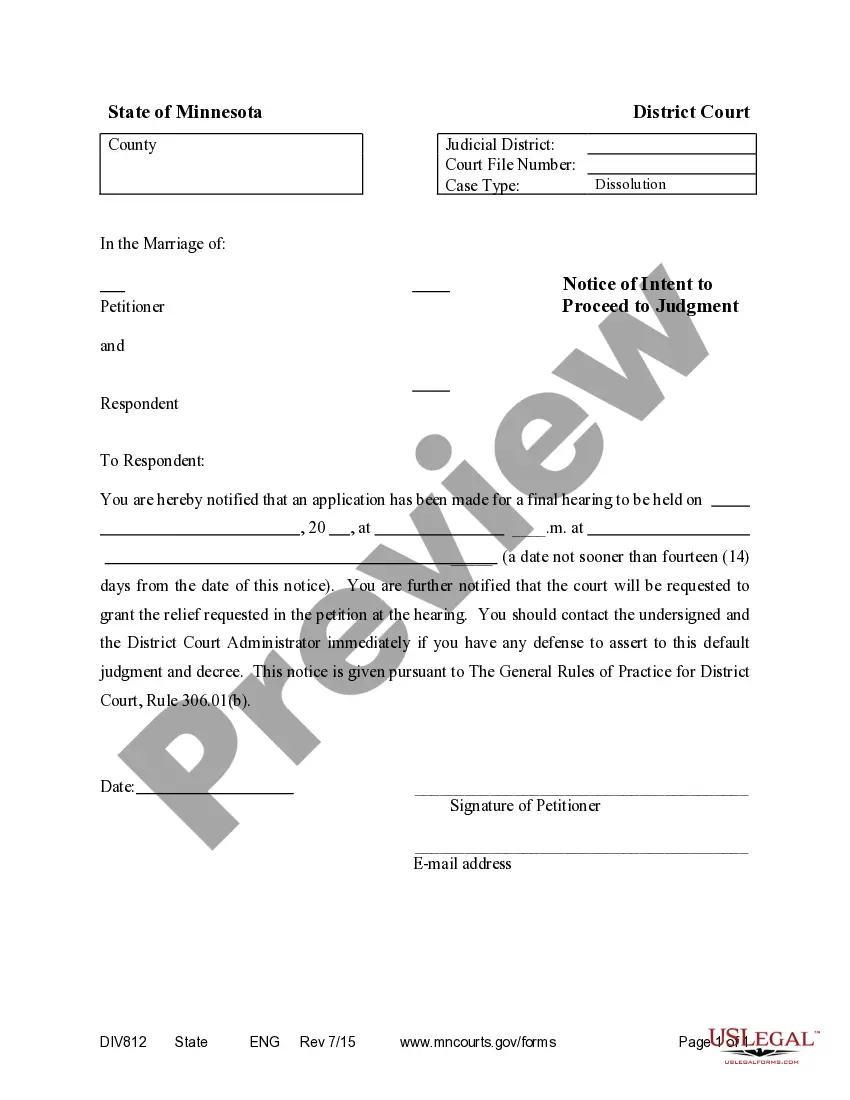
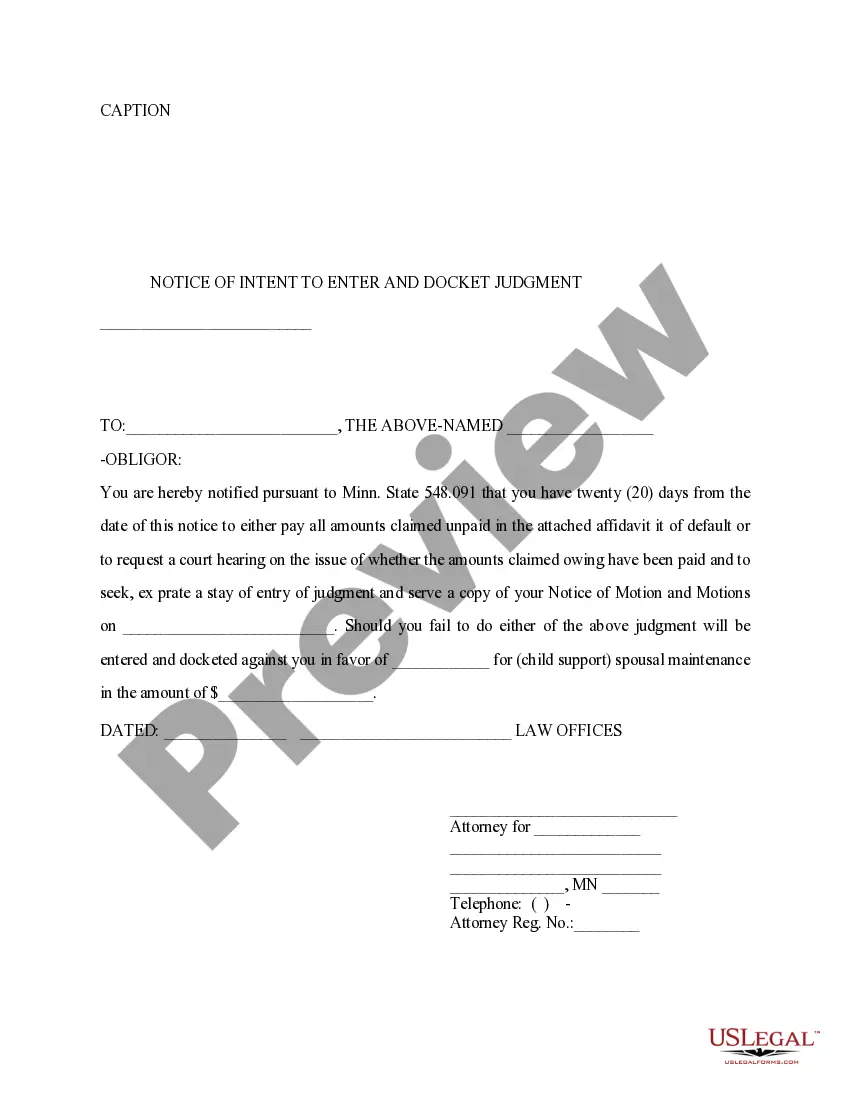
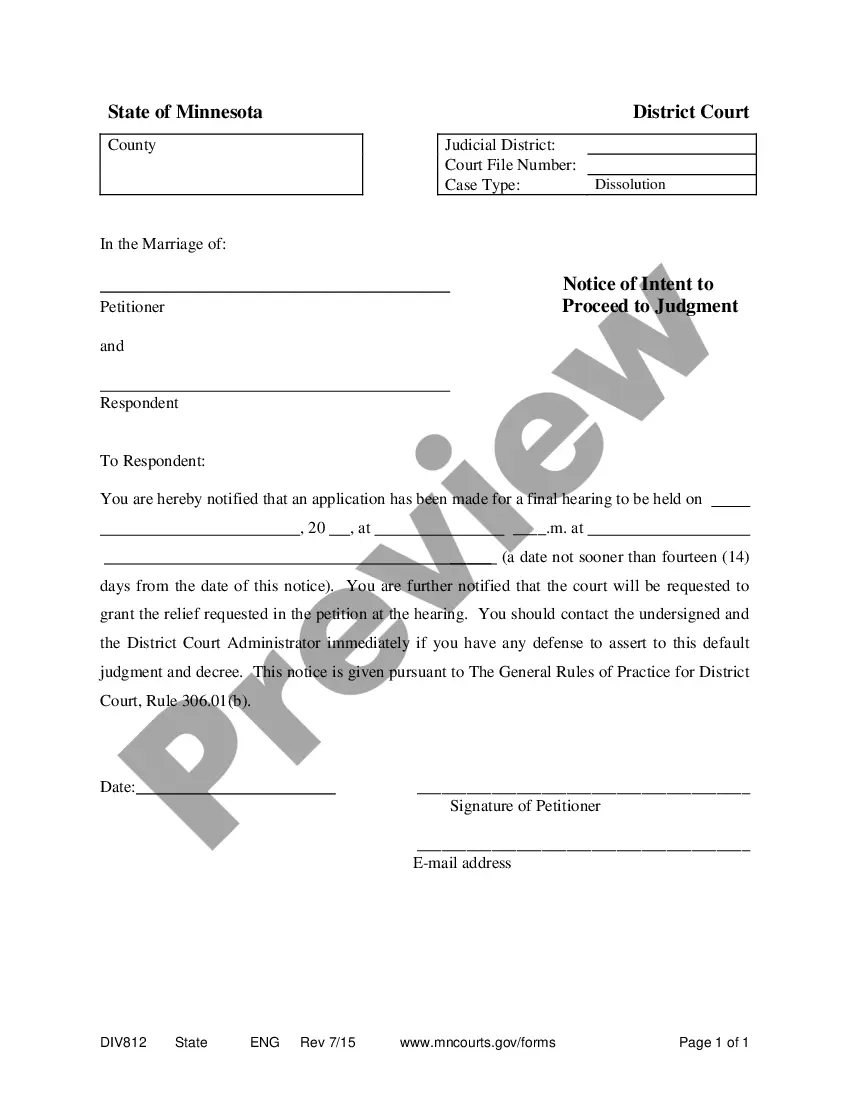
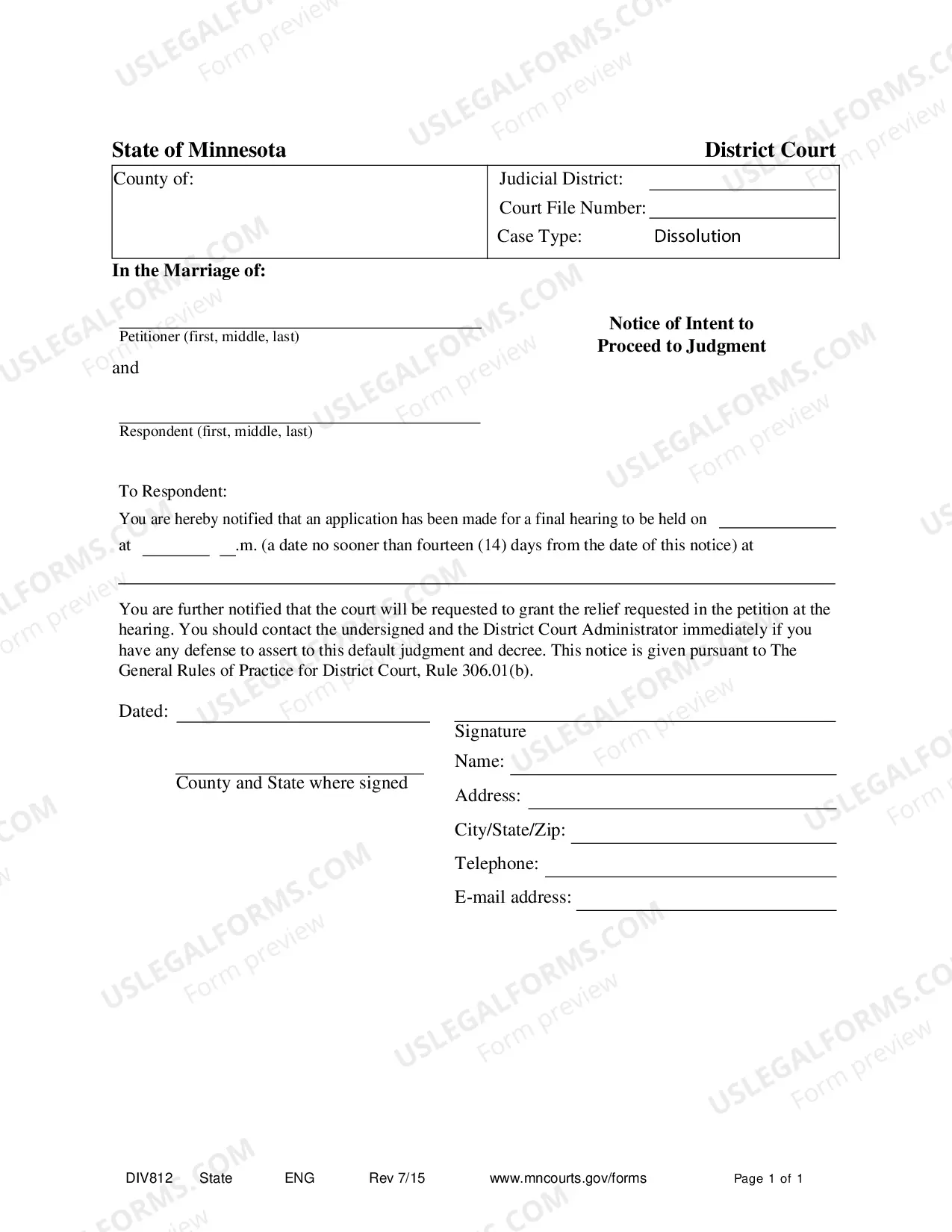
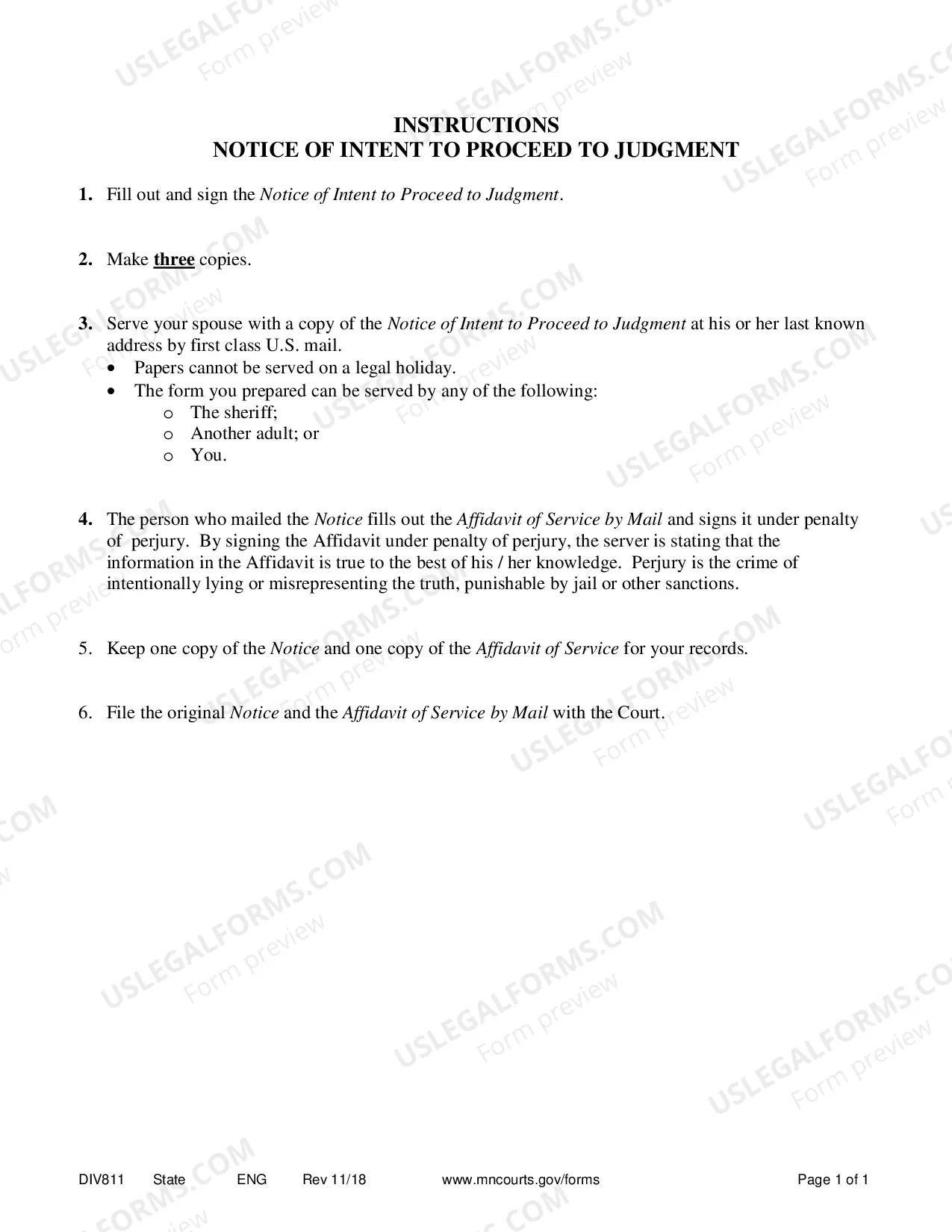
Minnesota Notice of Intent to Proceed to Judgment
Description
Get your form ready online
Our built-in tools help you complete, sign, share, and store your documents in one place.
Make edits, fill in missing information, and update formatting in US Legal Forms—just like you would in MS Word.
Download a copy, print it, send it by email, or mail it via USPS—whatever works best for your next step.
Sign and collect signatures with our SignNow integration. Send to multiple recipients, set reminders, and more. Go Premium to unlock E-Sign.
If this form requires notarization, complete it online through a secure video call—no need to meet a notary in person or wait for an appointment.
We protect your documents and personal data by following strict security and privacy standards.

Make edits, fill in missing information, and update formatting in US Legal Forms—just like you would in MS Word.

Download a copy, print it, send it by email, or mail it via USPS—whatever works best for your next step.

Sign and collect signatures with our SignNow integration. Send to multiple recipients, set reminders, and more. Go Premium to unlock E-Sign.

If this form requires notarization, complete it online through a secure video call—no need to meet a notary in person or wait for an appointment.

We protect your documents and personal data by following strict security and privacy standards.
Looking for another form?
How to fill out Minnesota Notice Of Intent To Proceed To Judgment?
Obtain any template from 85,000 legal documents, including the Minnesota Notice of Intent to Proceed to Judgment, online with US Legal Forms. Each template is crafted and revised by state-certified attorneys.
If you already hold a subscription, Log In. Once you arrive on the form’s page, click the Download button and navigate to My documents to access it.
If you have yet to subscribe, follow the steps outlined below.
With US Legal Forms, you will consistently have instant access to the appropriate downloadable template. The service grants you entry to documents and categorizes them to streamline your search. Utilize US Legal Forms to obtain your Minnesota Notice of Intent to Proceed to Judgment quickly and effortlessly.
- Verify the state-specific prerequisites for the Minnesota Notice of Intent to Proceed to Judgment you wish to utilize.
- Review the description and view the sample.
- Once you are assured that the template meets your needs, simply click Buy Now.
- Select a subscription plan that truly suits your budget.
- Establish a personal account.
- Make a payment using one of two suitable methods: by credit card or through PayPal.
- Choose a format to download the document; two options are accessible (PDF or Word).
- Download the file to the My documents section.
- After your reusable form is downloaded, print it or save it to your device.
Form popularity
FAQ
Rule 77.04 in Minnesota outlines the procedures related to a Notice of Intent to Proceed to Judgment. This rule is essential for parties involved in civil cases, as it helps streamline the process of moving forward with a judgment when certain conditions are met. Essentially, if a party fails to respond or take action, the other party can file this notice to expedite the court's decision. By understanding Rule 77.04, you can effectively navigate the complexities of the Minnesota Notice of Intent to Proceed to Judgment.
Rule of Practice 521 in Minnesota outlines the procedures for filing and serving documents related to civil lawsuits. It ensures that parties receive proper notice, including the Minnesota Notice of Intent to Proceed to Judgment when necessary. This rule promotes fairness and transparency in legal proceedings. For those navigating this complex area, USLegalForms offers comprehensive tools to help you understand and comply with these requirements.
To enforce a judgment in Minnesota, the winning party must first obtain a certified copy of the judgment. Afterward, they can file a Minnesota Notice of Intent to Proceed to Judgment, which initiates the enforcement process. This may involve garnishing wages or seizing assets to satisfy the judgment. Utilizing resources from USLegalForms can simplify this process, providing necessary forms and guidance for effective enforcement.
The 55.01 rule in Minnesota pertains to the process of obtaining a judgment in civil cases. It allows a plaintiff to file a Minnesota Notice of Intent to Proceed to Judgment if the defendant fails to respond within the specified time frame. This rule streamlines the legal process, enabling plaintiffs to move forward with their claims efficiently. Understanding this rule can be crucial for anyone involved in a legal dispute in Minnesota.
In Minnesota, a person commits the crime of simple assault, a misdemeanor, by intentionally inflicting or attempting to inflict injury; or by any act intended to cause fear of imminent injury or death.Lunging at someone is also assault if the act is intended to cause fear of bodily harm.
Whoever does either of the following is guilty of murder in the second degree and may be sentenced to imprisonment for not more than 40 years: (1) causes the death of a human being with intent to effect the death of that person or another, but without premeditation; or.
There are three degrees of murder. They are governed by Minnesota Statutes: 609.185 (first degree murder), 609.19 (second degree murder), and 609.195 (third degree murder).Intentional second degree murder is intentional murder without premeditation.
Proof of similar threats from the same person in the past. Footage of the incident(s) Testimonies from witnesses.
Minnesota Statutes Section 609.749 prohibits harassing another person by engaging in conduct that causes the victim to feel frightened, threatened, oppressed, persecuted, or intimidated, regardless of the relationship between the harasser and victim.
The Elements of Assault It may be that the "spitter" had no intention to break the law or hurt the person he spit on (or at), but because spitting on someone can be considered an application of force, i.e, making contact with another person in an offensive manner, it qualifies as a simple assault.