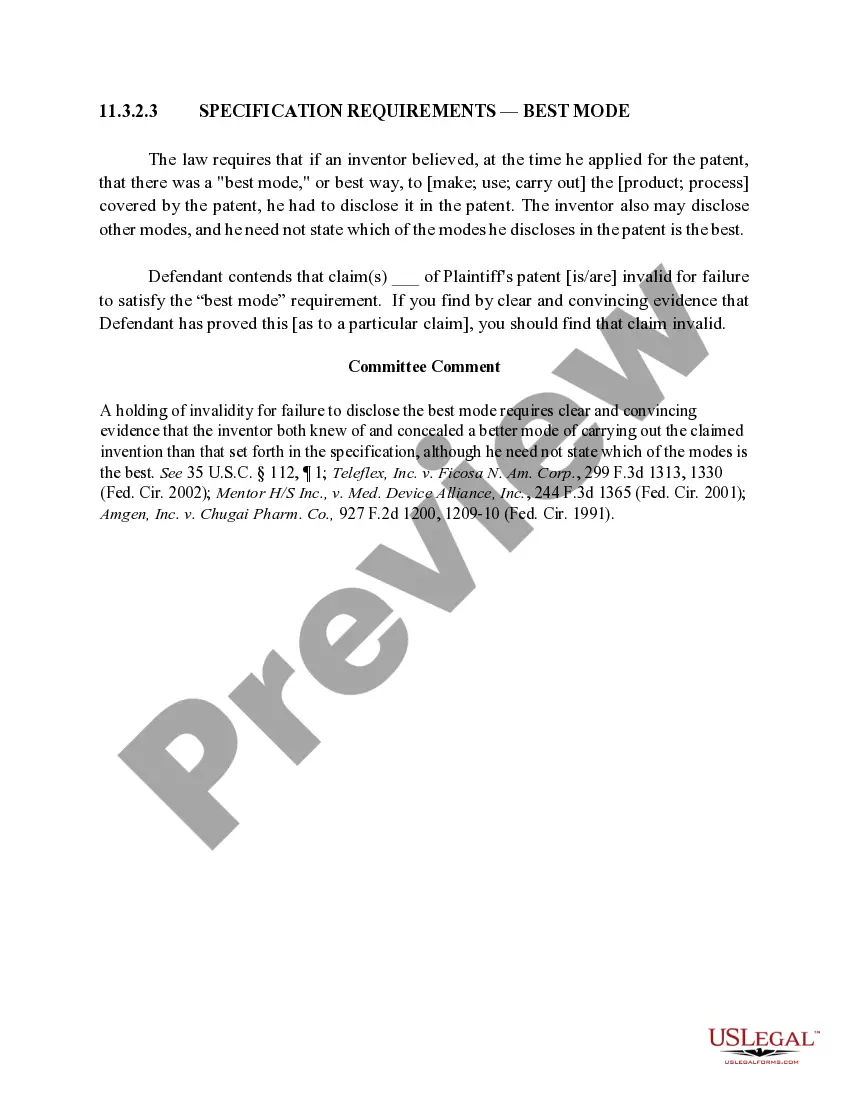
11.3.2.3 Specification Requirements - Best Mode
What this document covers
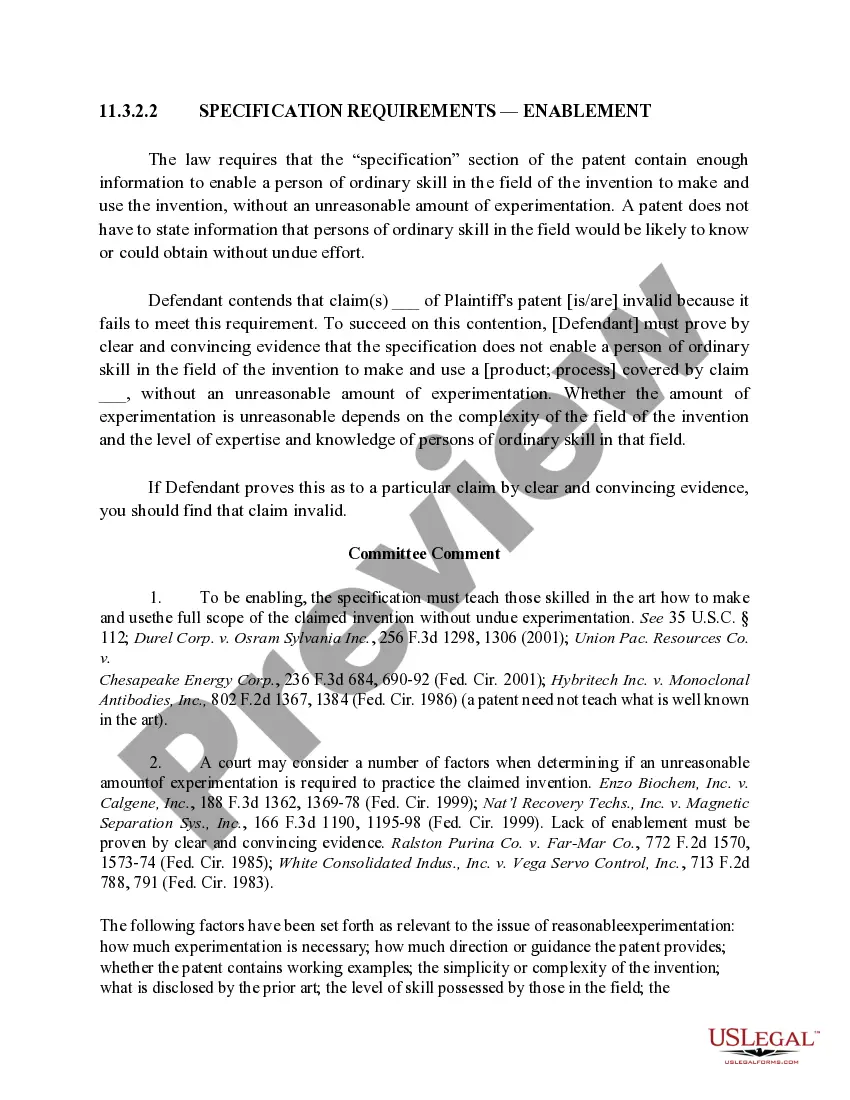
The 11.3.2.3 Specification Requirements - Best Mode form is a legal template used to address the best mode requirement of patent law. This requirement mandates that inventors disclose the best known method to make or use their invention when applying for a patent. This form is essential for legal proceedings concerning patent validity, specifically when a claim is challenged on the grounds of not satisfying the best mode requirement.
What’s included in this form
- Specification of the claims being challenged as invalid.
- Criteria for determining if the best mode requirement has been met.
- Clear and convincing evidence standard for proving the claim's invalidity.
When to use this form
This form is typically used during patent litigation when a defendant argues that a patent is invalid due to the inventor's failure to disclose the best mode. It helps in structuring the legal argument regarding patent validity and ensuring compliance with patent law.
Who this form is for
- Patent attorneys representing clients in litigation.
- Inventors involved in defending their patent claims.
- Legal professionals who need to assess patent validity issues.
How to prepare this document
- Identify the patent claims that are being challenged.
- Gather evidence to support the claim of invalidity.
- Complete the sections referring to the best mode requirement.
- Clearly outline the arguments relating to the inventor's knowledge and disclosures.
- Submit the completed form to the appropriate court as part of the litigation process.
Does this document require notarization?
This form does not typically require notarization to be legally valid. However, some jurisdictions or document types may still require it. US Legal Forms provides secure online notarization powered by Notarize, available 24/7 for added convenience.
Get your form ready online
Our built-in tools help you complete, sign, share, and store your documents in one place.
Make edits, fill in missing information, and update formatting in US Legal Forms—just like you would in MS Word.
Download a copy, print it, send it by email, or mail it via USPS—whatever works best for your next step.
Sign and collect signatures with our SignNow integration. Send to multiple recipients, set reminders, and more. Go Premium to unlock E-Sign.
If this form requires notarization, complete it online through a secure video call—no need to meet a notary in person or wait for an appointment.
We protect your documents and personal data by following strict security and privacy standards.

Make edits, fill in missing information, and update formatting in US Legal Forms—just like you would in MS Word.

Download a copy, print it, send it by email, or mail it via USPS—whatever works best for your next step.

Sign and collect signatures with our SignNow integration. Send to multiple recipients, set reminders, and more. Go Premium to unlock E-Sign.

If this form requires notarization, complete it online through a secure video call—no need to meet a notary in person or wait for an appointment.

We protect your documents and personal data by following strict security and privacy standards.
Typical mistakes to avoid
- Failing to provide clear and convincing evidence.
- Not specifying which claims are being contested.
- Incomplete arguments regarding the inventor's knowledge of the best mode.
Why complete this form online
- Convenient access to a legally validated template drafted by licensed attorneys.
- Editable format for customization to specific cases and claims.
- Immediate availability ensures timely use in legal proceedings.
Looking for another form?

Form popularity
FAQ
The best mode requirement is a safeguard against the desire on the part of some people to obtain patent protection without making a full disclosure as required by the statute.
The best mode requirement is entirely subjective. In other words, there is no requirement to disclose the absolute best way of carrying out the invention; instead, the inventor must disclose the best way known to him or her at the time the patent application is filed.
The five primary requirements for patentability are: (1) patentable subject matter, (2) utility, (3) novelty, (4) nonobviousness, and (5) enablement.
The sole purpose of the best mode requirement is to restrain inventors from applying for patents while at the same time concealing from the public preferred embodiments of their inventions, which they have in fact conceived.
There are five requirements that must be met to obtain a patent: patentable subject matter, utility, novelty, nonobviousness and enablement.
The best mode criterion ensures that if the inventor has developed any specific instrumentalities or techniques, they must be disclosed at the time of application as the best way of carrying out the invention.
To get the granted Patent, which is essential for the enforceability, every country has its criteria to judge the invention. Usually, Novelty, Inventive Step/Non-Obviousness and Industrial Applicability are the common criteria for judging an invention.