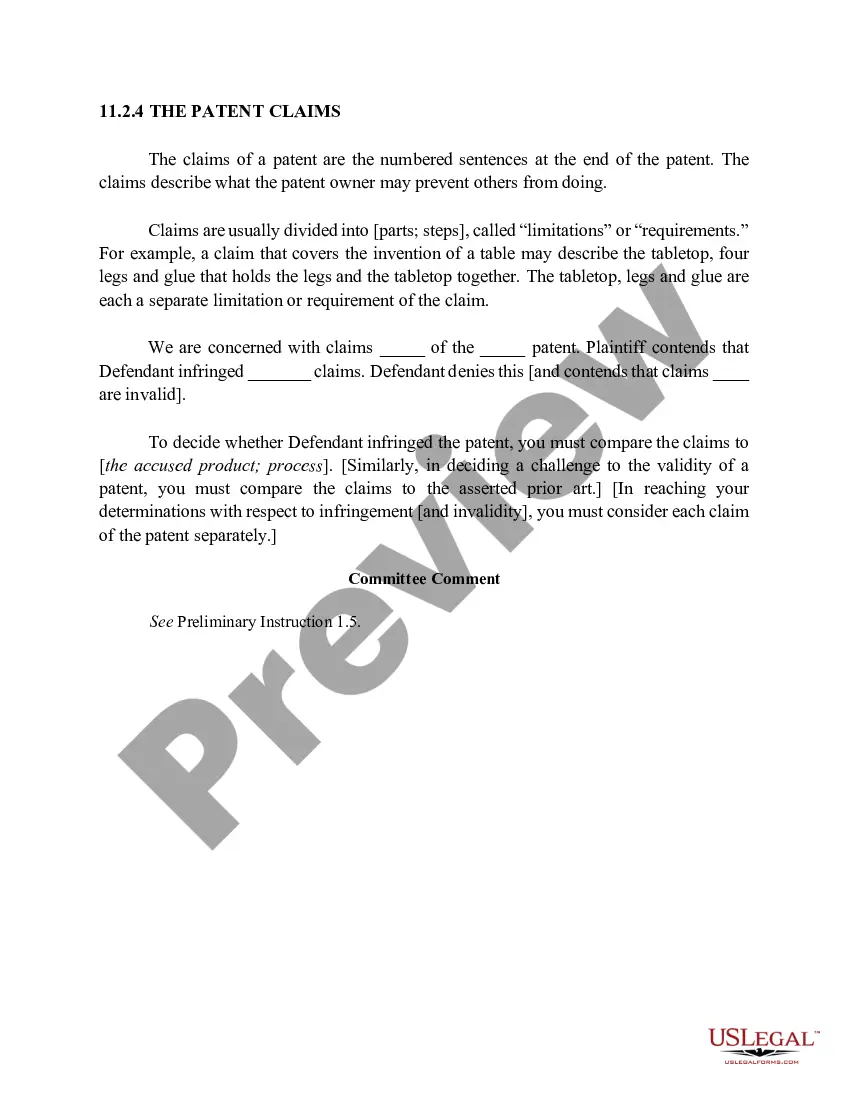
11.2.4 The Patent Claims
What is this form?
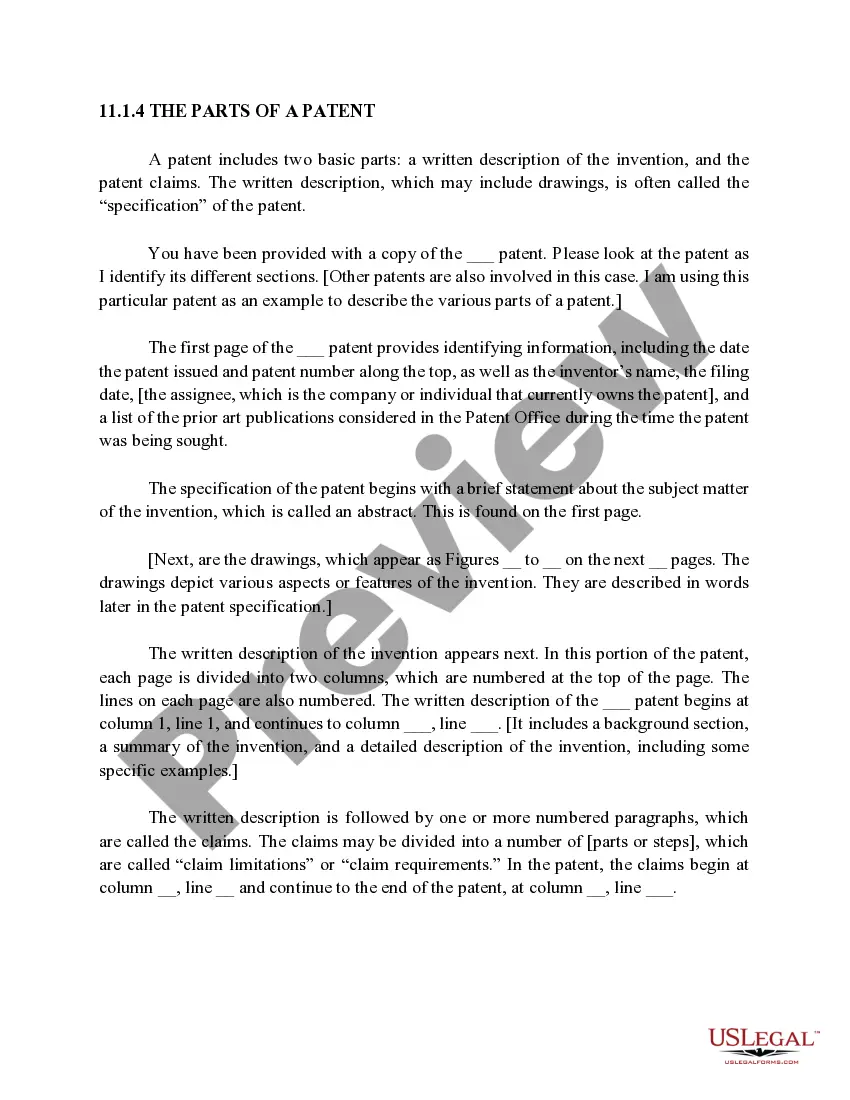
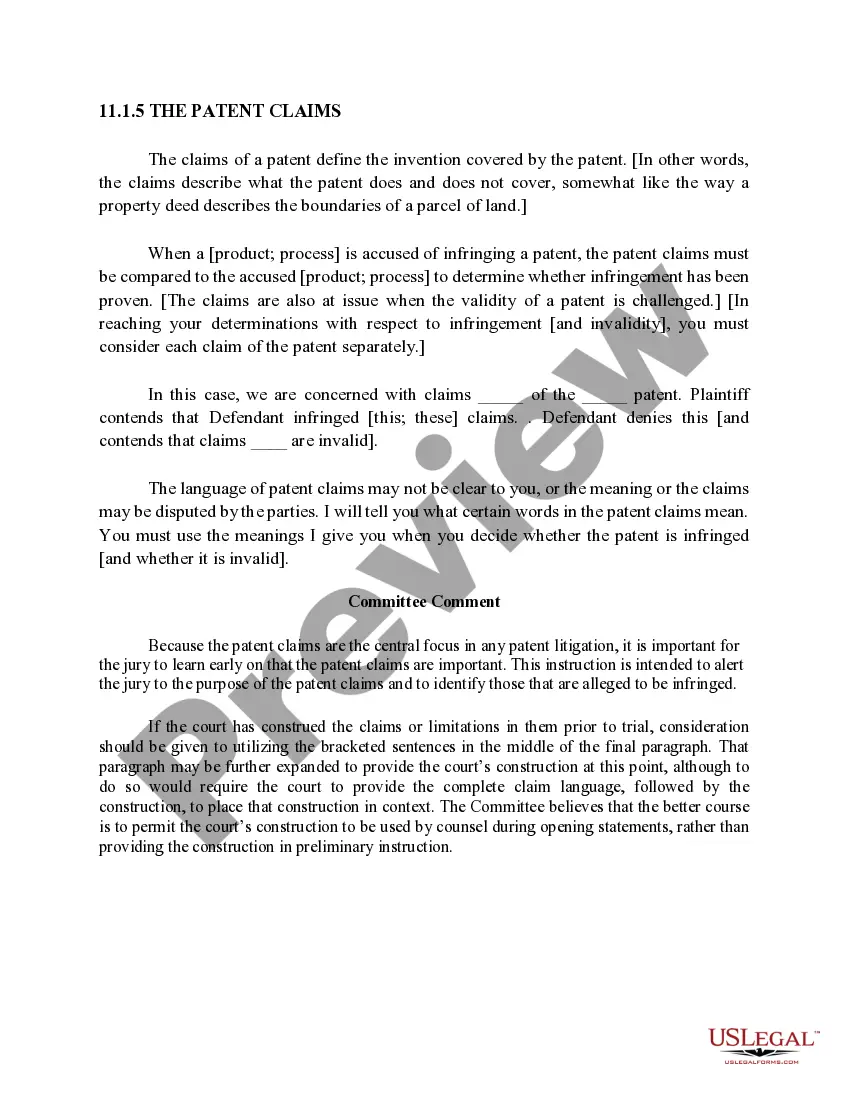
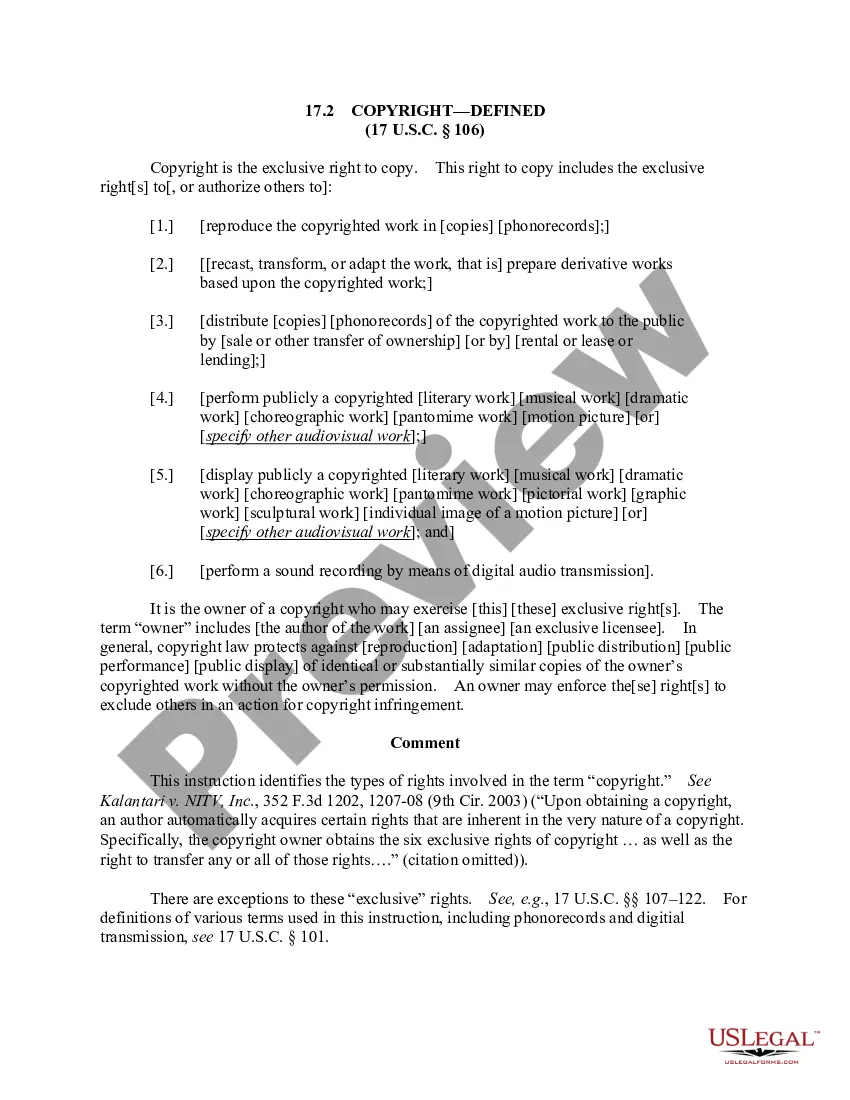
The Patent Claims form, identified as 11.2.4, provides a structured way to outline the specific claims of a patent. These claims define the boundaries of the patent owner's rights and what actions others may be prevented from taking. This form is essential in patent infringement cases, where clarity regarding what is protected by the patent is crucial for legal proceedings.
Main sections of this form
- Identification of specific claims involved in the infringement case.
- Clarification of the patent from which the claims derive.
- Statements regarding the actions alleged against the defendant.
- Instructions for comparing patent claims to the accused product or process.
- Separate consideration of each claim for both infringement and validity determinations.
When to use this form
This form should be used in legal scenarios involving patent disputes, particularly when a patent owner believes their rights are being infringed by another party. It is essential in cases where specific claims of a patent must be clearly articulated to support legal arguments regarding infringement or patent validity.
Intended users of this form
- Patent owners pursuing infringement claims.
- Defendants in patent litigation seeking to contest claims of infringement.
- Legal practitioners specializing in intellectual property law.
- Inventors who wish to understand the basis of their patent claims.
How to prepare this document
- Identify the claims of the patent involved in the case.
- Clearly state the patent number associated with the claims.
- Specify the claims that the plaintiff contends are infringed.
- Document the defendant's response regarding the validity of the claims.
- Outline the accused product or process for comparison.
Is notarization required?
In most cases, this form does not require notarization. However, some jurisdictions or signing circumstances might. US Legal Forms offers online notarization powered by Notarize, accessible 24/7 for a quick, remote process.
Get your form ready online
Our built-in tools help you complete, sign, share, and store your documents in one place.
Make edits, fill in missing information, and update formatting in US Legal Forms—just like you would in MS Word.
Download a copy, print it, send it by email, or mail it via USPS—whatever works best for your next step.
Sign and collect signatures with our SignNow integration. Send to multiple recipients, set reminders, and more. Go Premium to unlock E-Sign.
If this form requires notarization, complete it online through a secure video call—no need to meet a notary in person or wait for an appointment.
We protect your documents and personal data by following strict security and privacy standards.

Make edits, fill in missing information, and update formatting in US Legal Forms—just like you would in MS Word.

Download a copy, print it, send it by email, or mail it via USPS—whatever works best for your next step.

Sign and collect signatures with our SignNow integration. Send to multiple recipients, set reminders, and more. Go Premium to unlock E-Sign.

If this form requires notarization, complete it online through a secure video call—no need to meet a notary in person or wait for an appointment.

We protect your documents and personal data by following strict security and privacy standards.
Avoid these common issues
- Failing to specify which patent claims are at issue.
- Neglecting to provide clear descriptions of the accused product or process.
- Overlooking the requirement to analyze each claim separately.
- Using jargon without explanation, which can confuse non-legal audiences.
Why complete this form online
- Convenience of instant access to legal forms.
- Editability allows for customization to specific cases.
- Reliability provided through forms drafted by licensed attorneys.
Legal use & context
- This form is integral for asserting patent rights in legal proceedings.
- Clear documentation of claims is critical for both enforcement and defense strategies.
- Understanding patent claims helps avoid potential infringement issues.
Looking for another form?
Form popularity
FAQ
Patents may be searched using the following resources: Patent Public Search. Global Dossier. Patent Application Information Retrieval (PAIR) Public Search Facility. Patent and Trademark Resource Centers (PTRCs) Patent Official Gazette. Common Citation Document (CCD) Search International Patent Offices.
A very simple example for a patent claim: "A furniture having at least three legs." An easily understandable example of a claim is: "A furniture having at least three legs." This claim covers all the chairs, tables and every furniture that has at least three legs.
Parts of a Claim A claim is generally presented in three parts, the preamble, a transitional phrase (or word), and the body.
The record for most claims in a patent belongs to U.S. Patent No. 6,684,189, Apparatus and Method Using Front-end Network Gateways and Search Criteria for Efficient Quoting at a Remote Location, with 887 claims.
A patent claim is said to be the heart of a patent application. It defines the boundary and subject matter of the patent that is sought to be protected. The claim describes the elements or aspects of the invention that the patentee can prevent others from creating, using, or selling against his or her permission.
A very simple example for a patent claim: "A furniture having at least three legs." An easily understandable example of a claim is: "A furniture having at least three legs." This claim covers all the chairs, tables and every furniture that has at least three legs.
The first claim of an issued patent is always numbered "1," with each claim thereafter following in an ascending numerical sequence. Most patents contain about 10-20 claims, although there are some patents with only one claim and others with hundreds of claims.
A patent claim defines the boundaries of an invention, and therefore lays down what the patent does and does not cover. A patent claim is the most important thing in a patent application, for it defines the subject matter that is sought to be protected.