11.3.2.1 Specification Requirements - Written Description
What this document covers
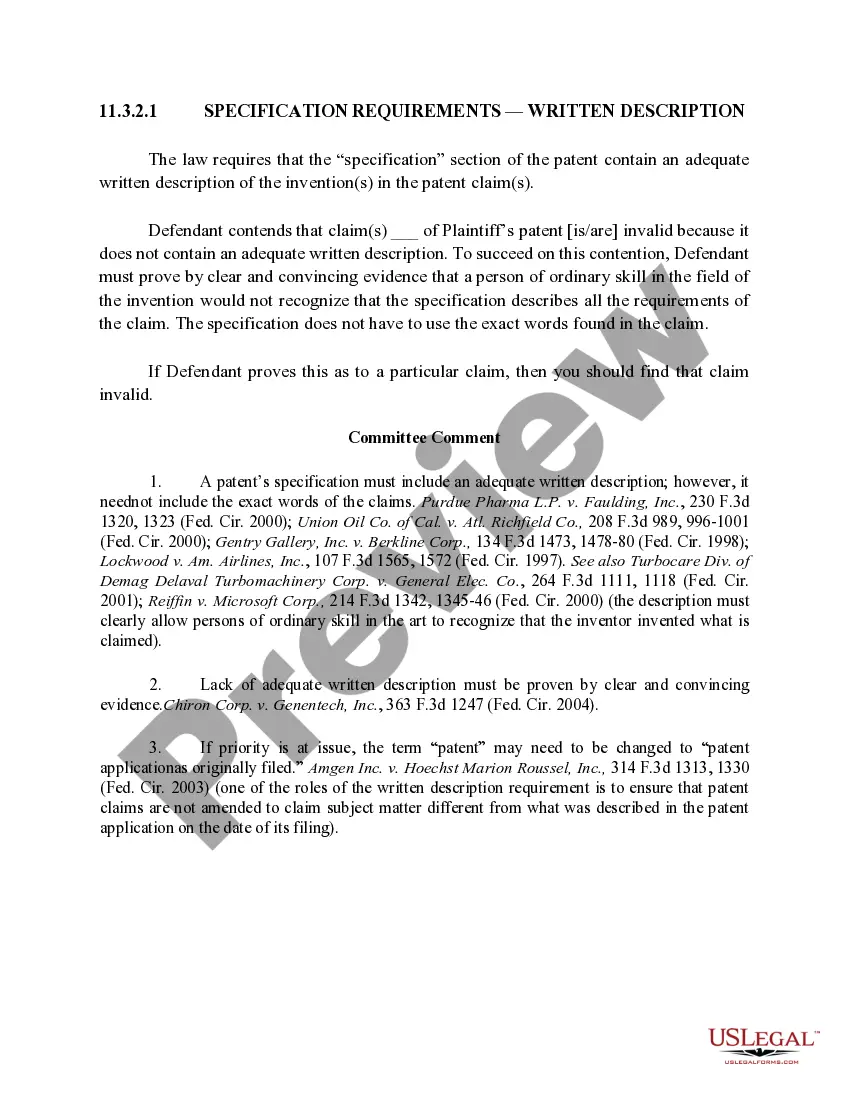
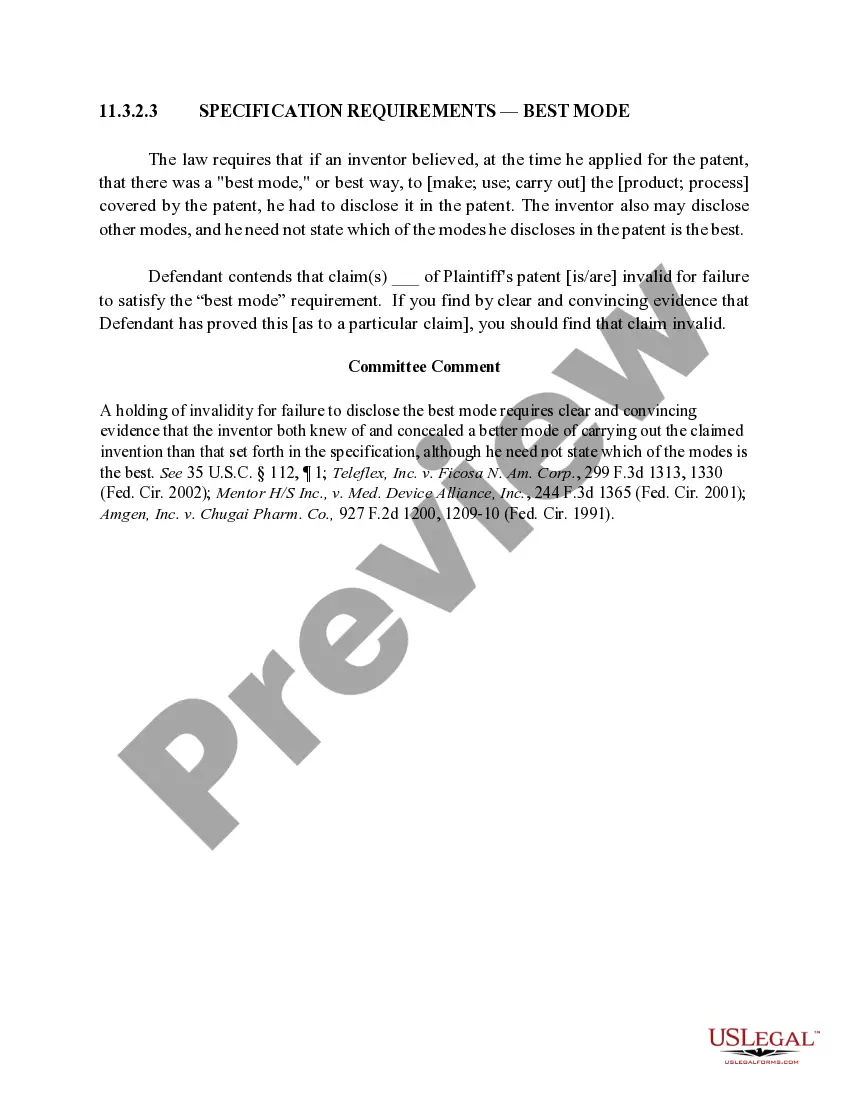
The 11.3.2.1 Specification Requirements - Written Description form is an essential legal document in the patent application process. It establishes the requirement for an adequate written description of an invention within the patent claims. This form differs from other legal templates by focusing specifically on the specification section of a patent, ensuring it conveys enough information for those skilled in the relevant field to recognize the invention as described.
Main sections of this form
- Specification section requirements: Describes the need for a clear written description of the invention.
- Clarity and evidence standards: Requires that claims meet clear and convincing evidence standards for invalidation.
- Legal precedent references: Includes citations of relevant cases to support the description requirements.
- Instructions for proving invalidity: Outlines how a defendant can contest the validity of a claim based on inadequate description.
When to use this form
This form is useful when a defendant asserts that a patent claim lacks an adequate written description, seeking to invalidate the claim in legal proceedings. It applies during patent litigation or when challenging a patent's validity based on its specification section.
Who should use this form
- Patent defendants: Individuals or companies contesting patent validity.
- Attorneys specializing in intellectual property: Legal professionals representing clients in patent-related cases.
- Inventors seeking to understand patent requirements: Those interested in ensuring their inventions comply with legal standards.
How to prepare this document
- Identify the patent claims under contestation that lack written descriptions.
- Gather evidence demonstrating what a person of ordinary skill would recognize from the specification.
- Document your arguments and supporting evidence clearly and concisely.
- Submit the completed form in the appropriate legal format as per court requirements.
- Ensure that all entries are thoroughly checked for accuracy before filing.
Is notarization required?
This form usually doesn’t need to be notarized. However, local laws or specific transactions may require it. Our online notarization service, powered by Notarize, lets you complete it remotely through a secure video session, available 24/7.
Get your form ready online
Our built-in tools help you complete, sign, share, and store your documents in one place.
Make edits, fill in missing information, and update formatting in US Legal Forms—just like you would in MS Word.
Download a copy, print it, send it by email, or mail it via USPS—whatever works best for your next step.
Sign and collect signatures with our SignNow integration. Send to multiple recipients, set reminders, and more. Go Premium to unlock E-Sign.
If this form requires notarization, complete it online through a secure video call—no need to meet a notary in person or wait for an appointment.
We protect your documents and personal data by following strict security and privacy standards.

Make edits, fill in missing information, and update formatting in US Legal Forms—just like you would in MS Word.

Download a copy, print it, send it by email, or mail it via USPS—whatever works best for your next step.

Sign and collect signatures with our SignNow integration. Send to multiple recipients, set reminders, and more. Go Premium to unlock E-Sign.

If this form requires notarization, complete it online through a secure video call—no need to meet a notary in person or wait for an appointment.

We protect your documents and personal data by following strict security and privacy standards.
Avoid these common issues
- Failing to provide clear evidence that the specification does not meet written description requirements.
- Misinterpreting the legal standards for what constitutes an adequate written description.
- Neglecting to review relevant case law that supports claims of invalidity.
Why complete this form online
- Convenient access: Download and complete the form from anywhere at any time.
- Editability: Modify the form as necessary to fit your specific legal needs.
- Reliability: Access forms drafted by licensed attorneys to ensure legal compliance.
Legal use & context
- This form is used in patent litigation to assess the validity of patent claims.
- The adequacy of the written description is crucial for enforceability of patent rights.
- Inadequate descriptions can lead to claims being invalidated, impacting patent holders significantly.
Summary of main points
- The form is essential for challenging patent claims based on inadequate written descriptions.
- Clear and convincing evidence is required to support claims of invalidity.
- Understanding legal precedents is critical for effective use of this form.
Looking for another form?
Form popularity
FAQ
The written description requirement requires an inventor to write down how to make and use (i.e., enablement requirement) the invention. The written description includes the text and the drawings. By doing so, after the patent expires, the patent can be used to teach the public how to implement the invention.
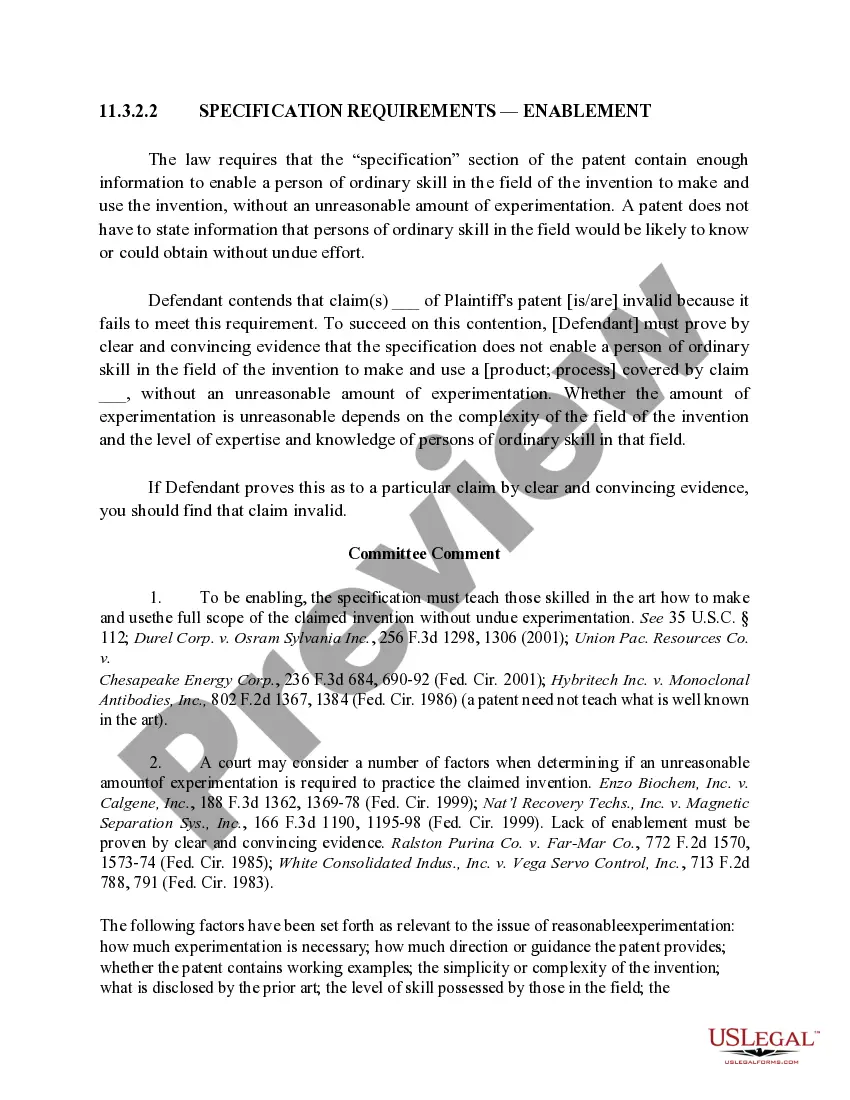
112(a) or the first paragraph of pre- 35 U.S.C. 112, USPTO personnel must establish on the record a reasonable basis for questioning the adequacy of the disclosure to enable a person of ordinary skill in the art to make and use the claimed invention without resorting to undue experimentation.
The written description requirement requires an inventor to write down how to make and use (i.e., enablement requirement) the invention. The written description includes the text and the drawings. By doing so, after the patent expires, the patent can be used to teach the public how to implement the invention.
A written description is a way of explaining or showing what something is like using words or pictures. It can be used to describe a person, place, thing, or idea. In legal terms, a written description is a specific identification of something, like a list of items in an estate.
The specification shall contain a written description of the invention, and of the manner and process of making and using it, in such full, clear, concise, and exact terms as to enable any person skilled in the art to which it pertains, or with which it is most nearly connected, to make and use the same, and shall set
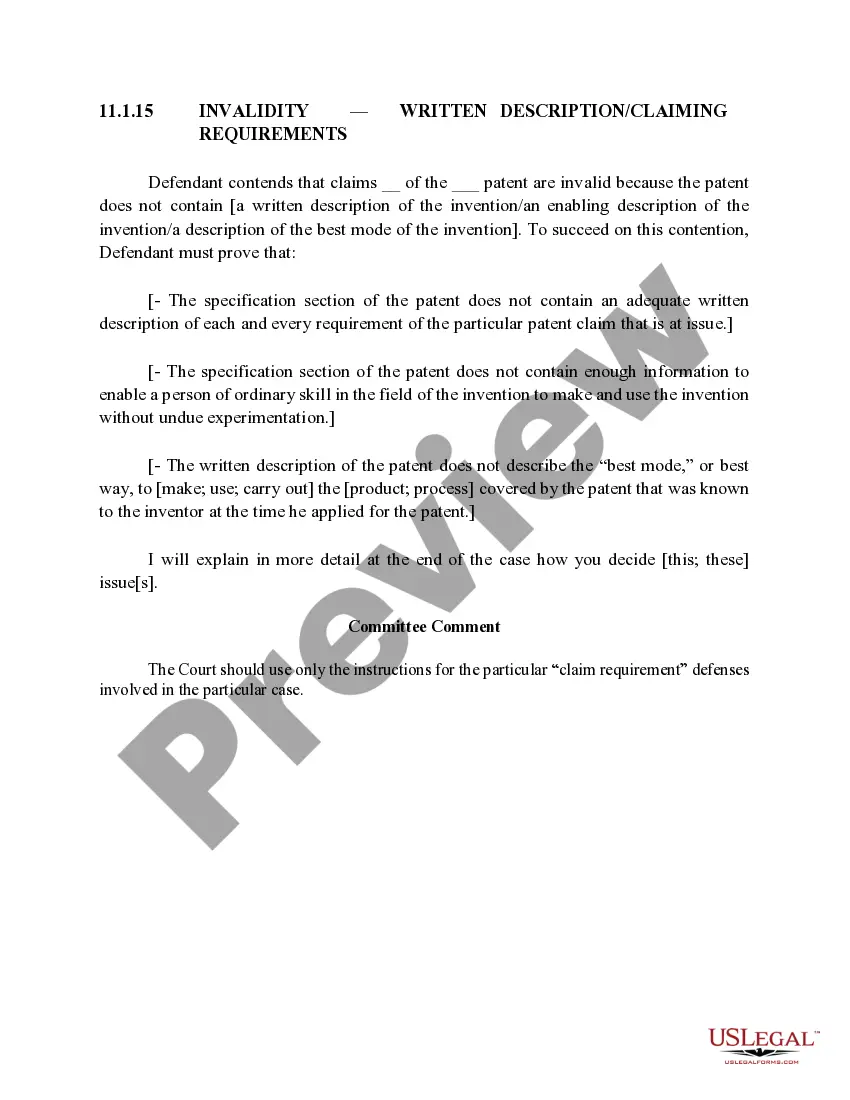
112, first paragraph require that the specification include the following: (A) A written description of the invention; (B) The manner and process of making and using the invention (the enablement requirement); and. (C) The best mode contemplated by the inventor of carrying out his invention.
A typical patent specification has the following sections: Title of invention; Field of invention; Background of invention with regard to the drawback associated with known art; Object of invention; Statement of invention; A summary of invention; A brief description of the accompanying drawing;
In the United States, 35 U.S.C. § 112 requires a written description that: (1) would enable one skilled in the art to understand the claimed subject matter; and (2) teaches one skilled in the art how to make and use the invention without "undue experimentation" (enablement).