11.1.15 Invalidity - Written Description / Claiming Requirements
Overview of this form
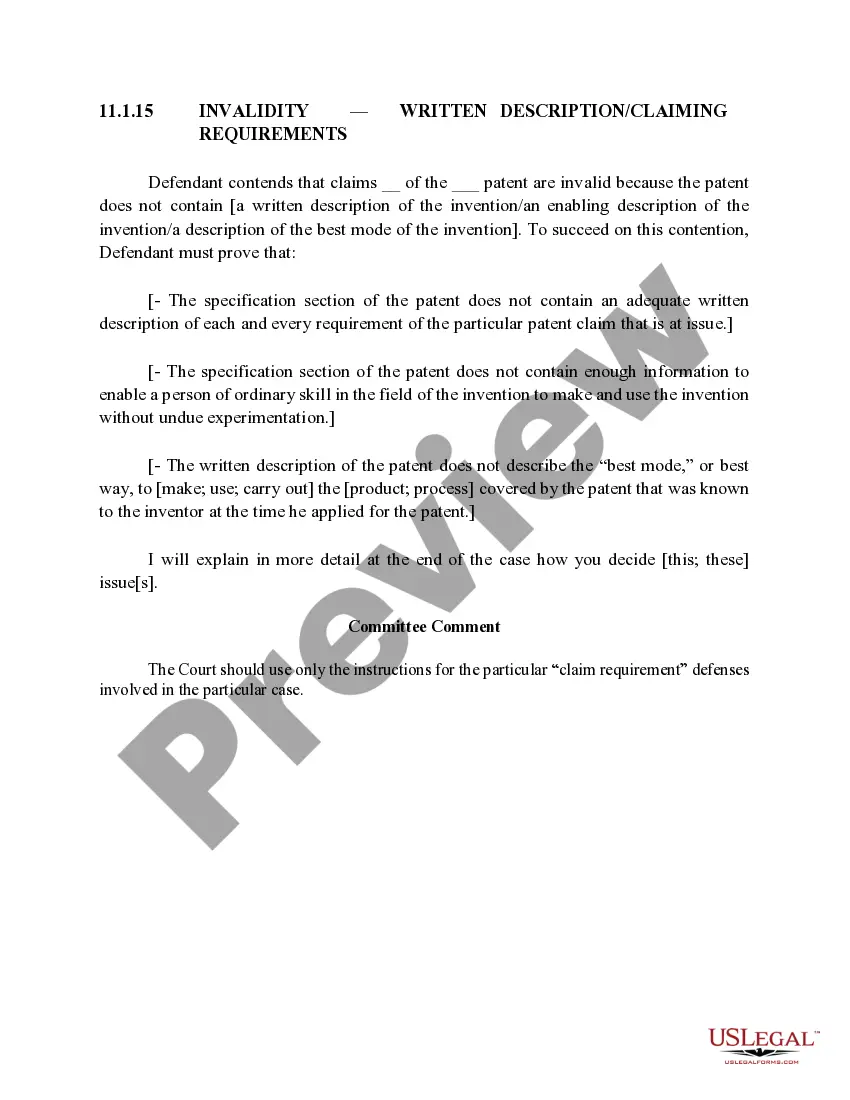
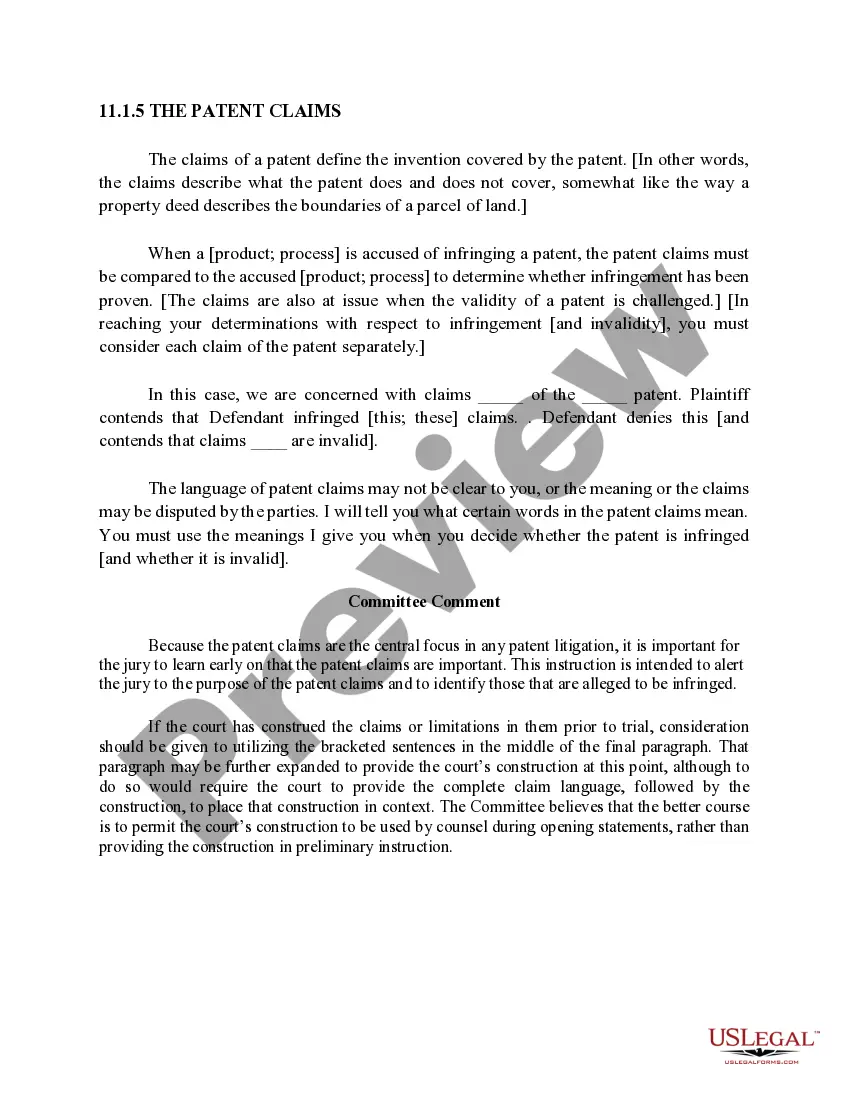
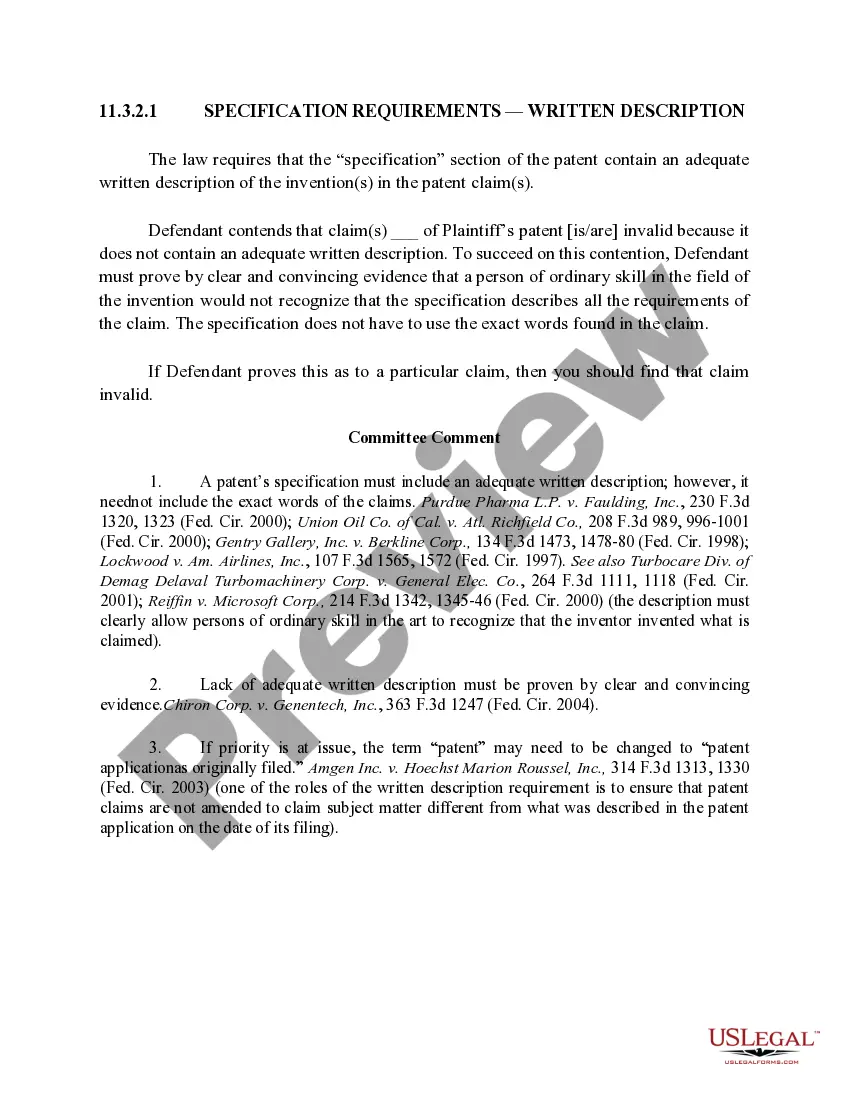
The Invalidity - Written Description / Claiming Requirements form is a legal instruction document used in patent law. It is designed for cases where a defendant argues that a specific patent claim is invalid due to the patent's inadequate written description, failure to enable someone skilled in the field to use the invention without undue experimentation, or not disclosing the best mode known to the inventor at the time of application. This form helps clarify the criteria that must be met for a successful invalidity claim and differs from other patent-related forms by focusing specifically on the written description requirements of patents.
Main sections of this form
- Identification of the specific patent claims being challenged.
- Requirements to prove invalidity based on written description, enablement, and best mode.
- Instructions for the court on how to assess these claims during the trial.
- Guidance on how to structure arguments related to patent invalidity.
Common use cases
This form should be used in legal proceedings where a defendant is contesting the validity of a patent. It provides structured guidance on presenting arguments related to the written description or claiming requirements outlined in a patent. It is applicable in cases involving patent litigation, especially when the defense hinges on the adequacy of the patent specification or the inventor's disclosure.
Intended users of this form
- Attorneys representing clients in patent litigation.
- Defendants in patent infringement cases seeking to challenge the validity of a patent.
- Legal professionals looking for structured guidance on patent law requirements.
Instructions for completing this form
- Identify and specify the patent claims that are being challenged.
- Gather evidence to support your contention regarding the written description or enabling requirements.
- Detail your arguments according to the criteria provided in the form.
- Ensure all necessary information is included to support the case for patent invalidity.
- Consult with legal experts if needed to ensure completeness and accuracy.
Does this form need to be notarized?
This form usually doesn’t need to be notarized. However, local laws or specific transactions may require it. Our online notarization service, powered by Notarize, lets you complete it remotely through a secure video session, available 24/7.
Get your form ready online
Our built-in tools help you complete, sign, share, and store your documents in one place.
Make edits, fill in missing information, and update formatting in US Legal Forms—just like you would in MS Word.
Download a copy, print it, send it by email, or mail it via USPS—whatever works best for your next step.
Sign and collect signatures with our SignNow integration. Send to multiple recipients, set reminders, and more. Go Premium to unlock E-Sign.
If this form requires notarization, complete it online through a secure video call—no need to meet a notary in person or wait for an appointment.
We protect your documents and personal data by following strict security and privacy standards.

Make edits, fill in missing information, and update formatting in US Legal Forms—just like you would in MS Word.

Download a copy, print it, send it by email, or mail it via USPS—whatever works best for your next step.

Sign and collect signatures with our SignNow integration. Send to multiple recipients, set reminders, and more. Go Premium to unlock E-Sign.

If this form requires notarization, complete it online through a secure video call—no need to meet a notary in person or wait for an appointment.

We protect your documents and personal data by following strict security and privacy standards.
Mistakes to watch out for
- Failing to clearly identify the specific patent claims being challenged.
- Neglecting to gather sufficient evidence to support the arguments.
- Using overly complex legal jargon that may confuse the court.
- Overlooking jurisdictional specifics that may affect the argument.
Why complete this form online
- Convenient access to legal templates at any time.
- Easy editing to customize the form for specific cases.
- Reliability with forms drafted by licensed attorneys.
Looking for another form?
Form popularity
FAQ
The five primary requirements for patentability are: (1) patentable subject matter, (2) utility, (3) novelty, (4) nonobviousness, and (5) enablement.
112(a) or pre- 35 U.S.C. 112, first paragraph that the specification describe how to make and how to use the invention. The invention that one skilled in the art must be enabled to make and use is that defined by the claim(s) of the particular application or patent.
The four requirements for a utility patent are: The invention must fall within one of the statutory classes. The invention must be useful. The invention must be novel. The invention must be nonobvious.
112, first paragraph require that the specification include the following: (A) A written description of the invention; (B) The manner and process of making and using the invention (the enablement requirement); and. (C) The best mode contemplated by the inventor of carrying out his invention.
Perhaps the key to understanding the difference between enablement and the written description requirement is that you can bootstrap knowledge of one of skill in the art into your application for enablement purposes, but no such bootstrapping is allowable under the written description requirement.
A written description is a way of explaining or showing what something is like using words or pictures. It can be used to describe a person, place, thing, or idea. In legal terms, a written description is a specific identification of something, like a list of items in an estate.
The written description requirement requires an inventor to write down how to make and use (i.e., enablement requirement) the invention. The written description includes the text and the drawings. By doing so, after the patent expires, the patent can be used to teach the public how to implement the invention.