11.1.14 Invalidity - Obviousness
About this form
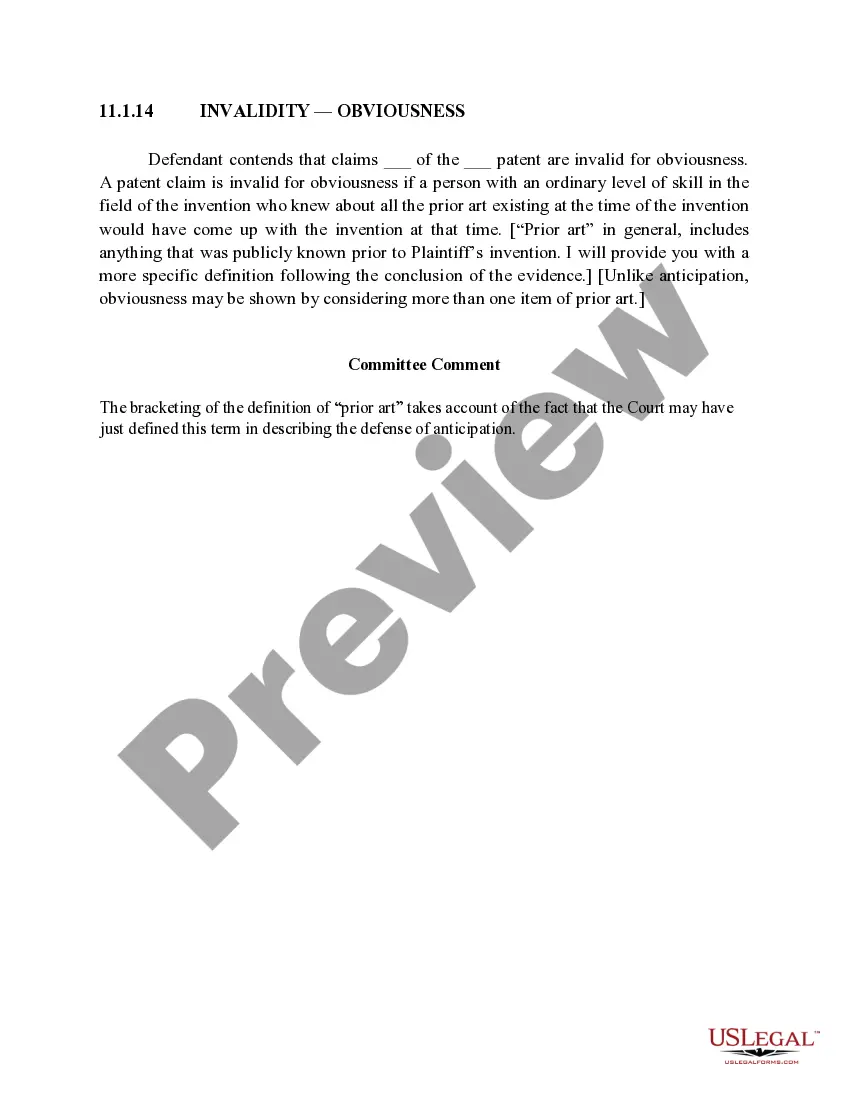
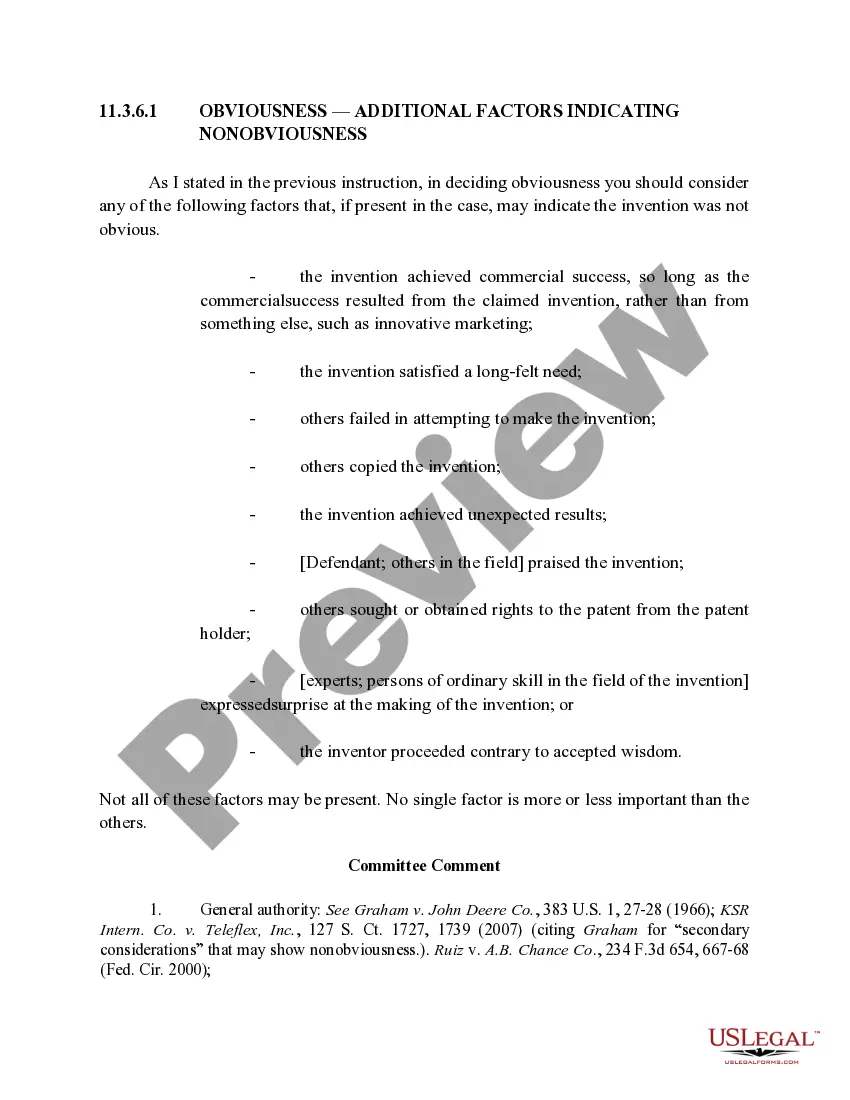
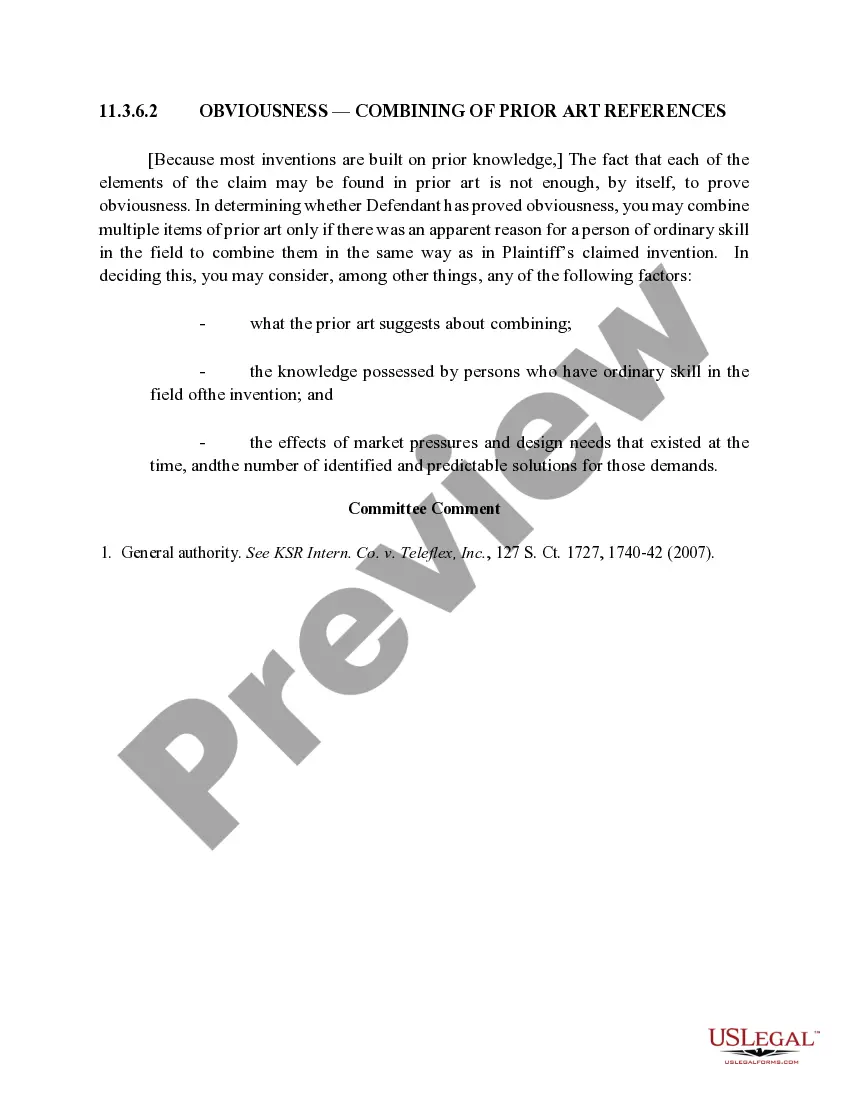
The 11.1.14 Invalidity - Obviousness form is a legal document used in patent infringement cases. It serves to assert that certain claims of a patent are invalid due to obviousness. This form helps define the criteria under which a patent claim may be considered obvious, distinguishing it from similar concepts like anticipation. Utilizing this form can facilitate a clear understanding of patent validity during litigation, focusing on a standard of what a person with ordinary skill in the field would have known at the time of the invention.
Key parts of this document
- Introduction of claims being challenged for obviousness.
- Definition of "prior art" relevant to the claims.
- Explanation of how obviousness can be demonstrated using multiple items of prior art.
- Reference to the court's definitions provided during the trial.
- Legal framework offered by the Federal 7th Circuit Court.
When to use this form
This form is necessary when a defendant in a patent infringement case argues that one or more claims of a patent are invalid based on the grounds of obviousness. It is typically used during the defense phase of a patent litigation where the defendant needs to present a case that the invention would have been obvious to someone with ordinary skill in the related field at the time the patent was filed.
Who should use this form
- Individuals or companies facing patent infringement claims.
- Attorneys representing clients in patent litigation.
- Parties interested in challenging the validity of a patent in court.
How to prepare this document
- Identify the specific claims of the patent that are being challenged.
- Introduce the patent number associated with the claims.
- Provide evidence of prior art relevant to the claims.
- Draft a concise argument demonstrating how the claims are obvious based on analyzed prior art.
- Review and finalize the document ensuring all necessary legal language is included.
Notarization requirements for this form
Notarization is not commonly needed for this form. However, certain documents or local rules may make it necessary. Our notarization service, powered by Notarize, allows you to finalize it securely online anytime, day or night.
Get your form ready online
Our built-in tools help you complete, sign, share, and store your documents in one place.
Make edits, fill in missing information, and update formatting in US Legal Forms—just like you would in MS Word.
Download a copy, print it, send it by email, or mail it via USPS—whatever works best for your next step.
Sign and collect signatures with our SignNow integration. Send to multiple recipients, set reminders, and more. Go Premium to unlock E-Sign.
If this form requires notarization, complete it online through a secure video call—no need to meet a notary in person or wait for an appointment.
We protect your documents and personal data by following strict security and privacy standards.

Make edits, fill in missing information, and update formatting in US Legal Forms—just like you would in MS Word.

Download a copy, print it, send it by email, or mail it via USPS—whatever works best for your next step.

Sign and collect signatures with our SignNow integration. Send to multiple recipients, set reminders, and more. Go Premium to unlock E-Sign.

If this form requires notarization, complete it online through a secure video call—no need to meet a notary in person or wait for an appointment.

We protect your documents and personal data by following strict security and privacy standards.
Typical mistakes to avoid
- Failing to adequately define prior art.
- Overlooking the need for multiple sources of prior art to demonstrate obviousness.
- Not aligning arguments with relevant legal standards set by applicable courts.
Why complete this form online
- Convenient access to up-to-date legal forms tailored for federal court proceedings.
- Editability, allowing users to customize details specific to their case.
- Reliability with forms drafted by licensed attorneys familiar with patent law.
Legal use & context
- This document is integral to asserting obviousness in patent litigation.
- It is legally recognized within the context of patent law disputes.
- Understanding the definition of "prior art" is crucial for proper use of this form.
Looking for another form?
Form popularity
FAQ
Obviousness is a question of law based on underlying factual inquiries.
Under the Graham Test, in order to determine whether an invention is obvious in light of the prior art, the following factors are considered: 1) the scope and content of the prior art; 2) the differences between the prior art and the claims (or invention) at issue; 3) the level of ordinary skill in the pertinent art;
More technically, when an examiner argues that a patent is obvious, this means she can combine references, and allege that a person of ordinary skill would know for example that a hammer is used to hit a nail, so a reference to a hammer and a nail can be combined.
An obviousness rejection is ordinarily based on a disclosure that qualifies as prior art under 35 U.S.C. 102 or pre- 35 U.S.C. 102. If it is established that a disclosure does not qualify as prior art under an appropriate section of 35 U.S.C.
Obviousness is a legal conclusion based on underlying factual inquiries: (1) scope and content of the prior art; (2) level of ordinary skill in the prior art; (3) differences between the claimed invention and the prior art; and (4) objective evidence of nonobviousness (aka ?secondary considerations?) (e.g., failure of
One way to show non-obviousness is to perform a patentability search prior to filing a patent application. Such a search should elicit the closest prior art, which will permit us to tell the story of the inventiveness and to prepare the claims of the application in such a way so as to avoid the prior art.
Patent obviousness is the idea that if an invention is obvious to either experts or the general public, it cannot be patented. Obviousness is one of the defining factors on how to patent an idea and whether or not an idea or invention is patentable.
Under the Graham Test, in order to determine whether an invention is obvious in light of the prior art, the following factors are considered: 1) the scope and content of the prior art; 2) the differences between the prior art and the claims (or invention) at issue; 3) the level of ordinary skill in the pertinent art;