Use Clause for Common Loading Areas
What this document covers
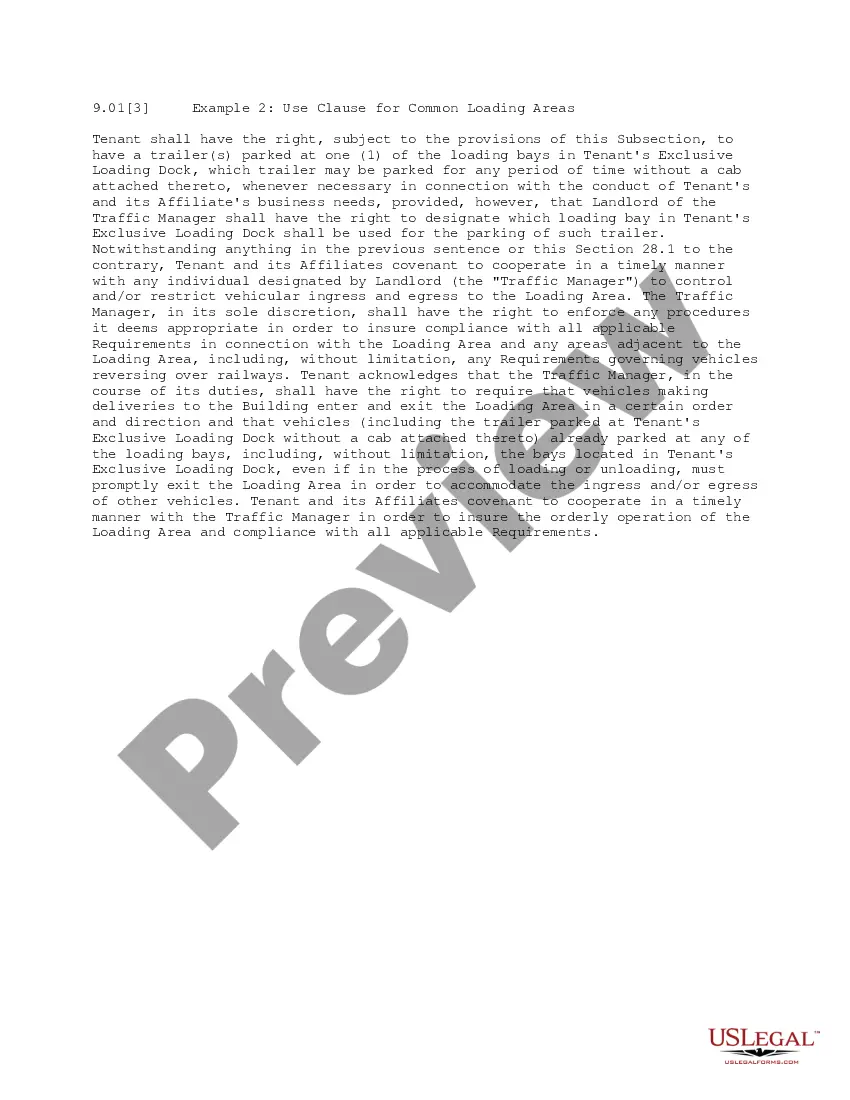
The Use Clause for Common Loading Areas is a legal document that grants tenants the right to park trailers in designated loading bays within their exclusive loading dock. This form clarifies the terms under which trailers can be parked and establishes the landlord's authority to designate specific loading bays. It differs from general lease agreements by focusing specifically on the use of loading areas related to business operations.
Form components explained
- Tenant's right to park trailers at designated loading bays.
- Landlord's authority to specify which loading bay can be used.
- Cooperation requirements with the Traffic Manager for orderly operation.
- Procedures for vehicle ingress and egress to ensure compliance and efficiency.
- Obligation to comply with applicable requirements regarding loading areas.
When to use this document
This form should be used when a tenant requires the use of designated loading areas for trailer parking in connection with their business activities. It is especially relevant in office lease agreements where the loading dock is exclusively used by the tenant and must be managed to accommodate traffic flow and loading/unloading operations effectively.
Who this form is for
- Commercial tenants who need to park trailers for business purposes.
- Landlords who wish to define the terms of trailer use in loading areas.
- Property managers tasked with overseeing loading dock operations.
How to prepare this document
- Identify the parties involved, including the tenant and landlord.
- Specify the designated loading bay for trailer parking.
- Outline the cooperation terms required by the Traffic Manager.
- Detail any specific requirements regarding vehicle access and compliance.
- Review the completed form for accuracy and ensure all parties sign the document.
Does this document require notarization?
This form usually doesn’t need to be notarized. However, local laws or specific transactions may require it. Our online notarization service, powered by Notarize, lets you complete it remotely through a secure video session, available 24/7.
Get your form ready online
Our built-in tools help you complete, sign, share, and store your documents in one place.
Make edits, fill in missing information, and update formatting in US Legal Forms—just like you would in MS Word.
Download a copy, print it, send it by email, or mail it via USPS—whatever works best for your next step.
Sign and collect signatures with our SignNow integration. Send to multiple recipients, set reminders, and more. Go Premium to unlock E-Sign.
If this form requires notarization, complete it online through a secure video call—no need to meet a notary in person or wait for an appointment.
We protect your documents and personal data by following strict security and privacy standards.

Make edits, fill in missing information, and update formatting in US Legal Forms—just like you would in MS Word.

Download a copy, print it, send it by email, or mail it via USPS—whatever works best for your next step.

Sign and collect signatures with our SignNow integration. Send to multiple recipients, set reminders, and more. Go Premium to unlock E-Sign.

If this form requires notarization, complete it online through a secure video call—no need to meet a notary in person or wait for an appointment.

We protect your documents and personal data by following strict security and privacy standards.
Avoid these common issues
- Failing to specify the designated loading bay.
- Not outlining the obligations to cooperate with the Traffic Manager.
- Omitting signatures from all required parties.
Benefits of using this form online
- Convenient access to legal documents at any time.
- Edit and customize the form easily to meet specific needs.
- Reliable templates drafted by licensed attorneys, ensuring legal compliance.
Legal use & context
- This form helps establish tenant rights and responsibilities regarding the use of loading areas.
- Clarifies the landlord's authority, helping to prevent disputes.
- Ensures compliance with traffic management requirements, which affects loading dock operations.
Quick recap
- The Use Clause for Common Loading Areas is vital for commercial tenants utilizing trailers.
- Defining loading area use helps avoid conflicts between tenants and landlords.
- Proper completion of the form is crucial for legal enforceability and operational efficiency.
Looking for another form?
Form popularity
FAQ
A force majeure clause (1) specifies the events which enable either party to declare a force majeure/act of God event, (2) how a party should notify its counterparty about the occurrence, and (3) the consequences after a force majeure event has occurred.
What is Force Majeure?Examples of events that might trigger a force majeure clause into effect include a declaration of war, a disease epidemic, or a hurricane, earthquake, or other natural disaster events that fall under the legal term, act of God.
An example of an operative clause is: " . 1 Neither party is responsible for any failure to perform its obligations under this contract, if it is prevented or delayed in performing those obligations by an event of force majeure. .
(1) Neither Party shall be in breach of its obligations under this Agreement (other than payment obligations) or incur any liability to the other Party for any losses or damages of any nature whatsoever incurred or suffered by that other (otherwise than under any express indemnity in this Agreement) if and to the
The Commons Clause restricts sales for a product or service whose value derives, entirely or substantially, from the functionality of the Software. While the Commons Clause documentation argues that substantially is a common legal term,10 it nonetheless fails to provide clear guidance on what is allowed or
Obligations of all parties. Ownership. Termination rights. Confidentiality. Limitation/indemnification of liability.