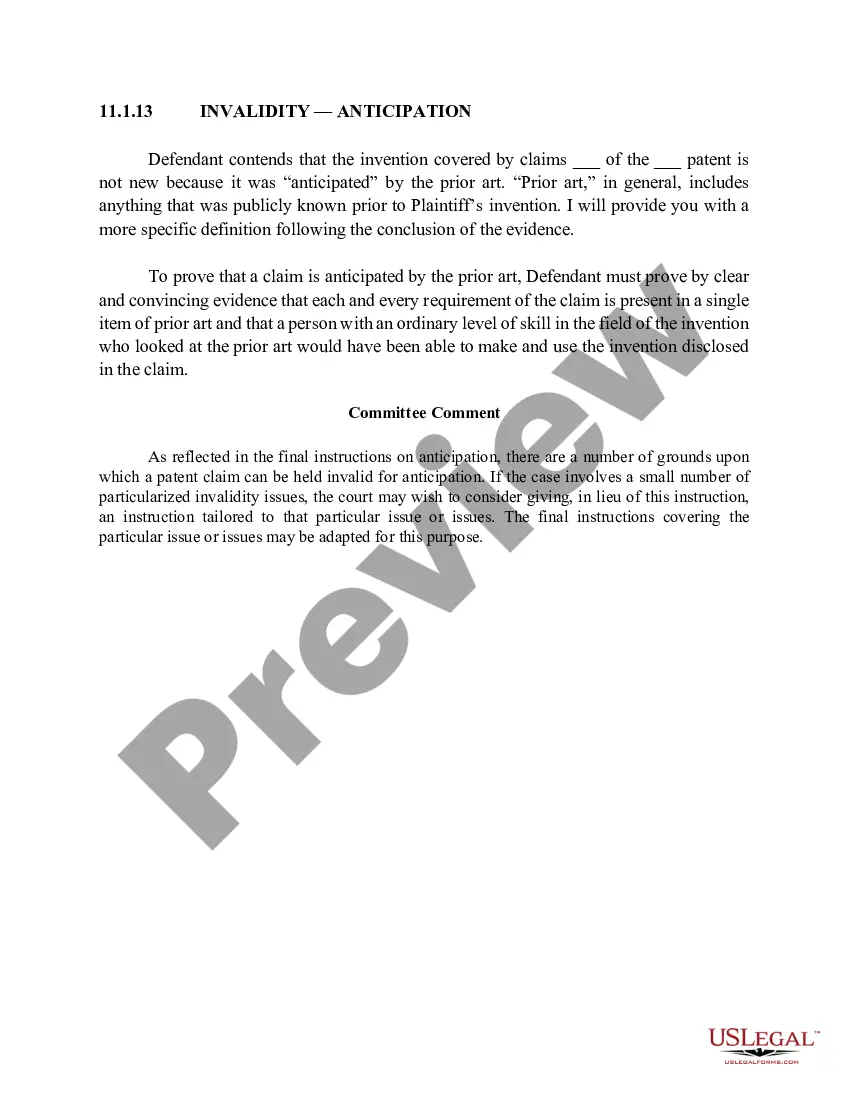
11.1.13 Invalidity - Anticipation
Overview of this form
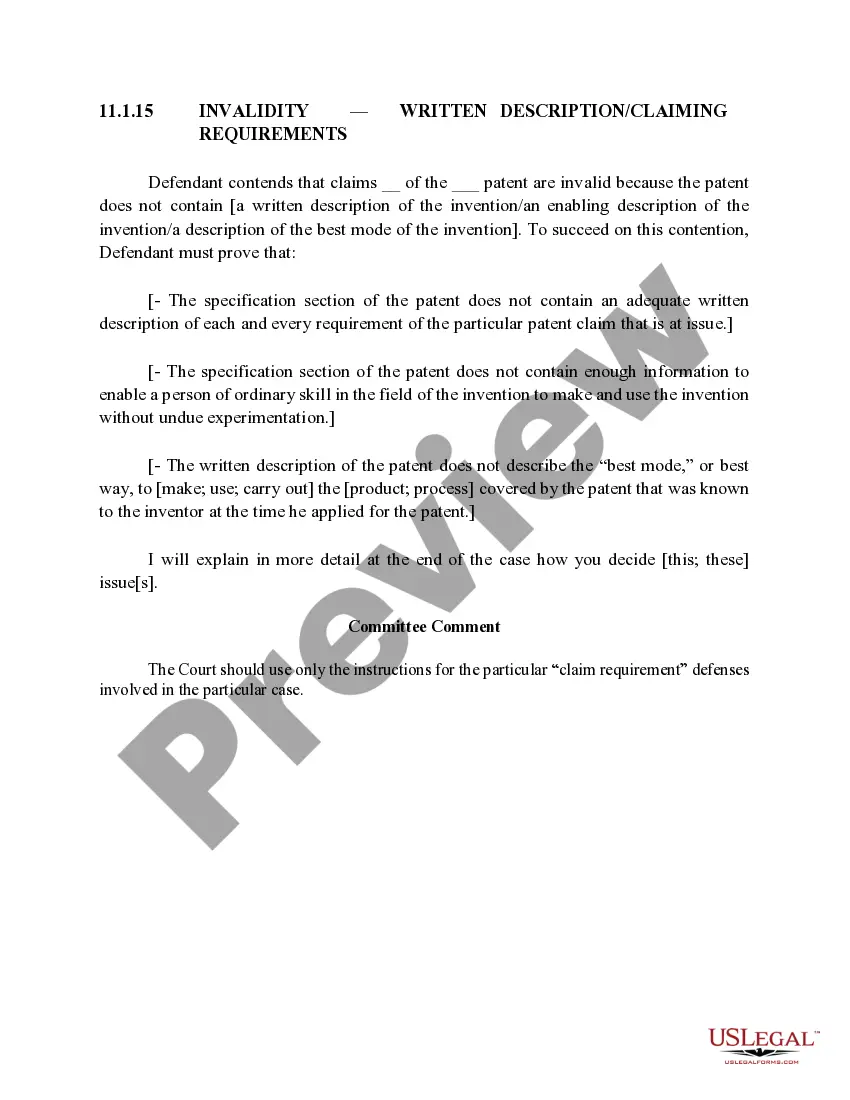
The Invalidity - Anticipation form provides official jury instructions pertaining to patent law, specifically addressing claims of anticipation. This legal form guides jurors in determining whether a patent claim is valid based on whether the invention was previously known or disclosed in prior art. Unlike other patent-related forms, this one specifically outlines how to evaluate the evidence regarding anticipation, which is a critical aspect of patent invalidity cases.
Key parts of this document
- Definition of "prior art" and its significance in patent claims.
- Criteria for proving anticipation by clear and convincing evidence.
- Instructions for jurors on evaluating the presence of claim requirements in prior art.
- Commentary on tailoring instructions based on specific invalidity issues.
When to use this document
This form should be used during patent litigation cases where the validity of a patent claim is contested based on the argument that the invention was anticipated by prior art. It is applicable when a defendant presents evidence claiming that a particular invention was already disclosed before the patent application was filed, requiring jurors to assess the validity of these claims.
Who should use this form
- Attorneys representing clients in patent litigation.
- Judges presiding over patent infringement cases.
- Parties involved in patent disputes who need to understand jury instructions related to anticipation.
How to prepare this document
- Identify the specific claims of the patent that are being contested.
- Gather evidence that shows the invention was publicly known before the filing date.
- Determine if all elements of the claim are present in the prior art.
- Prepare to present this evidence clearly to the jury during the trial.
- Review and modify the jury instructions as necessary to address specific invalidity issues.
Does this form need to be notarized?
Notarization is generally not required for this form. However, certain states or situations might demand it. You can complete notarization online through US Legal Forms, powered by Notarize, using a verified video call available anytime.
Get your form ready online
Our built-in tools help you complete, sign, share, and store your documents in one place.
Make edits, fill in missing information, and update formatting in US Legal Forms—just like you would in MS Word.
Download a copy, print it, send it by email, or mail it via USPS—whatever works best for your next step.
Sign and collect signatures with our SignNow integration. Send to multiple recipients, set reminders, and more. Go Premium to unlock E-Sign.
If this form requires notarization, complete it online through a secure video call—no need to meet a notary in person or wait for an appointment.
We protect your documents and personal data by following strict security and privacy standards.

Make edits, fill in missing information, and update formatting in US Legal Forms—just like you would in MS Word.

Download a copy, print it, send it by email, or mail it via USPS—whatever works best for your next step.

Sign and collect signatures with our SignNow integration. Send to multiple recipients, set reminders, and more. Go Premium to unlock E-Sign.

If this form requires notarization, complete it online through a secure video call—no need to meet a notary in person or wait for an appointment.

We protect your documents and personal data by following strict security and privacy standards.
Common mistakes
- Failing to clearly define "prior art" to the jury.
- Not providing sufficient evidence that all claim requirements are met by the prior art.
- Overlooking tailored instructions for specific invalidity issues.
Advantages of online completion
- Convenient access to official jury instructions from anywhere.
- Edit and customize the form to meet specific legal needs.
- Reliable format that adheres to federal court standards.
Legal use & context
- This form is used within the context of patent litigation to guide juries on evaluating invalidation claims.
- Jury instructions must be clear and backed by specific legal standards to ensure fair trial proceedings.
Key takeaways
- The Invalidity - Anticipation form is vital for understanding patent claim disputes.
- Evidence of prior art must meet strict criteria to invalidate a claim.
- Clear communication and tailored instructions enhance jury comprehension during trials.
Looking for another form?
Form popularity
FAQ
Some examples include identifying a lack of novelty reference published, filed, or claiming priority before the effective filing date, or combining two or more prior art publications that show that the claimed invention is obvious or lacks an inventive step.
102 when the invention is anticipated (or is ?not novel?) over a disclosure that is available as prior art. To reject a claim as anticipated by a reference, the disclosure must teach every element required by the claim under its broadest reasonable interpretation.
An invalidity/validity search is an exhaustive, date-limited prior art search conducted against the claims of a patent to verify its validity or render it invalid by uncovering relevant art filed before its earliest priority date.
The legal standard held in a patent infringement case is that it must be proven by a preponderance of the evidence.
Prove that the invention was on sale or available for public use?A patent can be invalidated if, within the 12 months prior to the filing of the patent application, the invention was on sale or available to the public in the United States, patented in another country, discussed in a publication, or recognized by other
In the context of patent law, anticipation refers to the prior invention or disclosure of the claimed invention by another, or the inventor's own disclosure of the claimed invention by publication, sale, or offer to sell prior to the inventor's application for a patent.
What Are The Grounds For Patent Invalidity Novelty. In order to be patented, the invention must be novel.Obviousness. Along with being new, to be patentable, the invention must be non-obvious.Failure To Fulfill The Promise. Patented inventions must be of some use.Double Patenting.Sufficiency Of Disclosure.
Any deliberate efforts for insufficient disclosure or description of information related to the invention can form the basis for the invalidation of the patent. Another basis of invalidation of the patent is false suggestion or representation to any fact or statement made in connection to the grant of the patent.