Liability Waiver for Horseback Riding
Understanding this form
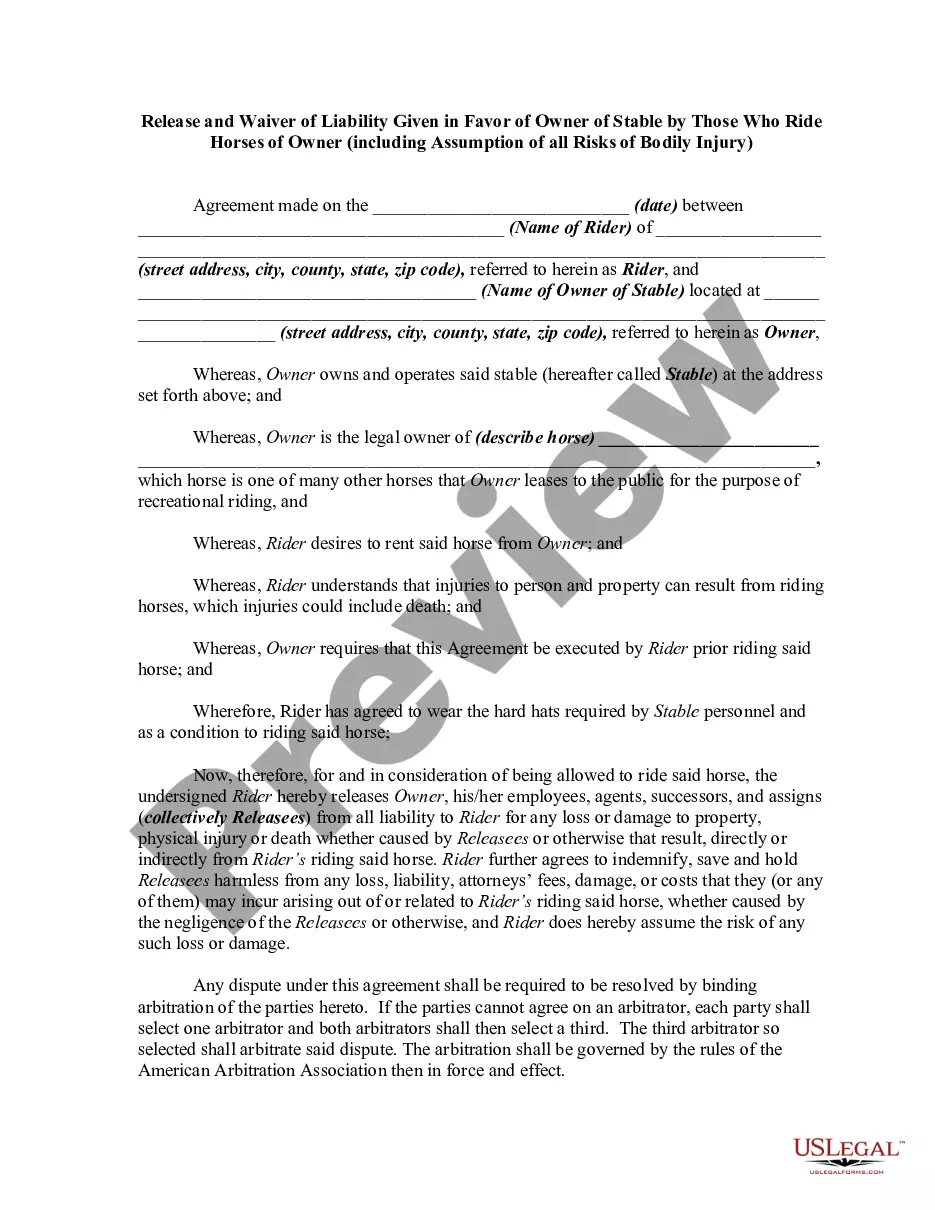
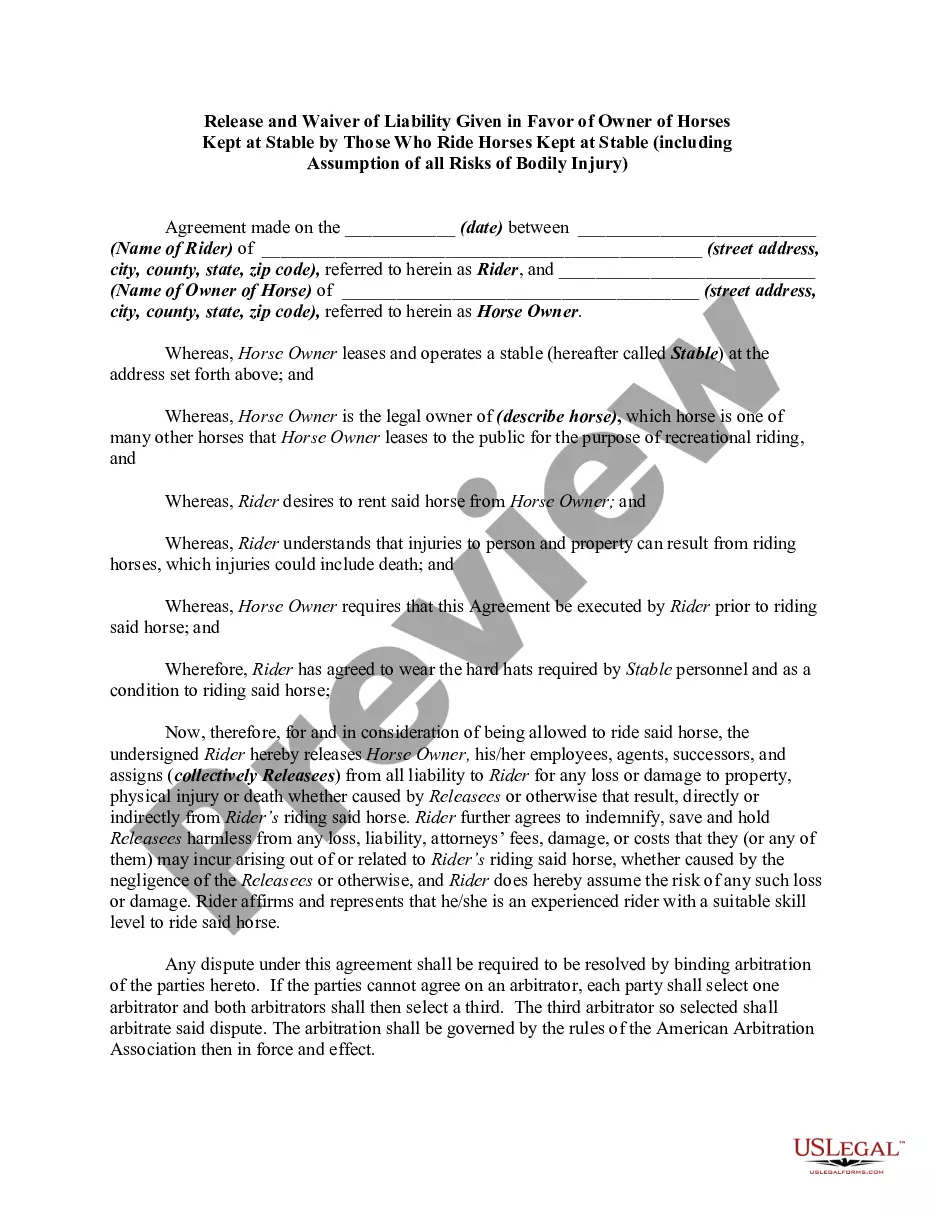
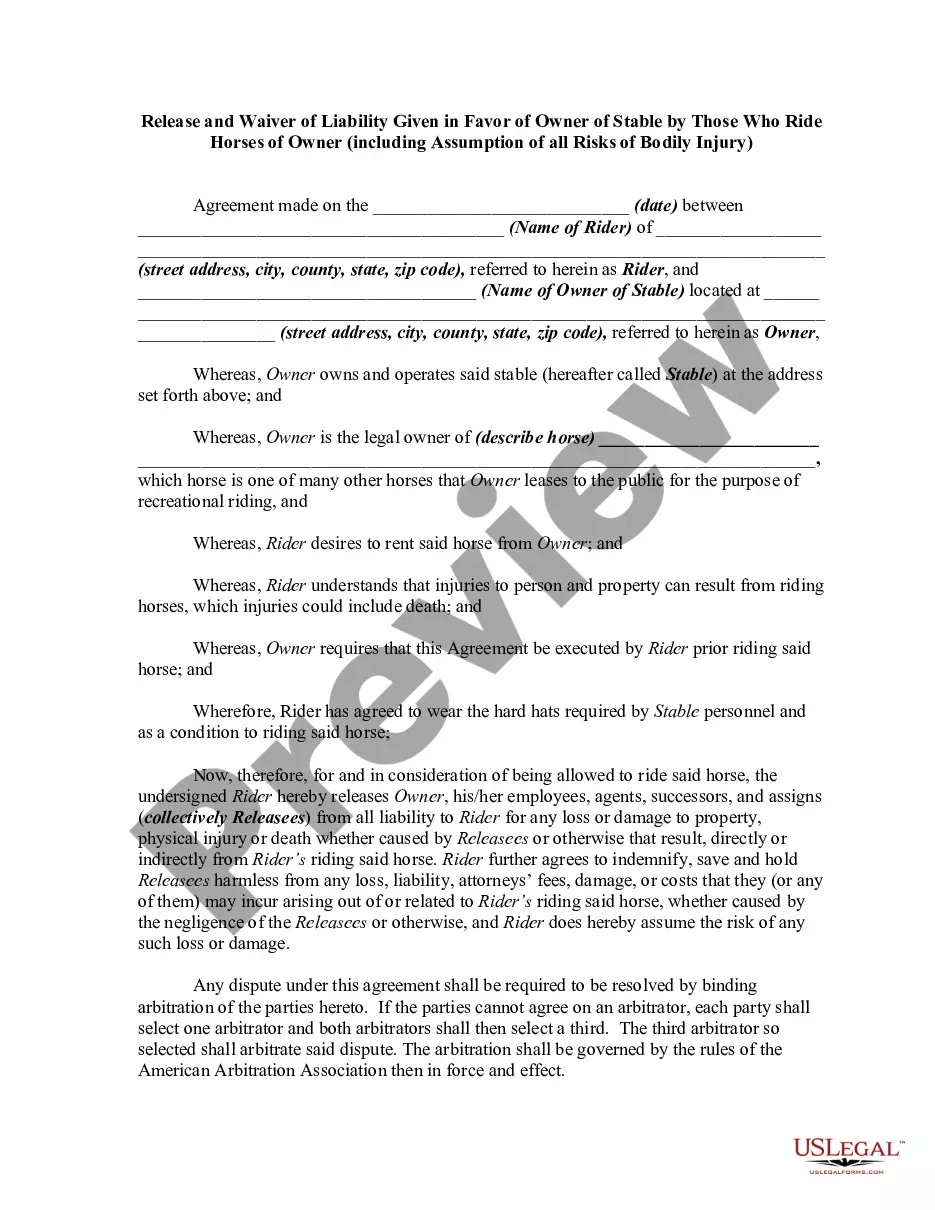
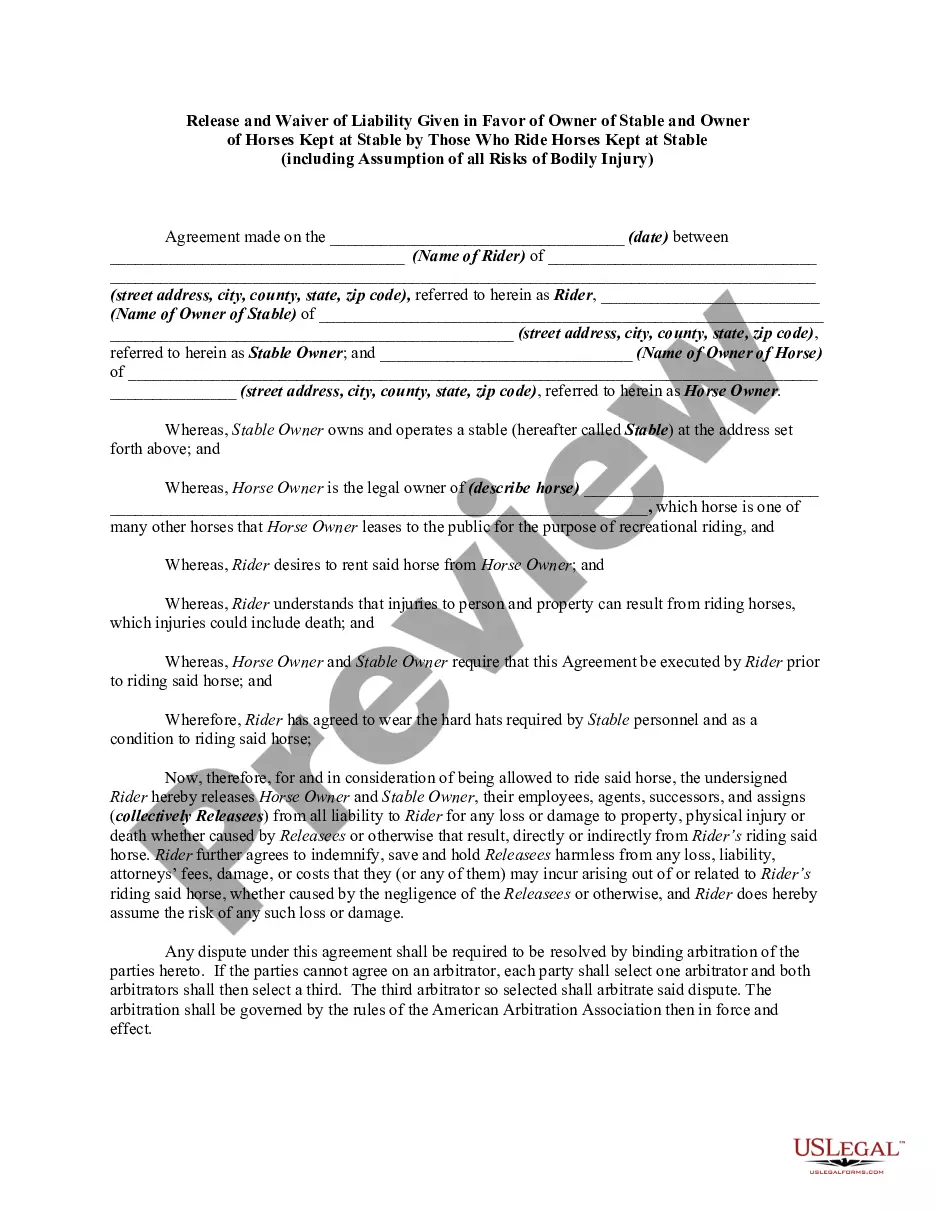
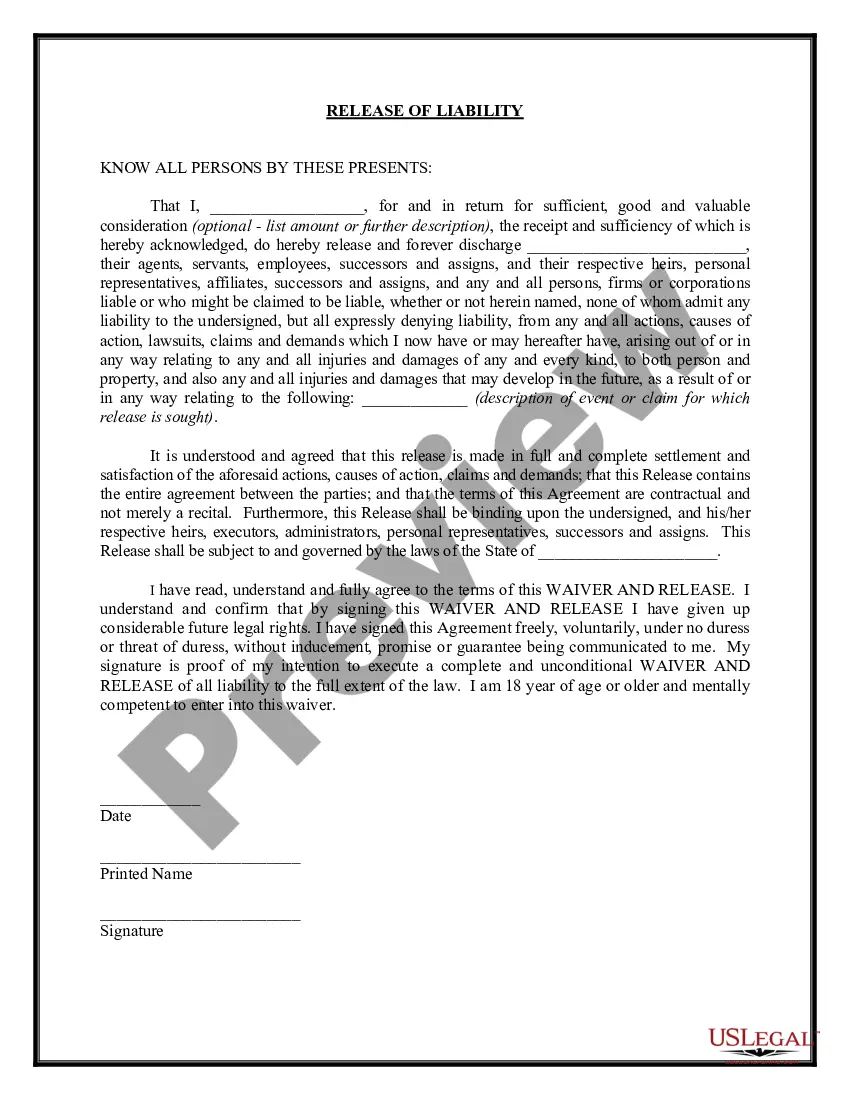
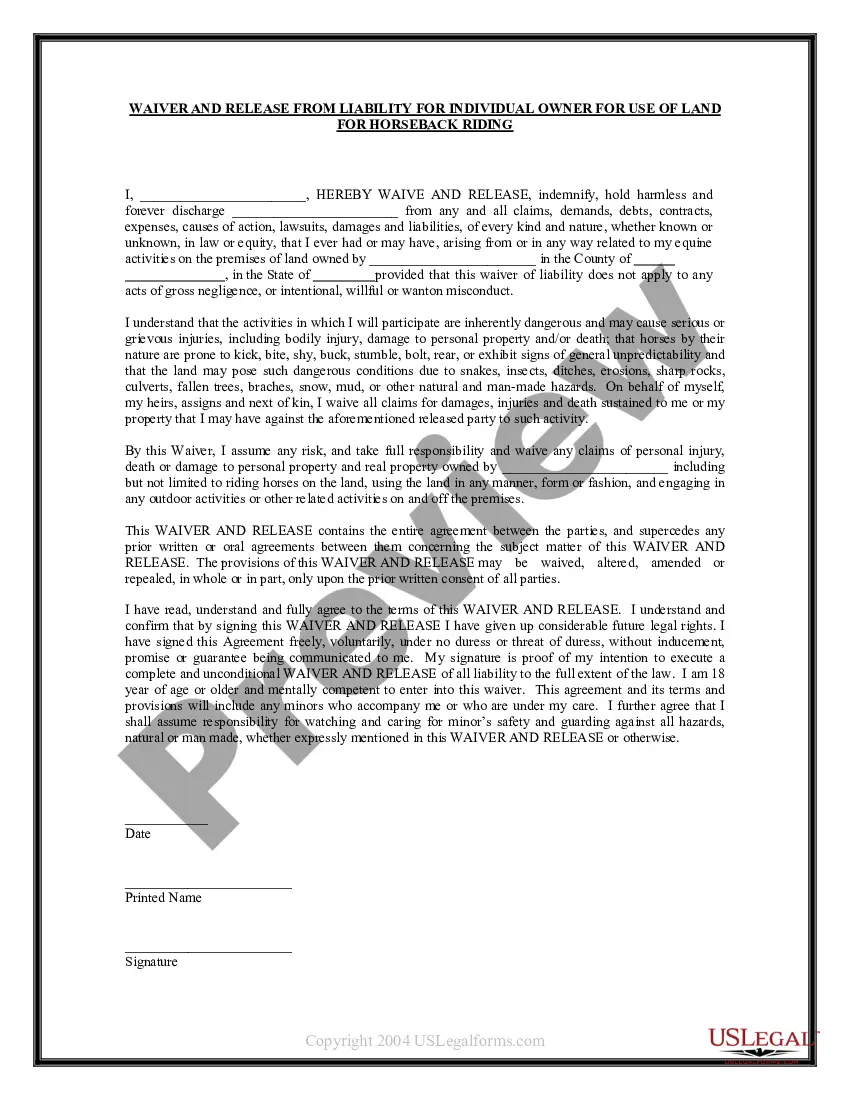
The Liability Waiver for Horseback Riding is a legal document that allows a rider to voluntarily relinquish their right to sue the horse stable owner for any injuries or damages that may occur while riding. This form is essential for protecting the stable owner from liability and ensuring that riders acknowledge the inherent risks associated with horseback riding. It is different from other waivers by specifically addressing the risks involved in equestrian activities and requiring riders to undertake personal responsibility for their safety.
Main sections of this form
- Date of agreement
- Name and address of the rider
- Name and address of the stable owner
- Description of the horse being rented
- Indemnity clause
- Arbitration agreement for dispute resolution
When to use this form
This form should be used when a rider intends to rent a horse for recreational riding at a stable. It is important in situations where the stable owner wants to ensure that riders are aware of the risks involved in horseback riding and agree not to hold the owner liable for any injuries or damages that may occur during the activity.
Intended users of this form
- Horse stable owners who rent horses for riding.
- Riders participating in horseback riding activities at any stable.
- Parents or guardians signing on behalf of minor riders.
- Those looking to minimize legal risks associated with equestrian activities.
Steps to complete this form
- Identify the date of the agreement.
- Enter the name and address of the rider.
- Provide the name and location of the stable owner.
- Describe the horse that is being rented.
- Read and understand the release of liability and indemnity clauses.
- Sign and date the document to finalize the agreement.
Notarization guidance
This form does not typically require notarization unless specified by local law. It is important for users to verify their local requirements to ensure the agreement is legally binding in their jurisdiction.
Get your form ready online
Our built-in tools help you complete, sign, share, and store your documents in one place.
Make edits, fill in missing information, and update formatting in US Legal Forms—just like you would in MS Word.
Download a copy, print it, send it by email, or mail it via USPS—whatever works best for your next step.
Sign and collect signatures with our SignNow integration. Send to multiple recipients, set reminders, and more. Go Premium to unlock E-Sign.
If this form requires notarization, complete it online through a secure video call—no need to meet a notary in person or wait for an appointment.
We protect your documents and personal data by following strict security and privacy standards.

Make edits, fill in missing information, and update formatting in US Legal Forms—just like you would in MS Word.

Download a copy, print it, send it by email, or mail it via USPS—whatever works best for your next step.

Sign and collect signatures with our SignNow integration. Send to multiple recipients, set reminders, and more. Go Premium to unlock E-Sign.

If this form requires notarization, complete it online through a secure video call—no need to meet a notary in person or wait for an appointment.

We protect your documents and personal data by following strict security and privacy standards.
Common mistakes
- Failing to include accurate contact information for all parties.
- Not properly describing the horse being rented.
- Ignoring the requirement for rider signatures.
- Overlooking the indemnity clause, which could leave the owner exposed legally.
Advantages of online completion
- Convenient access to a professionally drafted waiver at any time.
- Easy download and editing options to customize for specific needs.
- Reliable formats that comply with typical state requirements.
- Quick processing with the ability to complete and sign electronically.
Looking for another form?
Form popularity
FAQ
If you've been injured due to negligent actions, you can sue even if you signed a waiver. Winning a lawsuit concerning negligence is not uncommon. Many celebrities have sued for negligence even though they signed documents stating they understood the risks.
Under California personal injury laws, anyone injured in a horseback riding accident can file a personal injury lawsuit against those responsible for the accident.
A liability waiver, or release waiver, is a legal document that a company or organization requires members of the public to sign in order to protect their organization from being sued if you sustain an injury.Depending on the facts of your case, you may still be able to file a lawsuit and recover damages.
The dictionary definition of exercise is 'an activity that requires physical effort and is carried out to sustain or improve health and fitness' which means that horse riding most definitely does count as exercise.
Exercise The study found that horse riding meets the intensity level of exercise recommended by government guidelines. The report found that just half an hour of horse related activity, such as mucking out, is classed as moderate exercise, while trotting exerts more energy than playing badminton, says Megan.
Well, the good news is that you're never too old to ride a horse! As long as you can manage to get in and out of the saddle, you'll be able to embark on all the equine adventures you could wish for.
In California, a liability waiver must be clear, unambiguous, and explicit. In other words, waivers cannot be printed in faded ink, in small font, on the back of a paper, or in an otherwise ambiguous form. If the waiver that you sign is not represented clearly, it may not hold up in the event of a lawsuit.
A waiver is a legally binding provision where either party in a contract agrees to voluntarily forfeit a claim without the other party being liable. Waivers can either be in written form or some form of action.
A liability waiver, or release of liability, is a legal document that a company or organization has you sign in order to protect them from being sued in the event that you are injured.