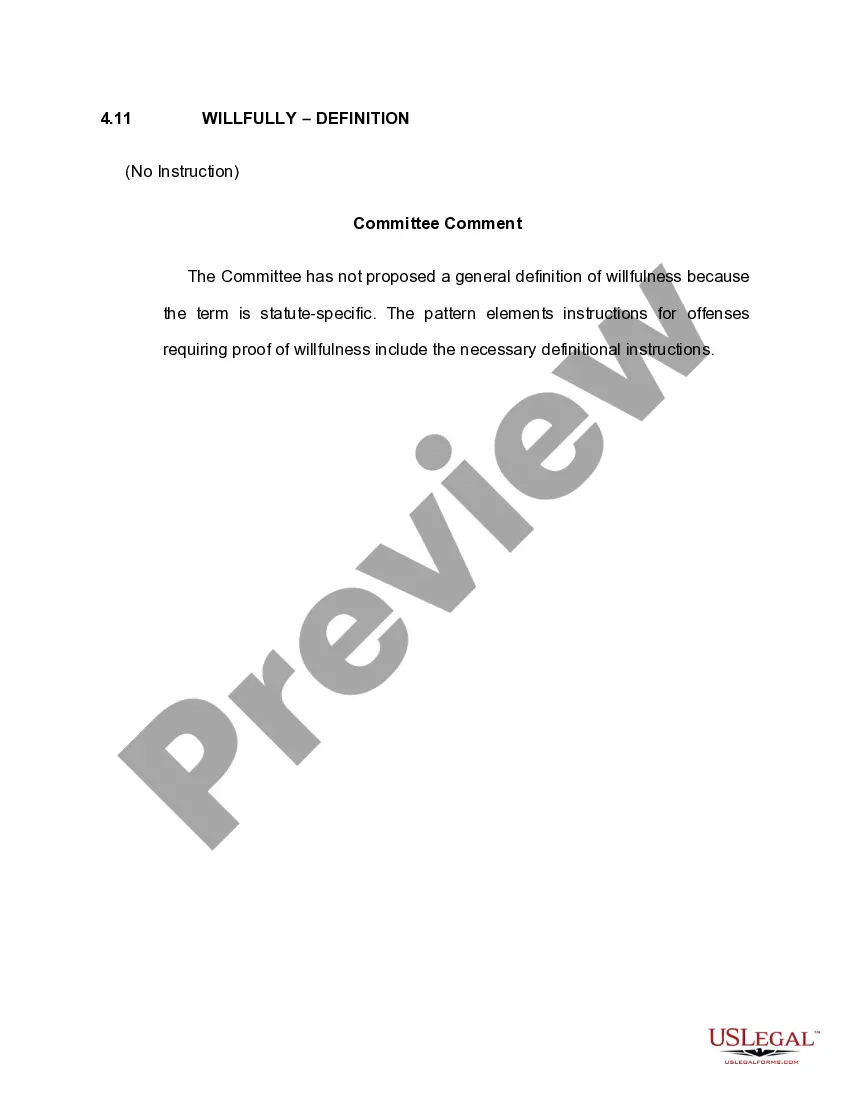
4.11 WILLFULLY - DEFINITION
Overview of this form
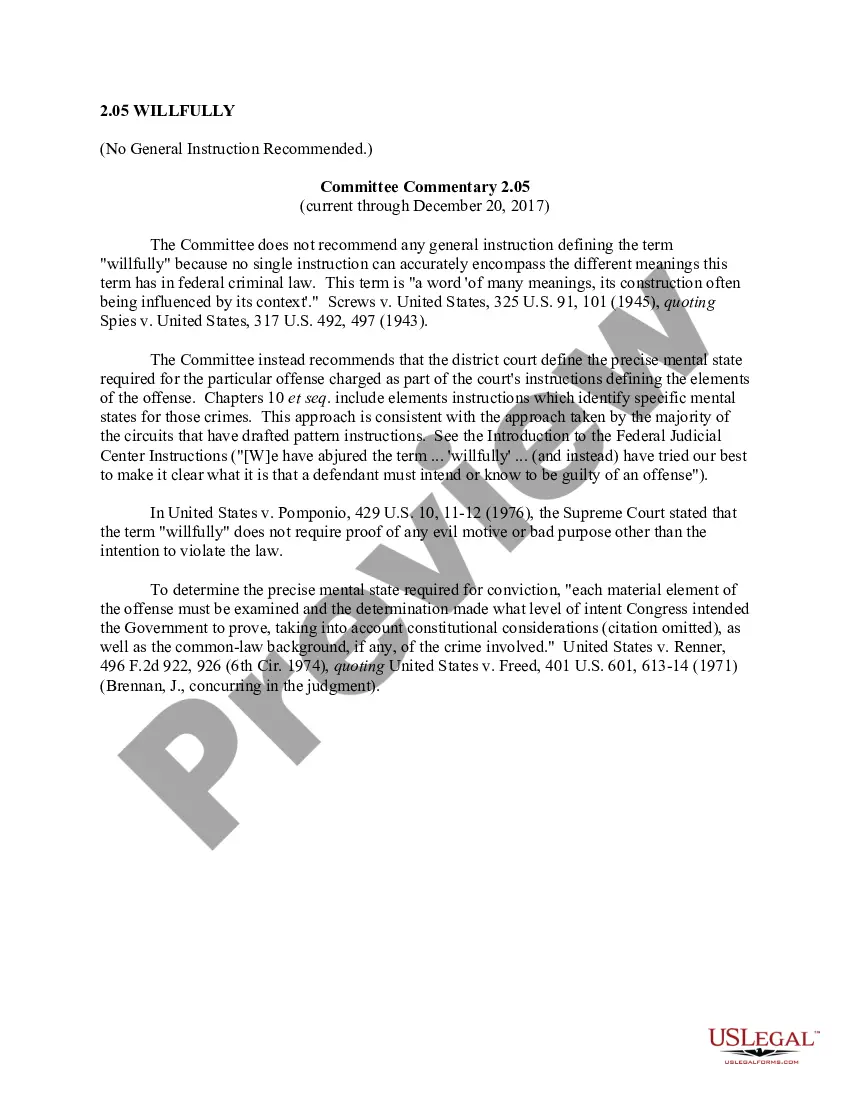
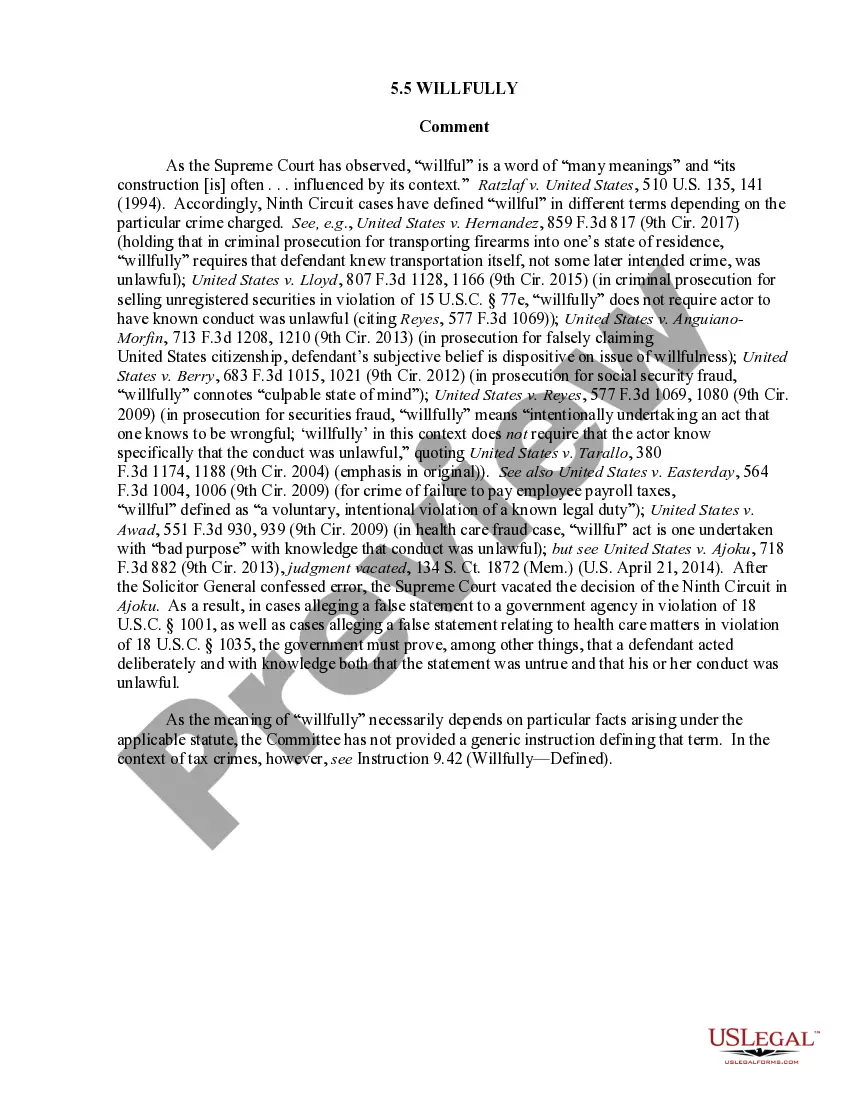
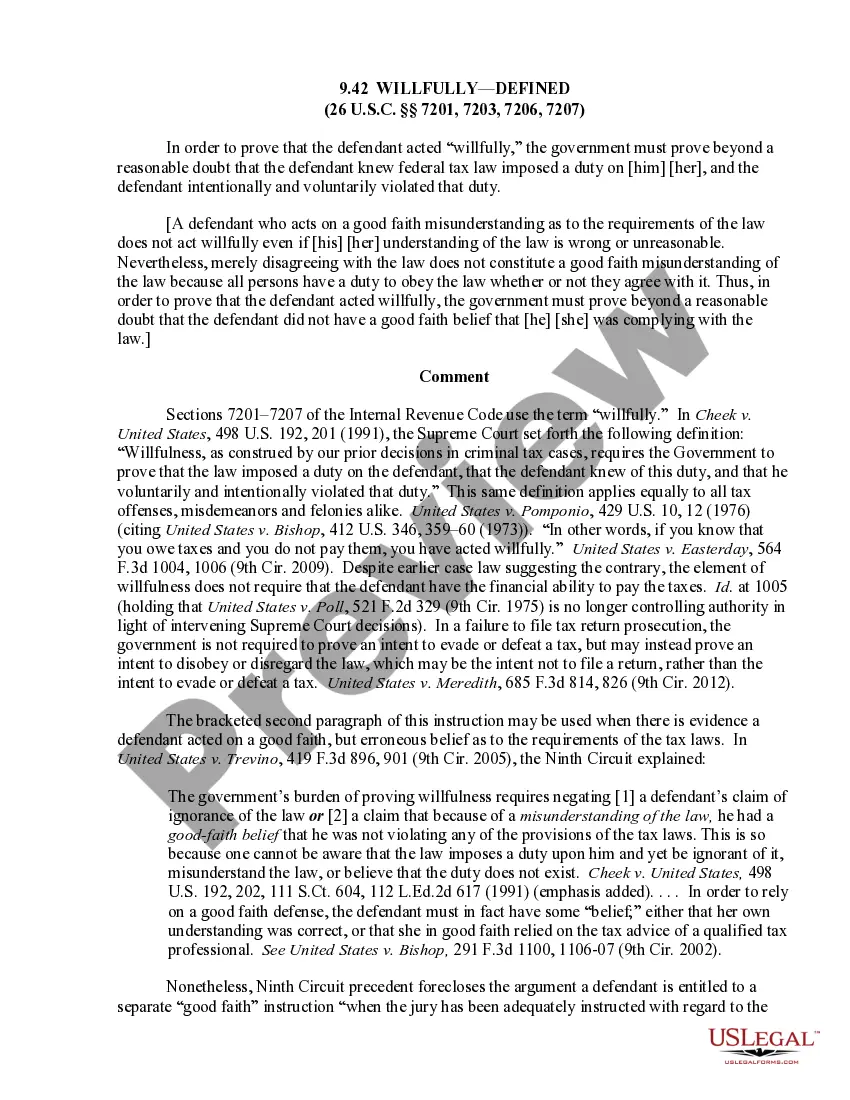
The 4.11 Willfully - Definition form provides a legally recognized definition of willfulness as adopted by the Federal 7th Circuit Court. This definition is crucial in cases where the proof of willfulness is necessary for establishing specific offenses. Unlike other legal forms that provide detailed instructions, this form clarifies that the definition of willfulness is statute-specific and varies based on the context of individual cases.
Main sections of this form
- Definition of willfulness specific to the statute in question.
- General guidance for interpreting willfulness in legal contexts.
- No specific instructional content, as it refers to other elements for context.
When to use this document
This form is essential when dealing with legal matters that require the establishment of willfulness in criminal cases or civil disputes. Situations may include cases of negligence, fraud, or other offenses where intent plays a crucial role in the evidence presented. It is particularly relevant for lawyers or parties involved in legal proceedings that necessitate clarification of willful actions.
Who should use this form
- Legal professionals seeking to define willfulness in court cases.
- Individuals involved in legal disputes requiring clear definitions of intent.
- Students or researchers studying legal definitions and their implications.
How to complete this form
- Review the statute relevant to your legal context that includes the term willfulness.
- Understand the specific elements required to prove willfulness in your case.
- Utilize the definition provided to support legal arguments or instructions in court.
Does this form need to be notarized?
Notarization is not commonly needed for this form. However, certain documents or local rules may make it necessary. Our notarization service, powered by Notarize, allows you to finalize it securely online anytime, day or night.
Get your form ready online
Our built-in tools help you complete, sign, share, and store your documents in one place.
Make edits, fill in missing information, and update formatting in US Legal Forms—just like you would in MS Word.
Download a copy, print it, send it by email, or mail it via USPS—whatever works best for your next step.
Sign and collect signatures with our SignNow integration. Send to multiple recipients, set reminders, and more. Go Premium to unlock E-Sign.
If this form requires notarization, complete it online through a secure video call—no need to meet a notary in person or wait for an appointment.
We protect your documents and personal data by following strict security and privacy standards.

Make edits, fill in missing information, and update formatting in US Legal Forms—just like you would in MS Word.

Download a copy, print it, send it by email, or mail it via USPS—whatever works best for your next step.

Sign and collect signatures with our SignNow integration. Send to multiple recipients, set reminders, and more. Go Premium to unlock E-Sign.

If this form requires notarization, complete it online through a secure video call—no need to meet a notary in person or wait for an appointment.

We protect your documents and personal data by following strict security and privacy standards.
Typical mistakes to avoid
- Misinterpreting the legal definition of willfulness as it can vary based on context.
- Failing to refer to the specific statute that requires the proof of willfulness.
- Using the definition without understanding its implications in a legal case.
Why use this form online
- Convenience of immediate access for legal professionals and individuals.
- Editability to tailor the definition to specific legal cases as required.
- Reliability of content drafted by licensed attorneys ensuring adherence to legal standards.
Legal use & context
- The definition of willfulness plays a crucial role in determining culpability in legal proceedings.
- Understanding this term can significantly affect the outcomes of cases involving criminal intent.
- It is important for various legal activities, including drafting legal documents and preparing for court.
Key takeaways
- The 4.11 Willfully - Definition form clarifies a term critical in legal contexts.
- Willfulness is statute-specific and the understanding differs per case.
- This definition is key for legal professionals and individuals involved in disputes requiring proof of intent.
Legal terms and meanings
- Willfulness: Intentional action or conduct that disregards the consequences or likelihood of harm.
- Statute-specific: A term or definition that applies only within the context of a specific law or regulation.
Looking for another form?

Form popularity
FAQ
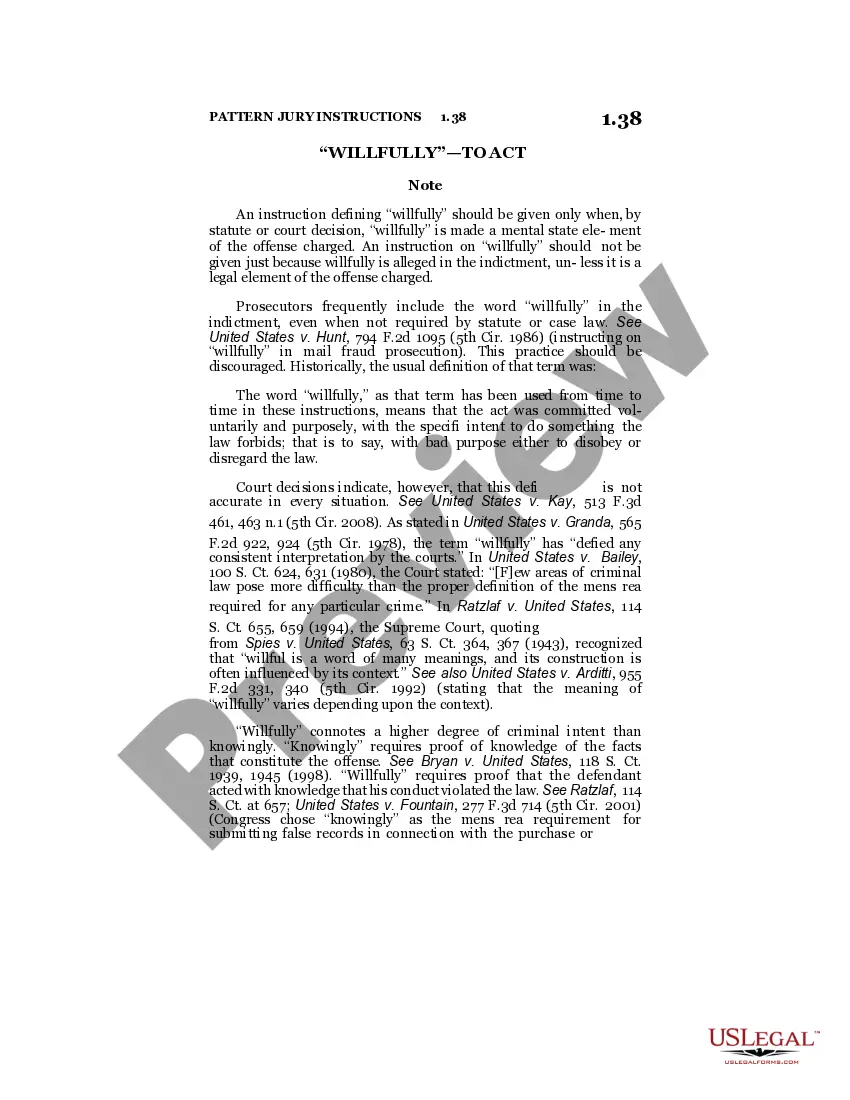
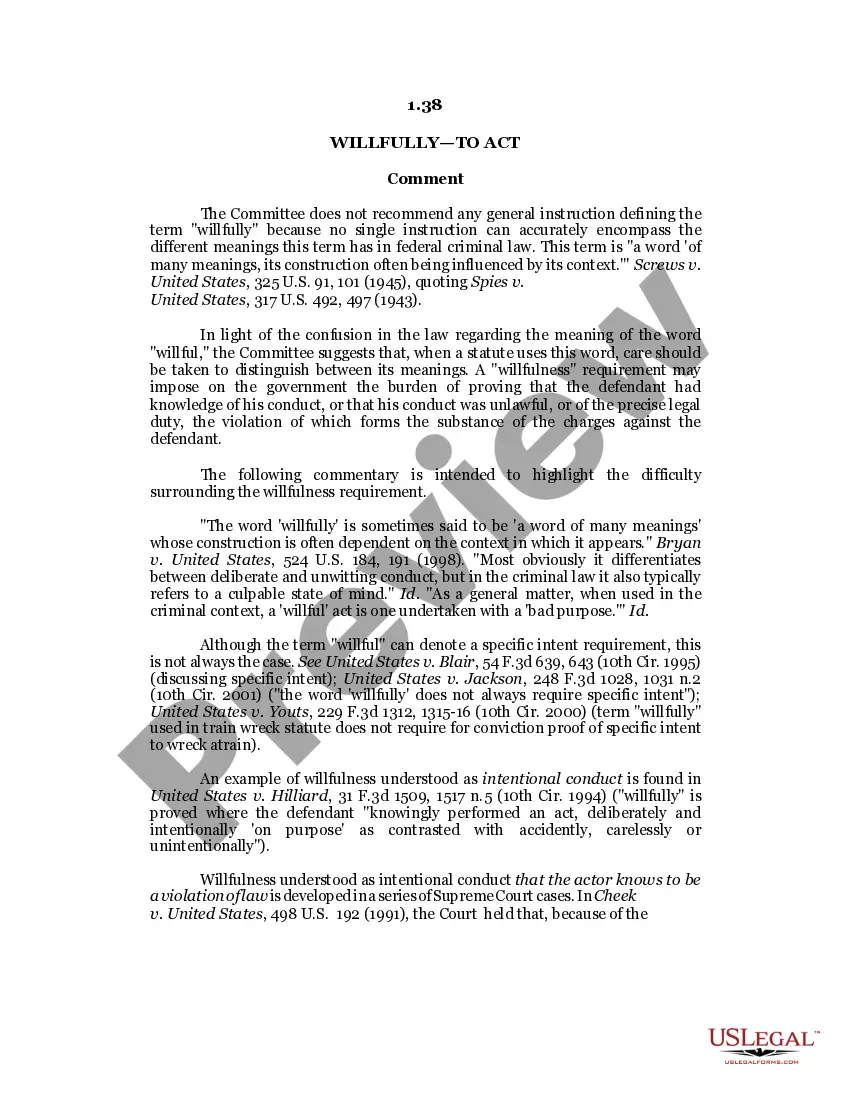
The important difference between willfully as defined in this instruction and the most frequently used definition of knowingly, as stated in Instruction 5.02, is that willfully requires proof beyond a reasonable doubt that the defendant knew his or her conduct was unlawful and intended to do something that 16 Page 17
When applied to the intent with which an act is done or omitted, ?willfully? implies simply a purpose or willingness to commit the act, or the omission. It does not require any intent to violate the law, or to injure another, or to acquire any advantage.
Search Legal Terms and Definitions adj. referring to acts which are intentional, conscious and directed toward achieving a purpose. Some willful conduct which has wrongful or unfortunate results is considered "hardheaded," "stubborn" and even "malicious." Example: "The defendant's attack on his neighbor was willful."
Direct evidence It often takes the form of: testimony from someone who says that the defendant told them that he or she intended to commit the crime, an eyewitness saying that the defendant acted deliberately, or. the defendant's confession that he or she intended to act.
An act is done "willfully" if done voluntarily and intentionally and with the specific intent to do something the law forbids. There is no requirement that the government show evil intent on the part of a defendant in order to prove that the act was done "willfully." See generally United States v. Gregg, 612 F.
Willful. Black's Law Dictionary: 2nd Edition. Definition: Proceeding from a conscious motion of the will; intending the result which actually comes to pass; designed; intentional ; malicious.