2.06 Judicial Notice
Understanding this form
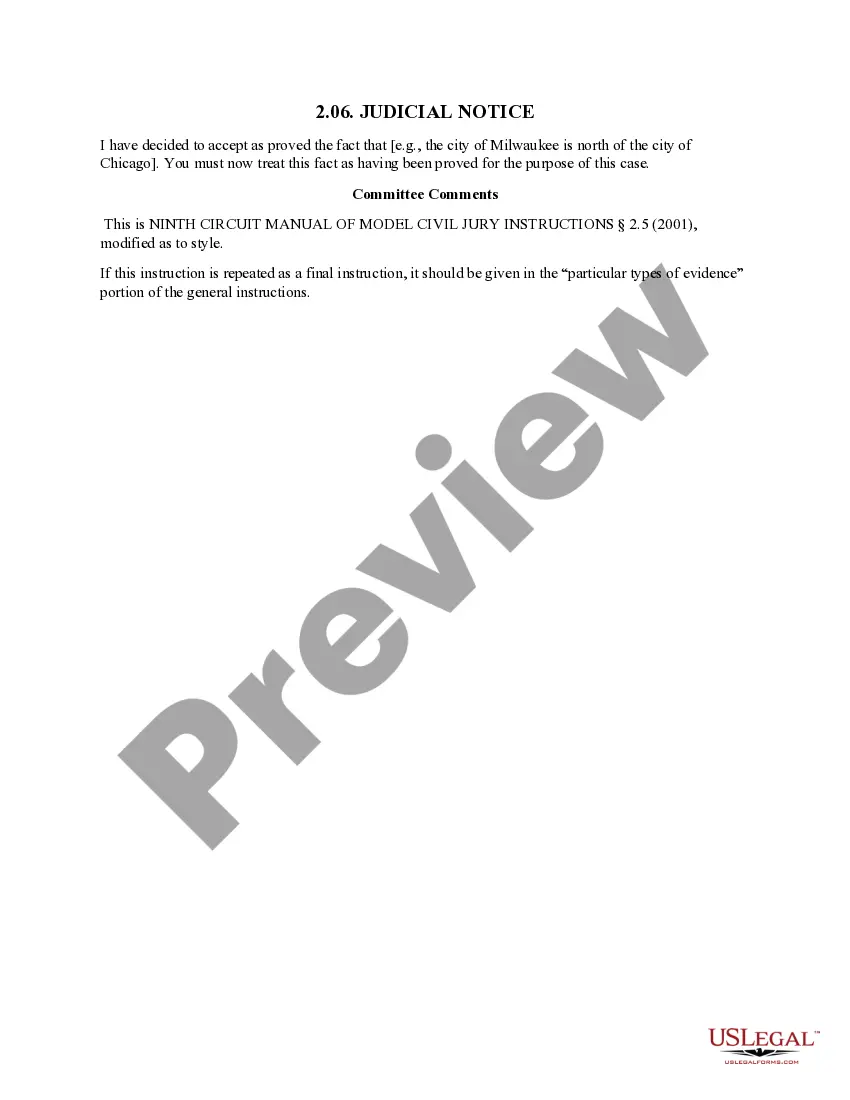
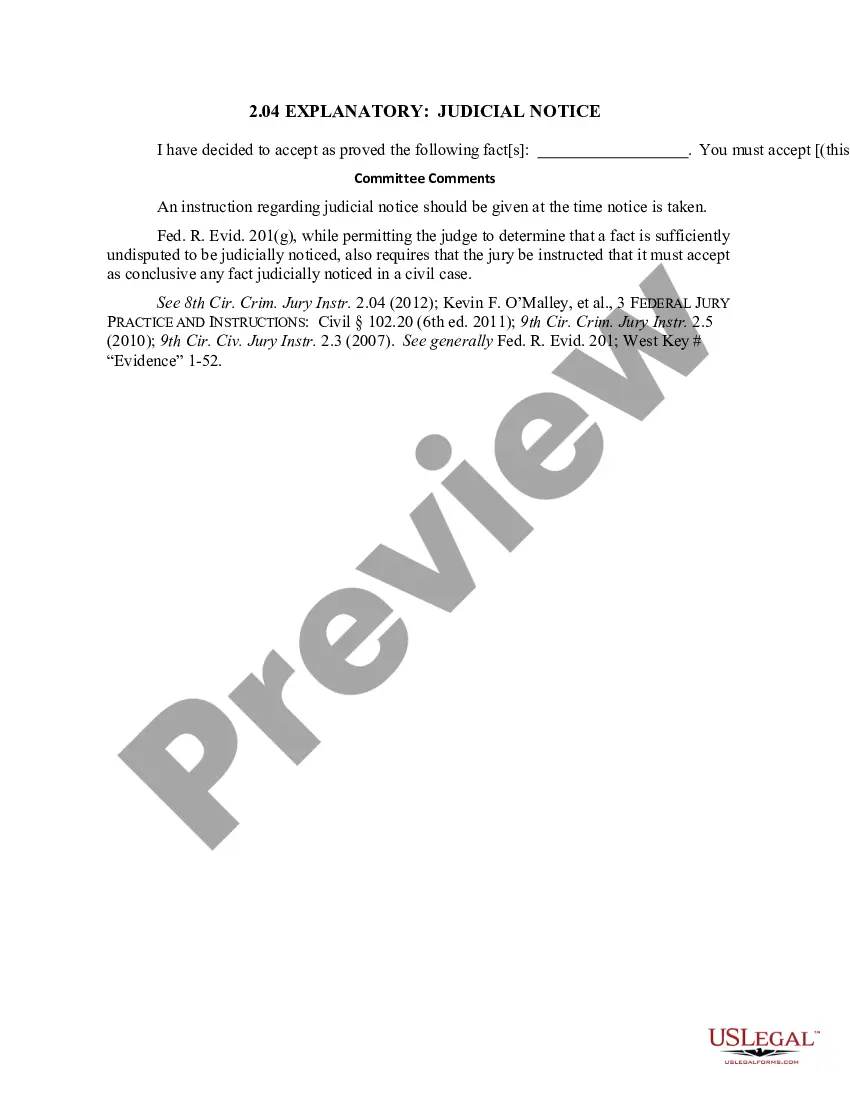
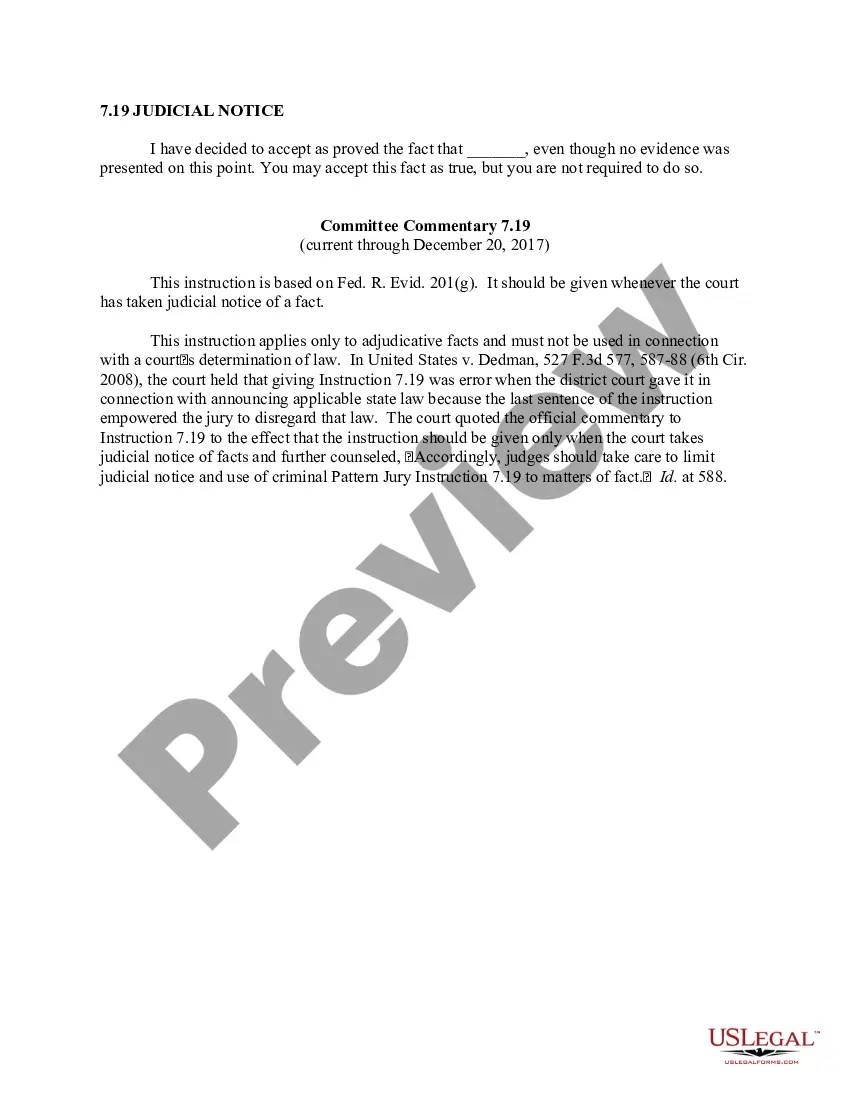
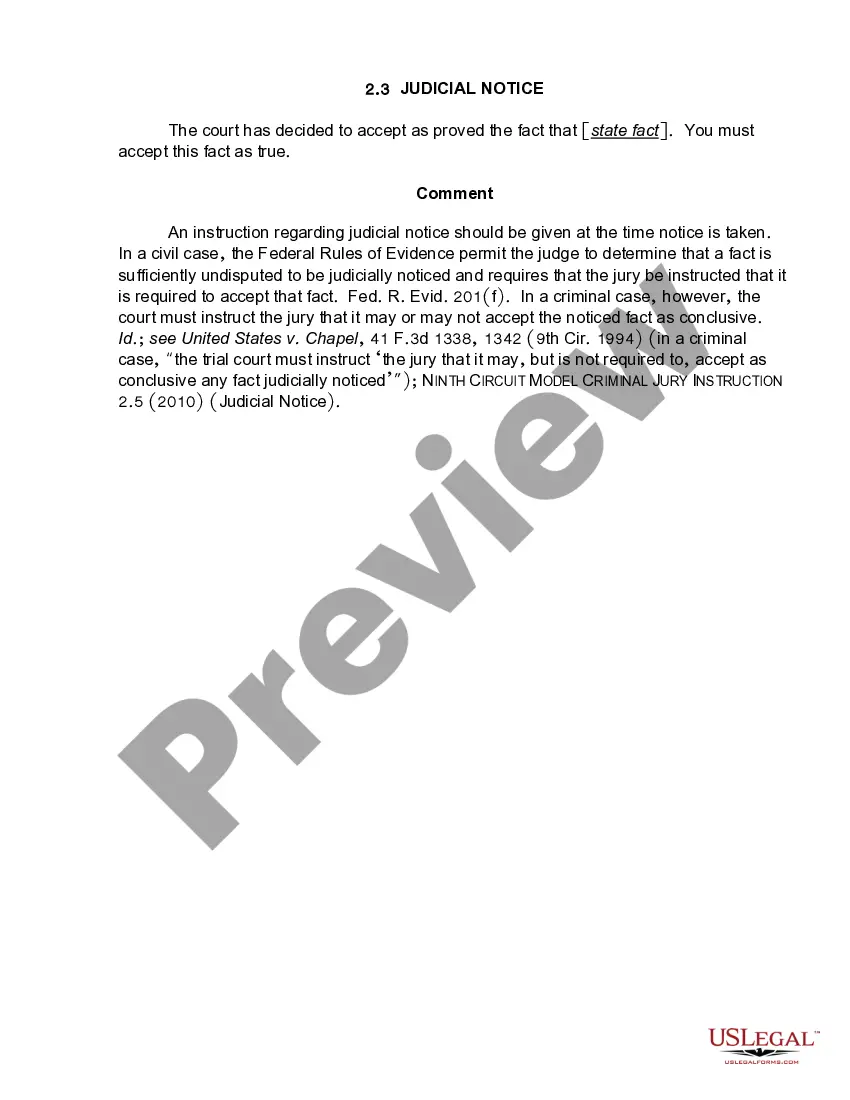
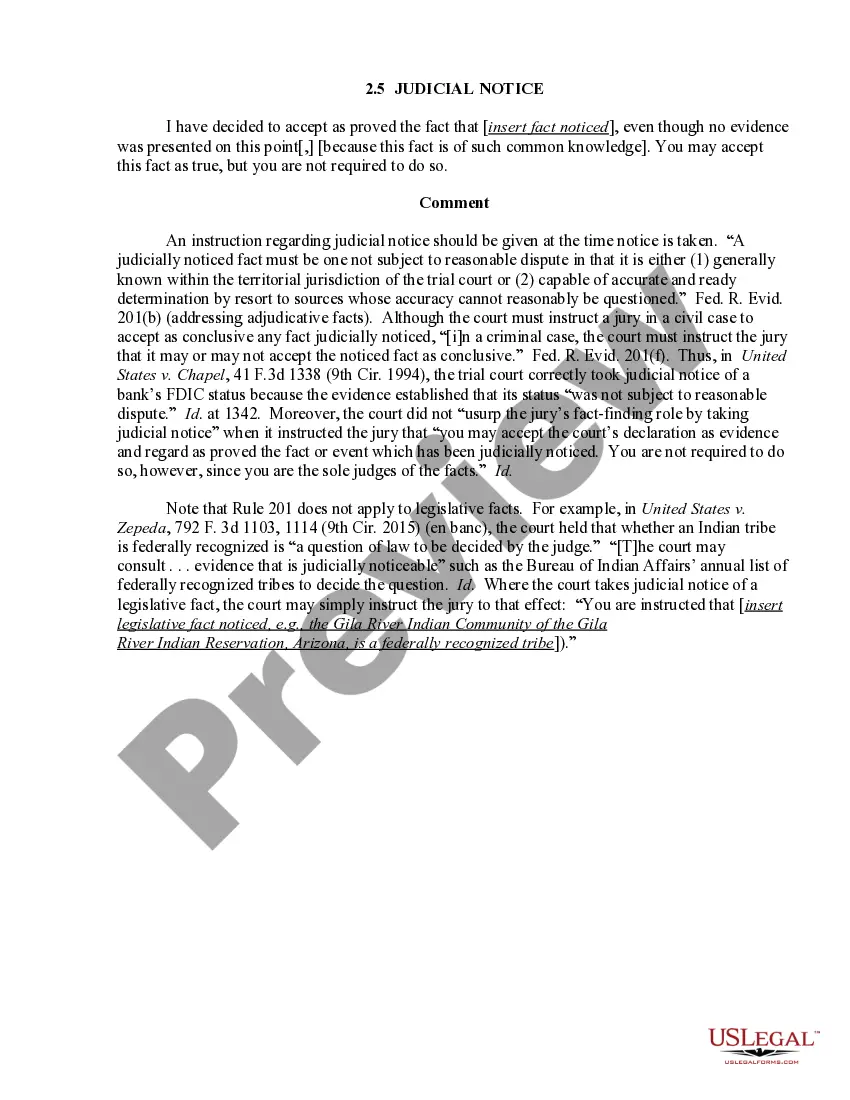
The 2.06 Judicial Notice form provides a formal method for a judge to recognize certain facts as established without requiring further evidence. This is particularly important in jury trials, where the jury is required to accept these facts as true for the case at hand. Unlike other legal forms, this instruction is specific to judicial notice, emphasizing the acceptance of uncontroverted facts in a legal setting.
Form components explained
- Statement of Proven Fact: Specifies a fact that the judge accepts as true, such as geographic or historical information.
- Instruction to the Jury: Directs the jury to treat the stated fact as established evidence during deliberations.
- Committee Comments: Offers guidance on the application and style of the instruction, based on previous legal conventions.

Common use cases
This form is used in judicial proceedings when a judge decides to acknowledge specific facts that do not need to be proven, such as common knowledge or undisputable information. For example, facts like geographical locations or well-known historical events can be included in this category. Its use is particularly relevant during jury trials where clarity and speed in establishing certain truths is essential.
Who needs this form
- Judges presiding over jury trials who need to establish certain facts without requiring evidence from the parties involved.
- Legal practitioners or attorneys preparing for a trial where judicial notice of specific facts is warranted.
- Instructing jurors on accepted facts during deliberations to guide their decision-making process.
Instructions for completing this form
- Identify the fact: Clearly establish the fact you intend to accept as proved.
- Draft the instruction: Write the instruction for the jury, indicating they must treat the identified fact as proven.
- Include committee comments: Refer to the comments from the committee to ensure correct application.
- Review for clarity: Ensure the instruction is clear and straightforward for jury understanding.
- Finalize the document: Confirm proper formatting and include any necessary signatures if required by the court.
Does this form need to be notarized?
Notarization is generally not required for this form. However, certain states or situations might demand it. You can complete notarization online through US Legal Forms, powered by Notarize, using a verified video call available anytime.
Get your form ready online
Our built-in tools help you complete, sign, share, and store your documents in one place.
Make edits, fill in missing information, and update formatting in US Legal Forms—just like you would in MS Word.
Download a copy, print it, send it by email, or mail it via USPS—whatever works best for your next step.
Sign and collect signatures with our SignNow integration. Send to multiple recipients, set reminders, and more. Go Premium to unlock E-Sign.
If this form requires notarization, complete it online through a secure video call—no need to meet a notary in person or wait for an appointment.
We protect your documents and personal data by following strict security and privacy standards.

Make edits, fill in missing information, and update formatting in US Legal Forms—just like you would in MS Word.

Download a copy, print it, send it by email, or mail it via USPS—whatever works best for your next step.

Sign and collect signatures with our SignNow integration. Send to multiple recipients, set reminders, and more. Go Premium to unlock E-Sign.

If this form requires notarization, complete it online through a secure video call—no need to meet a notary in person or wait for an appointment.

We protect your documents and personal data by following strict security and privacy standards.
Common mistakes
- Failing to clearly state the fact being accepted as proven, which may lead to juror confusion.
- Using ambiguous language that could mislead jurors about the accepted fact.
- Neglecting to reference the committee comments or style guide, resulting in inconsistencies.
Benefits of completing this form online
- Convenience: Easily access and download the form whenever needed without the hassle of physical paperwork.
- Editability: Customize the form to fit the specific needs of your case, ensuring accuracy and relevance.
- Reliability: Forms are drafted by licensed attorneys, providing peace of mind regarding their legality and applicability.
Legal use & context
- Judicial notice is a process that allows courts to accept facts without needing formal proof, simplifying legal proceedings.
- It is crucial in speeding up trials by eliminating the need for evidence on commonly known matters.
- Acceptance of uncontroverted facts aids jurors in focusing on the more complex aspects of the case.
Summary of main points
- The 2.06 Judicial Notice form is essential for recognizing established facts in legal proceedings.
- It streamlines the judicial process by allowing certain truths to be accepted without proof.
- The form is applicable across the 7th Circuit and does not require state-specific adaptations.
Looking for another form?

Form popularity
FAQ
When it comes to legal disputes, the courts are the final deciders of what the Constitution means. This authority ? known as judicial review ? gives the Supreme Court and federal courts the authority to interpret the Constitution.
COURT RECORDS. Background & Analysis. The Florida Evidence Code authorizes a court to take judicial notice of its own records, the records of other Florida courts, and records from any other state or federal court of the United States.
Key Concepts. The court may take judicial notice of adjudicative facts that are not subject to any reasonable dispute if the facts are common knowledge in the jurisdiction or can be easily determined by reference to reliable sources. The court may take such notice on its own motion or at the request of a party.
For example, a court may take judicial notice that it is nighttime at 7 PM in February in New York. If one party's theory of a car accident case assumes that a motorist's headlights should have been on because it was 7 PM, the party need not necessarily bring evidence to establish that 7 PM was after sunset.
Judicial notice is a means of bringing before a trial or appellate court "matters that are assumed to be indisputably true, so that the introduction of evidence to prove them will not be required." Kilroy v. State of California, 119 Cal. App. 4th 140, 148 (2004).
Judicial notice is used by a court when it declares a fact presented as evidence as true without a formal presentation of evidence. A court can take judicial notice of indisputable facts. If a court takes judicial notice of an indisputable fact in a civil case, the fact is considered conclusive. evidence.
(3) A court may take judicial notice of a fact, whether requested or not. (4) A party is entitled to an opportunity to be heard on whether a court should take judicial notice. In the absence of prior notification, a party shall, upon request, be given an opportunity to be heard after judicial notice has been taken.
What Is Judicial Notice? In a criminal case, if the court takes ?judicial notice? of a matter, the court must instruct the jury ?that it may, but is not required to, accept as conclusive any fact judicially noticed.? G.S. 8C-201(g); see also N.C.P.I.