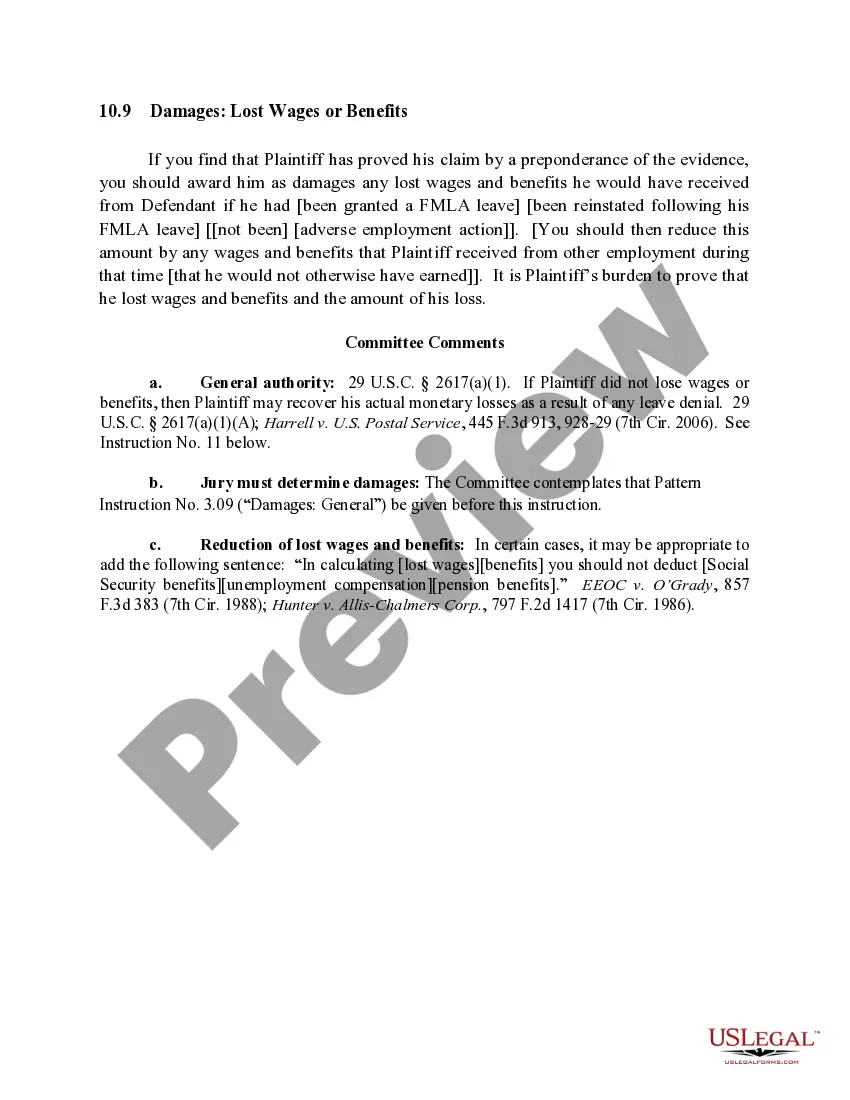
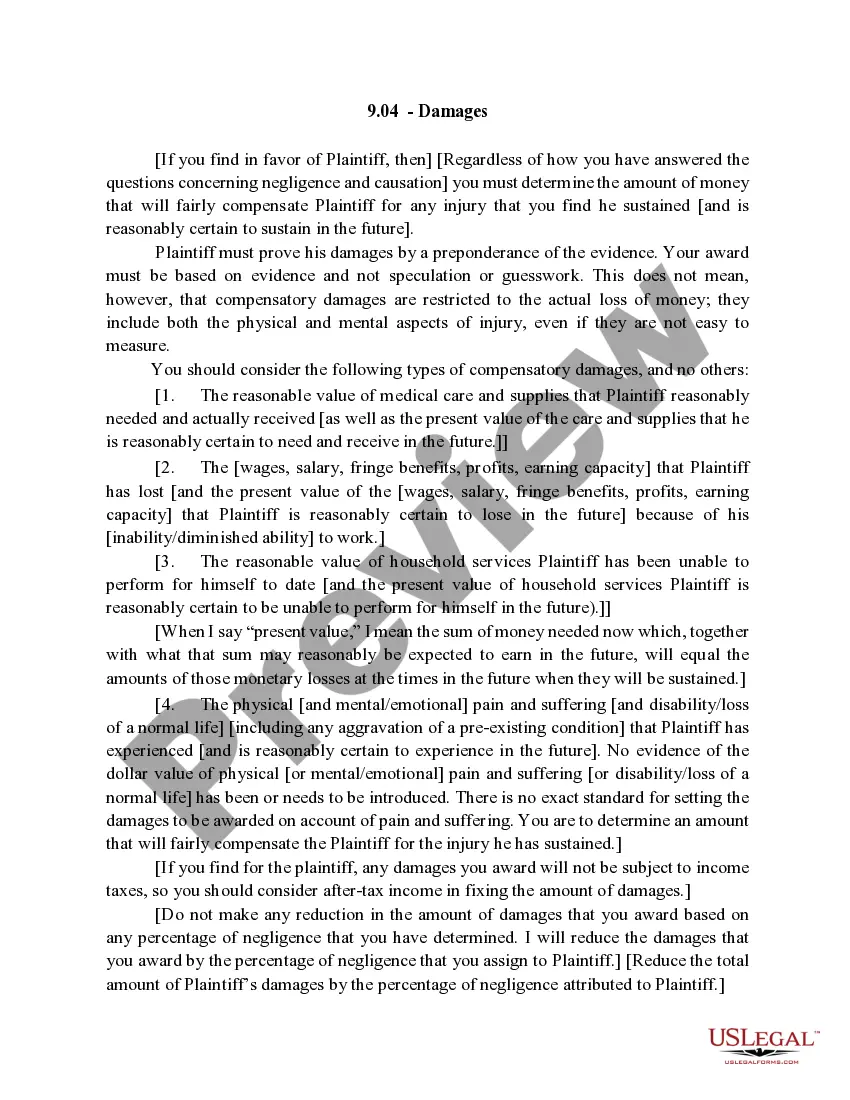
10.9 Damages: Lost Wages or Benefits
About this form
The 10.9 Damages: Lost Wages or Benefits form is an official legal document used to establish the amount of lost wages and benefits a plaintiff is entitled to receive as a result of wrongful acts by a defendant, such as the denial of Family and Medical Leave Act (FMLA) benefits or adverse employment actions. This form differs from other damages forms as it specifically focuses on calculating lost income and benefits directly tied to employment issues.
Key parts of this document
- Establishes criteria for determining lost wages and benefits based on plaintiff's claims.
- Details the burden of proof placed on the plaintiff to demonstrate lost earnings.
- Provides instructions on how to account for any alternative income received by the plaintiff during that period.
- Offers guidance on legal authorities applicable to the calculation of damages.
- Includes options for excluding certain types of compensation from calculations.
When to use this form
This form is used during legal proceedings when a plaintiff is seeking compensation for lost wages or benefits due to employment issues, such as being denied FMLA leave or facing adverse employment actions. It is especially relevant in cases where the plaintiff needs to demonstrate financial loss resulting from these actions, enabling a jury to make an informed decision regarding damages.
Who this form is for
This form is intended for:
- Plaintiffs who have claims related to employment issues and are seeking to recover lost wages or benefits.
- Attorneys representing individuals in employment-related lawsuits.
- Individuals involved in disputes regarding FMLA violations or other employment-related grievances.
Steps to complete this form
- Identify the plaintiff and defendant involved in the case.
- Specify the basis for the claim regarding lost wages or benefits.
- Document the exact amount of wages and benefits lost due to the actions of the defendant.
- Detail any alternative employment or benefits received during the claimed period.
- Include appropriate legal citations and references as required.
Notarization guidance
This form usually doesn’t need to be notarized. However, local laws or specific transactions may require it. Our online notarization service, powered by Notarize, lets you complete it remotely through a secure video session, available 24/7.
Get your form ready online
Our built-in tools help you complete, sign, share, and store your documents in one place.
Make edits, fill in missing information, and update formatting in US Legal Forms—just like you would in MS Word.
Download a copy, print it, send it by email, or mail it via USPS—whatever works best for your next step.
Sign and collect signatures with our SignNow integration. Send to multiple recipients, set reminders, and more. Go Premium to unlock E-Sign.
If this form requires notarization, complete it online through a secure video call—no need to meet a notary in person or wait for an appointment.
We protect your documents and personal data by following strict security and privacy standards.

Make edits, fill in missing information, and update formatting in US Legal Forms—just like you would in MS Word.

Download a copy, print it, send it by email, or mail it via USPS—whatever works best for your next step.

Sign and collect signatures with our SignNow integration. Send to multiple recipients, set reminders, and more. Go Premium to unlock E-Sign.

If this form requires notarization, complete it online through a secure video call—no need to meet a notary in person or wait for an appointment.

We protect your documents and personal data by following strict security and privacy standards.
Mistakes to watch out for
- Failing to accurately report all sources of income during the claim period.
- Not providing sufficient evidence to support the claims of lost wages.
- Overlooking to include applicable exclusions in the calculation of damages.
Why use this form online
- Immediate access to the most current legal form templates.
- Simple downloading and editing capabilities for personal customization.
- Guidance provided by licensed attorneys ensures reliability and accuracy.
Looking for another form?
Form popularity
FAQ
In order for a worker to be eligible for loss of earning power benefits: The worker's loss of earnings must be greater than 5 percent of wages at the time of injury. Medical certification must indicate that the worker's loss of earning capacity is due to the industrial injury or occupational disease.
Lost wages refer to the earnings you have already missed, while loss of earning capacity is the loss of future earning potential due to a long-term or permanent disability.
Lost wages include all the time away from work for both medical treatment and time missed due to physical incapacity to perform your normal work tasks. In order to establish lost wages, you will have the burden of proving all the necessary elements of the damages stemming from your injury.
Baker's Evangelical Dictionary of Biblical Theology - Wages. Wages N E S Payment given for services rendered. The semantic field of this term is usually found in economic contexts, where payment means some type of monetary compensation.
What Are Lost Wages? Lost wages, or lost income, refers to the money you would have earned but didn't because you could not work after injury. Not only does this include hourly wages, but it may also include sick or vacation days, tips, and commission.
Your average weekly wage includes all your gross wages, including overtime and bonuses. If you have a second job at the time of your injury, your average weekly wage also includes those wages. The higher your average weekly wage, the higher the wage loss benefits you receive.
Workers' compensation covers the costs of work-related injuries and illnesses, like medical bills and lost wages.
Such losses are usually referred to as ?lost earning capacity? in California.