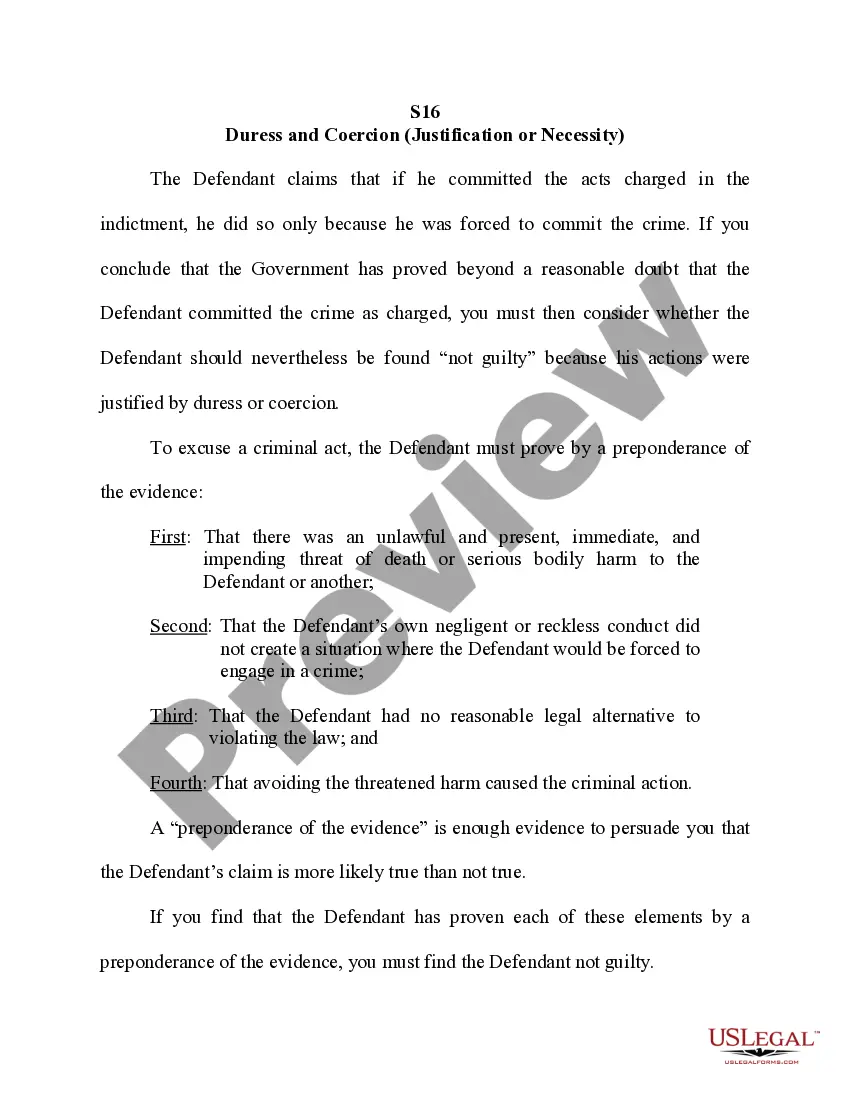
Duress and Coercion (Justification or Necessity)
About this form
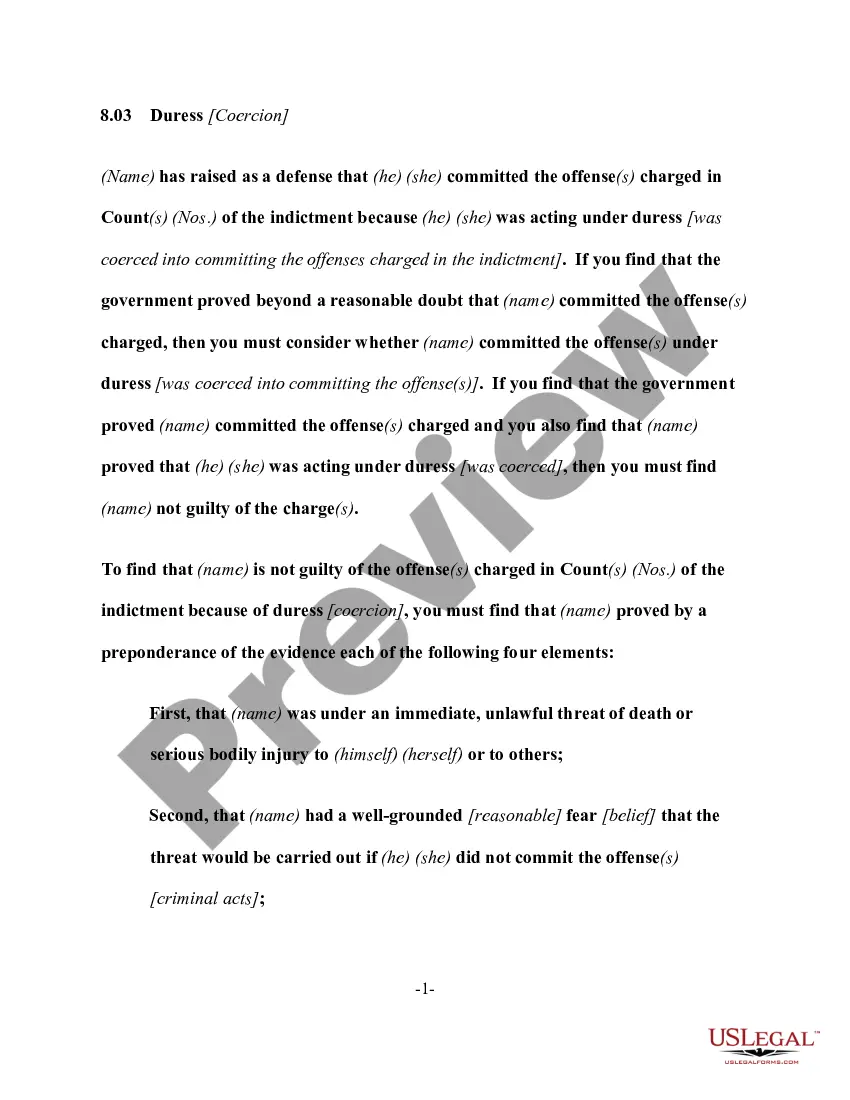
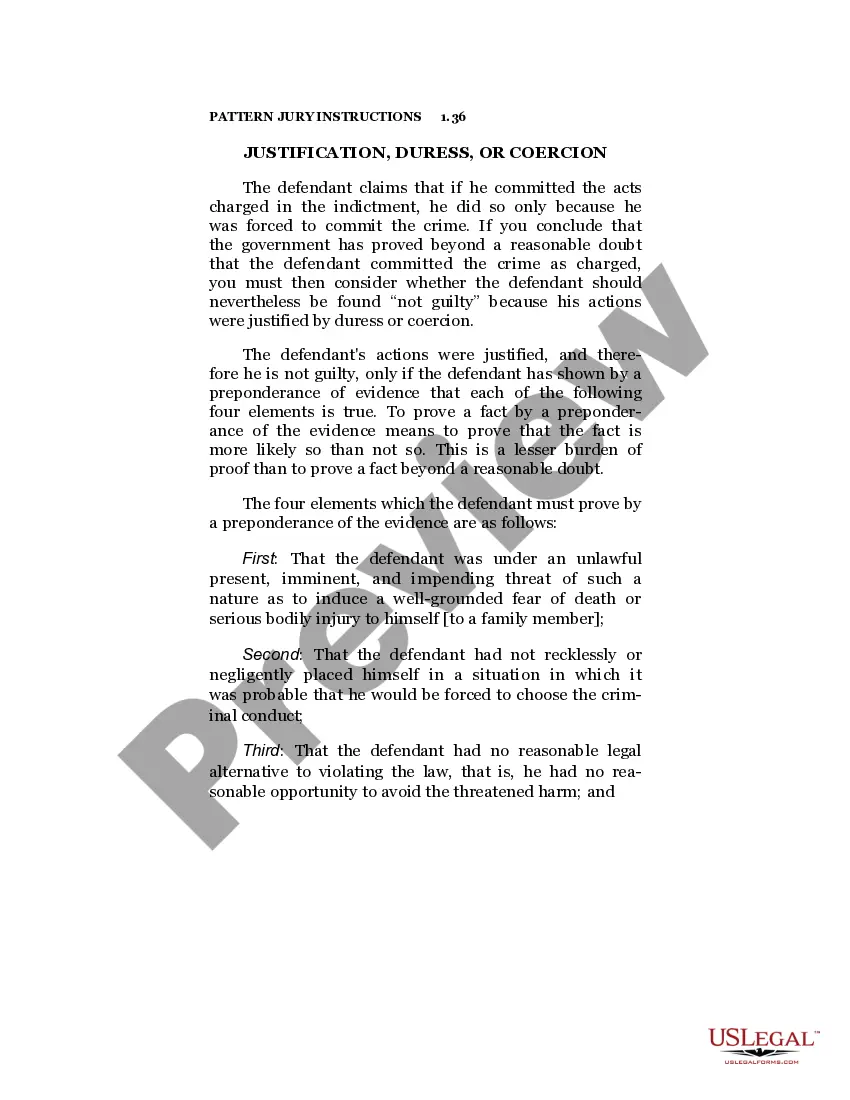
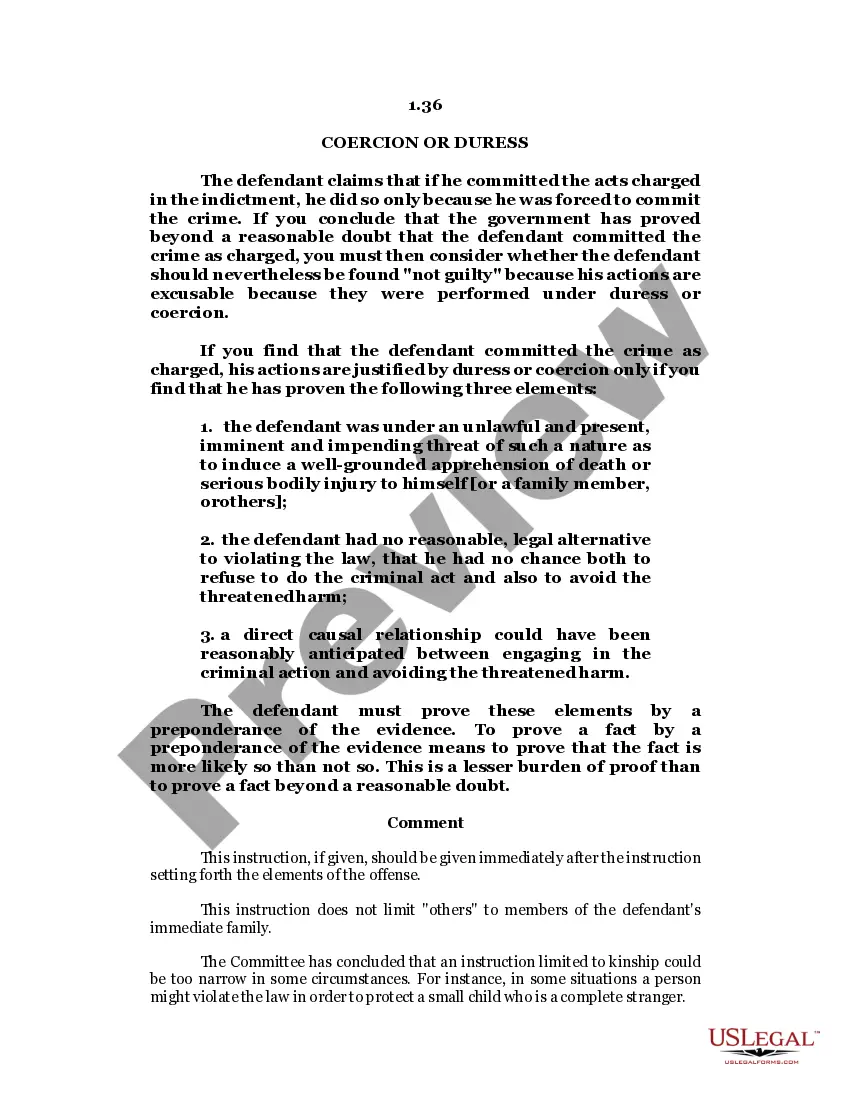
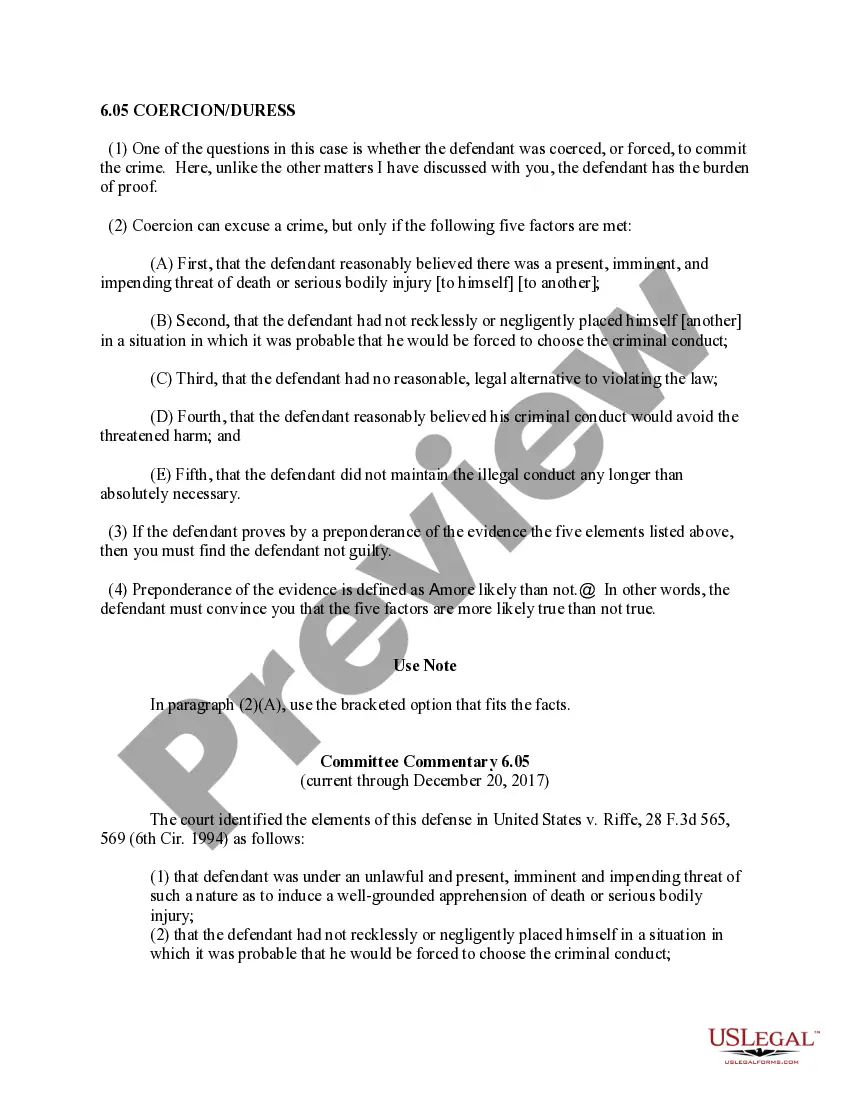
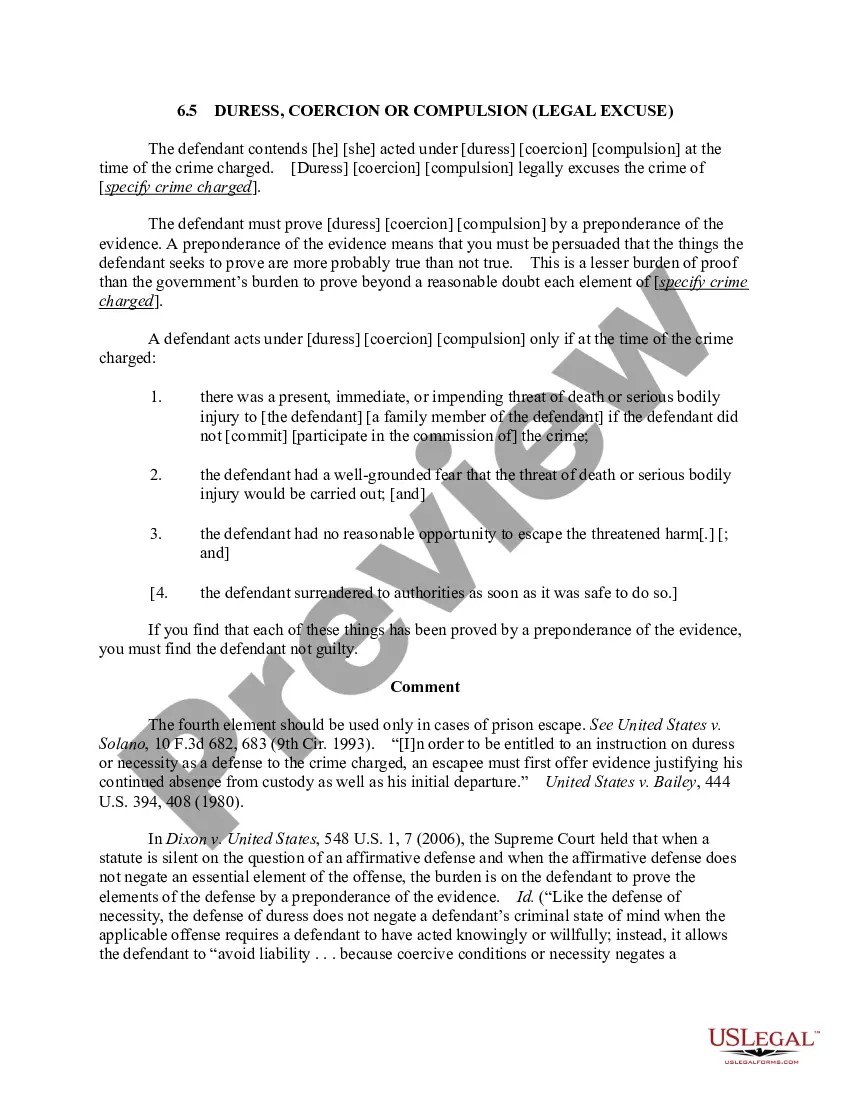
The Duress and Coercion (Justification or Necessity) form is a legal template that addresses situations where a defendant claims to have committed a crime under threat of imminent harm. It serves to outline the conditions under which a defendant may be excused from liability due to duress or coercion, distinguishing it from other forms of legal defense. This form is based on Pattern Jury Instructions from the 11th Circuit Federal Court of Appeals.
Main sections of this form
- Definition of duress and coercion as grounds for justification.
- Elements the defendant must prove to be excused from liability.
- Requirements for unlawful and immediate threats to the defendant or others.
- Clarification that the defendant's own actions must not have created the threatening situation.
- Establishment of a lack of reasonable legal alternatives to committing the crime.
- Condition that the criminal action directly results from avoiding the threatened harm.
When to use this form
This form is useful in criminal cases where the defendant asserts that they committed the alleged crime under duress or coercion. For instance, it may apply when a person commits theft while being threatened with physical harm, or if they engage in any illegal act because they believe their or another person's life is at stake. The form guides the jury to assess whether the defendant can be found "not guilty" under such circumstances.
Intended users of this form
- Defendants in criminal cases who claim to have acted under duress or coercion.
- Defense attorneys representing clients in situations involving threats to personal safety.
- Legal professionals preparing jury instructions for cases that include duress or coercion defense.
Instructions for completing this form
- Identify the defendant and the charges against them.
- Gather evidence supporting the claims of duress or coercion.
- Present findings showing there was a threat of serious bodily harm.
- Demonstrate that the defendant did not create the perilous situation through their own actions.
- Explain the lack of reasonable alternatives available to the defendant at the time.
Does this form need to be notarized?
In most cases, this form does not require notarization. However, some jurisdictions or signing circumstances might. US Legal Forms offers online notarization powered by Notarize, accessible 24/7 for a quick, remote process.
Get your form ready online
Our built-in tools help you complete, sign, share, and store your documents in one place.
Make edits, fill in missing information, and update formatting in US Legal Forms—just like you would in MS Word.
Download a copy, print it, send it by email, or mail it via USPS—whatever works best for your next step.
Sign and collect signatures with our SignNow integration. Send to multiple recipients, set reminders, and more. Go Premium to unlock E-Sign.
If this form requires notarization, complete it online through a secure video call—no need to meet a notary in person or wait for an appointment.
We protect your documents and personal data by following strict security and privacy standards.

Make edits, fill in missing information, and update formatting in US Legal Forms—just like you would in MS Word.

Download a copy, print it, send it by email, or mail it via USPS—whatever works best for your next step.

Sign and collect signatures with our SignNow integration. Send to multiple recipients, set reminders, and more. Go Premium to unlock E-Sign.

If this form requires notarization, complete it online through a secure video call—no need to meet a notary in person or wait for an appointment.

We protect your documents and personal data by following strict security and privacy standards.
Mistakes to watch out for
- Failing to provide sufficient evidence to support claims of duress or coercion.
- Overlooking the requirement that the defendant's own conduct did not create danger.
- Not clearly establishing the immediacy and severity of the threat faced.
Why complete this form online
- Convenience of downloading the form anytime and anywhere.
- Editability to tailor the content to specific legal situations.
- Reliability of using a template drafted by licensed attorneys.
Looking for another form?
Form popularity
FAQ
While duress is not a justification for committing a crime, it can serve as an excuse when a defendant committed a crime because they were facing the threat or use of physical force.
Defense. The Duress or Necessity defense arises when a person commits an offense when they felt they had no choice but to commit it. For example, committing a DUI when you were fleeing from danger and the only reasonable option was to drive while impaired.
Please note that the difference between duress and necessity is that necessity can be raised only where the defendant committed his criminal act as a result of the physical forces of nature, whereas the defense of duress is raised when the defendant committed his act as a result of threats made by another person.
An example is that breaking into someone's home during a fire in order to rescue a child inside, is justified. If the same act is done in the belief that there was a fire, when in fact there was no fire, then the act is excused if the false belief was reasonable.
The defense can arise when there's a threat or actual use of physical force that drives the defendant?and would've driven a reasonable person?to commit a crime. A classic example is someone holding a gun to the defendant's head to force the defendant to break the law.
(the defense of duress applies when the accused's participation in the offense was caused by a reasonable apprehension that the accused or another innocent person would be immediately killed or would immediately suffer serious bodily injury if the accused did not commit the act; the apprehension must reasonably
In the example, for instance, if the bus driver had access to an emergency braking device that was designed to stop the bus when the regular brakes failed, he would not be justified in committing a criminal act to prevent collision because he had a realistic alternative available to him.
While duress is not a justification for committing a crime, it can serve as an excuse when a defendant committed a crime because they were facing the threat or use of physical force. The defense must establish that a reasonable person in the defendant's position also would have committed the crime.