Duress (Coercion)
About this form
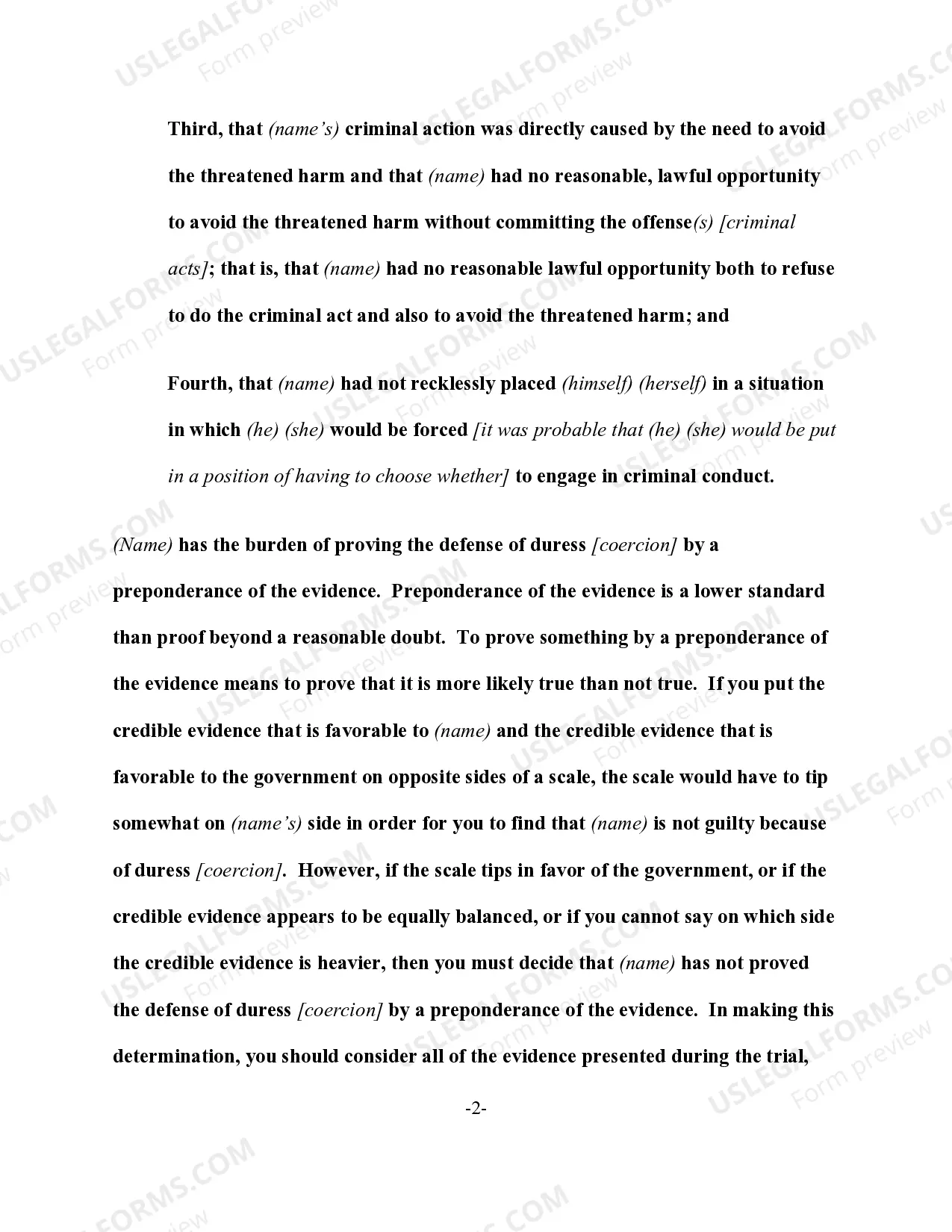
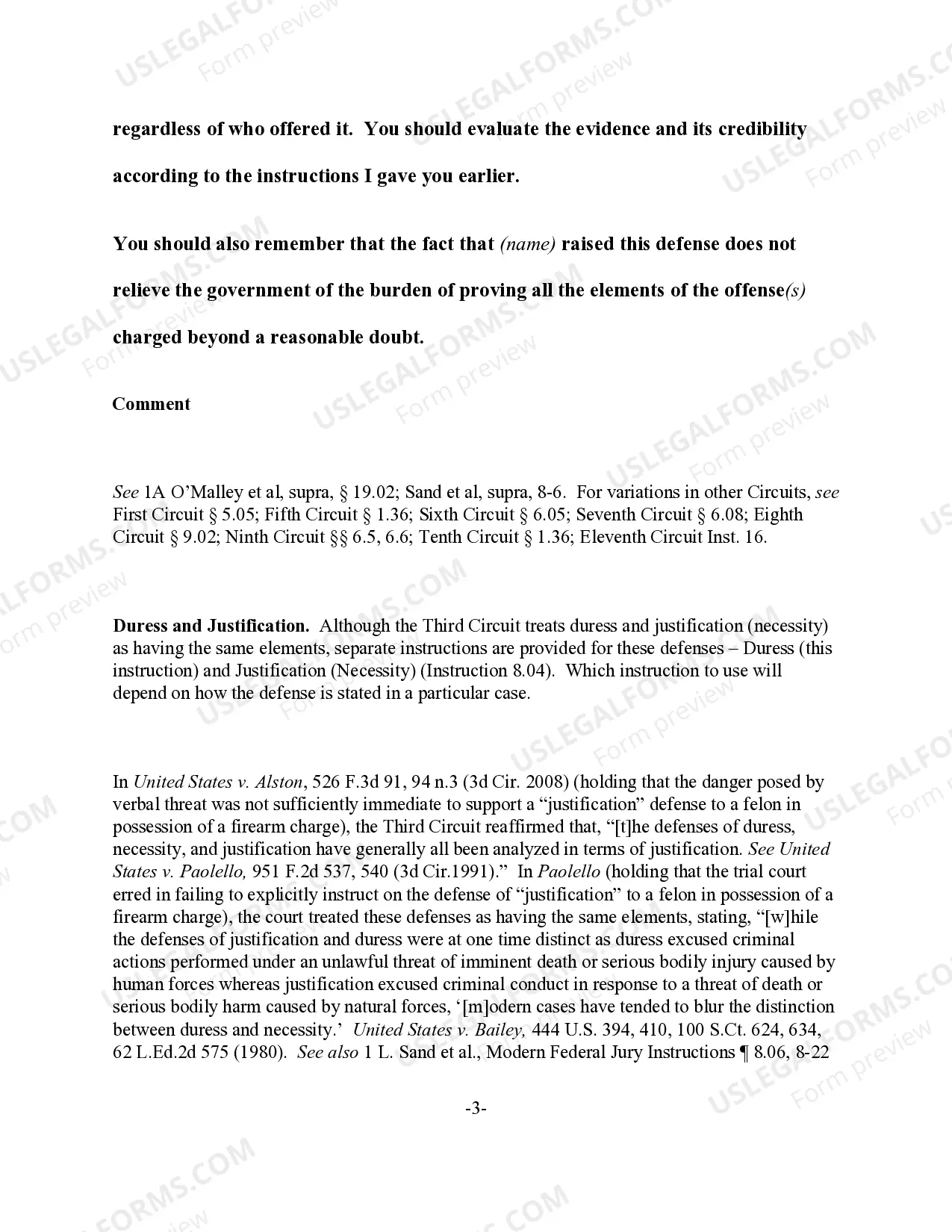
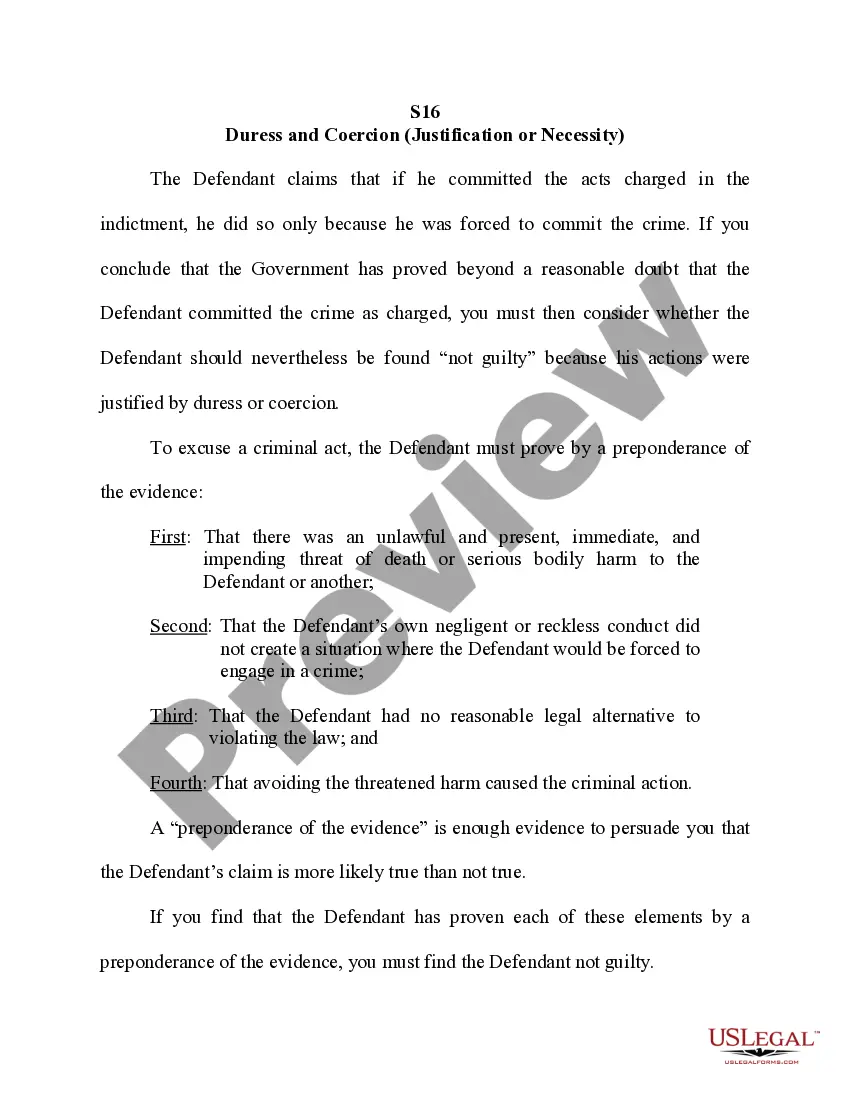
The Duress (Coercion) form serves as a legal defense in criminal cases where a defendant claims they acted under threat of immediate harm. This form outlines the conditions under which coercion can absolve or mitigate culpability for a crime, differentiating it from other defenses like necessity or justification. The focus is on the defendant's experience of an unlawful threat that compelled them to commit an illegal act to avoid greater harm.
What’s included in this form
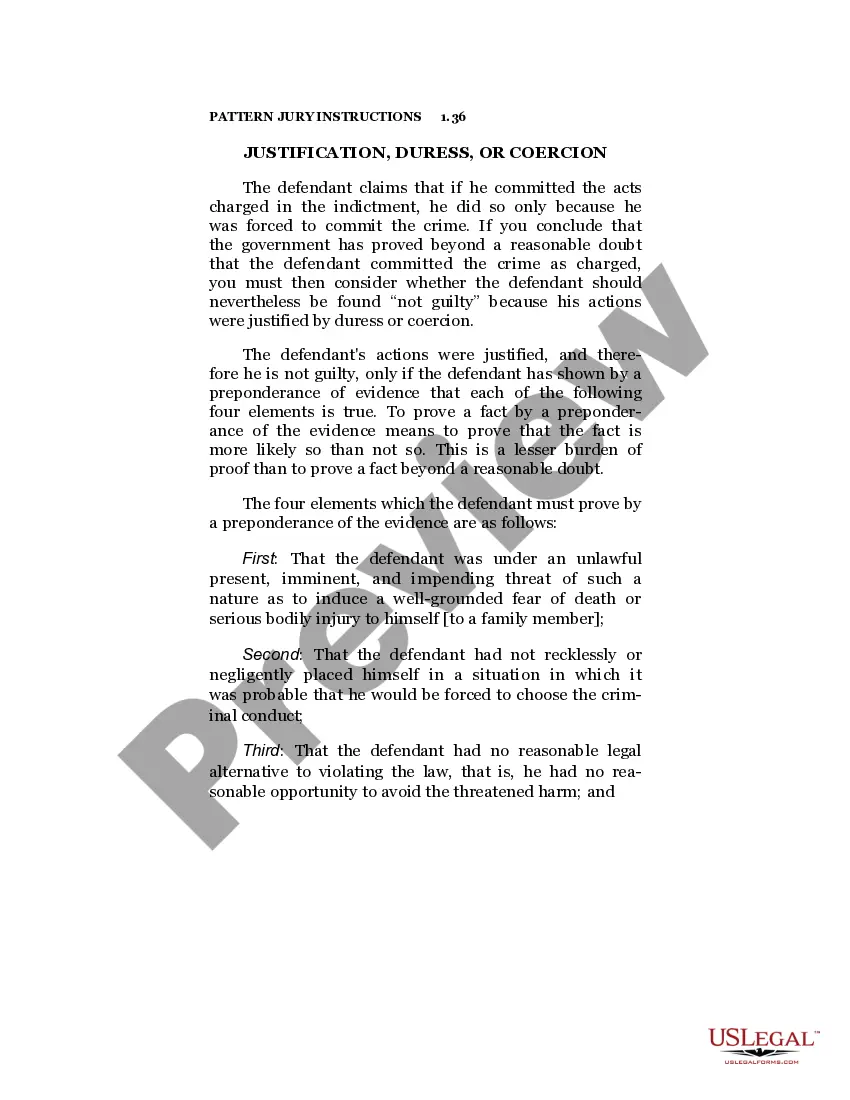
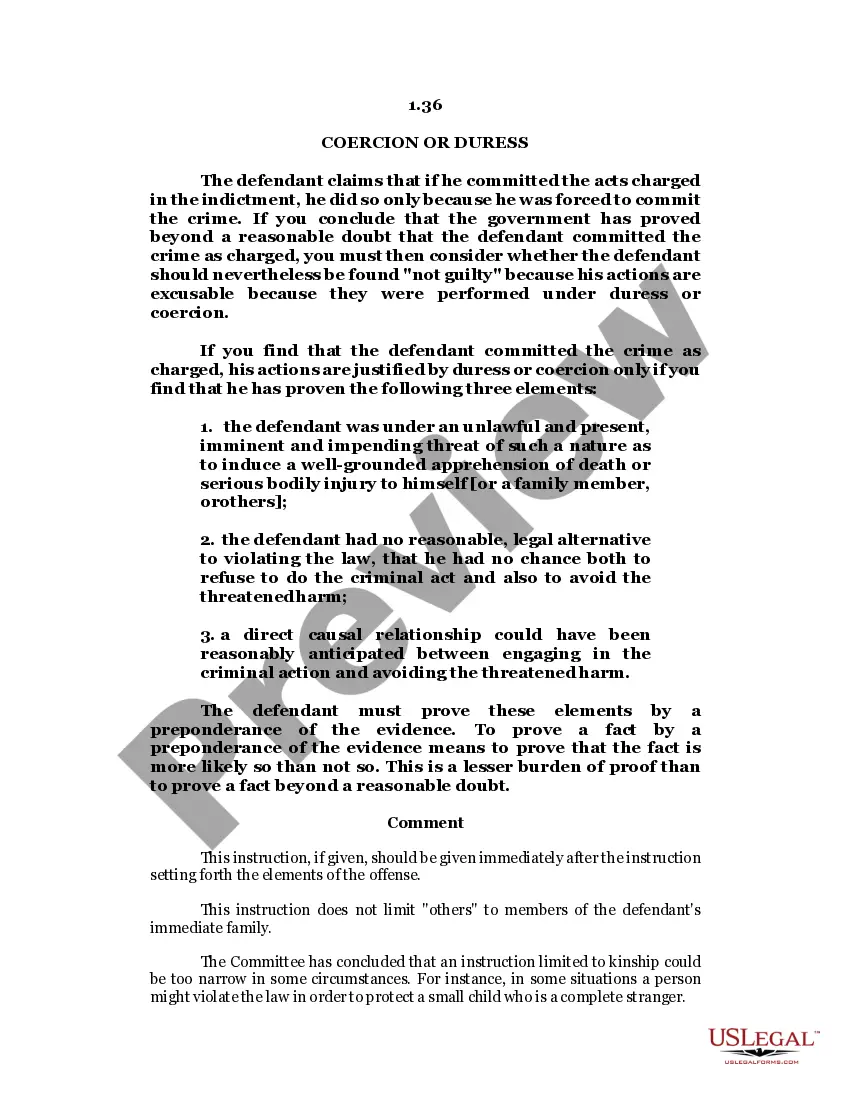
- Defense assertion: States that the defendant committed the offense under duress.
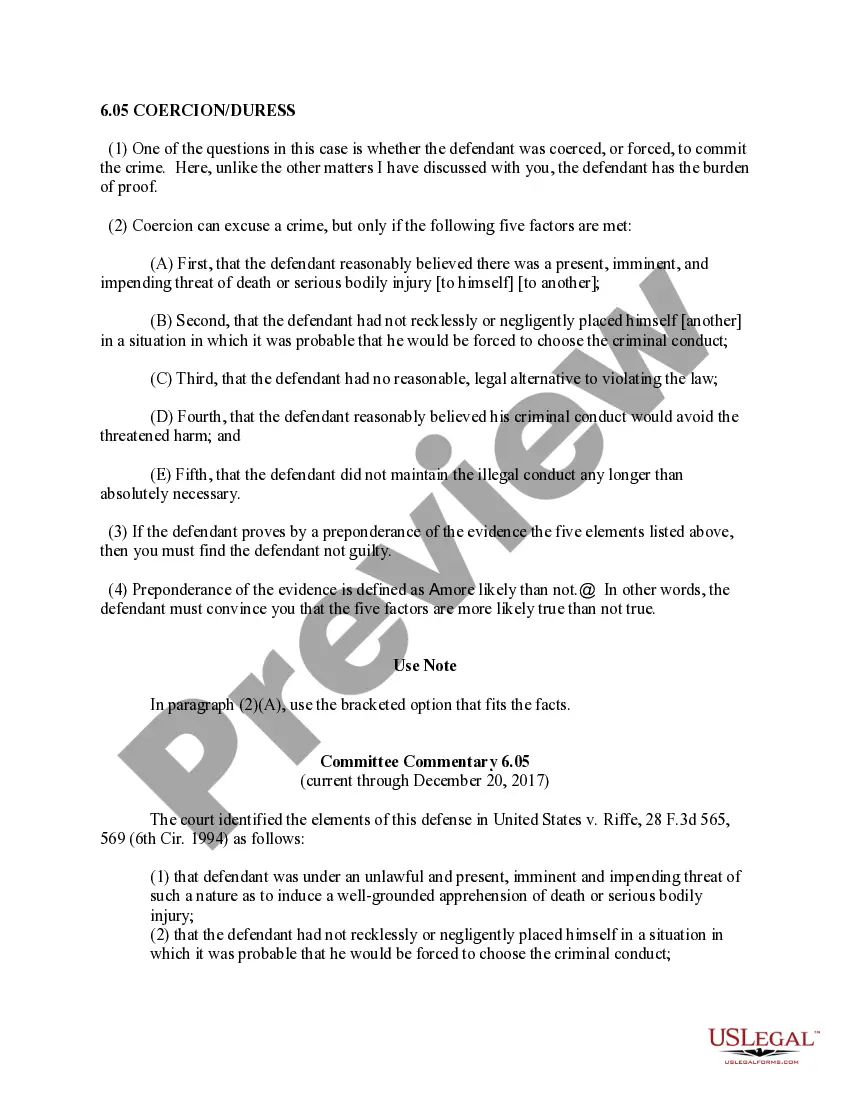
- Four essential elements: Details the conditions required to prove duress, which include an immediate threat, reasonable belief in that threat, absence of lawful alternatives, and lack of reckless behavior.
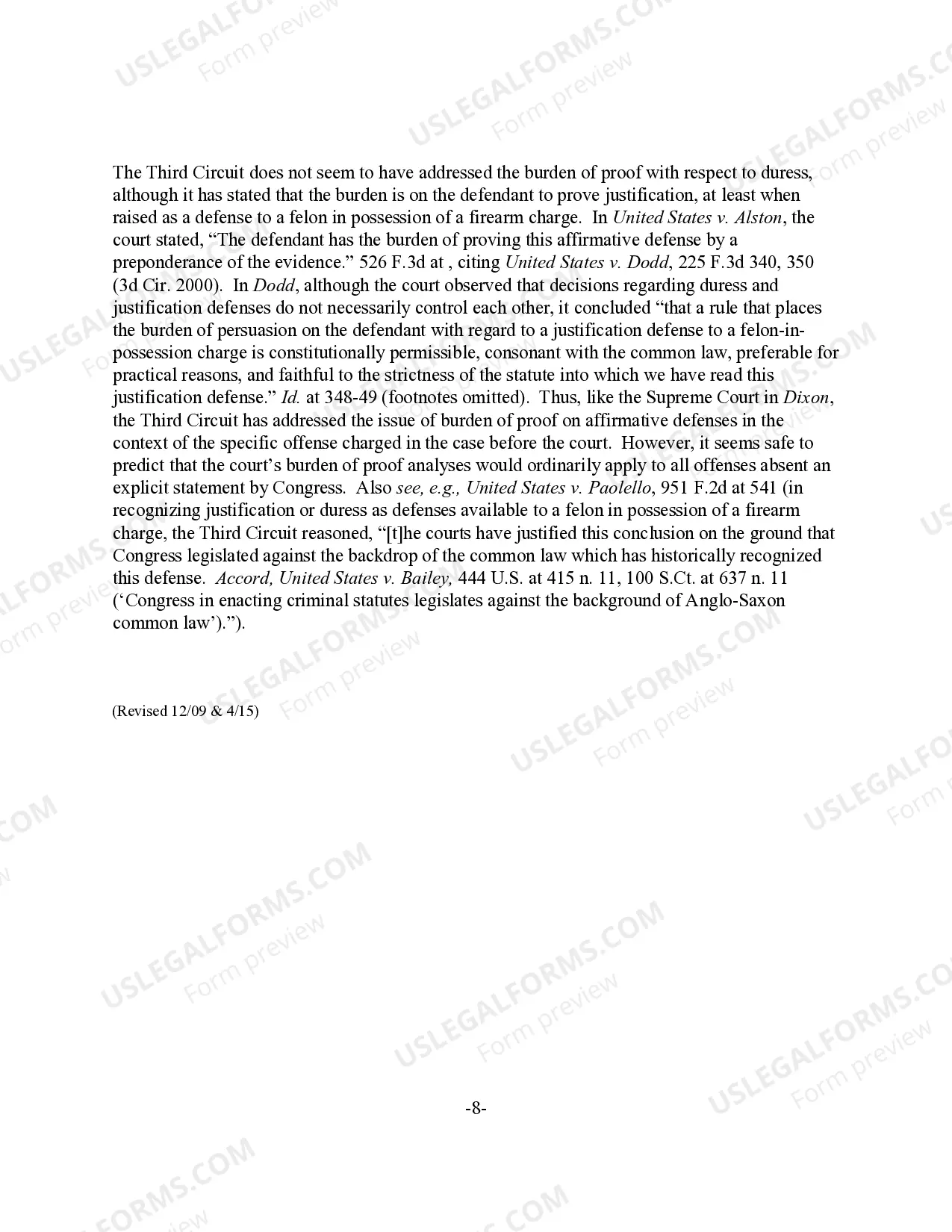
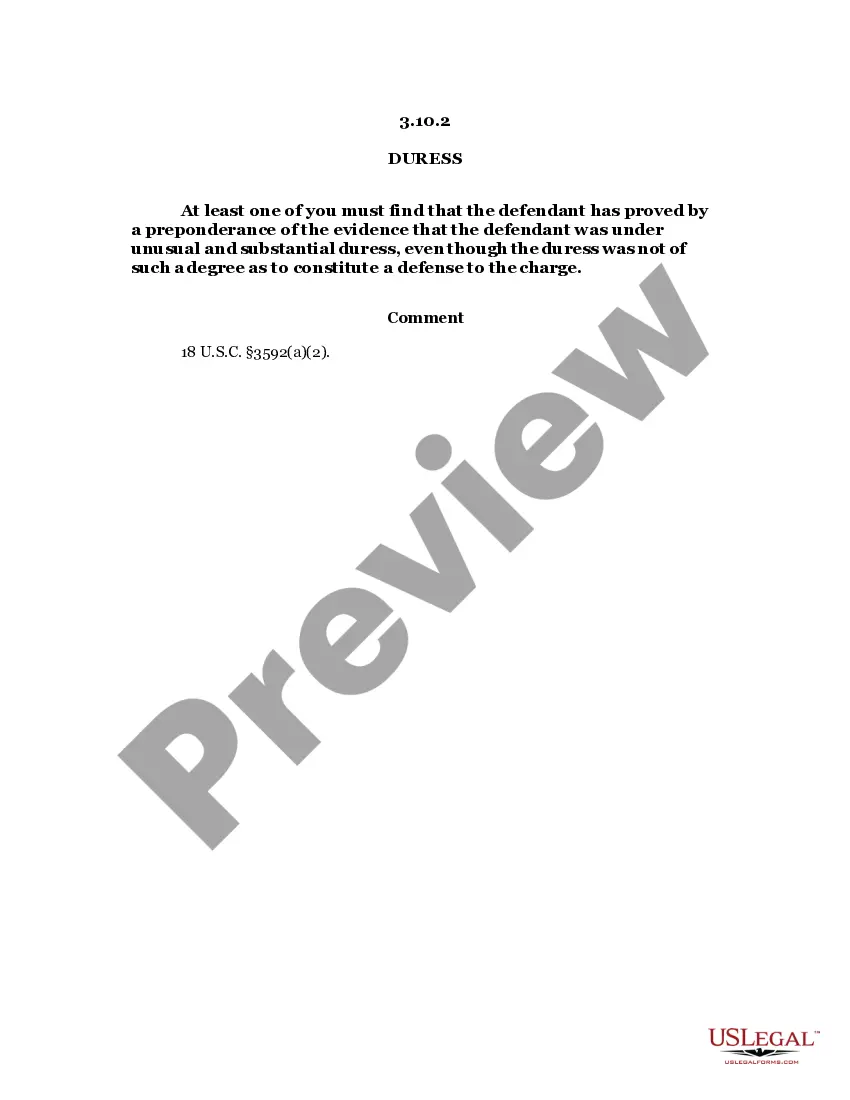
- Burden of proof: Clarifies that the defendant must prove duress by a preponderance of the evidence, which is a lower standard than beyond a reasonable doubt.
- Impact on guilt: Explains that if the defendant successfully proves duress, they may be found not guilty.

Common use cases
This form is applicable in situations where a participant in a crime asserts that they committed the offense due to being threatened with serious bodily harm or death. It is particularly relevant in criminal proceedings where the intentions and state of mind of the defendant are examined, emphasizing their lack of choice due to coercive circumstances.
Who needs this form
- Defendants facing criminal charges and seeking to assert duress as a defense.
- Individuals involved in cases where coercion affects their ability to make lawful choices.
- Legal representatives who need to prepare a defense based on the assertion of duress.
Instructions for completing this form
- Identify the defendant: Clearly state the name of the person raising the duress defense.
- Specify the offense: Include the charged offenses as per the indictment.
- Declare the threat: Describe the immediate threat of harm that prompted the criminal act.
- List the evidence: Provide factual elements supporting the claim of duress, including a lack of lawful alternatives.
- Sign and date: Ensure the form is signed and dated by the involved parties and legal counsel if applicable.
Does this form need to be notarized?
This form does not typically require notarization to be legally valid. However, some jurisdictions or document types may still require it. US Legal Forms provides secure online notarization powered by Notarize, available 24/7 for added convenience.
Get your form ready online
Our built-in tools help you complete, sign, share, and store your documents in one place.
Make edits, fill in missing information, and update formatting in US Legal Forms—just like you would in MS Word.
Download a copy, print it, send it by email, or mail it via USPS—whatever works best for your next step.
Sign and collect signatures with our SignNow integration. Send to multiple recipients, set reminders, and more. Go Premium to unlock E-Sign.
If this form requires notarization, complete it online through a secure video call—no need to meet a notary in person or wait for an appointment.
We protect your documents and personal data by following strict security and privacy standards.

Make edits, fill in missing information, and update formatting in US Legal Forms—just like you would in MS Word.

Download a copy, print it, send it by email, or mail it via USPS—whatever works best for your next step.

Sign and collect signatures with our SignNow integration. Send to multiple recipients, set reminders, and more. Go Premium to unlock E-Sign.

If this form requires notarization, complete it online through a secure video call—no need to meet a notary in person or wait for an appointment.

We protect your documents and personal data by following strict security and privacy standards.
Avoid these common issues
- Failing to provide sufficient evidence to meet the burden of proof.
- Not clearly defining the immediate threat experienced.
- Inadequately documenting the lack of lawful alternatives available.
- Relying on vague assertions of duress without specific examples.
Why complete this form online
- Convenience: Easily download and fill out the form at any time.
- Editability: Modify the form as needed to accurately reflect the specific circumstances of the case.
- Reliability: Access to legally vetted templates ensures that the form meets necessary legal standards.
Legal use & context
- The duress defense is recognized in many jurisdictions and can significantly impact criminal liability.
- Responsibility remains with the government to prove all elements of the offense beyond a reasonable doubt, irrespective of the raised defense.
- Understanding the nuances between duress, necessity, and justification is crucial for proper application in defense strategy.
Key takeaways
- Duress is a valid legal defense that requires specific elements to be proven.
- Filling out the Duress (Coercion) form properly is critical for the defendant's defense strategy.
- Use this form to articulate the circumstances under which criminal acts were committed due to threats.
Looking for another form?
Form popularity
FAQ
Proving duress in a contract requires two things be proven: The contract was signed by a serious threat of unlawful or wrongful action. Blackmail or physical violence are examples of signing a contract under duress. He or she must also show that they had no reasonable alternative but to agree to the contract.
What is duress? Duress refers to coercion that causes a person to perform an act against his or her will. Duress is an important concept in both civil and criminal law that recognizes that a person who is acting without free will should not be held responsible for the conduct.
Contracts Entered Under Duress Duress to an Individual. When an individual enters into a contract because of threats to that person physically, then the contract may be set aside as long as the threat of physical violence was the reason the person entered into the contract.Duress to Goods.Economic Duress.
Duress refers to a situation where one person makes unlawful threats or otherwise engages in coercive behavior that causes another person to commit acts that they would otherwise not commit. In McCord v. Goode, 308 S.W.
Requirements of Duress The party is in immediate threat of serious bodily harm or death. The threat made to the victim must be constant.The party believes that the perpetrator of the act will carry out the threat.There is no opportunity to escape safely, except by committing the unlawful act.
Difference between duress and coercion While duress is exercised concerning the life threats to an individual or his/her family or close relatives, coercion can be exercised against any person. Duress causes an imminent threat to an individual while coercion does not cover the ambits of imminent threat.
Physical coercion and threats of harm are common examples of conduct that constitute duress. Another form of conduct that might constitute legal duress includes wrongfully withholding a party's property, or threatening to wrongfully withhold the property until a contract is signed.