False Statement to a Federally Insured Institution
What this document covers
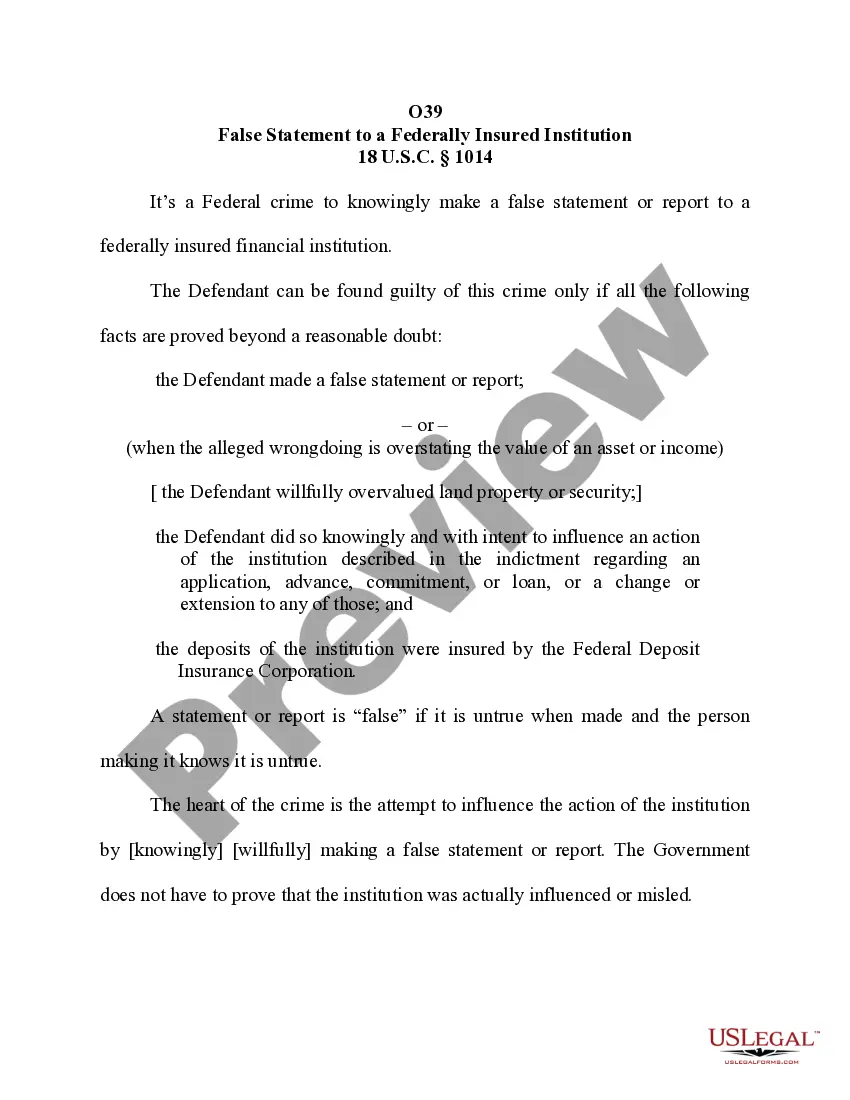
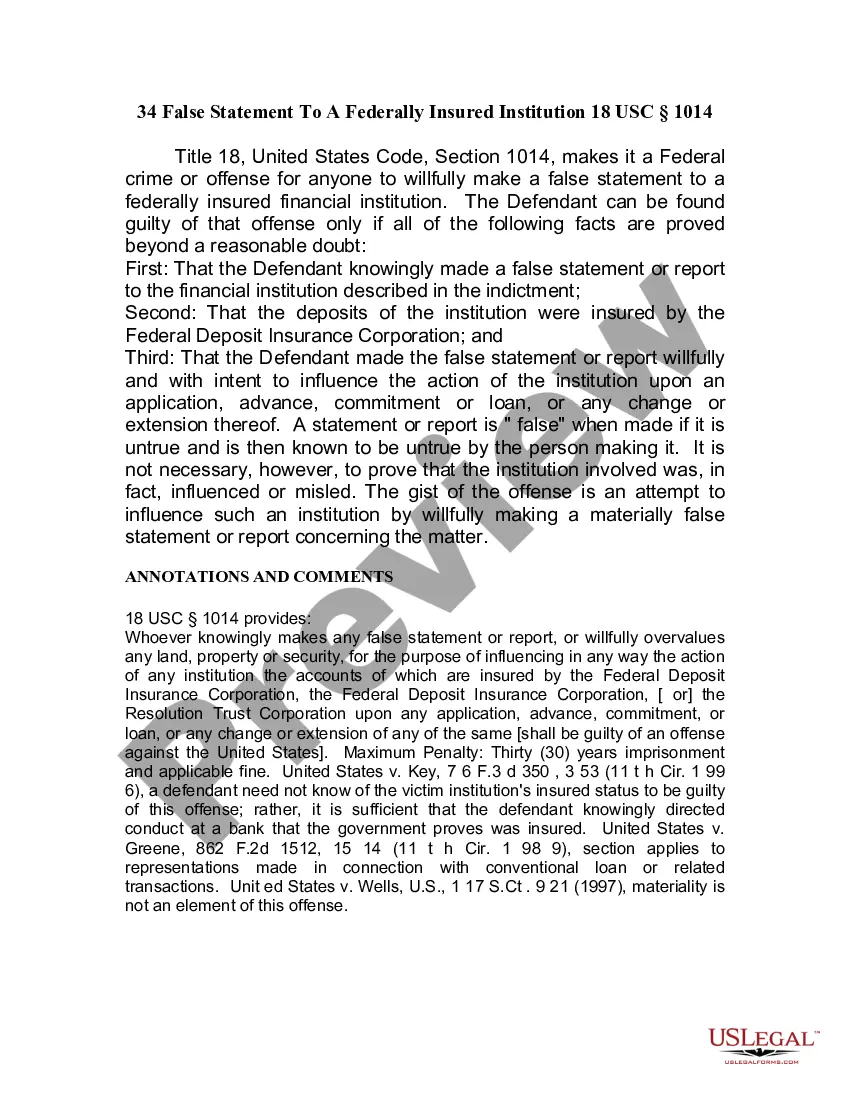
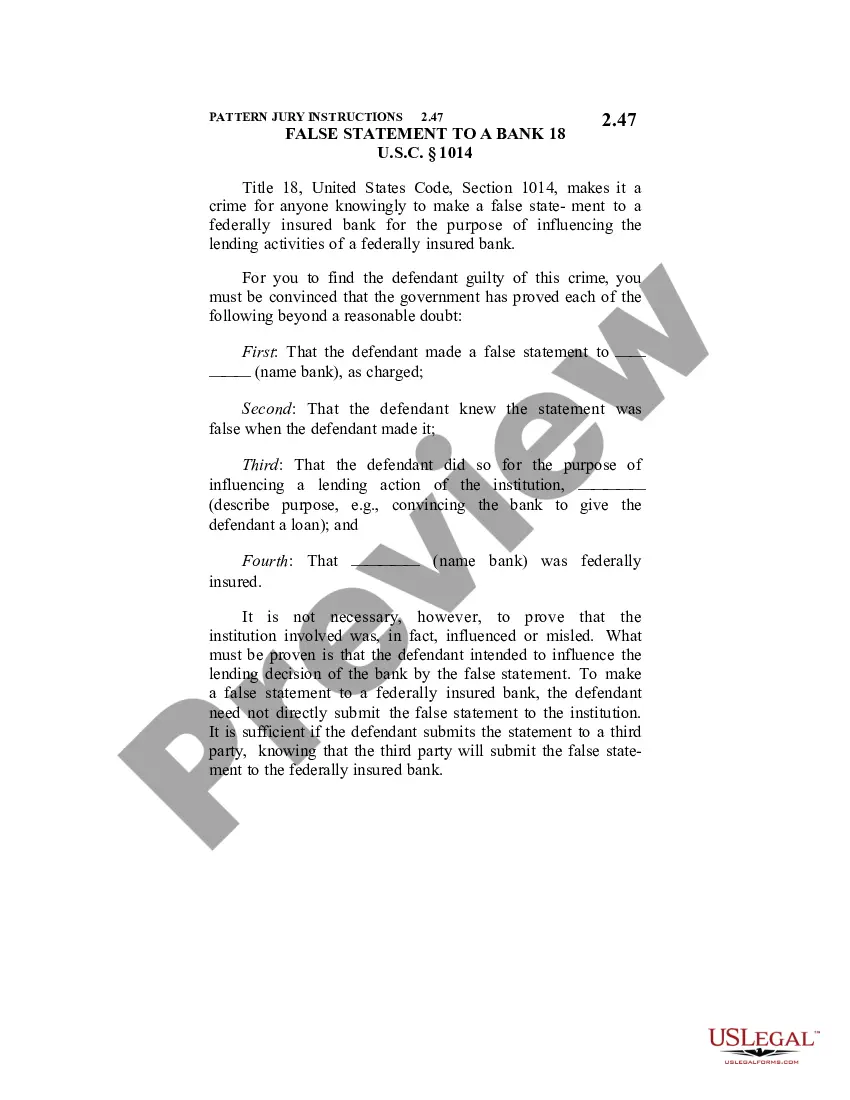
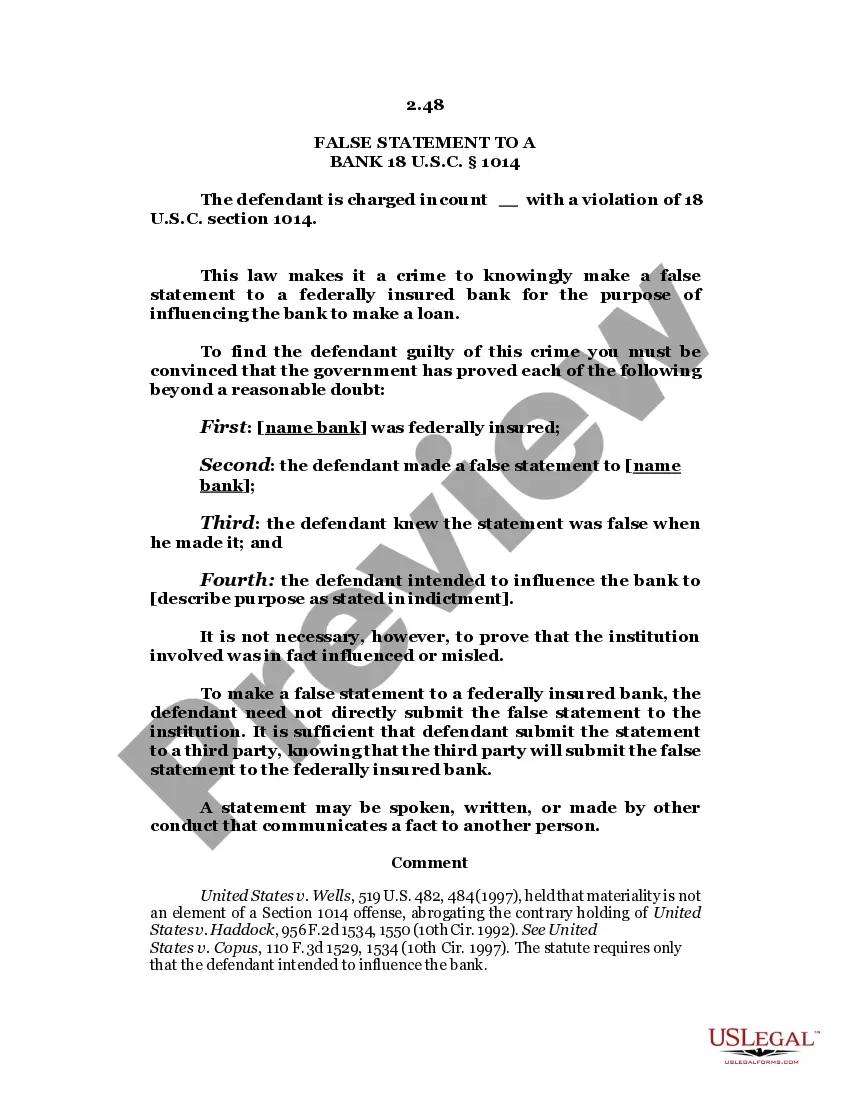
The False Statement to a Federally Insured Institution form is a legal document that outlines the elements of a federal crime involving the falsification of information to federally insured financial institutions. It is specifically designed to help individuals and entities understand the consequences of knowingly making false statements, which could lead to severe legal repercussions.
Form components explained
- Definition of a false statement or report.
- Requirements for proving guilt beyond a reasonable doubt.
- Criteria for intent and knowledge regarding the false statement.
- Conditions related to the insurance of the institution's deposits by the Federal Deposit Insurance Corporation.
Common use cases
This form is necessary when individuals are involved in any financial dealings with federally insured institutions and may be tempted to provide misleading information. It may be relevant in scenarios such as applying for a loan, requesting advances, or valuing assets. Understanding this form helps to avoid unintentional legal violations and the serious consequences that can follow.
Who this form is for
- Individuals applying for loans or financial assistance.
- Business owners seeking financing or partnerships.
- Financial professionals involved in transactions with federally insured institutions.
- Anyone needing to understand the legal ramifications of their statements to financial institutions.
How to complete this form
- Understand the definition of a false statement as it applies to your situation.
- Determine whether you have knowingly made a false statement or report.
- Ensure you recognize the importance of intent behind the false statement.
- Confirm your dealings involve a federally insured financial institution.
- Consider seeking legal advice if uncertain about any elements of the form.
Notarization guidance
This form does not typically require notarization unless specified by local law. However, it's advisable to consult a legal professional if in doubt about your specific situation.
Get your form ready online
Our built-in tools help you complete, sign, share, and store your documents in one place.
Make edits, fill in missing information, and update formatting in US Legal Forms—just like you would in MS Word.
Download a copy, print it, send it by email, or mail it via USPS—whatever works best for your next step.
Sign and collect signatures with our SignNow integration. Send to multiple recipients, set reminders, and more. Go Premium to unlock E-Sign.
If this form requires notarization, complete it online through a secure video call—no need to meet a notary in person or wait for an appointment.
We protect your documents and personal data by following strict security and privacy standards.

Make edits, fill in missing information, and update formatting in US Legal Forms—just like you would in MS Word.

Download a copy, print it, send it by email, or mail it via USPS—whatever works best for your next step.

Sign and collect signatures with our SignNow integration. Send to multiple recipients, set reminders, and more. Go Premium to unlock E-Sign.

If this form requires notarization, complete it online through a secure video call—no need to meet a notary in person or wait for an appointment.

We protect your documents and personal data by following strict security and privacy standards.
Typical mistakes to avoid
- Failing to fully understand the implications of the false statement.
- Overlooking the requirement for intent in making a false statement.
- Misrepresenting the value of assets or income without adequate reason.
Why use this form online
- Convenient access to essential legal information.
- Editable templates tailored to your needs.
- Quick download options for immediate use.
- Peace of mind from using attorney-drafted documents.
Legal use & context
- The form is based on federal law under 18 U.S.C. § 1014.
- Misstatements can lead to criminal charges, fines, or imprisonment.
- The prosecution must prove intent and knowledge of false statements beyond a reasonable doubt.
Key takeaways
- This form outlines federal regulations regarding false statements to financial institutions.
- Understanding its components helps prevent legal issues related to misleading information.
- Consult legal experts for clarity and guidance when dealing with financial statements.
Looking for another form?
Form popularity
FAQ
Material Requirements of a False Claim To prove a case, the whistleblower must demonstrate not only that the representation about the claim is false, but also that the representation is material, which usually means related to the government's decision to pay. Simply put the representation has to really matter.
Examples of false statements John told his little brother that sea otters aren't mammals, but fish, even though John himself was a marine biologist and knew otherwise.
DIFFERENCES BETWEEN PERJURY & MAKING FALSE STATEMENTS And for perjury, the statement must be literally false and made with intent to deceive or mislead. In contrast, making false statements applies when people lie to the government regardless of whether it's under oath or not.
Defamation consists of the wrongful injury to a person's reputation that is caused by communicating a false statement either orally (slander) or in writing (libel). There are different types of defamation or slander.
Section 1014 criminalizes the act of making false statements to a financial institution. If convicted of bank fraud you may be facing large fines of up to $1,000,000 and/or imprisonment of up to thirty years.
When you falsify that information to convince the other party to give you money or credit, it's a form of fraud. It violates PC 532a(1) making false financial statements.
"To prove a false statement in violation of 18 U.S.C. § 1001, the government must show that the defendant: (1) knowingly and willfully, (2) made a statement, (3) in relation to a matter within the jurisdiction of a department or agency of the United States, (4) with knowledge of its falsity." United States v.
It is a federal crime for anyone to willfully make a false statement to a federally insured financial institution. Lending institutions rely upon a company's financial statements in extending credit or granting a loan.