Adoption Agreement Between Married Prospective Adoptive Parents and Pregnant Natural Mother with Prospective Adoptive Parents Agreeing to Pay Medical and Hospital Costs of Pregnant Natural Mother
What this document covers
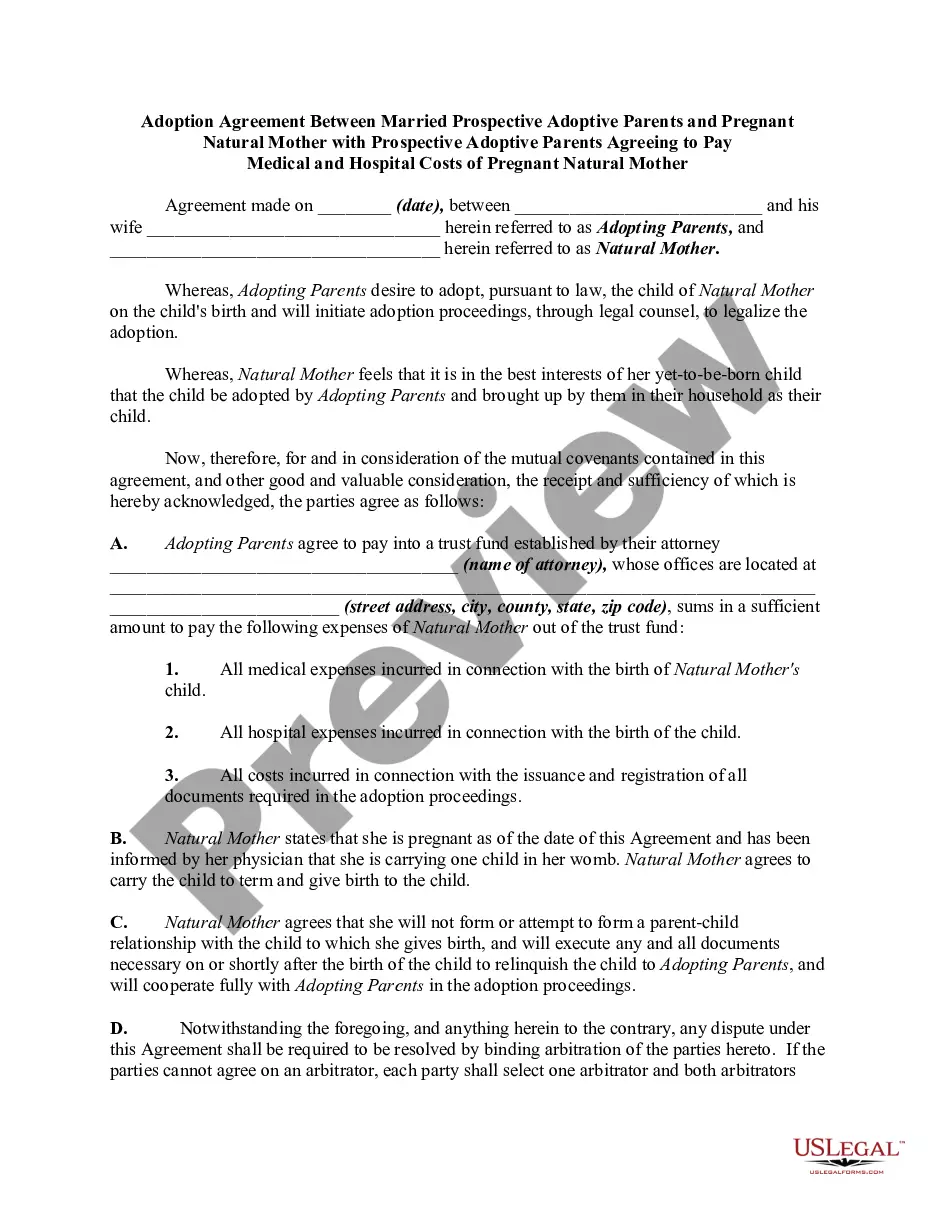
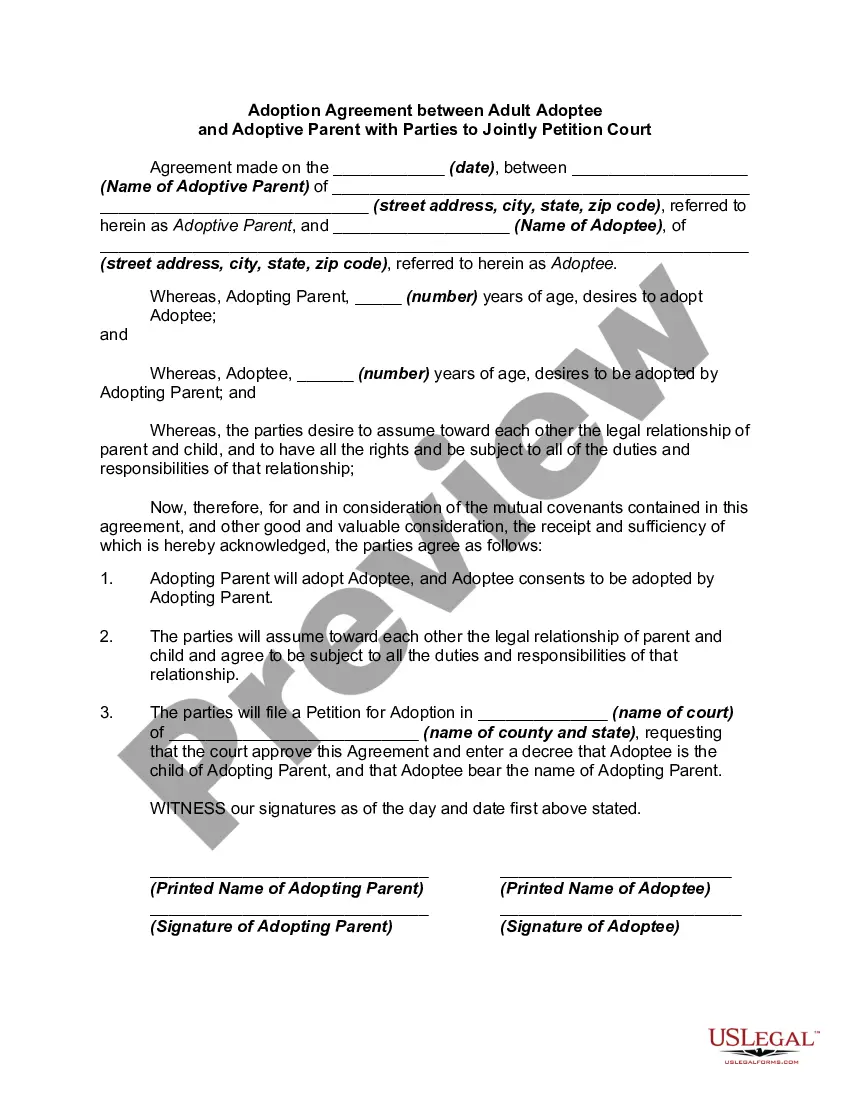
This Adoption Agreement Between Married Prospective Adoptive Parents and Pregnant Natural Mother is a legal contract that outlines the terms under which the prospective adoptive parents agree to support the natural mother's medical and hospital costs during her pregnancy. This form is uniquely designed to facilitate the adoption process by establishing clear financial responsibilities and intentions between the parties involved, ensuring that the natural mother's needs are met while enabling the legal adoption of her child.
What’s included in this form
- Identification of the parties involved: Names of the adopting parents and the natural mother.
- Financial commitments: Adoption parents' agreement to pay medical and hospital expenses through a trust fund.
- Natural mother's acknowledgment: Confirmation of pregnancy and agreement to carry the child to term.
- Relinquishment of parental rights: Natural mother's commitment to relinquish the child upon birth and cooperate in adoption proceedings.
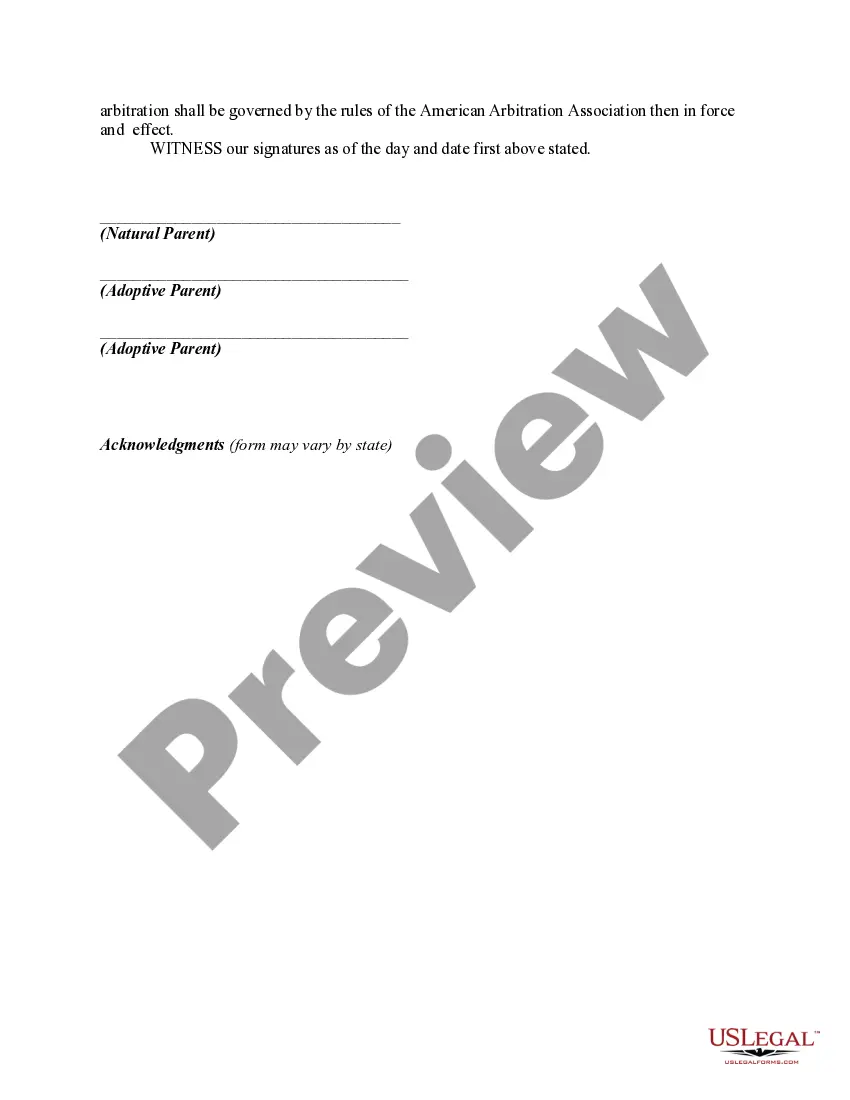
- Dispute resolution: Binding arbitration clause for any disagreements arising from the agreement.
When to use this document
This form should be used when married couples are pursuing adoption of an unborn child from a pregnant natural mother who has agreed to place her child for adoption. It is particularly relevant when the adopting parents wish to ensure the natural mother's medical expenses are covered during her pregnancy, thereby fostering a supportive arrangement that benefits all parties involved. This form is essential to establishing a legal framework that supports the adoption process and clarifies financial obligations.
Who this form is for
- Married couples looking to adopt a child from a pregnant natural mother.
- Pregnant natural mothers intending to place their children for adoption with a specific family.
- Attorneys assisting in adoption procedures who require clear agreements outlining the terms between parties.
Instructions for completing this form
- Identify the parties by entering the names of the adopting parents and the natural mother.
- Specify the date on which the agreement is made.
- Detail the financial arrangements, including the name of the attorney managing the trust fund for expenses.
- Include confirmation of pregnancy and acknowledgment of the natural mother's responsibilities.
- All parties must sign the agreement to validate it.
Does this form need to be notarized?
This form does not typically require notarization to be legally valid. However, some jurisdictions or document types may still require it. US Legal Forms provides secure online notarization powered by Notarize, available 24/7 for added convenience.
Get your form ready online
Our built-in tools help you complete, sign, share, and store your documents in one place.
Make edits, fill in missing information, and update formatting in US Legal Forms—just like you would in MS Word.
Download a copy, print it, send it by email, or mail it via USPS—whatever works best for your next step.
Sign and collect signatures with our SignNow integration. Send to multiple recipients, set reminders, and more. Go Premium to unlock E-Sign.
If this form requires notarization, complete it online through a secure video call—no need to meet a notary in person or wait for an appointment.
We protect your documents and personal data by following strict security and privacy standards.

Make edits, fill in missing information, and update formatting in US Legal Forms—just like you would in MS Word.

Download a copy, print it, send it by email, or mail it via USPS—whatever works best for your next step.

Sign and collect signatures with our SignNow integration. Send to multiple recipients, set reminders, and more. Go Premium to unlock E-Sign.

If this form requires notarization, complete it online through a secure video call—no need to meet a notary in person or wait for an appointment.

We protect your documents and personal data by following strict security and privacy standards.
Common mistakes
- Failing to clearly identify all parties involved and their respective roles.
- Not specifying the exact amounts to be paid into the trust fund or forgetting to detail the purpose of each payment.
- Neglecting to include signatures or dates, which may render the contract invalid.
- Overlooking the need for local legal compliance, which can vary by jurisdiction.
Benefits of using this form online
- Immediate access to the legal template and instructions tailored for easy use.
- Ability to fill out and edit the document conveniently from anywhere, at any time.
- Inclusion of templates drafted by licensed attorneys, ensuring compliance with legal standards.
- Simplified form completion process helps avoid errors and omissions.
Looking for another form?



Form popularity
FAQ
Therefore, the only way a birth parent could reclaim custody of an adopted child is by proving to a court that the decision to sign the relinquishment document was done under fraud or duress. In most cases a court will automatically deny custody to a birth parent when their parental rights have been terminated.
When people ask, When does the adoption become final for the adopting parents? we are happy to answer. In most adoptions, the final adoption hearing occurs around six months after placement, although some hearings can happen as little as three months or up to a year after placement.
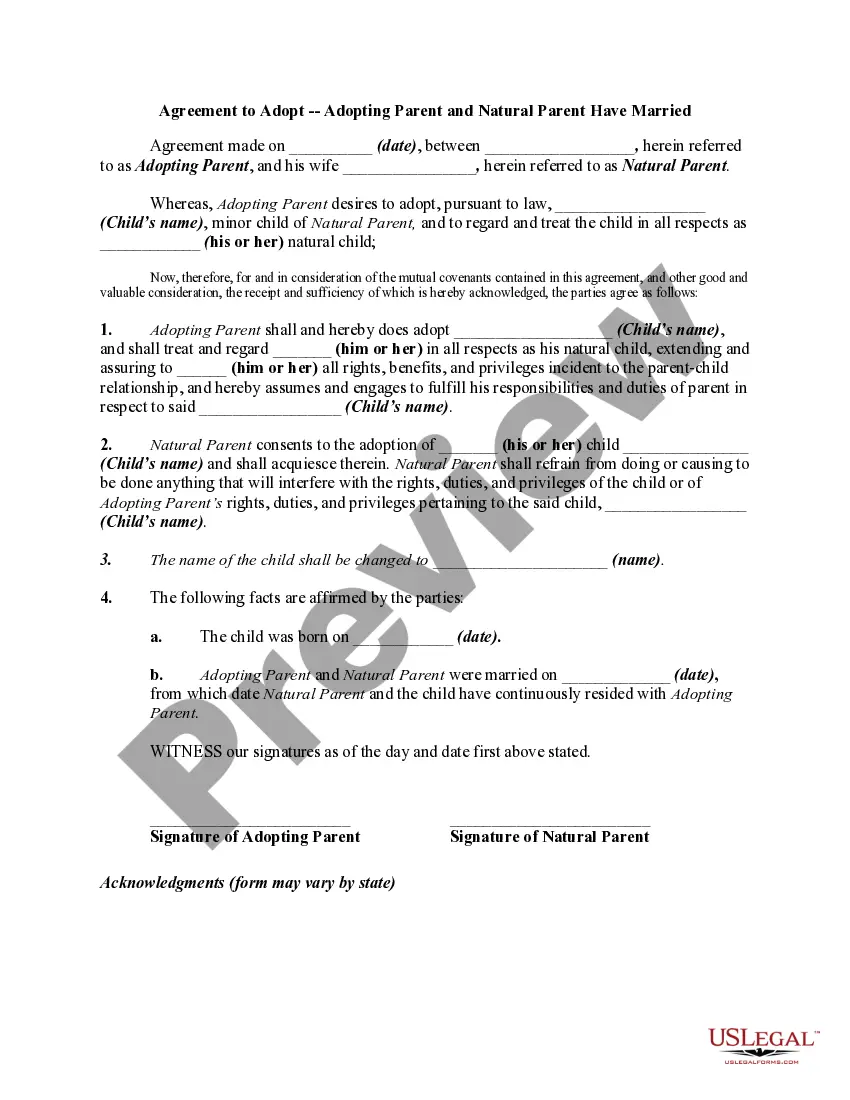
If you want to adopt a stepchild, you must have the consent (or agreement) of both your spouse and the child's other parent (the noncustodial parent) unless that parent has abandoned the child.Some State adoption laws do not require the other parent's consent in some situations, such as abandonment.
Generally, adoption requires the consent of both parents, provided they meet certain requirements. To gain parental rights, including the right to object to adoption, biological fathers unmarried to the mother must not only establish paternity, but also demonstrate a commitment to parenting the child.
Child abuse or neglect. Spousal abuse or domestic battery. A crime against children, including child pornography. A crime involving violence, including rape, sexual assault, or homicide, but not including other physical assault or battery. Aggravated assault on a family or household member.
Finalization of adoption usually takes place between three months and a year after the child comes home. An adoption cannot be finalized until the birth parents' revocation period (ranging from hours to months) has expired and the family's social worker has completed at least one post-placement visit.
Under California law, a noncustodial parent's consent isn't necessary for adoption if the parent willfully fails to communicate with and to pay for the care, support, and education of the child (when they were able to do so) for a period of at least one year.
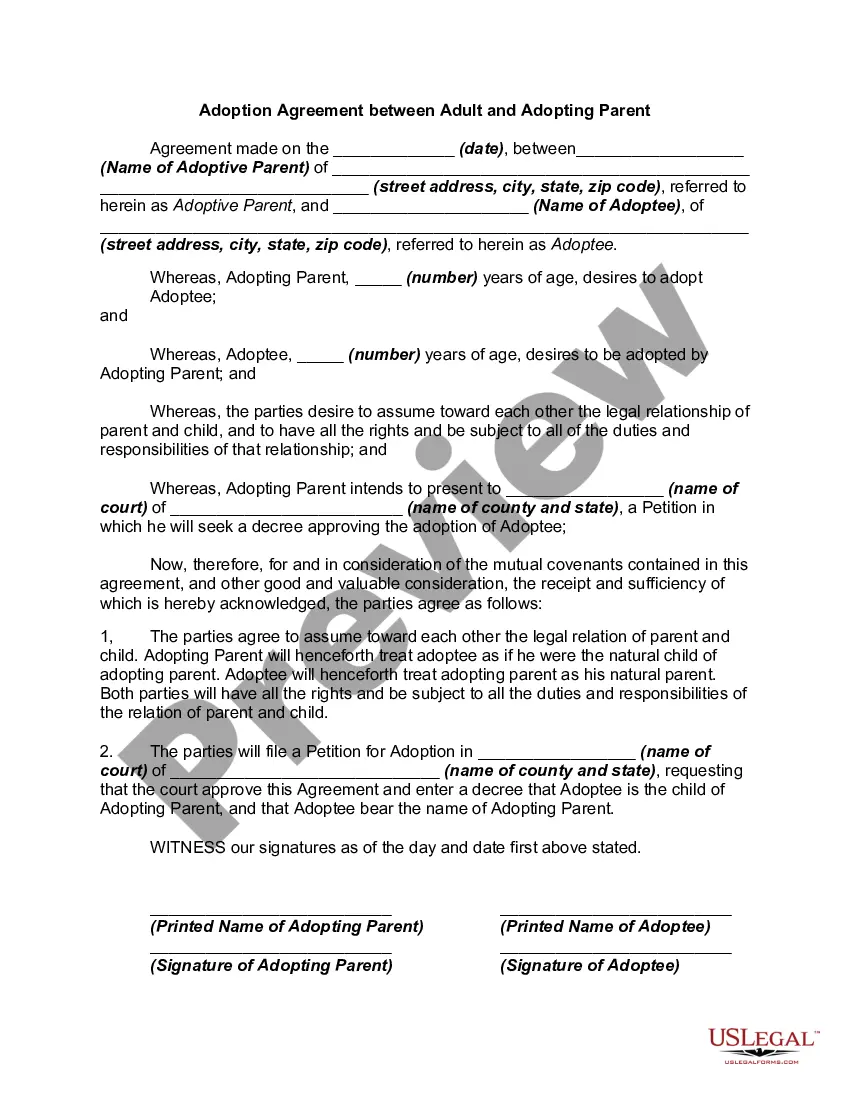
Adoption is the same legal process whether the individual is a child or an adult.The second reason, almost as common, is to formalize an existing parent/child relationship. For example, parents can adopt a now adult foster child or stepchild.
Adoption is one option for women who are pregnant and not ready and/or unable to care for a child once it is born. There are several reasons why a young woman may decide to give custody of her child to someone else, such as a relative or a loving family she may not know.