Smuggling
Understanding this form
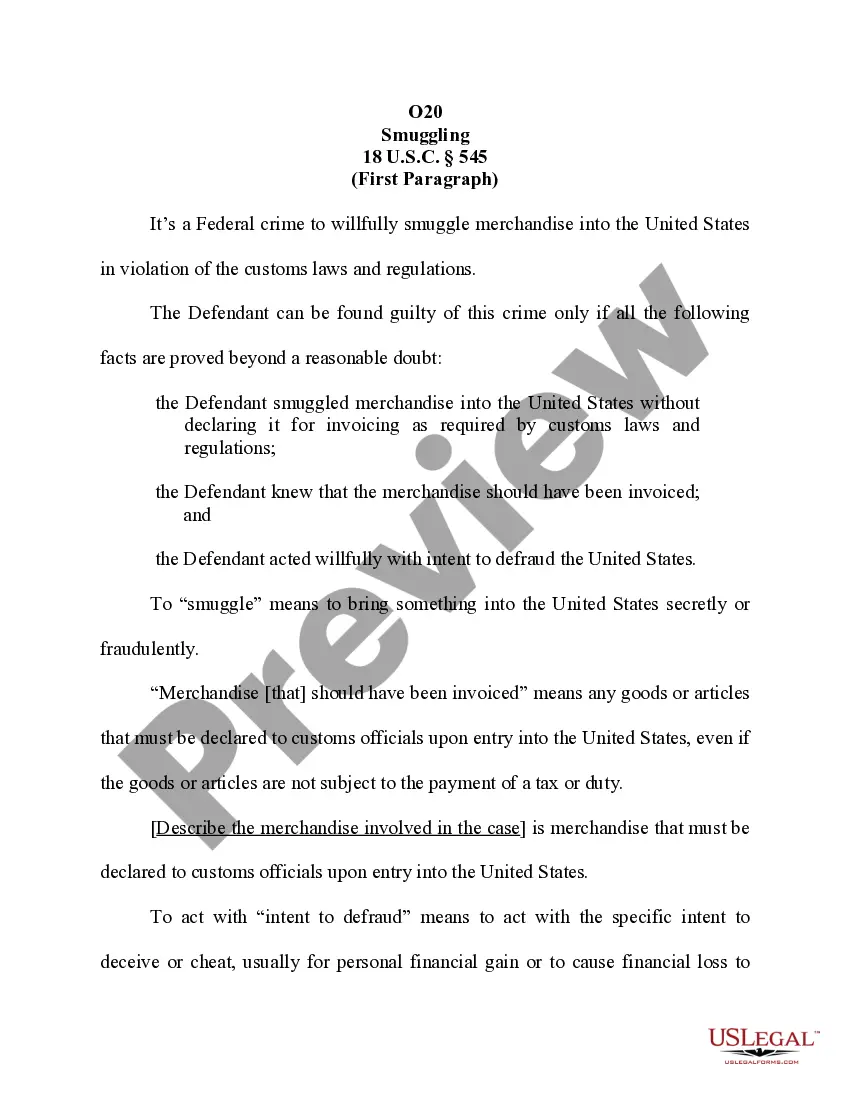
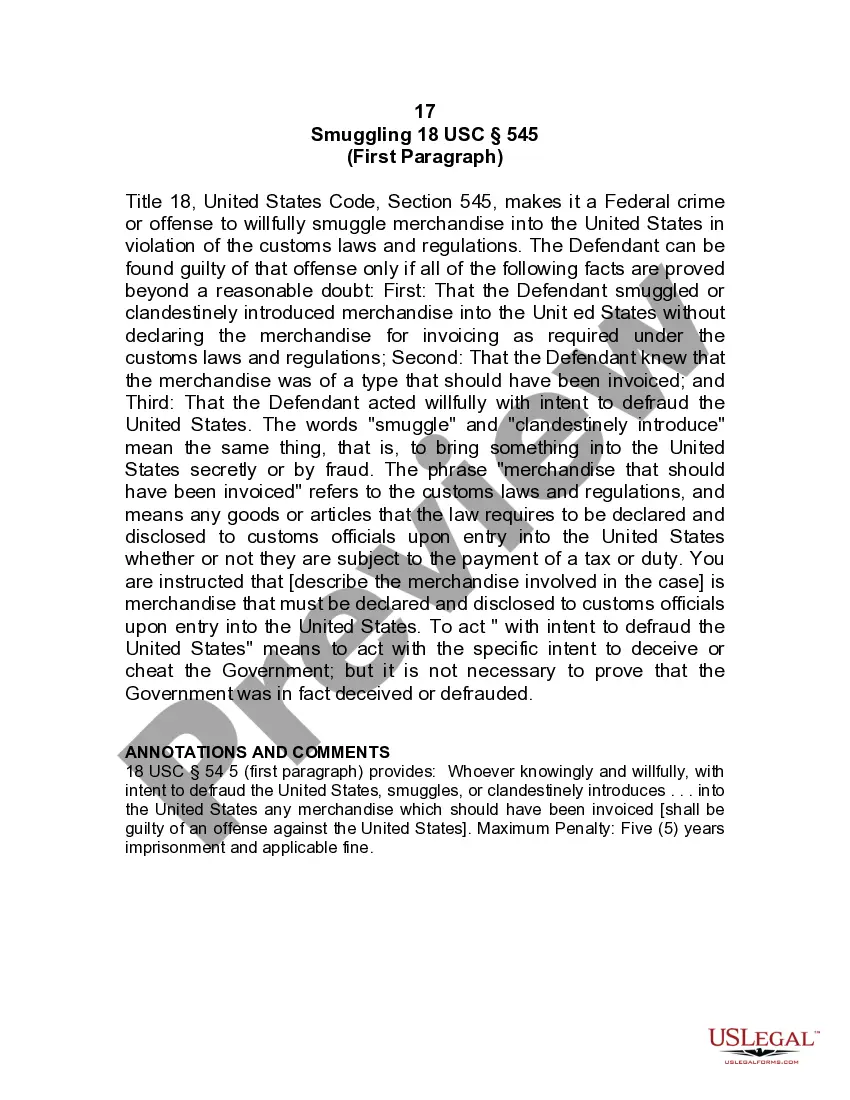
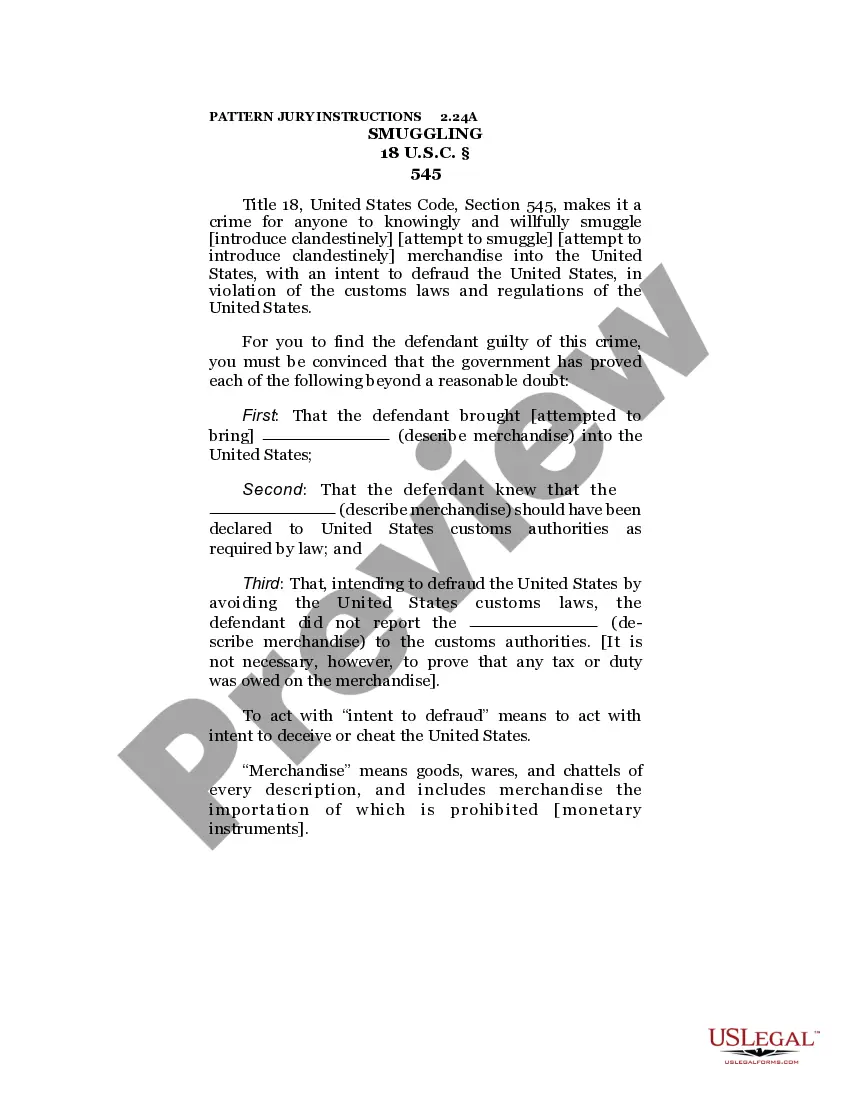
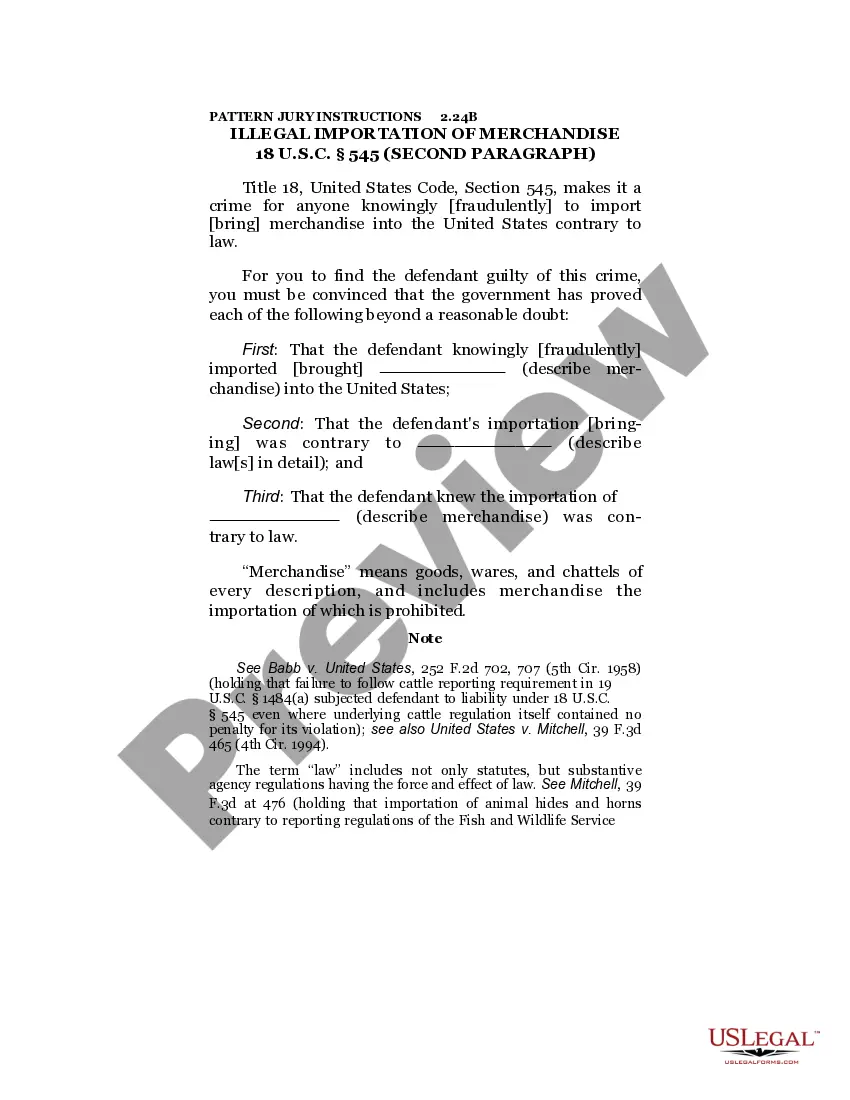
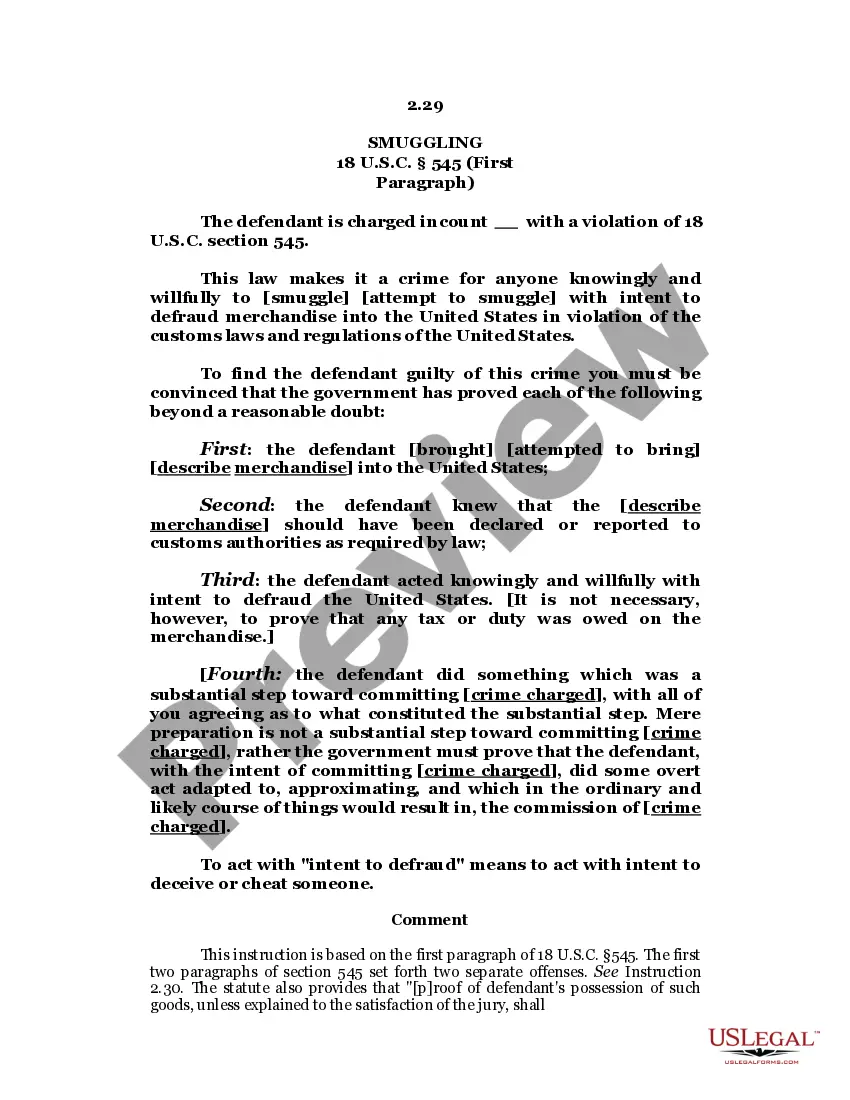
The Smuggling form is a legal document outlining the pattern jury instructions related to federal smuggling offenses under 18 U.S.C. § 545. It serves to inform jurors about the elements necessary to prove the crime of smuggling merchandise into the United States. This form is crucial for cases involving allegations of unlawfully bringing items into the country without proper declaration, providing a clear framework for understanding the legal requirements for a guilty verdict. Unlike other legal forms, this document focuses specifically on the nuances of federal law regarding smuggling, ensuring accurate jury instruction during trials.
Key parts of this document
- Definition of smuggling: Clearly describes what constitutes illegal smuggling under federal law.
- Elements of the offense: Outlines the necessary facts that must be proven beyond a reasonable doubt, including intent and knowledge of customs regulations.
- Intent to defraud: Specifies the legal interpretation of acting with intent to deceive the United States.
- Description of merchandise: Details the types of goods that require declaration upon entry into the United States.
When this form is needed
This form is needed in federal court cases where a defendant is charged with smuggling merchandise into the United States. It is used during jury trials to ensure that jurors understand the legal standards for evaluating the evidence presented by the prosecution. Situations can include cases involving individuals or businesses that are accused of attempting to bypass customs regulations for illicit financial gain.
Who this form is for
- Attorneys representing defendants in federal smuggling cases.
- Prosecutors in cases involving smuggling violations.
- Legal professionals and judges needing a comprehensive understanding of jury instructions related to smuggling.
- Individuals involved in federal legal proceedings regarding customs violations.
Completing this form step by step
- Identify the elements of the smuggling charge to be read to the jury.
- Review the definitions included in the form to ensure comprehension of key legal terms.
- Specify the merchandise that is alleged to have been smuggled, providing a clear description.
- Determine the intent behind the actions of the defendant with regards to the smuggling allegations.
- Ensure that all legal standards outlined are accurately translated into jury instructions.
Notarization requirements for this form
In most cases, this form does not require notarization. However, some jurisdictions or signing circumstances might. US Legal Forms offers online notarization powered by Notarize, accessible 24/7 for a quick, remote process.
Get your form ready online
Our built-in tools help you complete, sign, share, and store your documents in one place.
Make edits, fill in missing information, and update formatting in US Legal Forms—just like you would in MS Word.
Download a copy, print it, send it by email, or mail it via USPS—whatever works best for your next step.
Sign and collect signatures with our SignNow integration. Send to multiple recipients, set reminders, and more. Go Premium to unlock E-Sign.
If this form requires notarization, complete it online through a secure video call—no need to meet a notary in person or wait for an appointment.
We protect your documents and personal data by following strict security and privacy standards.

Make edits, fill in missing information, and update formatting in US Legal Forms—just like you would in MS Word.

Download a copy, print it, send it by email, or mail it via USPS—whatever works best for your next step.

Sign and collect signatures with our SignNow integration. Send to multiple recipients, set reminders, and more. Go Premium to unlock E-Sign.

If this form requires notarization, complete it online through a secure video call—no need to meet a notary in person or wait for an appointment.

We protect your documents and personal data by following strict security and privacy standards.
Common mistakes to avoid
- Failing to clearly establish the elements of the crime in jury instructions.
- Using vague or ambiguous language when describing the merchandise involved.
- Neglecting to define important legal terms for jurors.
- Overlooking the need to prove intent to defraud beyond a reasonable doubt.
Why use this form online
- Convenience of access from anywhere, allowing legal professionals to use the form as needed.
- Editability to customize language or content specific to individual cases.
- Reliability of having up-to-date legal information drafted by licensed attorneys.
Legal use & context
- This form is used to ensure jurors understand the legal standards required for a conviction in federal smuggling cases.
- It is enforceable in federal court and is critical for maintaining clarity in legal proceedings.
- Failure to properly instruct the jury can lead to appeals or retrials.
Main things to remember
- The Smuggling form outlines the legal requirements for proving smuggling under federal law.
- It is essential for both legal professionals and individuals facing smuggling charges.
- Careful completion of the form can significantly impact the outcome of legal proceedings.
Looking for another form?
Form popularity
FAQ
If a smuggler brings an illegal immigrant over at a non-designated point of entry, they are liable to pay a fine, be imprisoned for up to 10 years, or both.
At a minimum, human smuggling is a felony in the third-degree, carrying fines up to $10,000 and a prison term between two and 10 years.
These include the participation in illegal trade, such as in the drug trade, illegal weapons trade, prostitution, human trafficking, kidnapping, exotic wildlife trade, art theft, blood diamonds, heists, chop shops, illegal immigration or illegal emigration, tax evasion, import/export restrictions, providing contraband
Under Texas law, the offense of smuggling persons is categorized as a third-degree felony, which is punishable by a sentence of two to ten years in prison and a fine of up to $10,000. This applies when a person knowingly transports a person into or through the state with the intent to obtain a financial benefit.
Migrants smuggled across the border between Mexico and the United States pay about $2,000, 4 while migrants from beyond Mexico (and thus needing to cross multiple borders) could pay as much as $10,000. Recent figures indicate that to migrants use indirect routes leading from other continents.
The laws when it comes to California drug trafficking is very clear. ing to U.S. Code, Title 18, Part I, Chapter 27, anyone that knowingly smuggled goods into the United States that they should have been billed for or are illegal can be sentenced to up to 20 years in prison.
Title 18, Section 545 of the United States Code defines the federal crime of smuggling goods, a serious felony offense under the laws of the United States.