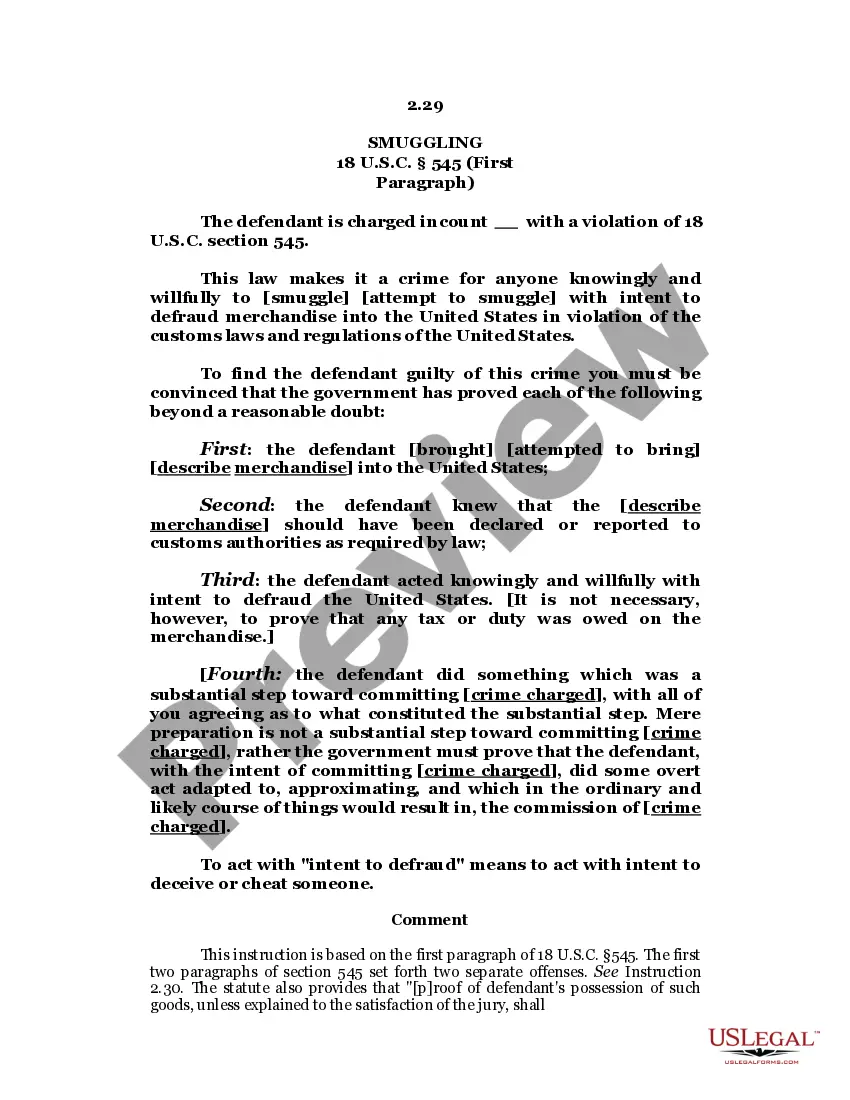
SMUGGLING / 18 U.S.C. Sec. 545 (First Paragraph)
About this form
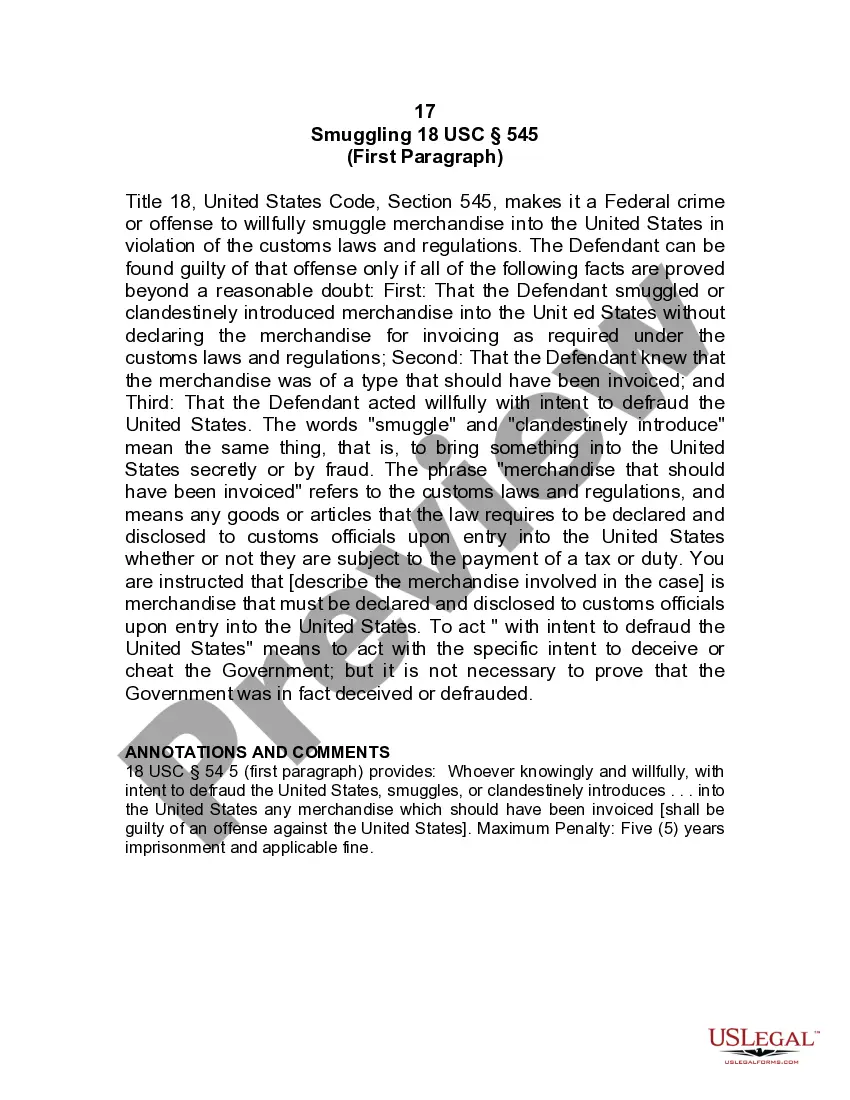
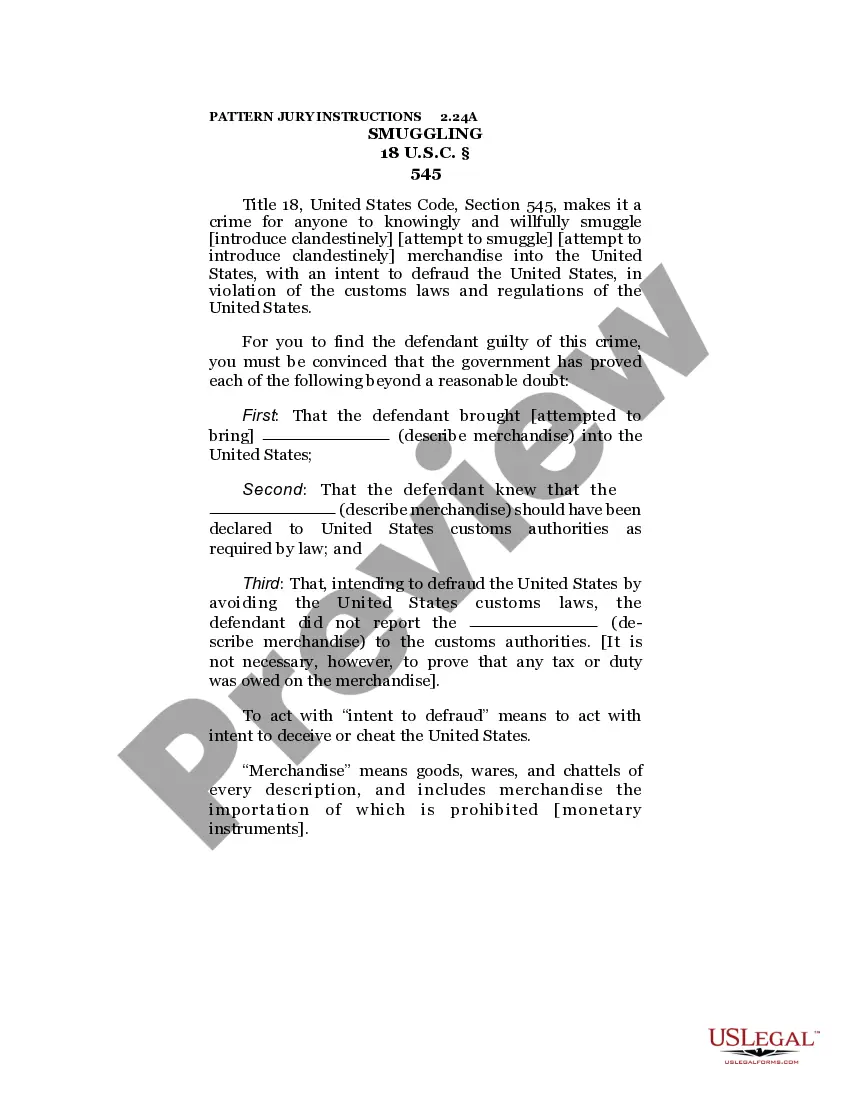
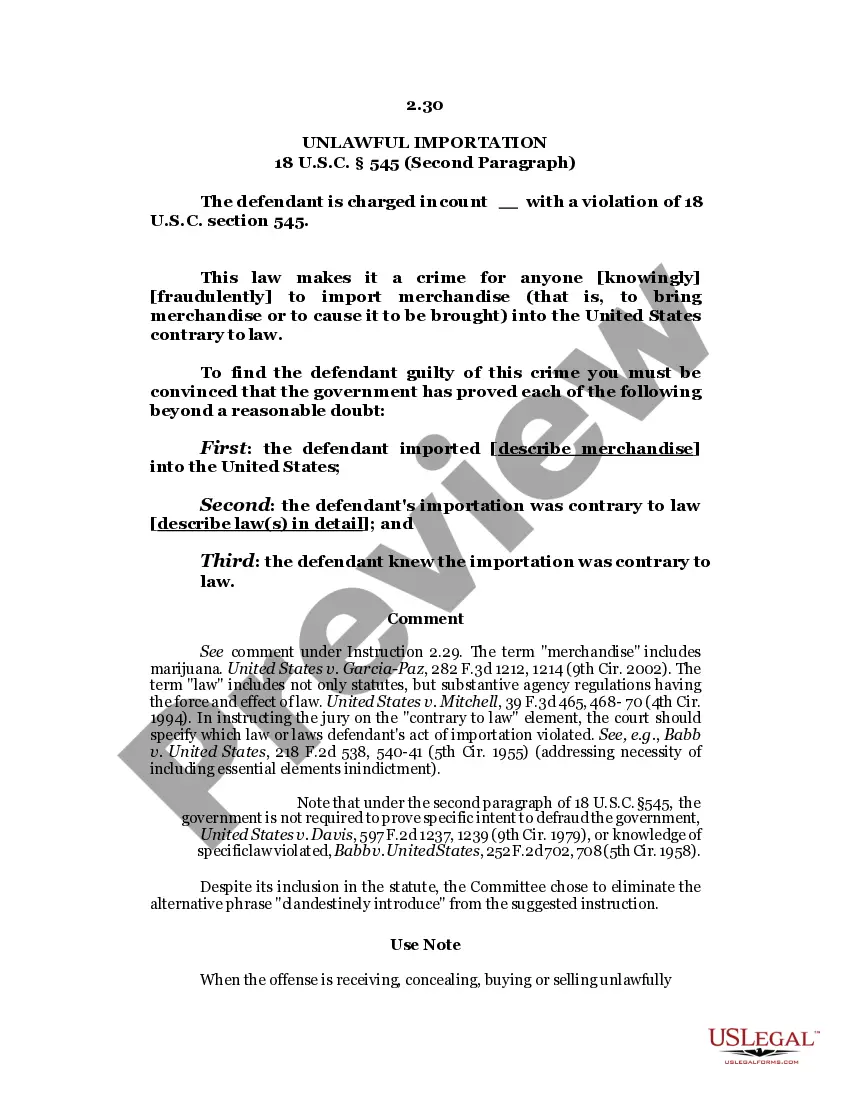
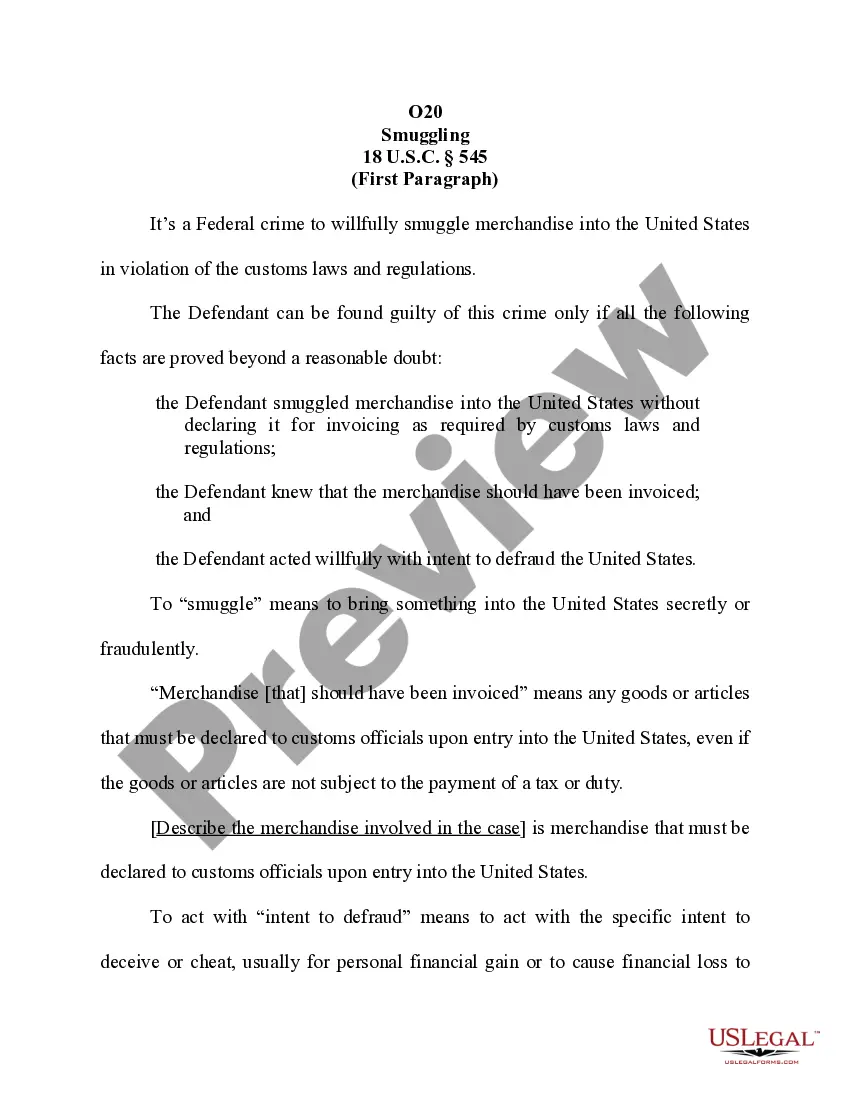
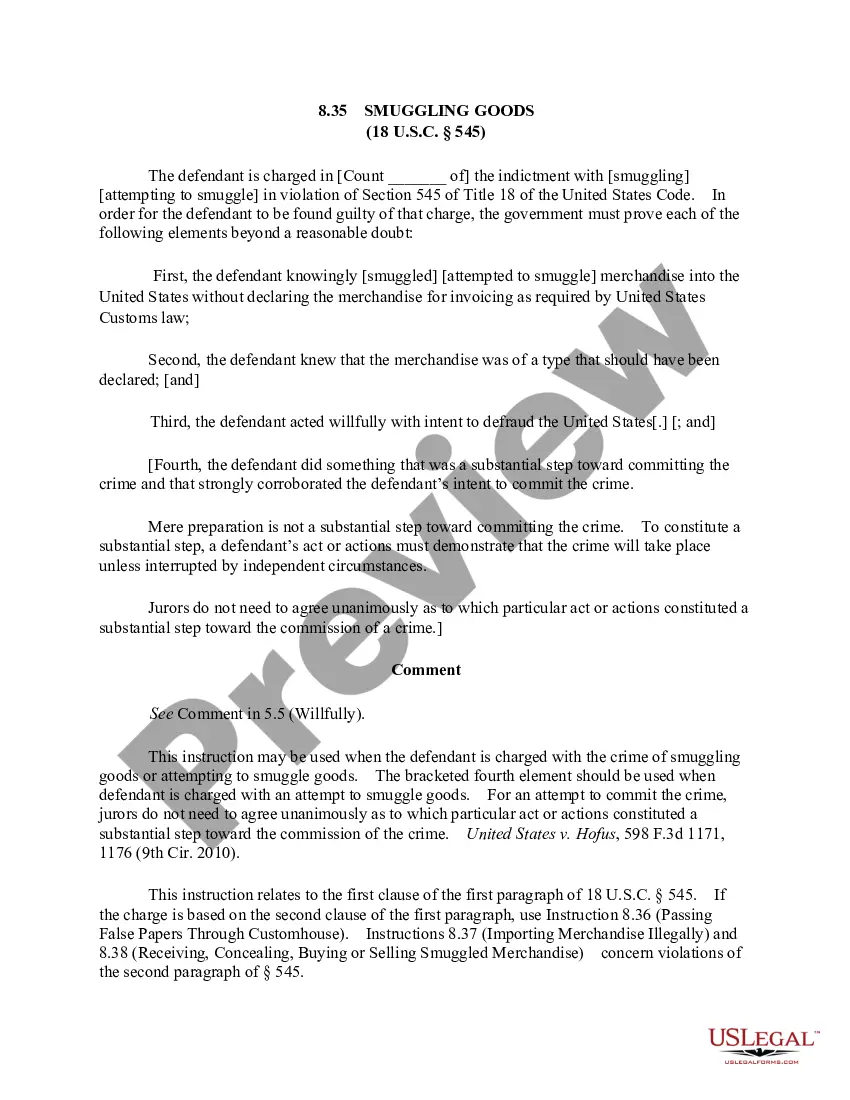
This form relates to the crime of smuggling under 18 U.S.C. § 545. It is used to charge individuals who knowingly and willfully attempt to bring merchandise into the United States without declaring it as required by customs laws. The form outlines the necessary elements that the government must prove to establish guilt, emphasizing the intent to defraud the U.S. This form is distinct from other legal documents in its focus on customs violations and the nuances of intent regarding smuggling offenses.
What’s included in this form
- Definition of smuggling and the requirement of intent to defraud.
- Elements that must be proven for a guilty verdict.
- Clarification on the necessity of proof regarding the defendant's knowledge of customs laws.
- Explanation of what constitutes a substantial step toward committing the crime.
- Guidance on the interpretation of "intent to defraud" and its legal implications.
Situations where this form applies
This form should be used in cases where an individual is charged with smuggling goods into the United States. It is applicable when there is evidence that the defendant brought or attempted to bring merchandise without proper declaration to customs authorities, and there is an intent to deceive or avoid legal obligations related to customs regulations.
Who can use this document
- Prosecutors handling cases of smuggling violations.
- Legal professionals representing clients accused of smuggling.
- Individuals seeking to understand their rights and obligations under U.S. customs laws.
- Anyone involved in legal proceedings related to customs violations.
How to complete this form
- Begin by stating the defendant's name and the specific charge of smuggling.
- Detail the merchandise that is the subject of the smuggling charge.
- Outline the circumstances under which the merchandise was brought into the U.S.
- Clarify knowledge of customs laws, demonstrating that the defendant knew declaration was required.
- Include evidence or statements showing the defendant's intent to defraud.
- Ensure all appropriate elements are included to prove intent and action taken.
Notarization guidance
This form does not typically require notarization unless specified by local law. However, it is advisable to consult with legal counsel to ensure compliance with any jurisdictional requirements.
Get your form ready online
Our built-in tools help you complete, sign, share, and store your documents in one place.
Make edits, fill in missing information, and update formatting in US Legal Forms—just like you would in MS Word.
Download a copy, print it, send it by email, or mail it via USPS—whatever works best for your next step.
Sign and collect signatures with our SignNow integration. Send to multiple recipients, set reminders, and more. Go Premium to unlock E-Sign.
If this form requires notarization, complete it online through a secure video call—no need to meet a notary in person or wait for an appointment.
We protect your documents and personal data by following strict security and privacy standards.

Make edits, fill in missing information, and update formatting in US Legal Forms—just like you would in MS Word.

Download a copy, print it, send it by email, or mail it via USPS—whatever works best for your next step.

Sign and collect signatures with our SignNow integration. Send to multiple recipients, set reminders, and more. Go Premium to unlock E-Sign.

If this form requires notarization, complete it online through a secure video call—no need to meet a notary in person or wait for an appointment.

We protect your documents and personal data by following strict security and privacy standards.
Typical mistakes to avoid
- Failing to prove the necessary intent to defraud, which is critical for conviction.
- Providing insufficient evidence to link the defendant to the goods in question.
- Not clearly establishing what constitutes a substantial step toward the crime.
- Neglecting to include all required elements of the crime as stated in the statute.
Why complete this form online
- Convenience of downloading the form directly from your device.
- Access to template forms that are drafted by licensed attorneys.
- Editable formats allow for easy customization to fit your specific case.
- Instant availability ensures you can meet legal deadlines efficiently.
Legal use & context
- 18 U.S.C. § 545 outlines the federal offense of smuggling goods into the United States.
- The form serves as a legal basis for prosecution in smuggling cases.
- Possession of undeclared goods can be used as circumstantial evidence against the defendant.
- The legal definition of intent to defraud is understood to include efforts to circumvent U.S. customs laws.
Key takeaways
- The smuggling form outlines the legal framework for customs violations.
- Understanding intent and substantial steps is critical for defendants.
- Consulting legal counsel is recommended for navigating charges related to this offense.
Looking for another form?
Form popularity
FAQ
Smuggling is the illegal transporting of goods. These goods can be legal, such as alcohol and tobacco, or illegal, such as drugs and arms. Illegal trafficking of immigrants is also a form of smuggling.
Any person owning in whole or in part any vessel of the United States who employs, or participates in, or allows the employment of, such vessel for the purpose of smuggling, or attempting to smuggle, or assisting in smuggling, any merchandise into the territory of any foreign government in violation of the laws there
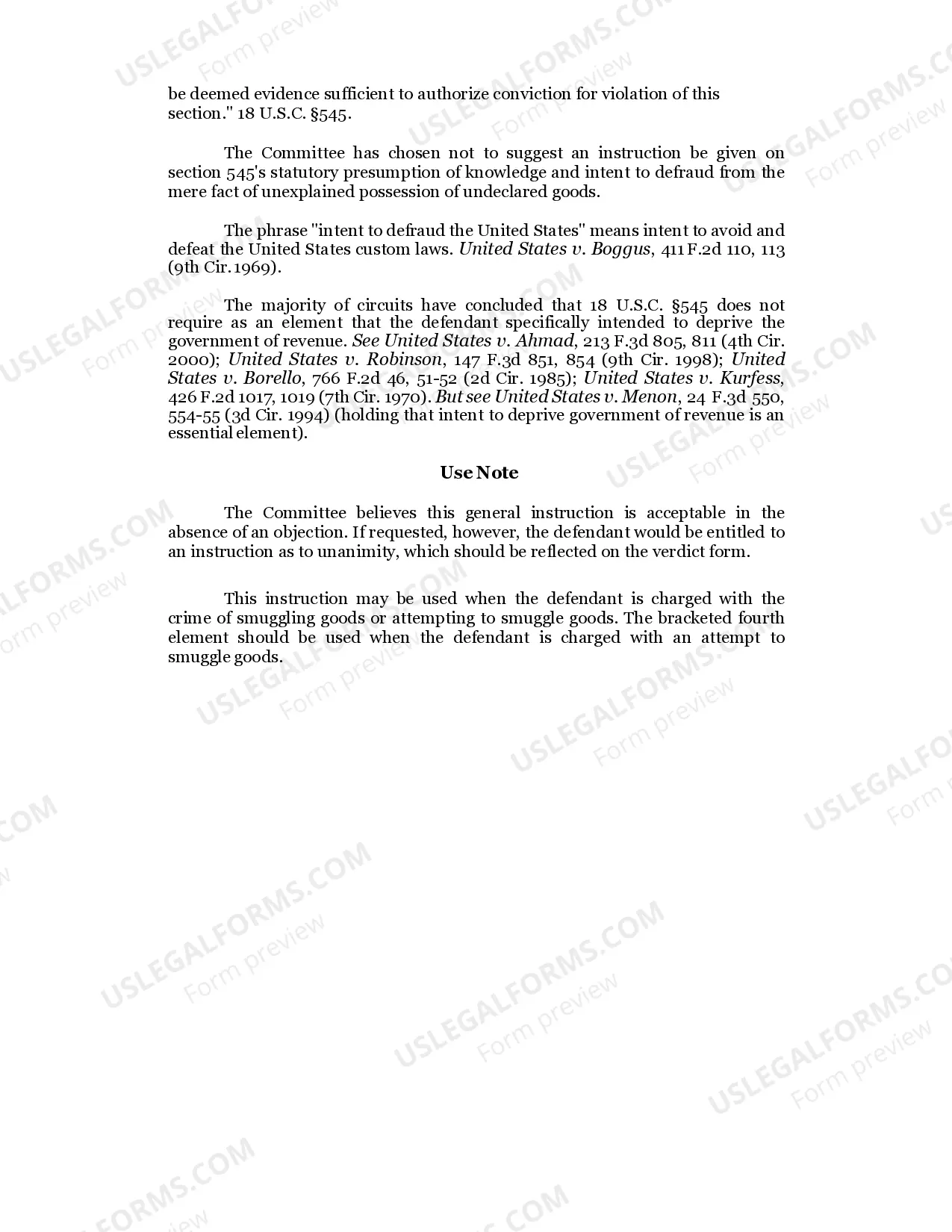
Shall be fined under this title or imprisoned not more than 20 years, or both. Proof of defendant's possession of such goods, unless explained to the satisfaction of the jury, shall be deemed evidence sufficient to authorize conviction for violation of this section.
Title 18 of the United States Code, Section 545 also contains a forfeiture provision. It provides that any goods which were brought into the United States in violation of the anti-smuggling statute and are subsequently seized by federal law enforcement will be forfeited to the United States.
Smuggling started in the reign of Edward I (late 13th century) when a Customs duty was placed on the export of wool, which was in great demand in Europe. The initial duties were small, but as the Hundred Years War progressed in the 14th century, so the tax increased in order to fund troops and further fighting.
Whoever fraudulently or knowingly exports or sends from the United States, or attempts to export or send from the United States, any merchandise, article, or object contrary to any law or regulation of the United States, or receives, conceals, buys, sells, or in any manner facilitates the transportation, concealment,
Methods of smuggling change little; all are variants of two main techniques: the undetected running of cargoes across frontiers and the concealment of goods in unlikely places on ships or cars, in baggage or cargo, or on the person. Get a Britannica Premium subscription and gain access to exclusive content.