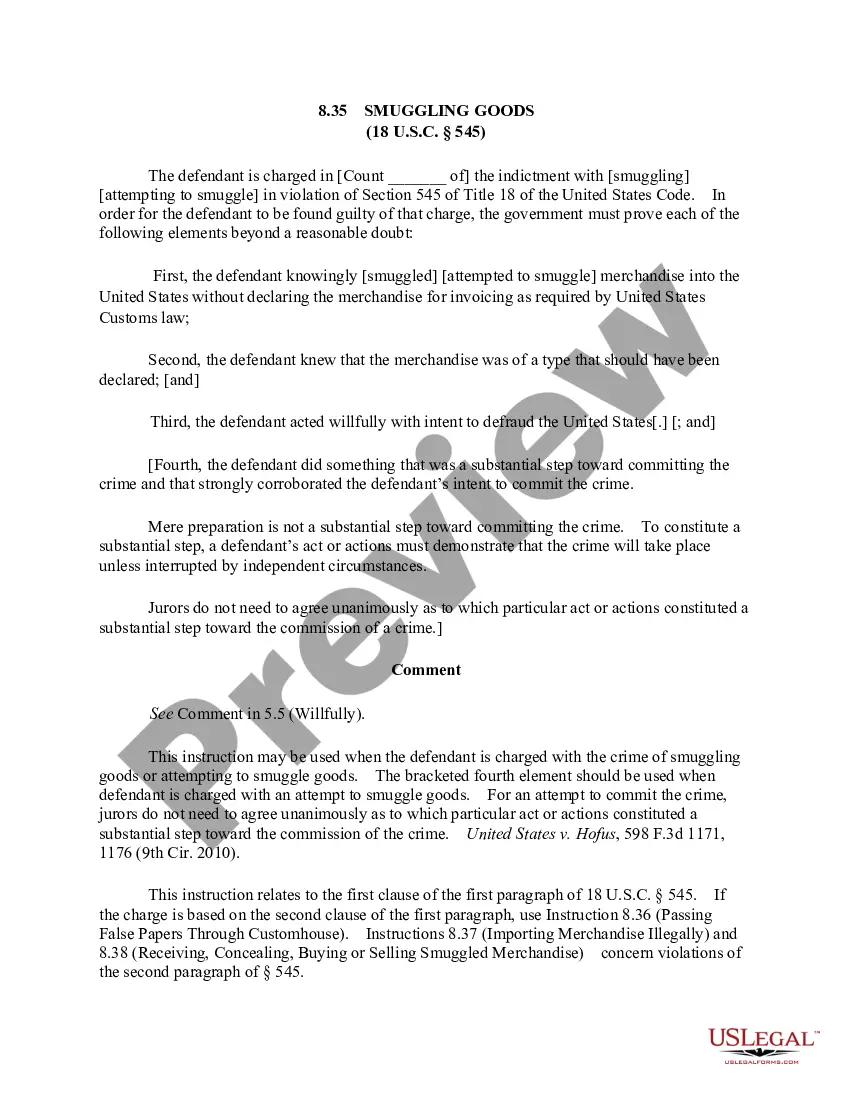
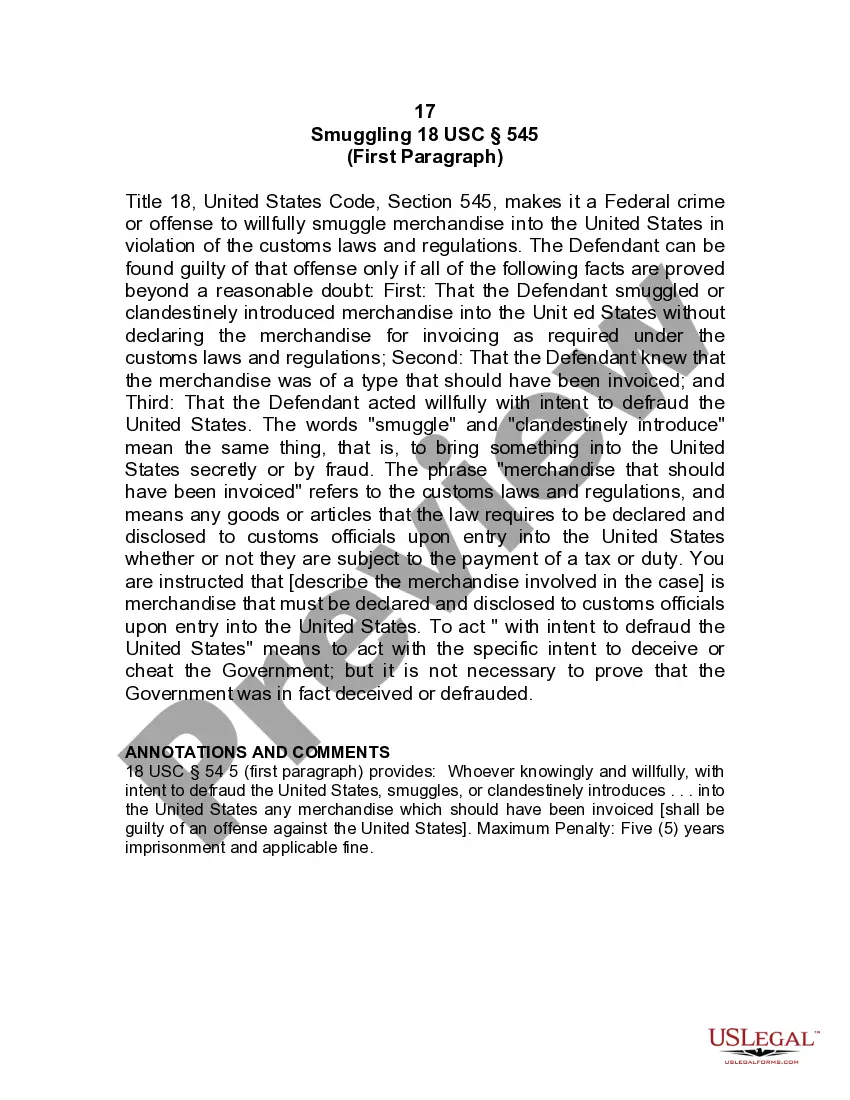
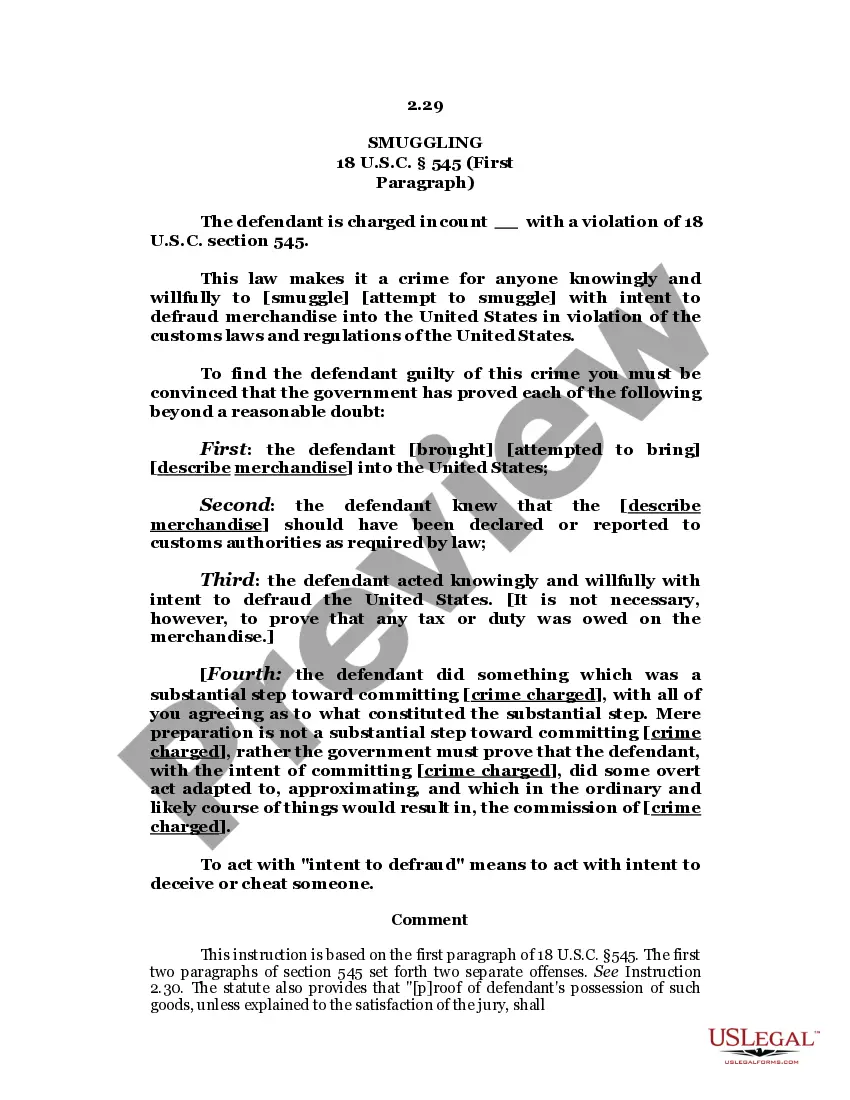
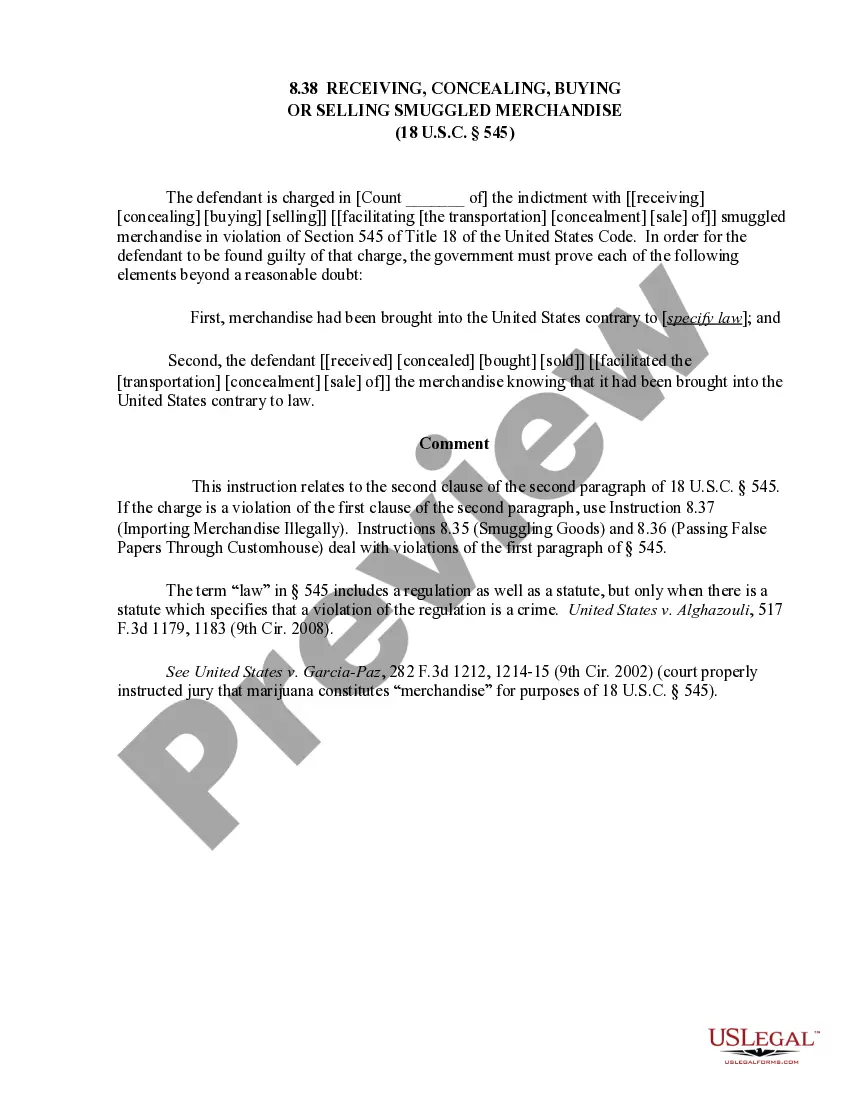
8.35 Smuggling Goods (18 U.S.C. Sec. 545).

Does this form need to be notarized?
Notarization is not commonly needed for this form. However, certain documents or local rules may make it necessary. Our notarization service, powered by Notarize, allows you to finalize it securely online anytime, day or night.
Get your form ready online
Our built-in tools help you complete, sign, share, and store your documents in one place.
Make edits, fill in missing information, and update formatting in US Legal Forms—just like you would in MS Word.
Download a copy, print it, send it by email, or mail it via USPS—whatever works best for your next step.
Sign and collect signatures with our SignNow integration. Send to multiple recipients, set reminders, and more. Go Premium to unlock E-Sign.
If this form requires notarization, complete it online through a secure video call—no need to meet a notary in person or wait for an appointment.
We protect your documents and personal data by following strict security and privacy standards.

Make edits, fill in missing information, and update formatting in US Legal Forms—just like you would in MS Word.

Download a copy, print it, send it by email, or mail it via USPS—whatever works best for your next step.

Sign and collect signatures with our SignNow integration. Send to multiple recipients, set reminders, and more. Go Premium to unlock E-Sign.

If this form requires notarization, complete it online through a secure video call—no need to meet a notary in person or wait for an appointment.

We protect your documents and personal data by following strict security and privacy standards.
Looking for another form?
Form popularity
FAQ
Smuggling is the illegal transporting of goods. These goods can be legal, such as alcohol and tobacco, or illegal, such as drugs and arms. Illegal trafficking of immigrants is also a form of smuggling.
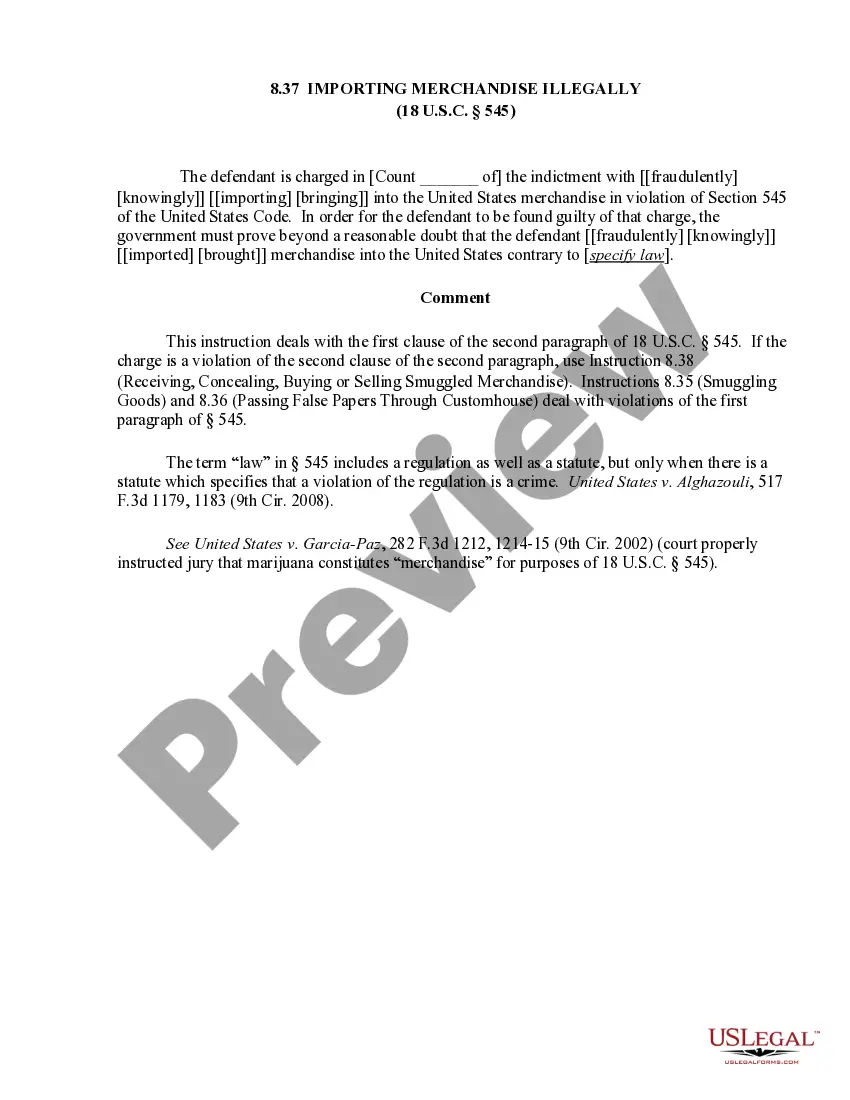
Whoever fraudulently or knowingly exports or sends from the United States, or attempts to export or send from the United States, any merchandise, article, or object contrary to any law or regulation of the United States, or receives, conceals, buys, sells, or in any manner facilitates the transportation, concealment,
(18 U.S.C. § 1519) The government need not prove that the defendant's sole or even primary intention was to obstruct justice so long as the government proves beyond a reasonable doubt that one of the defendant's intentions was to obstruct justice. The defendant's intention to obstruct justice must be substantial.
A smuggling goods conviction in federal court carries sever potential criminal consequences. The maximum penalty for smuggling goods under Section 545 is 20 years in federal prison plus fines and fees.
The judge instructs the jury about the relevant laws that should guide its deliberations. (In some jurisdictions, the court may instruct the jury at any time after the close of evidence. This sometimes occurs before closing arguments.) The judge reads the instructions to the jury.
Title 18 of the United States Code, Section 545 also contains a forfeiture provision. It provides that any goods which were brought into the United States in violation of the anti-smuggling statute and are subsequently seized by federal law enforcement will be forfeited to the United States.
(18 U.S.C. § 2(b)) A defendant may be found guilty of the crime(s) charged even if the defendant did not personally commit the act(s) constituting the crime if the defendant willfully caused an act to be done that if directly performed by him would be an offense against the United States.
(18 U.S.C. § 545) Mere preparation is not a substantial step toward committing the crime. To constitute a substantial step, a defendant's act or actions must unequivocally demonstrate that the crime will take place unless interrupted by independent circumstances.